The influx of computer technology into classrooms during the past decade raises the questions -- how can we teach children to use computers productively and what effect will learning to program computers have on them? During this same period, researchers have investigated novice learning of computer programming.
Teaching and Learning Computer Programming unites papers and perspectives by respected researchers of teaching and learning computer science while it summarizes and integrates major theoretical and empirical contributions. It gives a current and concise account of how instructional techniques affect student learning and how learning of programming affects students' cognitive skills.
This collection is an ideal supplementary text for students and a valuable reference for professionals and researchers of education, technology and psychology, computer science, communication, developmental psychology, and industrial organization.
eBook - ePub
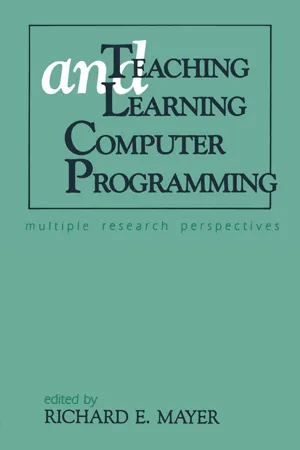
Teaching and Learning Computer Programming
Multiple Research Perspectives
- 340 pages
- English
- ePUB (mobile friendly)
- Available on iOS & Android
eBook - ePub
About this book
Information
1

Introduction to Research on Teaching and Learning Computer Programming
I. | Recent Developments | |
A. | Phase 1: Powerful Claims | |
B. | Phase 2: Disappointing Realities | |
C. | Phase 3: Multidisciplanary Research and Theory | |
II. | Current Research Issues | |
A. | Teaching Computer Programming | |
B. | Learning Computer Programming | |
III. | Overview of Chapters | |
IV. | Implications | |
Abstract
Research on teaching and learning computer programming is in its childhood; however, already scholars are reaching some preliminary consensus concerning the respective merits of mediated versus discovery instruction and the conditions for transfer to nonprogramming domains. This chapter begins by briefly summarizing recent developments in educational computing. The next section of the chapter explores two topics that have begun to receive research attention during the past few years: identifying appropriate methods of instruction for computer programming and describing the cognitive consequences of learning computer programming. In the third section, some of the contributions of each chapter in this volume are highlighted. Finally, the chapter closes with an analysis of the implications of current research on teaching and learning computer programming.
Recent Developments
This book is concerned with what research can tell us about teaching and learning computer programming. Computers are rapidly becoming a part of schooling and computer programming is finding its place in the curriculum. Until recently, however, not much was known about how students learn or what students learn from programming experiences.
The history of research on teaching and learning computer programming can be analyzed into three phases: an initial phase in which many strong claims were made concerning the expected outcomes and best methods of instruction for computer programming, an observation phase in which mounting data pointed to problems in students’ learning, and a research phase in which theory-based studies were carried out to systematically understand the processes underlying learning and teaching computer programming.
Phase 1: Powerful Claims
Imagine an educational revolution in which children, working on their own in a highly responsive environment, could teach themselves to be more systematic and organized problem solvers. This is the vision that underlaid much of the early interest in educational computing and that stimulated claims for discovery teaching and highly transferable learning.
In his influential book, Mindstorms: Children, Computers and Powerful Ideas, Papert (1980, p. 19) offered an alternative to using the computer to “put children through their paces.” Instead of letting the computer program the child, Papert envisioned a reversal in which the child would program the computer. “My vision of a new kind of learning environment demands free contact between children and computers,” Papert (1980, p. 60) proclaimed. Furthermore, “in teaching the computer how to think, children embark on an exploration about how they themselves think” (p. 19). The result is that “powerful intellectual skills are developed in the process” (p. 60).
Papert’s (1980) advocacy for computer programming as a worthwhile educational domain seemed to have implications for both the instructional methods and expected outcomes of school programs in computing. First, early advocates for computer programming argued for a discovery approach that allowed for plenty of hands-on programming experience in an unstructured environment. Second, early advocates argued that students who learned how to program computers would also show increases in general cognitive development; that is, in learning to program, children would also learn how to think (Mayer, Dyck, & Vilberg, 1986).
Thus, as the 1980s began, there were many strong claims made for the power of computer programming as a vehicle for learning problem-solving skills and for discovery as the instructional method of choice, but there was no powerful research support for the claims.
Phase 2: Disappointing Realities
As computer programming projects began to appear with more frequency in schools, observations of student learning did not always match the powerful claims. The ideal vision of students’ becoming better problem solvers due to hands-on LOGO learning collided with the documented reality of students’ difficulties in learning even the fundamentals of LOGO (Dalbey & Linn, 1985; Fay & Mayer, 1987; Gregg, 1978; Kurland & Pea, 1985; Linn, 1985; Pea & Kurland, 1984; Perkins, 1985; Webb, 1984).
For example, Nickerson, Perkins, and Smith (1985) summarized the unpublished results of a small scale LOGO project involving 16 students conducted by Papert and his colleagues in Brookline, Massachusetts. The instructional method included up to 35 hours of hands-on, nondirective programming experience as advocated by Papert (1980). Case studies of individual children indicated that “students developed a number of skills specific to programming, but we are less certain that they developed powerful general skills” (Nickerson et al., 1985, p. 277).
Nickerson et al. (1985) also summarized some early evaluations of LOGO instruction carried out by Pea and Kurland at the Bank Street College of Education. Approximately 50 children received about 25 hours of hands-on, nondirective instruction. Nickerson et al. (1985, p. 277) summarize the findings as “disappointing” because students performed poorly on predicting what would happen for various LOGO commands, locating bugs in procedures, and writing programs that involved variables or conditional tests. Intensive studies of seven children who received more in depth LOGO programming experience revealed that “students often produced programs without really comprehending how the programs worked” (Nickerson et al., 1985, p. 277).
Learning even the rudiments of LOGO appeared to be difficult for children and transfer to other domains seemed minimal. In a comparison of students who received extensive LOGO programming experience with students who received no programming experience, Pea and Kurland (1984) found no major differences on tests of general planning skill and, hence, no support for the idea that learning to program improves thinking in domains beyond programming. Based on a survey of early studies, Perkins (1985, p. 12) was forced to conclude that research had disclosed “no transfer of skill and poor learning within LOGO itself.” Similarly, Dalbey and Linn’s (1985, p. 267) review of research in the mid-1980s indicated that “students who learn LOGO fail to generalize this learning to other tasks.”
Thus, by the mid-1980s, it was clear that learning how to use a programming language did not seem to result in powerful learning outcomes. The occasional hint of positive transfer (Clements & Gullo, 1984; Gorman & Bourne, 1983) occurred under more guided methods of instruction and was not yet replicated. As Dalbey and Linn (1985, p. 267) observed, in those few documented cases of students learning transferable skills from LOGO, the degree of transfer was restricted to the “specific applications of particular language features” and resulted from “instruction which emphasizes transfer.”
Phase 3: Multidisciplinary Research and Theory
As the 1980s draw to a close, we have survived the first two phases—strong claims and disappointing realities—and are entering into a new phase of multi-disciplinary theory-based research. The initial vision of teaching and learning computer programming has been altered in two important ways: First, instead of advocating discovery methods of instruction, current research suggests that more guidance is needed to insure learning. The focus of current research is on understanding how the conditions of instruction affect what is learned. Second, instead of predicting major changes in children’s cognitive development, current research suggests that transfer is most likely to occur for skills most similar to those learned in programming. The focus of current research is on understanding the conditions under which transfer can be expected to occur.
Research during this third phase has begun to find evidence for transfer but only under certain conditions. For example, Mayer and Fay (1987) found evidence of positive transfer of spatial cognition skills for students who meaningfully learned to use several LOGO turtle graphics commands, and Mayer, Dyck, and Vilberg (1986) found evidence of positive transfer of procedure comprehension skills for students who successfully mastered elementary BASIC computer programming. In both cases, an apparent prerequisite for transfer of problem-solving skills beyond programming was that the skill had been successfully understood within the programming domain. Similarly, in both cases transfer occurred for skills in nonprogramming domains that were clearly analogous to skills within the programming domain.
Research since the mid-1980s has become increasingly more theory driven. Instead of asking, “Does learning a programming language affect a child’s thinking skills?” a more productive set of questions is, “What is learned from instruction in computer programming?” or “How does the method of instruction affect the student’s cognitive processing?” Instead of evaluating the effectiveness of an instructional program, current research begins with a cognitive analysis of programming knowledge into parts that can be specified, evaluated, and taught. Furthermore, current research draws on theories of transfer in order to better understand the cognitive conditions under which transfer occurs.
This book represents a picture of the current state of research on teaching and learning computer programming. Although the vision of the first phase has become more modest, moderated partly by the realities of the second phase, the current phase of research retains the idea that computer programming may ultimately become an exciting and revolutionary part of the curriculum. The challenge for researchers and educators is to understand the relationship between learning to program and learning to think.
The goals for teaching computer programming remain a central issue today as they did for Papert in 1980 but the research goals and theories have begun to mature. Computer programming can be viewed as a subject to be learned for its own sake or as a vehicle for teaching students about their own thinking processes. This latter view still entices and challenges us, and the emerging cognitive theory of computer programming enables us to more fruitfully accept the challenge.
Current Research Issues
The chapters in this book address the current state of research on two issues: teaching computer programming and learning computer programming.
Teaching Computer Programming
The teaching issue is concerned with determining instructional factors that contribute to students’ productive learning of computer programming. Here, we may begin with the hypothesis, stimulated by Papert (1980), that hands-on computer programming experience in a discovery environment is best. Many of the chapters in this volume report empirical studies of the merits of discovery as a method for teaching computer programming.
The overwhelming consensus among the authors in this volume is that, for most children, a hands-on discovery environment should be complemented with direct instruction and mediation by a teacher. For example, in chapter 2 Clements and Merriman conclude that “it is clear that LOGO programming—especially divorced from mediated instruction—does not represent an educational panacea, as Papert is often misunderstood to have claimed.” In chapter 3, Fay and Mayer’s study of school children in LOGO classrooms found that many children enter the classrooms with “inaccurate models & of the LOGO graphics environment” and may “require more direct instruction or pretraining in the prerequisite skills in order to benefit from LOGO experience.” Lehrer et al. (chap. 4) summarize their studies by noting that “mediated instruction in LOGO is a prerequisite for the transfer of LOGO to other domains.” Littlefield et al. (chap. 5) report that “mastery of the programming language has not been achieved when LOGO has been taught in a discovery-oriented environment” and “if mastery is not achieved, the discovery and transfer of general thinking skills as a result of learning LOGO cannot occur.” In chapter 6, Soloway et al. argue that transfer of programming skills requires that students be given guided learning emphasizing that ‘‘there is more than one right answer” to programming problems. Perkins et al. (chap. 9) present research showing that productive learning of programming is enhanced by guiding students’ “development of mental models through which they understand what the computer does” and helping students acquire “strategies & to organize their problem-solving efforts.” In chapter 8, Webb and Lewis’s research indicates that learning of computer programming is enhanced when students engage in the following activities: “giving explanations, giving & suggestions, receiving responses to questions, receiving &...
Table of contents
- Cover
- Half Title
- Title Page
- Copyright Page
- Dedication
- Table of Contents
- List of Contributors
- Preface
- 1. Introduction to Research on Teaching and Learning Computer Programming
- 2. Componential Developments in LOGO Programming Environments
- 3. Learning LOGO: A Cognitive Analysis
- 4. Influences of LOGO on Children’s Intellectual Development
- 5. Learning LOGO: Method of Teaching, Transfer of General Skills, and Attitudes Toward School and Computers
- 6. E Unum Pluribus: Generating Alternative Designs
- 7. Instructional Strategies for the Problems of Novice Programmers
- 8. The Social Context of Learning Computer Programming
- 9. Instructional Conditions in Pascal Programming Classes
- 10. An Introductory Pascal Class: A Case Study of Students’ Errors
- 11. Learning and Transfer of Debugging Skills: Applying Task Analysis to Curriculum Design and Assessment
- 12. New Directions in Educational Computing Research
- Author Index
- Subject Index
Trusted by 375,005 students
Access to over 1.5 million titles for a fair monthly price.
Study more efficiently using our study tools.
Frequently asked questions
Yes, you can cancel anytime from the Subscription tab in your account settings on the Perlego website. Your subscription will stay active until the end of your current billing period. Learn how to cancel your subscription
No, books cannot be downloaded as external files, such as PDFs, for use outside of Perlego. However, you can download books within the Perlego app for offline reading on mobile or tablet. Learn how to download books offline
Perlego offers two plans: Essential and Complete
- Essential is ideal for learners and professionals who enjoy exploring a wide range of subjects. Access the Essential Library with 800,000+ trusted titles and best-sellers across business, personal growth, and the humanities. Includes unlimited reading time and Standard Read Aloud voice.
- Complete: Perfect for advanced learners and researchers needing full, unrestricted access. Unlock 1.5M+ books across hundreds of subjects, including academic and specialized titles. The Complete Plan also includes advanced features like Premium Read Aloud and Research Assistant.
We are an online textbook subscription service, where you can get access to an entire online library for less than the price of a single book per month. With over 1.5 million books across 990+ topics, we’ve got you covered! Learn about our mission
Look out for the read-aloud symbol on your next book to see if you can listen to it. The read-aloud tool reads text aloud for you, highlighting the text as it is being read. You can pause it, speed it up and slow it down. Learn more about Read Aloud
Yes! You can use the Perlego app on both iOS and Android devices to read anytime, anywhere — even offline. Perfect for commutes or when you’re on the go.
Please note we cannot support devices running on iOS 13 and Android 7 or earlier. Learn more about using the app
Please note we cannot support devices running on iOS 13 and Android 7 or earlier. Learn more about using the app
Yes, you can access Teaching and Learning Computer Programming by Richard E. Mayer in PDF and/or ePUB format, as well as other popular books in Education & Education General. We have over 1.5 million books available in our catalogue for you to explore.