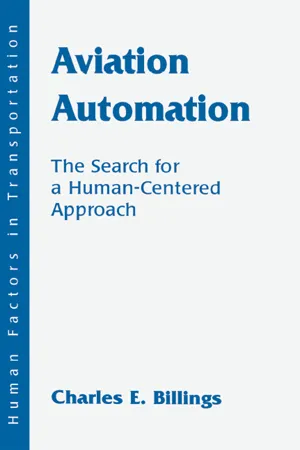
The advent of very compact, very powerful digital computers has made it possible to automate a great many processes that formerly required large, complex machinery. Digital computers have made possible revolutionary changes in industry, commerce, and transportation. This book, an expansion and revision of the author's earlier technical papers on this subject, describes the development of automation in aircraft and in the aviation system, its likely evolution in the future, and the effects that these technologies have had -- and will have -- on the human operators and managers of the system. It suggests concepts that may be able to enhance human-machine relationships in future systems. The author focuses on the ability of human operators to work cooperatively with the constellation of machines they command and control, because it is the interactions among these system elements that result in the system's success or failure, whether in aviation or elsewhere.
Aviation automation has provided great social and technological benefits, but these benefits have not come without cost. In recent years, new problems in aircraft have emerged due to failures in the human-machine relationship. These incidents and accidents have motivated this inquiry into aviation automation. Similar problems in the air traffic management system are predicted as it becomes more fully automated. In particular, incidents and accidents have occurred which suggest that the principle problems with today's aviation automation are associated with its complexity, coupling, autonomy, and opacity. These problems are not unique to aviation; they exist in other highly dynamic domains as well. The author suggests that a different approach to automation -- called "human-centered automation" -- offers potential benefits for system performance by enabling a more cooperative human-machine relationship in the control and management of aircraft and air traffic.
- 370 pages
- English
- ePUB (mobile friendly)
- Available on iOS & Android
eBook - ePub
About this book
Information
PART II
THE EVOLUTION AND COURSE OF AVIATION AUTOMATION
In chapter 4, Sidney W. A. Dekker and I discuss some facets of the history and evolution of industrial automation, to set the stage for a presentation of aircraft (chapter 5) and aviation system (chapter 7) automation. These discussions include the effects that the introduction of specific automation elements have had on the humans in the system, and on the system itself.
Likely future trends in aircraft and air traffic management automation are described in chapter 6 and 8. Chapter 8 also contains a discussion of rapidly evolving trends in aviation system design, and the implications of these new concepts for future system development. These chapters have been written at a time of intense planning activity in the domain of air traffic management (ATM), and ATM concepts will have evolved further by the time this book is published, but some of the changes that are being proposed are so fundamental as to demand consideration here.
CHAPTER 4
HUMANS AND THE EVOLUTION OF INDUSTRIAL AUTOMATION
Sidney W. A. Dekker and Charles E. Billings
The Ohio State University
INTRODUCTION
It is a truism that “those who forget the past are doomed to repeat it.” This chapter has been written to remind us where automation came from, its effects on human operators, and some of the mistakes that have been made in conceiving, developing, and implementing industrial automation, in the hope that we may avoid them as we go on to consider the future of aviation automation.
Rather than simply recounting a necessarily incomplete history of industrial automation, we explore some beliefs (more properly, myths) about automation that remain prevalent today. We illustrate them with historical examples. These cases can teach us many lessons, from which we have extracted only a few. On the other hand, this has been the history of technology as well; lessons that could have been learned centuries ago are not always embodied in our present knowledge base.
PREVALENT MYTHS ABOUT TECHNOLOGY AND TECHNOLOGY CHANGE
Myth 1: Technology Change Is Preordained, Predictable, and Imperative
To what extent can technology change be given direction beforehand? Is technological change predictable? Is it ultimately unavoidable? Looking at some of the breakthroughs that marked technological advances during the industrial revolution, we see different patterns. First, technology change often has a long incubation period. Weaving looms were not just a product of the industrial age: Techniques for making cloth had reached a high level of development by the dawn of the industrial revolution. Egyptians made extensive use of weaving looms around 1500 B.C., and other traces of looms go back as far as 4400 B.C. Efforts to automate the loom itself were found in sketches by Leonardo da Vinci. The first real attempt to automate the process was the later (early 1600s) Dutch bar loom.
Second, insights are often more serendipitous than preplanned. The Montgolfier brothers, for instance, burned hay in their hot-air balloon in the belief that as the smoke rose it would lift the balloon. Most technology of that period was developed empirically, or came from a serendipitous insight; nearly all such insights (like many today) were based on porous knowledge, despite an improving scientific base. Do we really understand why cancer chemotherapy works?
And third, technology change is not a self-propelled imperative; rather, it is a function of the interplay between societal constraints and opportunities on the one hand and those technological evolutions and serendipitous insights on the other. Mokyr (1990) likened the evolution of technology to biological evolution. He postulated that “technology is epistemological in nature” (p. 276). Techniques (the knowledge of how to produce a good or a service) are like species: They arise, or speciate, are reproduced, adapt, or fail to adapt and become extinct. New ideas are like mutations; they represent deviations from the norm. Many are stillborn or do not survive infancy (pp. 277–278); some survive and adapt, later to become a new norm.
This implies that not only is a new technique’s inception unpredictable; so is its effect within a field of practice. Because an invention represents an attack upon a “constraint that everybody else took as a given” (Mokyr, 1990, p. 9), the new technology will in turn change practices, often in unpredictable ways. Changed technology is likely to have unanticipated, distant, and sometimes uncontrollable effects, including effects in other domains. Improved weaving looms (the water frame and self-acting mule) improved productivity, but required more power, first delivered by water, but by steam engines as early as 1785 (Reeve, 1971). By the 1800s, British industry had attained superiority in delivering power to many kinds of factories.
The motto of the 1933 Chicago World’s Fair was, “Science finds, Industry applies, Man conforms” (Norman, 1993). Humans were assumed to adapt to technology, not technology to humans and the various systems that represented them: organizations, trades, societies, and the body politic. The teleology behind the motto was simplistic and oblivious to the evolutionary complexity of technology change. It reinforced the view that technology change is causal and that the direction of technology change is preordained. In fact, technology change fails to follow predictable paths (except in hindsight, which makes it all too easy to attribute causality to its meanderings). The notion of a technological imperative is tempting, but it oversimplifies the complexity of technological change and the haphazard opportunism that often appears to give it direction. The motto of the 1933 World’s Fair was misguided, or more properly, inverted, as Norman suggested. Rather, it should be “People propose, Science studies, Technology conforms” (p. 253). But this still implies that technology conforms to human needs without forcing its own constraints on humans, which is manifestly incorrect. Perhaps the motto should have been, “People adapt; Science adapts; Technology adapts.”
Myth 2: Technology Can Help Us to Supplant the Unreliable Human
Charles Babbage, the 19th century inventor of huge “engines” that could calculate and compute, often dwelled on the impact his machines could have on a society that still relied on manual labor. Human intelligence, to a great extent, could be replaced by machines: “the wondrous pulp and fibre of the brain … substituted by brass and iron” (Swade, 1993, p. 88). Could machines indeed replace unreliable human beings and could untrained workers operate them without mistakes? Babbage’s machines were never built during his lifetime, so we cannot know the answer. Automating human error out of systems, however, is still “assumed by many to be the prescription of choice to cure an organization’s ‘human error problem’” (Woods et al., 1994, p. 23). Let us review some historical evidence to see whether automation indeed (a) did eradicate human errors and (b) did reduce claims on human ingenuity.
The changes in work practices brought about by industrial automation conveyed, in hindsight, many benefits, but human error was far from eradicated. Instead, its nature changed (see Wiener, 1993). In 1803, the Frenchman Joseph Marie Jacquard was commissioned to improve a loom built by Jacques de Vaucanson. Without any guidance (documentation was unavailable), Jacquard developed an attachment to the loom in 1805. His device represented the first instance of an important aspect of automation—that of machine programmability.
The Jaquard attachment made the loom automatic, in that it was capable of producing complex weaving patterns in textiles by controlling the motions of many shuttles of different colored threads. The program for the pattern was contained on steel cards in which holes were punched. The attachment was an instant success. By 1812, 11,000 Jacquard looms were working in France alone.
The programmability enabled new creativity for the pattern developers or programmers, who were freed from the constraints that manual weaving had imposed on their creativity, but also enabled new errors (recall Ernst Mach’s 1905 adage that error and expertise stem from the same source). Errors changed in nature: for example, from manually shoving the shuttle in the wrong direction, to making programming errors during card punching. Note that the unwanted consequences of such inadvertent actions can grow hand in hand with increased automation. A manual shoving error produced just one thread out of place; an error in programming the card could easily ruin the whole woven product. Human errors were neither eradicated nor contained by automation. In this case, they were amplified.
Not only does automation not eradicate human error, the myth that an automated world will make smaller claims on human ingenuity is also palpably false. Both ingenuity and fallibility are fundamentally part of human performance, however automated the system being controlled. Mach’s adage is true: Expertise and errors are cut from the same cloth. Changes in technology require the exercise of new human ingenuity. Yet automation—although sometimes requiring human ingenuity to work—often limits the exercise of human creativity. What we see is the necessity for “tailoring” of technology on the one hand, and the limited opportunity to do so through peripheralization of the human role on the other hand. Let us examine this contradiction historically.
First, consider peripheralization. Automation reduces the need to follow all details of a process (Hollnagel, 1993) and often removes the human from hands-on contact with whatever is produced. Not only that, the speed of the process is no longer constrained by what the unaided human can handle. As long as the individual weaver operated the hand loom, the individual produced the whole cotton product. Control and coordination of the various subtasks of the weaving process were at the weaver’s discretion. With the introduction of the power loom, pacing and various other aspects of control of the task became external to the operator:
The most novel feature of factory work was its continuity and regularity; the machines had to be kept running. The pace of work was set by the water-wheel or steam-engine, not by man’s physical endurance or dexterity. While the tasks themselves were monotonous, and often simple, the factory worker had to be alert and reliable. It was for this, rather than skill, that he was paid. To punish lateness, absenteeism, casualness and inattention, the factory owners applied a series of scaled fines and wage reductions. (Reeve, 1971, p. 72)
Automation took control away from the human, but made new demands at the same time. This is the other side of the contradiction: the need for tailoring. Practitioners adapt the technology provided for them in a locally pragmatic way, developing a variety of strategies to cope with the automation’s brittleness or complexity. Workers always find it necessary to tailor, or adapt, automated devices and their work processes to accommodate the changed technology and to insulate the larger system from automation’s idiosyncrasies and deficiencies (Woods et al., 1994). Especially during development and early application, fine control over the process may be needed to make it work at all.
Historical reports of such tailoring are sparse. Given the ubiquity of technological change in the cotton industry in the period between 1750 and 1850, acts of tailoring were probably not sufficiently noteworthy to document. Tailoring was not looked at as a separate phenomenon, simply because of its essential role in technological change. Emery (1977) elegantly described the importance (and at the same time anonymity) of the tailoring process for cotton weaving:
Cotton was fortunate: its tougher, more predictable fibres withstood the jerkiness of the early machines remarkably well. Nevertheless much patience and skill was required to make the best of the early machines and in the progress of the industry as much credit should go to the anonymous, piecemeal improvers as to the initial innovators. Many of the early wooden machines [thus] lasted well on into the nineteenth century and no doubt prolonged the age of improvisation, (p. 25)
In other words, the changed technology simply would not have worked without various new tailoring activities, enabled by the ingenuity of people.
Logic would dictate that the more mature a technology (the less “jerky” the looms), the less tailoring will be required, and thus the less human ingenuity matters. But does this argument hold? The law of requisite variety (Ashby, 1956) states that the variety of a controller should match the variety of the system to be controlled. Effective control will not be possible if the controller has less variety than the system. However, that—exacerbated by the de-skilling that occurs—is exactly what happens here.
A child of what sometimes is called the second Industrial Revolution, numerical control (NC) illustrates both sides of the peripheralization-tailoring contradiction and the violation of the law of requisite variety eloquently. Numerical control was another instance of machine programmability. The first numerical control machine tool was demonstrated in 1952 at the Massachusetts Institute of Technology (Reintjes, 1991). Originated for the aerospace industry, numerical control developed into a way to drive machines of all sorts, removing considerable control over production from individual tradesmen and transferring it to management and programmers. The repercussions on individuals were significant. A Boeing machinist, transferred to a numerical control machine, said:
I felt so stifled, my brain wasn’t needed anymore. You just sit there like a dummy and stare at the damn thing. I’m used to being in control, doing my own planning. Now I feel like someone else has made all the decisions for me. I feel downgraded, depressed. I couldn’t eat. When I went back to the conventional milling machine I worked like crazy to get it out of my system. I like to feel like I’m responsible for the whole thing—beginning to end. I don’t like anybody doing my thinking for me. With numerical control I feel like my head’s asleep. (Noble, 1983, p. 242)
The “central contradiction of numerical control” (Noble, 1983, p. 269) was that it frustrated, yet depended on, the skills and motivation of the people that worked with it. Not only did numerical control de-skill workers, although still requiring those old skills when the automation failed; it also required the acquisition of new skills at the same time, thus defeating much of its claimed efficiency. Paper-tape numerical control machines proved extremely brittle and inflexible. For instance, operators had to be able to read the tape (a skill in which they had not been trained) when it jammed or some other difficulty arose (Noble, 1983; Reintjes, 1991). Automation proved fallible and expensive. Human ingenuity, once again, had to be relied on to keep production going.
Myth 3: Throughout the Ages, Technology Change Has Been Motivated by High Wage Costs
This belief is known as the Habakkuk thesis (after Habakkuk, 1962). Whether wage costs are an incentive to automate remains an issue of considerable debate in many domains. During the industrial revolu...
Table of contents
- Cover
- Half Title
- Title Page
- Copyright Page
- Dedication
- Table of Contents
- Series Foreword
- Preface
- I Aviation Automation: Past, Present, and Future
- II The Evolution and Course of Aviation Automation
- III The Roles of Human Operators in the Aviation System
- IV Issues for Future Aviation Automation
- Appendix A: Aviation Accidents and Incidents
- Appendix B: Wiener and Curry Guidelines for Aircraft Automation (1980)
- Glossary of Acronyms and Abbreviations
- References
- Author Index
- Subject Index
Trusted by 375,005 students
Access to over 1.5 million titles for a fair monthly price.
Study more efficiently using our study tools.
Frequently asked questions
Yes, you can cancel anytime from the Subscription tab in your account settings on the Perlego website. Your subscription will stay active until the end of your current billing period. Learn how to cancel your subscription
No, books cannot be downloaded as external files, such as PDFs, for use outside of Perlego. However, you can download books within the Perlego app for offline reading on mobile or tablet. Learn how to download books offline
Perlego offers two plans: Essential and Complete
- Essential is ideal for learners and professionals who enjoy exploring a wide range of subjects. Access the Essential Library with 800,000+ trusted titles and best-sellers across business, personal growth, and the humanities. Includes unlimited reading time and Standard Read Aloud voice.
- Complete: Perfect for advanced learners and researchers needing full, unrestricted access. Unlock 1.5M+ books across hundreds of subjects, including academic and specialized titles. The Complete Plan also includes advanced features like Premium Read Aloud and Research Assistant.
We are an online textbook subscription service, where you can get access to an entire online library for less than the price of a single book per month. With over 1.5 million books across 990+ topics, we’ve got you covered! Learn about our mission
Look out for the read-aloud symbol on your next book to see if you can listen to it. The read-aloud tool reads text aloud for you, highlighting the text as it is being read. You can pause it, speed it up and slow it down. Learn more about Read Aloud
Yes! You can use the Perlego app on both iOS and Android devices to read anytime, anywhere — even offline. Perfect for commutes or when you’re on the go.
Please note we cannot support devices running on iOS 13 and Android 7 or earlier. Learn more about using the app
Please note we cannot support devices running on iOS 13 and Android 7 or earlier. Learn more about using the app
Yes, you can access Aviation Automation by Charles E. Billings in PDF and/or ePUB format, as well as other popular books in Technology & Engineering & Human-Computer Interaction. We have over 1.5 million books available in our catalogue for you to explore.