- 352 pages
- English
- ePUB (mobile friendly)
- Available on iOS & Android
eBook - ePub
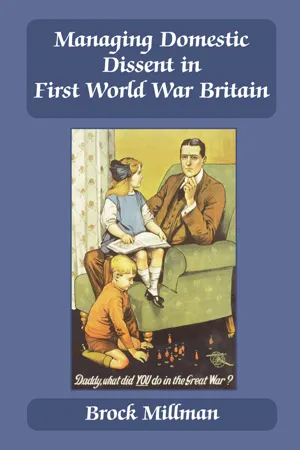
Managing Domestic Dissent in First World War Britain
About this book
The author argues that the way the British Government managed dissent during World War I is important for understanding the way that the war ended. He argues that a comprehensive and effective system of suppression had been developed by the war's end in 1918, with a greater level in reserve.
1
War and Dissent, 1914–1915
IN AUGUST 1914 Britain declared war on Germany. In Britain, as in all combatant countries, such few voices as were raised in dissent were overwhelmed by a chorus supportive of the decision to resort to arms. It would have been strange had it been otherwise. While its entry to the war had been controversial, attended by the resignation of several members of the Asquith government, Britain entered the war to defend well-defined and long-established interests. It was widely believed that the war would be over quickly and that victory would not require any fundamental change to peacetime ways of doing things.
This is not to say that there were no dissenters. From the beginning, there were prominent men who associated themselves in opposition to the war. During its first year, however, they were without a coherent body of followers, agreed programme, or effective organization. While these things existed in embryo, dissent had not yet developed to the point where it could be a threat to the war effort. Such would remain the case until an increasingly total war, requiring greater levels of sacrifice and necessitating wartime departures such as conscription, began to produce mass disaffection associated, ultimately, with elite dissent. It is, however, important that we understand the basic nature of British anti-war dissent because, while dissent grew in scope and significance, it grew from particularly British roots and its nature did not change. Repression can only be effective if it is constructed to account for the particular characteristics of a given dissent.
Ramsay MacDonald and the faction of the Independent Labour Party (ILP) opposing Britain’s entry to the war must surely have pride of place in any discussion of anti-war dissent in Britain. From the time of the first ILP peace meeting in Trafalgar Square, even before the declaration of war, much of the party leadership never looked back.1 Many of them – Keir Hardie, Ramsay MacDonald and others such as Philip Snowden, Fenner Brockway and Clifford Allen – were either pacifists or convinced, at least, that war between nations did not serve the interests of the working class.
Brockway was a good example of a socialist dissenter and a pacifist. The son of missionary parents, he had graduated from liberalism to advanced socialism by 1907. Throughout he was an uncompromising pacifist. No Marxist, he considered that only pacifism was reconcilable with socialist principles. The only exception he was ever willing to make to this general rule was in the case of colonial peoples struggling for independence. Even this exception was still some decades away in development, and hardly covered Britain’s case in 1914.2 As well, for socialists like Brockway, many of them perhaps less convinced pacifists than he was, the conflict between nations was of less relevance than the struggle for the rights of labour. The secret of the bayonet – need it be said? – was that there was a worker on either end. ‘We are told that international Socialism is dead’, began the ILP Christmas card for 1914,
that all our hopes and ideals are wrecked by the fire and pestilence of European war. It is not true. Out of the darkness and depth we hail our working class comrades of every land. Across the roar of guns, we send sympathy and greetings to the German Socialists.
In forcing this appalling crime upon the nations, it is the rulers, the diplomats, the militarists who have sealed their doom. In tears of blood and bitterness, the greater Democracy will be born.
With steadfast faith we greet the future; our cause is holy and imperishable, and the labour of our hands has not been in vain.
Long Live Freedom and Fraternity!
Long Live International Socialism!3
Long Live International Socialism!3
While these sentiments were certainly those of a minority, they were, nevertheless deeply held.
For his part, Ramsay MacDonald, in 1914 the leader of the ILP, the umbrella Labour Party and the Parliamentary Labour Party (PLP),4 represented a greater constituency within British politics: the perplexed – those who combined socialism with religious motives and who, if internationalist by creed, were patriots by instinct. While certainly considered ‘pacifists’ at the time, adherents of this persuasion would be more correctly labelled today, following Martin Ceadel, ‘pacific-ists’: anti-war, but not in all cases, convinced that sometimes recourse to war might be a regrettable necessity.5 This was certainly not a very well defined, nor comfortable position. One of his biographers, Bernard Sacks, is probably most correct in describing MacDonald as a ‘practical pacifist’.6 That is, while not a pure pacifist like Brockway, he was so opposed to war in principle that he could scarcely identify a single case which would justify it. ‘I do not think’, he wrote to another of the perplexed, in May 1916,
that [in the event of war] a socialist would be inconsistent if he performed work of national importance such as teaching and farming. I am quite sure that if a Socialist Government were in power conditions might arise when it would have to defend itself, but it would do so on a philosophy of individual conscience and not of State tyranny over the individual. That is where the difference comes in between us and the militarists. … If, in addition to being a Socialist, one is a member of the Society of Friends or a Tolstoyan, then of course, one’s Socialist principles must be mixed up with the others, only do not say that the combination of principles which results is pure socialism because it is not.7
One, perhaps, could fight if a citizen of a socialist country under attack, if one was a volunteer, and provided that there were no conflicting religious principles. Britain was not a socialist country in 1914. MacDonald was not sure that it had been attacked. With MacDonald there were religious scruples. Moreover, like many dissenters MacDonald believed that conscription must inevitably follow from involvement in a European war. Conscription, as Keir Hardie put it, was ‘the badge of the slave’.8 MacDonald, quite plainly, was not likely to provide very effective support for Britain’s war effort.
On the other hand, like many of the perplexed, MacDonald was well able to distinguish between combatants. If the war had to be fought, then he certainly hoped that Britain would win it. Britain’s participation was a crime; yet a German victory would be a disaster. Overcoming his loathing for the idea of war, in August 1914 MacDonald even offered to work for the national interest provided that his fundamental objections were understood. He was made to understand by Lloyd George, however, that this was simply not good enough.9 Going further, in October MacDonald took up a challenge to put his principles into practice by volunteering to work for a field ambulance unit. He crossed over into France to see what he could do. He was not at the front for very long, however, before he was arrested by the military authorities and deported back to Britain.10 He withdrew thereafter into an opposition more extreme than it need have been. Confused MacDonald may have been: he was also already peripheralized and identified as a leader of dissent.
In August 1914 MacDonald withdrew from leadership of the Labour Party when it became clear that the dissenters would be in the minority. To prevent permanent disunion, Arthur Henderson, his successor, allowed him to remain as treasurer.11 MacDonald had already found an alternative forum for political activity. With other, like-minded dissenters, he became a prominent, founding member of the Union of Democratic Control (UDC).12 MacDonald’s primary objection, always, was less with the war (which he hated) than with the way in which Britain had entered the war, and the prewar diplomacy which had brought it about (which he absolutely abhorred). The only rational policy, he considered, was to fight until a tolerable peace could be made, and then to work to ensure that there was never a repetition.13 Moreover, as a socialist, MacDonald was not slow to indict social inequalities as the root of the political evil which had led to the war. If the war had to be fought, he considered, then the rich should be made to finance it out of their own pockets, thus reducing their liking for conflict, avoiding placing a burden on future generations, and accomplishing wealth redistribution.14 MacDonald, needless to say, very quickly became rather unpopular with very many people.
Both the convinced socialists and the perplexed, combined against the war, were a minority within the Labour Party, labour movement and working class. If all had answered the cry found, for instance, in the ILP Christmas card, dissent might have been vigorous and effective from the beginning of the war. Within Labour ranks, however, a split had already developed in August 1914. When MacDonald proposed that Labour MPs vote against war credits, he had found himself opposed by a solid block of ILP Trades Union Congress (TUC) members led by John Hodge. Patriotism rather than socialist or pacifist principle was the guiding light of this faction. Hodge insisted that the question was an easy one: ‘either we are for our country or we are against it’.15 Even where full-blooded, bellicose patriotism was not in evidence, the majority Labour view was that it would be a political mistake, both strategic and tactical, to compromise the allied war effort. Disagreement within the Labour Party reflected division within the working class. About the only place where Labour unity was preserved through the war was in London. Here, Herbert Morrison – Labour’s coming man – managed to preserve a fragile unity by deliberately avoiding the question of the war altogether.16
Elsewhere, division was the rule, and the patriots in the ascendance. Throughout the war, the Webbs tell us, five-sixths of the PLP and ninetenths of the aggregate membership of the Labour Party supported the government’s war policy.17 ‘From the beginning of the war to the end’, they affirm,
the Labour Party, alike in all its corporate acts, and by the individual efforts of its leading members … stuck at nothing in its determination to help the Government win the war.18
The Webbs were certainly over-stating the case, but not much.19 Even in the ILP – both as a party, and the Labour grouping most accepting of dissent – dissenters were a minority in 1914 and remained so until the Leeds conference of 1917 at least. Marwick provides a useful illustration. In 1918 (with dissent at its high point), in Bradford (a town notorious for its militancy), and in the local ILP (that organization most opposed to the war), absent membership ‘was accounted for as follows – 429 in His Majesty’s Forces, nineteen in His Majesty’s Prisons, with, in addition, twenty-nine conscientious objectors on Alternative Service’.20 In a place, a time and an organization in which we would expect dissenters to be disproportionately over-represented within a general working-class membership, serving soldiers outnumbered objectors of all types, by 9 to 1, and absolutists by almost 23 to 1.
There were exceptions to the general rule that patriotism overruled dissent in the early years of the war, places where the outbreak of war did not lead to immediate social consolidation. Clydeside was one. The reasons, however, were particular to the region. In Glasgow, for instance, a class divide of the most dangerous kind existed which was not at all lessened by the clumsy policies adopted by the Scottish Office in 1914–15.21 There was, in addition, a substantial immigrant Irish population in Glasgow, and wherever they were found, the Irish were fodder for dissent during the First World War period.22 On the Clyde, moreover, the local dissenting leadership almost immediately attempted to turn wartime grievances and fears of approaching conscription to political purposes. Dissent’s national leadership did not learn this trick until the later months of 1915. The local Labour leadership tended, finally, to be far more radical than was usual. John MacLean, for instance, the most prominent local Marxist, was not only very popular, but almost unique among British Marxists in being against the war from the beginning. Here only were the most radical voices in British political life against...
Table of contents
- Cover
- Half Title
- Title Page
- Copyright Page
- Table of Contents
- List of Figures
- Series Editor’s Preface
- List of Abbreviations
- Introduction
- 1 War and Dissent, 1914–1915
- 2 McKenna at the Home Office, August 1914–May 1915
- 3 Simon at the Home Office, May–December 1915
- 4 Samuel at the Home Office, 1916
- 5 A Society Turning Against Itself
- 6 The Battle of Cory Hall: ‘By Any Means Necessary Short of Murder’
- 7 The Lloyd George Solution
- 8 Leeds, Stockholm and After
- 9 The National War Aims Committee
- 10 1918
- 11 Towards the Abyss
- Conclusion
- Bibliography
- Index
Trusted by 375,005 students
Access to over 1.5 million titles for a fair monthly price.
Study more efficiently using our study tools.
Frequently asked questions
Yes, you can cancel anytime from the Subscription tab in your account settings on the Perlego website. Your subscription will stay active until the end of your current billing period. Learn how to cancel your subscription
No, books cannot be downloaded as external files, such as PDFs, for use outside of Perlego. However, you can download books within the Perlego app for offline reading on mobile or tablet. Learn how to download books offline
Perlego offers two plans: Essential and Complete
- Essential is ideal for learners and professionals who enjoy exploring a wide range of subjects. Access the Essential Library with 800,000+ trusted titles and best-sellers across business, personal growth, and the humanities. Includes unlimited reading time and Standard Read Aloud voice.
- Complete: Perfect for advanced learners and researchers needing full, unrestricted access. Unlock 1.5M+ books across hundreds of subjects, including academic and specialized titles. The Complete Plan also includes advanced features like Premium Read Aloud and Research Assistant.
We are an online textbook subscription service, where you can get access to an entire online library for less than the price of a single book per month. With over 1.5 million books across 990+ topics, we’ve got you covered! Learn about our mission
Look out for the read-aloud symbol on your next book to see if you can listen to it. The read-aloud tool reads text aloud for you, highlighting the text as it is being read. You can pause it, speed it up and slow it down. Learn more about Read Aloud
Yes! You can use the Perlego app on both iOS and Android devices to read anytime, anywhere — even offline. Perfect for commutes or when you’re on the go.
Please note we cannot support devices running on iOS 13 and Android 7 or earlier. Learn more about using the app
Please note we cannot support devices running on iOS 13 and Android 7 or earlier. Learn more about using the app
Yes, you can access Managing Domestic Dissent in First World War Britain by Brock Millman in PDF and/or ePUB format, as well as other popular books in History & Military & Maritime History. We have over 1.5 million books available in our catalogue for you to explore.