- 198 pages
- English
- ePUB (mobile friendly)
- Available on iOS & Android
eBook - ePub
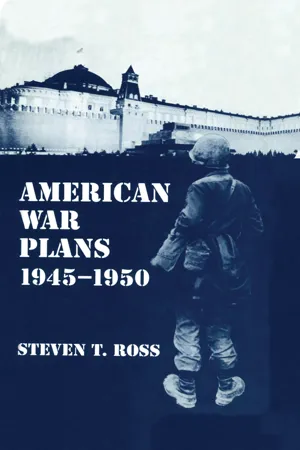
American War Plans 1945-1950
About this book
In late 1945, it became clear that the Soviet Union was an aggressive power. American military planners began to develop strategies to deal with the frightening possibility of a war with the Soviet Union. This work examines those plans.
Chapter I
The Threat
In the years immediately following World War II the Joint Chiefs of Staff lacked a definitive expression of American policy to use as a basis for strategic planning. The Chiefs knew that U.S.-Soviet relations were deteriorating and that an emerging consensus within the political community was coming to view the USSR as an aggressive power seeking nothing less than domination of the world. Yet the same political leaders wanted a rapid demobilization of America’s armed forces and drastic reductions in defense spending. Moreover, it was by no means clear how the administration intended to respond to what it perceived as a growing Soviet threat.
Political figures in the executive and congressional branches of government had a number of options under active consideration including a return to fortress America, the provision of economic aid to Europe in order to reconstitute a balance of power, diplomatic and military responses to Soviet initiatives on a case-by-case basis and the creation of regional alliance systems designed to check Russian expansion. Until the late 1940s it was not clear which policy or combination of policies would be adopted. Consequently, the Joint Chiefs had to devise their own estimates of Soviet intentions and capabilities.
In 1945 the service chiefs were men of vast experience. Generals Marshall and Arnold and Admirals King and Leahy and their successors Generals Eisenhower and Spaatz and Admiral Nimitz had guided America’s armed forces to victory in the Second World War. They understood the complexities of the higher direction of war and were equally familiar with the need to establish effective working relationships with their political leaders. Through formal and informal contacts with administration officials, the chiefs were fairly well informed about the evolving opinions of the nation’s political leaders, thus mitigating to some degree the absence of clear foreign and defense policies. Consequently, in their analysis of Soviet intentions and capabilities, the chiefs’ views followed the same evolutionary pattern as that of the civilian policy makers.
JCS interest in post-war relations with the USSR began even before the defeat of Germany. On May 16, 1944, the JCS informed the Secretary of State that the Soviet Union was going to emerge from the war as a leading world power. After the conclusion of hostilities, a clash between Russia and Great Britain was a possibility as the two powers moved to enhance their strategic positions, but the United States might avert such a clash by promoting continued harmony among the Big Three.1 On August 16, 1944, the JCS again stated its belief that the USSR would emerge from the war as a major global power while England, though remaining a significant factor in world politics, would be much reduced in strength. The United States and the Soviet Union would in fact become the world’s dominant powers in the wake of the Allied victory.2
On February 5, 1945, the JCS produced a more detailed assessment of Russian post war intentions. The Soviets would, the JCS believed, reduce their armed forces to three million active servicemen and one million recruits in order to release manpower for the massive tasks of economic reconstruction and recovery, which would not be completed before 1952. During this interval the USSR would have no economic motive for political expansion. Moscow did fear capitalist encirclement but would, nonetheless, seek accommodations with noncommunist states and attempt to avoid open clashes with the United States and Great Britain. The Soviets would try to dominate Eastern Europe and other states on their borders, and there did exist a traditional but latent desire for warm water ports. The Soviets would in more remote areas seek to prevent the formation of hostile alliance systems, but above all, Moscow would attempt to avoid hostilities with the West at least until economic recovery was complete.3
Later in the year a more ominous note began to appear in JCS appraisals. On October 9, 1945, the Joint Strategic Survey Committee on its own initiative reported to the Chiefs that negotiations with the USSR to establish post-war stability in Europe and the Pacific had failed to produce positive results. Moreover, Moscow, although making significant gains in the war and stretching Soviet power from the Kurile Islands to the Elbe, was still not satisfied. The Russians were currently demanding African trusteeships and putting pressure on Turkey and Norway for concessions in the Dardenelles, Spitzbergen and Bear Island. The Soviets were also carrying on large scale subversive activities in Latin America. Russian demands thrived on past success and led to new adventures. The United States for its part was rapidly reducing its military might, and once demobilized it would be virtually impossible to reconstitute rapidly American military power. To recall veterans and reconvert industry back to war production would require an extended mobilization period. The JSSC recommended that in light of Russia’s aggressive attitude the United States undertake a careful examination of its military means of resistance.4
The JCS accepted the JSSC paper on October 15 and on the following day examined an intelligence report on Soviet military capabilities. Currently, the USSR had an army of 477 divisions. The Air Force included 350 fighter and 230 bomber regiments with a total of about 35,000 combat aircraft. With the addition of a small navy, recruits, and NKVD units the USSR had 12,700,000 men and women in uniform. Like the Americans, the Russians were quickly demobilizing, but Moscow intended to maintain substantial peacetime forces. The JCS estimated that after demobilization the USSR would have 4,411,000 troops under arms. The army would consist of 113 divisions supported by 410 air regiments and a small navy. There would also exist eighty-four satellite divisions, a figure that would grow to 114 divisions during the next three years. Although of lesser quality than Soviet formations, the satellite divisions could relieve Russian units from various occupation tasks and thus increase the number of divisions available to the Soviets for active operations.5
The report estimated that the Soviet Union had the military capability of overrunning Western Europe including Scandinavia and excluding Britain at any time between 1945 and 1948. The Soviets also had the forces to mount simultaneous offensives against Turkey and Iran. The Russians had only limited capabilities in the Far East, and their navy, designed primarily for coastal operations, posed no serious threat to the continental United States or to its vital sea lines of communication. The Soviet Air Force was organized for ground support of the army and for home defense; it too posed no immediate danger to the continental United States or its possessions. The Soviets were working vigorously on the development of atomic weapons, but the JCS thought that the USSR would not possess atomic bombs for at least five years. Thus, if the United States was in no immediate danger from Soviet arms, Western Europe and much of the Middle East could not effectively resist a Soviet attack. Moreover, as the Americans and British continued to demobilize the Soviet ability to overrun Europe and the Middle East would grow substantially.6
Despite their pessimistic view of the military balance the JCS did not in fact believe that there was any immediate danger of hostilities. The Chiefs stated that the Soviets intended to expand whenever and wherever possible but would try to avoid a major war. The lack of atomic weapons, a long-range air force, and a blue water fleet plus the need to restore the economy were factors that would lead Moscow to exercise restraint and avoid direct challenges to vital American interests.7
On October 23, 1945, the Joint Intelligence Staff reported on Soviet intentions and capabilities, noting that Moscow’s foreign policy was imperialistic and would not change but that Russia would not in the immediate future pursue its goals by means of a general war. It would take the USSR fifteen years to restore its war losses in manpower and industry, ten years to modernize its railway and military transportation system, five to ten years to produce atomic bombs and create a long-range strategic air force, and fifteen to twenty years to build an effective ocean-going fleet.8
Despite structural weaknesses the USSR was, nevertheless, immensely powerful. Because of American and British demobilization and the chaotic conditions prevailing in Europe, the Soviets, even after completing their demobilization, could easily overrun the area, and by generating additional forces could also conquer Turkey and Iran. After demobilizing, the Russians could deploy thirty divisions against Western Europe, thirty against Iran and Manchuria, thirteen for home defense, and forty as an operational reserve. Satellite divisions, though not as effective as Russian units would be in their ability to keep order to rear areas, guard lines of communication and even participate in some active operations.9 In effect the intelligence staff believed that Soviet and satellite armies could with relative ease overrun Europe and the Middle East at any time during the next several years. The Russians could not, however, threaten militarily the Western Hemisphere or Japan. Moreover, the JIS did not expect the USSR to resort to war.10
In the following months JCS intelligence officers continued to propound the view of Russia as a powerful nation seeking expansion by means short of war. The Joint Intelligence Staff on October 26, 1945, stated that Moscow’s immediate aim was to create a security zone around the state’s borders which meant continuing pressure on Turkey, Iran, Greece, Italy, and Afghanistan. The Soviet Union’s long-range political objective was to gain control of the Eurasian landmass and its strategic approaches. The Soviets would, however, display great tactical flexibility and seek to avoid war with the United States.11 On November 1, the Intelligence Staff again asserted that the USSR was trying to recover from the war and modernize the economy and would, therefore, try to avoid an armed conflict for at least a decade.12 A report of November 8 indicated that the Russian army had about 25,000 tanks and 60 to 70,000 large caliber artillery pieces. The Russians were not going to increase their inventories but were in the process of modernizing their major weapons systems. Qualitative improvements of ground force weapons did not, however, pose a direct military threat to the continental United States.13
A brief report on some of America’s allies, written on November 16, 1945, indicated that France was militarily quite weak and that Great Britain, acting alone, could do little more than defend the British Isles and perhaps the Cairo-Suez area.14 Still, the Americans were not particularly alarmed for another intelligence report submitted on November 29 indicated that although the USSR could overrun Europe, Turkey, Iran and Iraq, they would not in fact launch an attack for at least five years.15
On January 31, 1946, the Joint Intelligence Committee again addressed the question of Soviet goals. The Committee believed that during the next five years the USSR would seek to consolidate wartime gains and obtain concessions from Turkey and Iran. Moscow would also try to expand its influence further into the Middle East.16 T...
Table of contents
- Cover
- Title
- Copyright
- Dedication
- CONTENTS
- List of Maps
- Introduction
- Chapter I The Threat
- Chapter II The Pincher Plans
- Chapter III The Bomb and Broiler
- Chapter IV From Bushwacker to Halfmoon
- Chapter V From Offtackle to Drops hot
- Chapter VI The Continuing Dilemma
- Conclusion
- Bibliography
Trusted by 375,005 students
Access to over 1.5 million titles for a fair monthly price.
Study more efficiently using our study tools.
Frequently asked questions
Yes, you can cancel anytime from the Subscription tab in your account settings on the Perlego website. Your subscription will stay active until the end of your current billing period. Learn how to cancel your subscription
No, books cannot be downloaded as external files, such as PDFs, for use outside of Perlego. However, you can download books within the Perlego app for offline reading on mobile or tablet. Learn how to download books offline
Perlego offers two plans: Essential and Complete
- Essential is ideal for learners and professionals who enjoy exploring a wide range of subjects. Access the Essential Library with 800,000+ trusted titles and best-sellers across business, personal growth, and the humanities. Includes unlimited reading time and Standard Read Aloud voice.
- Complete: Perfect for advanced learners and researchers needing full, unrestricted access. Unlock 1.5M+ books across hundreds of subjects, including academic and specialized titles. The Complete Plan also includes advanced features like Premium Read Aloud and Research Assistant.
We are an online textbook subscription service, where you can get access to an entire online library for less than the price of a single book per month. With over 1.5 million books across 990+ topics, we’ve got you covered! Learn about our mission
Look out for the read-aloud symbol on your next book to see if you can listen to it. The read-aloud tool reads text aloud for you, highlighting the text as it is being read. You can pause it, speed it up and slow it down. Learn more about Read Aloud
Yes! You can use the Perlego app on both iOS and Android devices to read anytime, anywhere — even offline. Perfect for commutes or when you’re on the go.
Please note we cannot support devices running on iOS 13 and Android 7 or earlier. Learn more about using the app
Please note we cannot support devices running on iOS 13 and Android 7 or earlier. Learn more about using the app
Yes, you can access American War Plans 1945-1950 by Steven T. Ross in PDF and/or ePUB format, as well as other popular books in History & Military & Maritime History. We have over 1.5 million books available in our catalogue for you to explore.