eBook - ePub
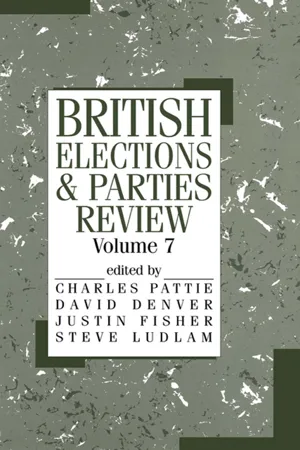
British Elections and Parties Review
- 304 pages
- English
- ePUB (mobile friendly)
- Available on iOS & Android
eBook - ePub
British Elections and Parties Review
About this book
This volume features key political issues for 1990s Britain: the reform of the Labour party; the use of opinion polls; the impact of the media; European integration; Scotland and regional trends; and the bases of party support.
Information
Reference Section
To a large extent the range and nature of material covered in this section are now well established. As in previous volumes in the series, we begin with the handy chronology of important events in 1996 prepared, as usual, by David Broughton; anyone who has had to survey the period since the last election will know that Broughton's annual chronologies are invaluable.
The next three sections are also regular features - detailed results of the three parliamentary by-elections held during the year, summaries of opinion poll results on voting intentions and other relevant matters, and a summary of the May local election results together with information on local by-elections. The latter formerly concerned hardly anyone outside a small circle of enthusiasts but during 1996 they began to be cited by the Conservatives as evidence of a recovery in their popularity.
Section 5 re-introduces a topic which we covered in earlier editions of British Elections & Parties - details of various economic indicators in summary form, which might save readers some research time if they are looking for this sort of material.
The section on political parties contains material updated from previous editions and finally we include an updated and substantially expanded list of Web sites of interest to teachers, researchers and students working on parties, elections and public opinion.
We would like to express our thanks to those who have helped in the gathering and checking of the material contained in this section, including David Broughton, David Cowling, Colin Railings, Michael Thrasher, Nick Moon of NOP and Bob Wybrow of Gallup.
David Denver
Justin Fisher
Justin Fisher
1. Chronology of Events 1996
January
- 1. A man was shot dead in Lurgan in Northern Ireland by the Direct Action Against Drugs organization, the seventh such killing since April 1995.
- 3. An order was issued for the deportation of a Saudi Arabian dissident, Mohammed al-Mas'ari, following complaints by the Saudi Arabian government over his activities in London.
- 5. It was officially confirmed that there was no intention to sell Admiralty Arch in central London.
- 8. An industrial tribunal ruled that the Labour Party's policy, requiring selection of prospective parliamentary candidates in certain constituencies to be from women-only short lists, contravened the Sex Discrimination Act of 1975.Labour Party leader, Tony Blair, made a speech in Singapore in which he set out his vision of a 'stakeholder economy'. Francois Mitterrand, President of France 1981-95, died aged 79.
- 9. Sir Christopher Bland was appointed chairman of the BBC in place of Marmaduke Hussey.
- 11. The former Prime Minister, Baroness Thatcher, delivered the Keith Joseph Memorial Lecture in which she called for radical expenditure cuts and derided what she termed 'no-nation Conservatism'.
- 17. Sir Richard Body resumed the Conservative whip in the House of Commons which he had voluntarily resigned in November 1994 over the European Communities (Finance) Bill. The overall Conservative majority in the Commons was thereby restored to five, with two by-elections pending.
- 18. The Prime Minister, John Major, announced that the government would issue a White Paper setting out its position on Europe prior to the opening of the European Union's Inter-Governmental Conference (IGC) in March.The Home Secretary, Michael Howard, announced that the practice of shackling pregnant prisoners who were about to give birth would be discontinued.
- 19. At the end of a trial lasting nearly eight months, Kevin and Ian Maxwell were cleared by a jury of conspiracy charges in connection with the collapse of the companies controlled by their father, the late Robert Maxwell.The House of Commons narrowly failed to give a second reading to the British Time (Extra Daylight) Bill, a private member's measure to align time in the United Kingdom with that on the continent of Europe.
- 21. Sharp differences over education policy emerged in the Labour Party when it was revealed that Shadow Cabinet member Harriet Harman was to send her son to a selective grammar school in Kent.
- 22. The ruling faction of Walsall Metropolitan District Council was displaced by another faction of the Labour Group.
- 23. The House of Commons privileges committee issued a report critical of the former editor of the Guardian (Peter Preston) for using House of Commons headed paper in a fax purporting to come from the then Chief Secretary to the Treasury, Jonathan Aitken. The committee declined to take any further action.
- 24. The Prime Minister announced proposals for elections to a Northern Ireland assembly.
- 26. Kevin Maxwell was ordered to stand trial on further charges of conspiracy to defraud, in connection with the collapse of companies controlled by his late father.The House of Commons gave an unopposed second reading to the Offensive Weapons Bill, a private member's bill designed to forbid the carrying of dangerous knives.
- 30. Nicholas Soames, Minister for the Armed Forces, announced that a series of epidemiological studies would be undertaken arising from allegations of the effects of Gulf War syndrome.Gino Gallagher, an alleged leader of the banned Irish National Liberation Army, was shot dead in Belfast.A large cross-party grouping of MPs called for the issue of parliamentary salaries to be referred to the Nolan Committee.
- 31. The Labour Party announced that it would not be appealing against the ruling that its policy on all-women short lists was illegal.
February
- 1. The Labour Party retained the Hemsworth parliamentary seat in a by-election. A Socialist Labour Party candidate saved her deposit. The Conservative backbench 1922 committee agreed new procedures whereby it would not be possible to launch a direct challenge to John Major's leadership of the Conservative Party before the next general election.Gerry Adams, the President of Sinn Féin, held a meeting with President Bill Clinton in Washington.
- 5. The first privatized rail services began running on South West Trains and Great Western routes.
- 7. Tony Blair, the Labour Party leader, announced his party's proposals for removing from hereditary peers their right to participate in the work of the House of Lords.
- 8. United News and Media (publishers of the Daily Express and other newspapers) and MAI (a television and financial services group) announced their intention to merge.The National Health Service prescription charge was increased from £5.25 to £5.50 with effect from 1 April. The Roman Catholic Archbishop of Liverpool since 1976, Derek Worlock, died aged 76.
- 9. A huge bomb exploded on the Isle of Dogs in east London, apparently having been placed by the IRA, thus effectively ending the IRA ceasefire.
- 12. John Townend was elected chairman of the Conservative 92 Group of right-wing MPs in succession to Sir George Gardi...
Table of contents
- Cover
- Title
- Copyright
- Contents
- PREFACE
- NOTES ON CONTRIBUTORS
- ABSTRACTS OF ARTICLES
- Political Awareness and Heterogeneity in Models of Voting: Some Evidence from the British Election Studies
- The Missing Tories in Opinion Polls: Silent, Forgetful or Lost?
- Anchors Aweigh: Variations in Strength of Party Identification and in Socio-political Attitudes among the British Electorate 1991-94
- Class and Nation in England and Scotland
- Crooked Margins and Marginal Seats
- A Question of Interaction: Using Logistic Regression to Examine Geographic Effects on British Voting Behaviour
- Discourses of Modernization: Gaitskell, Blair and the Reform of Clause IV
- Voting Behaviour, The Economy and the Mass Media: Dependency, Consonance and Priming as a Route to Theoretical and Empirical Integration
- Error-Correction Models of Party Support: The Case of New Labour
- The Enhancement of Leadership Power: The Labour Party and the Impact of Political Communications
- From the Europe of Nations to the European Nation? Attitudes of French Gaullist and Centrist Parliamentarians
- The Conservative Party, Electoral Strategy and Public Opinion Polling, 1945-64
- REFERENCE SECTION
Trusted by 375,005 students
Access to over 1.5 million titles for a fair monthly price.
Study more efficiently using our study tools.
Frequently asked questions
Yes, you can cancel anytime from the Subscription tab in your account settings on the Perlego website. Your subscription will stay active until the end of your current billing period. Learn how to cancel your subscription
No, books cannot be downloaded as external files, such as PDFs, for use outside of Perlego. However, you can download books within the Perlego app for offline reading on mobile or tablet. Learn how to download books offline
Perlego offers two plans: Essential and Complete
- Essential is ideal for learners and professionals who enjoy exploring a wide range of subjects. Access the Essential Library with 800,000+ trusted titles and best-sellers across business, personal growth, and the humanities. Includes unlimited reading time and Standard Read Aloud voice.
- Complete: Perfect for advanced learners and researchers needing full, unrestricted access. Unlock 1.5M+ books across hundreds of subjects, including academic and specialized titles. The Complete Plan also includes advanced features like Premium Read Aloud and Research Assistant.
We are an online textbook subscription service, where you can get access to an entire online library for less than the price of a single book per month. With over 1.5 million books across 990+ topics, we’ve got you covered! Learn about our mission
Look out for the read-aloud symbol on your next book to see if you can listen to it. The read-aloud tool reads text aloud for you, highlighting the text as it is being read. You can pause it, speed it up and slow it down. Learn more about Read Aloud
Yes! You can use the Perlego app on both iOS and Android devices to read anytime, anywhere — even offline. Perfect for commutes or when you’re on the go.
Please note we cannot support devices running on iOS 13 and Android 7 or earlier. Learn more about using the app
Please note we cannot support devices running on iOS 13 and Android 7 or earlier. Learn more about using the app
Yes, you can access British Elections and Parties Review by David Denver,Justin Fisher,Steve Ludlam,Charles Pattie in PDF and/or ePUB format, as well as other popular books in Politics & International Relations & Political Campaigns & Elections. We have over 1.5 million books available in our catalogue for you to explore.