First Published in 2004. Written by one of the most highly regarded U.S. ecologists, this book presents basic ecological principles in a series of vignettes, illustrated by cartoons and simple diagrams, covering such subjects as growth, energy, ecological change, diversity, economics and technology, among others. Drawing upon essays written during a forty-year career as a teacher, research and ecologist, this volume about environmental literacy is written for the general reader and understandable at any level from grade school to senior citizen.
TO GROW OR NOT TO GROW IS NOT THE QUESTION. THE QUESTION IS WHEN TO STOP GETTING BIGGER AND START GETTING BETTER.
Explanation. How often have you heard the statement “grow or die”? Is this a true statement of fact, or should we add “but not under all circumstances”? To the businessperson, continuous economic growth is an article of faith; without such growth, business will fail. But when growth in body size of the individual stops at adolescence, one does not die. In fact, to many of us the best part of life begins! Are there different kinds of growth, such a quantity versus quality growth? Are there times and places where growth is appropriate, and are there times and places where growth is detrimental (like cancer)? To get some reasoned answers to these questions let us consider the basics of growth forms.
THE CARRYING CAPACITY CONCEPT AND THE S-CURVE
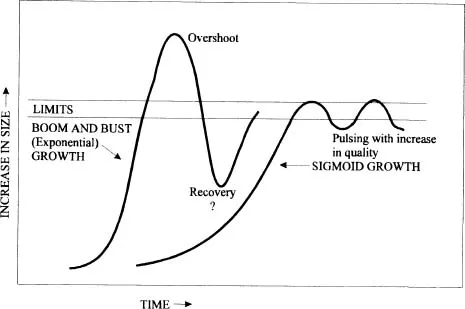
The basic pattern for the growth of almost anything is a sigmoid curve, as shown in Figure 1.1, in which we plot increase in size (weight, numbers, or other measures of size) on the vertical axis and time on the horizontal axis. With this pattern, the rate of growth is slowed or reduced more and more as size approaches some sort of upper limit or when some kind of plateau is reached. Such a pattern is often known as an “S-curve” for growth. For an individual, the limit to growth is determined by the genetic makeup, which halts growth when full adult size is reached. For populations and ecosystems, the limit is what ecologists call the carrying capacity, that is, the size that can be sustained at a given time and place. Leveling off at the population or system level is not automatic or certain, as it is with the individual, but depends on when diminishing return of scale (negative feedback) starts to reduce the growth rate. Usually, the carrying capacity plateau is a pulsing one where size varies up and down around a plateau level, depending on fluctuations in the environment or other external forces. If for any reason the limits are raised, then growth in size may begin to plateau again at a new fluctuating carrying capacity level. Sigmoid growth forms, either self-limited or moderated by interactions with other species (competitors, predators, or parasites, for example), are the most common patterns that we find in nature.
Figure 1.1
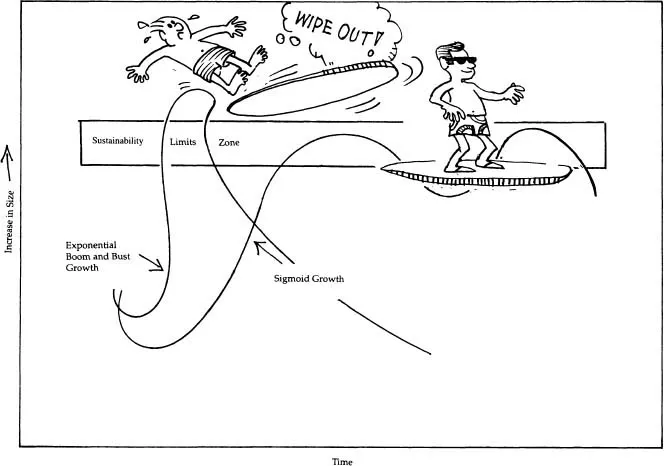
However, as also shown in Figure 1.1, there is another quite different pattern of growth that is not uncommon. It involves a more or less uncontrolled or exponential rate of increase, with doubling and redoubling at short time intervals, which results in a boom-and-bust pattern (Cartoon 1.1), because the momentum becomes so great that size overshoots the carrying capacity level and a rapid decrease or “downsizing” occurs. Some natural populations (e.g., Arctic lemmings) exhibit this kind of growth; numbers increase very rapidly until the population overshoots some resource limit or becomes victim to predation or disease. Or maybe a favorable season or other conditions end. Then the population “crashes,” with the death of large numbers of individuals, perhaps to repeat the cycle at some later time. Of course, with this growth pattern there is always a risk of extinction if the “bust” is too deep.
Cartoon 1.1 Riding the waves or wipeout in surfing is analogous to sigmoid vs. boom-and-bust growth models.
Unfortunately, we are seeing this “boom-and-bust” pattern more and more in human affairs. While it is logical to assume that economic growth, for example, cannot keep increasing without disastrous “busts” in a planet that is itself not growing, there remains a widespread belief that humans are more or less immune to limits because human ingenuity and technology can overcome environmental or resource limitations. There is no real evidence that such is the case, but there are the cornucopia (“horn of plenty” metaphor) technologists among us who are optimistic that hydrogen economy, landless agriculture, wasteless industry, and other new technologies will enable a very large human population (ten billion or more) to coexist with enough natural environment to provide the necessary life support. We will consider some of these possibilities in Chapter Seven, especially as related to the “technological paradox.” But first we need to consider other aspects of growth and the key role that energy plays in the human–environment interaction.
HOW SOCIAL INSECTS DEAL WITH GROWTH
Perhaps we can learn something from the social insects: the ants, termites, and social wasps. Like humans, they tend to form large colonies, which superficially resembles cities. Also like humans, these insects have been extremely successful in the evolutionary survival race, since they comprise from 50 to 80 percent of the total biomass (weight) of all insects now living on the planet. Their success is due in large measure to cooperative division of labor within the colony and efficient use of resources. Although their rigid caste system — i.e., specialized workers, reproductive individuals, nurses, soldiers — is not something we would want to emulate, their ability to regulate colony size so as not to exceed environmental limitations is something that might merit our attention. Professor E.O. Wilson, an world authority on the social insects, speaks of colony regulation as “programmed demography” in that, as a colony grows to a large size, birth and death rates are altered so that population size levels off, thereby avoiding “boom and bust” or the syndrome of too rapid growth followed by decline.
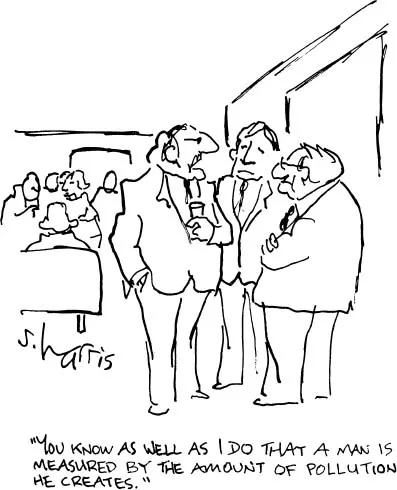
Population control in the harvester ant (so-called because they collect and store seeds in underground galleries) is an especially good example. The colonies grow in sigmoid fashion, leveling off in density after about six years. As the number of ants returning to the colony without seeds (signifying that the local food supply is getting scarce) increases, the rate of “antenna contacts” (the way ants communicate with each other) rises, and fewer eggs and larvae are produced (Gordon, 1995). Unfortunately, when it comes to humans, interaction between people in crowded cities seems to increase violence and pollution without a decrease in birth rates!
Cartoon 1.2
FUTURE HUMAN POPULATION GROWTH
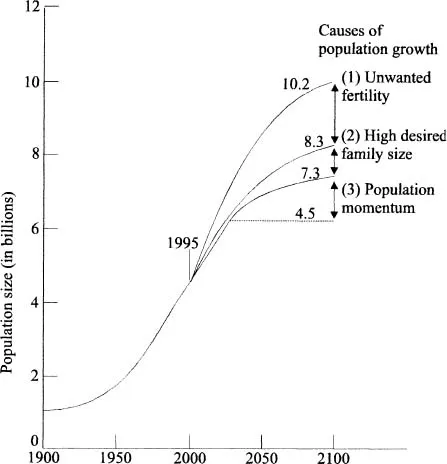
The future pattern of human population growth will play a major role in the future quality of society and the environment. Most demographers (population scientists) project that human population growth will eventually be sigmoid, as shown in Figure 1.2. Even if every woman now alive bore two children who survived into adulthood, the so-called replacement rate, the human population, now five billion, would continue to grow until well into
Figure 1.2 Bongaart’s projection for human population growth (Science 263:771-776,1994)
the next century and perhaps level off at a minimum of seven billion. This is “population momentum,” the third factor in Figure 1.2, which results from the fact that such a large part of the population of the underdeveloped world is just coming to reproductive age, so that there will be a lot of births even if women on average had only two children. The two other causes of growth shown in the table are “unwanted fertility,” babies born who are not wanted or cannot be cared for (teenage pregnancies, for example), and “high desired family size,” where children are perceived to be needed for child labor and to take care of parents in their old age. Adding the effects of these three factors projects a leveling off at about ten billion by 2100.
Society cannot do anything about population momentum, but a concerted effort could be made to reduce growth factors 1 and 2 if enough people and political leaders were convinced that such an effort would result in a better world for all. We can be optimistic about this because at the 1994 United Nations conference on population held in Cairo (a city with a very large population of poor people) it was revealed that more and more women in underdeveloped countries are seeking family-planning services in order to have two rather than six children. Furthermore, all nations voted for a plan to commit billions of dollars to the cause of curbing population growth, especially by promoting education and career opportunities for women.
THE OPTIMUM IS LESS THAN THE MAXIMUM
Safe or optimal carrying capacity, as a level below the maximum or saturation level, is a concept that comes out of the ecological study of animal populations that may be relevant to our human situation. It has often been observed that animals such as quail or muskrats maintain population numbers that are well below that which might be supported by food supply and other vital resources. In such cases, individuals are less vulnerable to predators, disease, or weather that temporarily reduces food supply or habitat cover. What is known as territorial behavior or the territorial imperative, in which individuals and families do not tolerate close neighbors, is another mechanism that we may observe in nature that keeps a population below saturation level.
As a general principle, we can say that in terms of the well-being of the individual, the optimum density is less than the maximum. Or, to put it more bluntly, the world can support more warm bodies, like cows in a feedlot, than it can support quality human beings !
THE QUESTION OF WHEN
Returning to the original question of when, we can conclude that there are times and places when growth in size is necessary for survival, and there are situations in which further growth in size is deleterious (i.e., cancerous). Then it is time to stop getting bigger and start getting better. More on this in Vignette 1.3.
When individuals, towns, businesses, or systems in general are small or young, it is generally “grow or die,” but when things get large, complex, or mature it may be “grow and die”! For more on the growth dilemma, see Essay 1.
Vignette 1.2
AFFLUENCE REDUCES THE POPULATION SIZE THAT CAN BE SUSTAINED ON A GIVEN RESOURCE BASE.
Explanation. “You cannot have your cake and eat it too” is an old expression that comes back to haunt us as we face a world that is increasingly divided between the rich and the poor. Remember that during the French Revolution Marie Antoinette got her head cut off some time after she was reported as suggesting “let them eat cake” when informed that the poor did not have enough bread. The actual nu...
Table of contents
Cover Page
Half Title page
Title Page
Copyright Page
Dedication
Contents
Frontmatter
Preface
Chapter 1 What We Learn From Ecology About Growth
Chapter 2 What We Learn From Ecology About Energy
Chapter 3 What We Learn From Ecology About Organization
Chapter 4 What We Learn From Ecology About Change
Chapter 5 What We Learn From Ecology About Behavior
Chapter 6 What We Learn From Ecology About Diversity
Chapter 7 Human Ecology What We Don't Learn From Nature
Chapter 8 Bottom Lines
1 Essays and Commentaries for Further Reading
Literature Cited
Index
Trusted by 375,005 students
Access to over 1.5 million titles for a fair monthly price.
Study more efficiently using our study tools.
Frequently asked questions
Yes, you can cancel anytime from the Subscription tab in your account settings on the Perlego website. Your subscription will stay active until the end of your current billing period. Learn how to cancel your subscription
No, books cannot be downloaded as external files, such as PDFs, for use outside of Perlego. However, you can download books within the Perlego app for offline reading on mobile or tablet. Learn how to download books offline
Perlego offers two plans: Essential and Complete
Essential is ideal for learners and professionals who enjoy exploring a wide range of subjects. Access the Essential Library with 800,000+ trusted titles and best-sellers across business, personal growth, and the humanities. Includes unlimited reading time and Standard Read Aloud voice.
Complete: Perfect for advanced learners and researchers needing full, unrestricted access. Unlock 1.5M+ books across hundreds of subjects, including academic and specialized titles. The Complete Plan also includes advanced features like Premium Read Aloud and Research Assistant.
Both plans are available with monthly, semester, or annual billing cycles.
We are an online textbook subscription service, where you can get access to an entire online library for less than the price of a single book per month. With over 1.5 million books across 990+ topics, we’ve got you covered! Learn about our mission
Look out for the read-aloud symbol on your next book to see if you can listen to it. The read-aloud tool reads text aloud for you, highlighting the text as it is being read. You can pause it, speed it up and slow it down. Learn more about Read Aloud
Yes! You can use the Perlego app on both iOS and Android devices to read anytime, anywhere — even offline. Perfect for commutes or when you’re on the go. Please note we cannot support devices running on iOS 13 and Android 7 or earlier. Learn more about using the app
Yes, you can access Ecological Vignettes by Eugene P Odum in PDF and/or ePUB format, as well as other popular books in Architecture & Urban Planning & Landscaping. We have over 1.5 million books available in our catalogue for you to explore.