Advertising, Gender and Society explores contemporary social-psychological theory and original research that examines the portrayal of gender in advertising. It reports empirical data, discusses the social implications of gendered advertising and comments on the relevant 2019 ASA rules.
Zawisza-Riley analyses theories such as stereotype content and elaboration likelihood models, stereotype threat and ambivalent sexism theories, the selectivity hypothesis as well as implicit and embodied cognition to illuminate the relationships between sex, gender and advertising in cultural and social contexts. The author thus examines the portrayal of gender in advertising, its effectiveness and effect on audiences and the ways in which audiences, marketers and policy-makers can mitigate potential harm of gendered advertising. She offers theory extension and novel application of existing theory and research to the subject of gender advertising.
Advertising, Gender and Society is ideal for students, academics and professionals in the fields of psychology, gender and media studies as well as marketing, advertising and policy-making.
Advertising is our environment. We swim in it as fish swim in the water. We cannot escape it… Advertising messages are inside our intimate relationships, our home, our hearts, our heads.
Kilbourne (1999, p. 57)
The history of society and advertising
Advertising has been part of societies and cultures for centuries, and can be traced back to ancient civilisations (Bhatia, 2000). For example, the Egyptians, Ancient Greeks and Romans used papyrus for sales messages, wall posters and lost and found adverts, while political campaign messages were found in the ruins of Pompeii and Arabia. Commercial paintings on rocks are also found across continents in Africa, South America and Asia some of which date back to 4000 BC. Oral advertising in the form of poetry was popular in ancient China as far back as the eleventh century BC. In fact, evidence of the world oldest print advertisement was found in China in the form of a copper printing plate dating to the Song dynasty (960–1279). It promoted manufacturing ‘fine quality needles’ from ‘high quality steel rods’ (Liu, 2013). In the Middle Ages advertising for tradesmen was primarily pictorial to bypass the problem of widespread illiteracy. Images such as a boot, a horseshoe or a bag of flour communicated the relevant professions such as a shoemaker or a miller. Street callers or town criers were also a common sight in thirteenth-century Parisian markets. Their cries have been recorded in a poem titled ‘Les Crieries de Paris’ by de la Villeneuve. These early examples already point at the close links between culture and advertising. They speak of day-to-day concerns of everyday people and inform us about the key developments in trade and crafts.
Major cultural developments of the nineteenth century contributed to new forms and a greater volume of advertising (Tudor, 1986). Specifically, the emergence of capitalism and printing technology saw a substantial growth in print magazines and newspapers advertising in England. These were primarily advertisements for books, newspapers, medicines and fashion. Advances in the printing press and availability of repeated print advertising resulted in the development of nationally recognisable brands and the emergence of a loyal customer following. Paid magazine advertising was born: the French newspaper La Presse was the first to offer paid advertising on its pages in June 1836. It quickly become apparent that this innovation extended readership, and thus profit, allowing for further price reductions and the greater affordability of the press. The model was so successful that it was soon adopted by other newspapers including those in the UK. As the affluence of the British middle classes was growing so was their appetite for new products and health remedies. Instances of ‘Quackery’ (dishonest ‘medical’ practices) and false advertising were growing. The eighteenth-century tobacco company set up by Coper Bros & Co in Liverpool in 1848 launched one of the first systematic advertising campaigns that employed innovations such as consistent use of brand names, repetitive advertising and market segmentation by class. The campaign targeted men from different socio-economic backgrounds in distinct ways (Seaton, 1986). Shockingly to today’s consumers, middle-class men were promised health benefits from smoking, e.g. that it kept disease at bay and preserved one’s lungs. The campaign for the working classes, on the other hand, offered a ‘rugged heavy taste’, while the upper-classes were promised ‘delicate fragrance’.
All these developments inevitably led to an emergence of advertising agencies with Thomas J. Barrat acclaimed as the pioneer of advertising in London and Volney B. Palmer setting up the first advertising agency in Philadelphia, USA in 1840s (Haig, 2005). Barrat promoted Pear Soap using slogans and images of middle-class children and paintings in order to associate the brand with aspiration, quality, high society and domestic comforts. In his work he stressed the importance of changing tastes and the need to constantly re-evaluate market trends. He understood that culture is not static and that advertisers need to keep up with changes. Palmer on the other hand started his business idea from buying space in the key newspapers and reselling it to advertisers at higher prices. The adverts were however still created by the companies and not by Palmer. Palmer’s omission became a business opportunity for N.W. Ayer & Son who set up their advertising agency in Philadelphia in 1869 (Eskilson, 2007). Unlike Palmer, they offered the full package from designing through to creating and implementing full advertising campaigns. By the beginning of the twentieth century, advertising was recognised a profession, and big companies would spend over $50K yearly for national advertising (Eskilson, 2007). This period marks the birth of brands still recognised today such as Quaker Oats, American Tobacco Company, Remington Typewriters and Procter and Gamble (Pope, 1983). The key products advertised at that time were food, cars, cosmetics and tobacco. In fact, the growing car manufacturing industry, championed by companies such as General Motors, indirectly contributed to the development of global advertising agencies (Spring, 2013). For example, the J. Walter Thompson advertising agency was the first to expand to London, Egypt, South Africa and Asia – a move inspired by the need to sell cars outside the USA.
The twentieth century brought further important technological changes to society that were embraced by the advertising industry (Lears, 1995). These included radio and television, which quickly become the new channels of communication for advertisers. Socio-political changes saw the need for psychological insights into the workings of advertising. For example, the Great Depression in the 1930s led to budget cuts in the advertising industry. During that time Viennese social psychologists such as Lazarsfeld, Hahoda and Herzog employed their expertise to increase the sales of products such as stockings, chocolate and instant coffee. In the 1940s advertising was used for non-commercial reasons and played a key role in the mobilisation of the nation against the Nazis and Japan in World War II. Food shortages resulting from the war led General Electric to employ psychologists such as Kurt Lewin to work on campaigns promoting the consumption of internal organ meats such as liver, heart and kidneys. Such advertising helped the government to feed the nation during the long years of crisis.
Perhaps some of the best insights into the intersections between culture, society and advertising are revealed through instances in which advertising is subjected to social and moral critique. The early post-war days saw a seminal example of such critique with the publication of ‘The Hidden Persuaders’ by Vance Packard in 1957. The book was an exposé of motivational tactics supposedly used by advertisers to lure consumers into buying. It caused a social outcry by identifying subliminal strategies that apparently drew on Freudian sexual drives and were said to operate outside of consumers’ awareness and control. The American Association of Advertising Agencies (AAAA) was quick to respond with a defensive tongue in cheek campaign. They released an ad illustrating a glass with ice cubes and a slogan ‘People have been trying to find the breasts in these ice cubes since 1957’ (Schiffman, Hansen & Kanuk, 2007, see eResources 1 and 2 for a link to this ad and a recent play on it by Absolut). However, the audience was not convinced. Though psychological research since has cast doubts on the practical effectiveness and utility of subliminal advertising (Aylesworth, Goodstein & Goodstein, 1999; Greenwald, Spangenberg, Pratkanis & Eskenazi, 1991; Bustin, Jones, Hansenne & Quoidbach, 2015), the public outcry led to an introduction of laws prohibiting its use in countries such as the UK and Australia.
The social scrutiny of advertisers continues today with renewed vigour, and frequently tends to focus on issues of gender bias (Advertising Standards Authority, ASA, 2017) and body image(Dittmar, 2007), making this book very timely. The omnipresence of the Internet and Social Media have empowered consumers to respond rapidly and directly to advertising campaigns perceived by them as damaging or offensive. Recent examples include Protein World’s ‘Beach Body Ready’ campaign (summer 2015) and Zara’s ‘Love your curves’ campaign (spring 2017; see eResources 3–7 for a links). The Beach Body Ready posters for weight loss products displayed at tube stations in London portrayed an attractive slim woman in a yellow bikini accompanied by a big slogan ‘Are you beach body ready?’ The consumer backlash followed promptly with the posters being vandalised and the wording changed to ‘Each body is ready’ and various spoofs found online. This consumer protest revealed audiences’ awareness of the negative effects such unachievable body images have on women. Zara’s campaign ended up in trouble for very similar reasons. Their poster showed two very slim teenage girls wearing Zara’s skinny jeans and the slogan read ‘Love your curves’. A visceral Social Media response followed with consumers questioning ‘what f****** curves?’ on Twitter. Both campaigns have been discontinued and the ‘Beach Body Ready’ campaign spurred the Advertising Standards Authority in the UK to revise current policies and regulations with regards to how gender is portrayed in advertising (see Chapter 10). Such immediate, vocal and direct consumer reaction was impossible in the era preceding the Internet.
The history of advertising and the examples above show how tightly society and advertising are intertwined. Advertising certainly cannot exist without society and modern society does not seem to be able to function without advertising. Whether the society shapes advertising or whether advertising merely mirrors society is a question I will discuss later in this chapter. Let’s however first turn to the concept of advertising itself.
What is advertising?
The origin of the word itself comes from the Latin word ‘advertere’ which can be translated as ‘to turn toward’, immediately suggesting that the basic function of an advert is to turn the consumer’s attention toward buying the product (Rossiter & Percy, 1997). A contemporary language dictionary tells us that an advertisement is ‘a public notice offering or asking for goods, services, etc.’ (Hornby & Wehmeier, 2000). However, consumer psychology and marketing research requires a more precise definition.
Marketing literature treats advertising as a part of marketing mix – one of the four consumer-oriented marketing strategies: product, price, place and promotion (East, 1997; Foxall & Goldsmith, 1995; Solomon, Bamossy, & Askegaard, 2004). In marketing mix terms, ‘product’ refers to what is being sold (i.e. the features the product should have); ‘price’ refers to the decisions about how much consumers should be charged for the product; ‘place’ to the distribution strategies; and finally, ‘promotion’ includes advertising and refers to various methods used to promote the products or services. Advertising itself is distinguished from other elements of promotion (e.g. public relations, selling promotion or individual selling) by defining it as a situation in which a product or service is presented in an impersonal way (without any contribution of the salesman) and for money (Kall, 2000). In the psychological literature, several approaches to advertising have been proposed. A cognitive approach, perhaps most compatible with the economic approach, defines advertisement as ‘an organised sequence of signals that decrease the buyer’s uncertainty as to the product’s features and increase the attractiveness of the product’ (Laszczak, 2000, p. 15). Grochowska (2001) adopts a linguistic take on ads and treats them as an analogy of text. As such the advertising message as well as language are said to be systems of abstract symbols where meaning is shared between the message sender and recipient. Another communication perspective is proposed by Lewinski (1999) who views advertising as a communication act that can be characterised by five features: It is teleological (aim-oriented), one-sided (unlike a dialog), addressed to an audience (i.e. an anonymous perceiver), multi-medial (the message is multi-channelled and simultaneously multi-coded) and commercial.
This last definition is exhaustive and integrates the majority of features listed by the other authors. It is also broader as it recognises that advertisements have different aims and various audiences. This is especially relevant to the subject of gendered advertisements that address perceivers who differ in their gender and gender attitudes. The studies overviewed later in this book will examine the extent to which particular types of gendered ads work best for different consumers (Chapters 5, 6, 7 and 9). By ‘gendered ads’ I mean advertisements that use gender stereotypes (be it traditional or non-traditional). At the same time I adopt Lewinski’s (1999) broad definition of advertising. For example, the goal of the gendered advertising messages of interest here is persuasive and commercial, their effects are analysed with specific groups of consumers in mind, they are by definition one-sided, and they use pictorial and verbal cues. Although the overall purpose of advertising is typically commercial, advertising goals of communication should not be confused with its commercial aims of selling the product (Beerli & Santana, 1999). For example, different information will be emphasised in an ad which informs consumers about a new product introduced to the market (informative ad), compared to one that reminds consumers about existing goods (reminding ad), or to a situation when the ad’s goal is to defend a brand’s position on a saturated market (defending ad, Laszczak, 2000). Advertising may also have non-commercial, social goals. In fact, social advertising, aka cause advertising, aims to change behaviours, habits or attitudes which are deemed unhealthy or undesirable and is not concerned with commercial gains (Mintz, Layne, Ladouceur, Hazel & Desrosiers, 2018).
The question of interest to consumer psychologists and advertisers is, however, how to achieve advertising goals irrespective of whether they are commercial or not. This is a question of how advertising works and what makes it effective. The psychological literature offers a wide range of answers in the form of various models. Below I outline the key developments in this area of research.
How does advertising work?
Much has been written on the subject of how advertising works, but in general there are two main approaches to ad effectiveness: economic and psychological (Maison, 2000). The economic approach simply posits that an effective ad results in higher sales. While it may recognise uncertainty reduction effects of advertising which acts as a signal of product quality, it focuses primarily on ad efficiency – the proportion of advertising costs to post-advertising sales (Hatt & Spek, 1997). The psychological approach represented in this book understands an effective ad to be one that leads to a desirable attitude formation or change followed by increased purchase intent or likelihood. As such the psychological approach is interested in ad perception, brand awareness as well as consumer attitudes and behaviours (Hatt & Spek, 1997). In particular, consumer psychologists strive to answer questions about psychological mechanisms behind advertising effectiveness such as ‘why’ and ‘how’ particular ad strategies influence consumers.
The history of psychological approaches to advertising goes back over 100 years to 1898 when the first formal model of advertising (AIDA) was introduced by E. St. Elmo Lewis (East, 1997). This simple model postulated that advertising works through four stages: Attention, Interest, Desire and Action (Figure 1.1.).
FIGURE 1.1 Illustration of an AIDA model of how advertising works
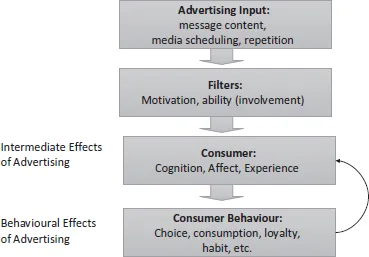
That is, in order to be effective, advertising needs to first grab consumers’ attention, spark their interest and inspire desire in order to provoke a purchase. This is the first example of ‘hierarchy of effects’ models of how advertising works. Since 1898, numerous variations of the ‘hierarchy of effects’ were proposed. What the models have in common is the sequential (or hierarchical) nature of the effects whereby each effect was considered a necessary pre-condition to the next and, thus, to advertising effectiveness. Vakratsas and Amber (1999) provide an exhaustive overview of the literature published on this subject and classify advertising models into seven groups. Their taxonomy is based on a distinction between intermediate (e.g. cognitive – C, affective – A and experience – E) and behavioural ad effects (e.g. purchase and brand choice). It also identifies the key filters of the advertising input: motivation, ability and attitude to the ad as these factors were found to moderate people’s responses to advertising (Figure 1.2.).
FIGURE 1.2 Framework for studying how advertising works
Source: Based on Vakratsas & Ambler (1999, p. 26)
Marketing Response Models (–) are among the simplest ones because they do not consider any intermediate effects. Instead, they relate advertising, price and promotion tactics directly to sales. Research in this stream mainly addresses short and long-term advertising effects on sales, and advertising elasticity and dynamics (current and carryover effects or dissipation of ad effects). These models stem from an econometric approach and give little insight into how ...
Table of contents
Cover
Half Title
Title Page
Copyright Page
Dedication
About the author
Acknowledgements
Preface
Part I: Key concepts: Advertising, gender and society
Part II: Gender, sex and advertising effectiveness
Part III: Recommendations for the audience, marketers and policy makers
References
Index
Trusted by 375,005 students
Access to over 1.5 million titles for a fair monthly price.
Study more efficiently using our study tools.
Frequently asked questions
Yes, you can cancel anytime from the Subscription tab in your account settings on the Perlego website. Your subscription will stay active until the end of your current billing period. Learn how to cancel your subscription
No, books cannot be downloaded as external files, such as PDFs, for use outside of Perlego. However, you can download books within the Perlego app for offline reading on mobile or tablet. Learn how to download books offline
Perlego offers two plans: Essential and Complete
Essential is ideal for learners and professionals who enjoy exploring a wide range of subjects. Access the Essential Library with 800,000+ trusted titles and best-sellers across business, personal growth, and the humanities. Includes unlimited reading time and Standard Read Aloud voice.
Complete: Perfect for advanced learners and researchers needing full, unrestricted access. Unlock 1.5M+ books across hundreds of subjects, including academic and specialized titles. The Complete Plan also includes advanced features like Premium Read Aloud and Research Assistant.
Both plans are available with monthly, semester, or annual billing cycles.
We are an online textbook subscription service, where you can get access to an entire online library for less than the price of a single book per month. With over 1.5 million books across 990+ topics, we’ve got you covered! Learn about our mission
Look out for the read-aloud symbol on your next book to see if you can listen to it. The read-aloud tool reads text aloud for you, highlighting the text as it is being read. You can pause it, speed it up and slow it down. Learn more about Read Aloud
Yes! You can use the Perlego app on both iOS and Android devices to read anytime, anywhere — even offline. Perfect for commutes or when you’re on the go. Please note we cannot support devices running on iOS 13 and Android 7 or earlier. Learn more about using the app
Yes, you can access Advertising, Gender and Society by Magdalena Zawisza-Riley in PDF and/or ePUB format, as well as other popular books in Psicologia & Storia e teoria della psicologia. We have over 1.5 million books available in our catalogue for you to explore.