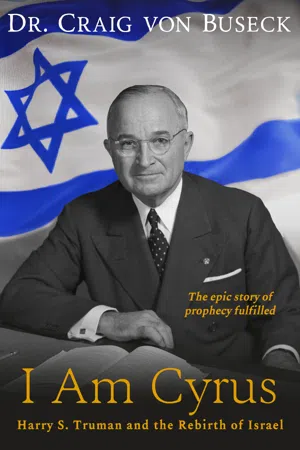
Improbable, if not impossible. How could a people who'd been scattered for two millennia reestablish a homeland on their ancient soil?Against all odds, an irresistible desire to return grew in courageous Jewish men and women who set out to rebuild their decimated homeland.Help came first through Great Britain's pledge to restore Palestine to the Jews. Britain, however, nearly reneged on that promise just as the Jews faced the Nazi Holocaust.Near the end of WWII, an unlikely man rose to the presidency of the United States. Harry S. Truman, a farmer and failed business owner, would decide not only the fate of Jewish survivors but also the future of their homeland.As a vote approached in the fledgling United Nations, pressure mounted. Truman slammed the White House doors shut to all who wanted to discuss Jewish statehood. Could anyone persuade the most powerful man in the world to reconsider?I Am Cyrus tells the epic story of Israel's rebirth—promises made, promises broken, and ultimately the fulfillment of the ancient prophecy that this people would indeed return to their Promised Land.
- English
- ePUB (mobile friendly)
- Available on iOS & Android
eBook - ePub
About this book
Information
Part One
THE PROMISE
Chapter One
THE JEWISH DIASPORA

597 BCE—JERUSALEM
The triumphant days of King David and King Solomon were distant memories when Nebuchadnezzar of Babylon conquered Jerusalem in 597 BCE5. The Hebrew kingdom seemed to be at an end. The glory of the nation of Israel had departed. It seemed to many that the unique relationship between the Hebrew people and Yahweh, their God, was irreparably broken. Most of the Jews were carried off to Babylon by Nebuchadnezzar. Those left behind in Eretz Israel were forced to toil among hostile neighbors with no organized government to provide protection.
It was the beginning of the Jewish Diaspora.
Seventy years passed, and then Cyrus the Great began his conquest of the lands surrounding Persia. As a follower of Zoroastrianism, Cyrus believed both good and bad gods existed. Yahweh was one of the good gods. He claimed that Yahweh visited him one night and commanded him to rebuild the temple in Jerusalem. Cyrus obeyed the heavenly vision, ordering the temple rebuilt and the Jews returned to their homeland.6
Judah became a protected theological state within the Persian Empire as Yahweh’s temple was rebuilt. This was a monumental task, but after years of toil, the temple was completed and rededicated to the glory of Yahweh. Persia ruled the ancient Near East for the next two hundred years, and the Jews enjoyed peaceful worship in Jerusalem.
THE RISE OF THE GREEKS
Then in 336 BCE, a Greek ruler named Alexander of Macedon—or Alexander the Great—swept across Asia with his armies. When he conquered Persia in 331 BCE, Eretz Israel became a Greek state.7 After the untimely death of Alexander in 323 BCE, three of his generals divided the Middle East among themselves.8 For the next 125 years, the Ptolemies and the Seleucids fought for the valuable Land of Israel, the crossroads of three continents. Then in 198 BCE, Antiochus III defeated the Ptolemies of Egypt and annexed Judea.
Antiochus initially allowed the same religious and political autonomy the Jews enjoyed under the Persians. But after a military loss to the Romans in Asia Minor, Antiochus retaliated against the Jews, trying to force them to reject Yahweh and embrace Greek paganism. He banned many traditional Jewish religious practices and made possession of the Torah a capital offense.
His son, Antiochus IV, came to the throne in 176 BCE and pushed even harder to eliminate the worship of Yahweh. When the Jews rebelled, he outlawed the observance of the Sabbath and circumcision. He defiled the holy temple by erecting an altar to the god Zeus, allowing the sacrifice of pigs, and opening the temple to non-Jews.9
THE MACCABEES
These actions united the Jewish people against Antiochus and soon uprisings took place across Eretz Israel. In the village of Modiin, a Jewish priest named Mattathias the Hasmonean refused to worship the Greek gods. In a bold act of defiance, Mattathias killed a Hellenistic Jew who stepped forward to offer a sacrifice to an idol on the local altar. Mattathias then fled with his five sons into the wilderness, where they made plans for full-scale war. Mattathias’ family became known as the Maccabees, from the Hebrew word for hammer, as their warfare skills struck hammer blows against their enemies.
When Mattathias died the following year, his son Judas Maccabee took his place, destroying pagan altars across Judea. Antiochus underestimated the will and strength of these Jewish freedom fighters and sent a small force to put down the rebellion. When those troops were annihilated, he led a more powerful army into battle only to be defeated yet again. In 164 BCE, Jerusalem was recaptured by the Maccabees in a stunning victory. Immediately, the Maccabees moved to ritually cleanse the temple, reestablishing Jewish worship and installing Jonathan Maccabee as high priest.
The successor to Antiochus agreed to the Jews’ demand for independence, and in the year 142 BCE, after more than 500 years of subjugation, the Jews were again masters of their own fate. Simon Maccabee, the last of the five sons of Mattathias to survive, ushered in an eighty-year period of Jewish independence in Judea.10
THE ROMANS
Independent Hasmonean rule lasted until 63 BCE when the Roman general Pompey conquered the Land of Israel, ending the Hasmonean state. After gaining control of the region, Julius Caesar appointed Hyrcanus II as ruler of Judea, as he was the son of Alexander Yannai, the former Hasmonean king. The Hasmonean dynasty ended in 37 BCE when the Idumean, Herod the Great, was named king of the Jews by the Roman Senate.
Under Julius Caesar, Judaism was officially recognized as a legal religion, a policy followed by the first Roman emperor, Augustus. But unlike the Persians and the Greeks, who encouraged Jewish religious freedom, the Romans brought with them their pantheistic practices. The Romans didn’t understand how the majority of the Jews could cling so closely to a religion that seemed so unusual—one that did not honor the deification of the emperor. Rome came down hard on its Hebrew subjects, levying steep taxes and persecuting those who resisted.
The emperor gave almost unlimited autonomy to Herod to govern the region.11 Along with the construction of numerous architectural wonders, Herod’s crowning achievement was the restoration and rebuilding of the temple of Jerusalem into one of the wonders of the ancient world. Herod had enclosed the original top of Mount Moriah with a rectangular set of retaining walls, built to support extensive substructures, and had filled the remaining space with dirt, sand, and stone. He then constructed a massive flat, paved area on which his magnificent temple was erected.
Despite his skill at bringing prosperity to Judea and his construction of theaters, aqueducts, and other magnificent structures, Herod was an Arabian Edomite, and his Jewish subjects did not trust him. After his death, the Romans divided his kingdom among three of his sons and his sister. During the siblings’ fractious rule, the Jews’ growing anger against Roman suppression escalated into a full-scale revolt.
In 66 CE, the First Jewish–Roman War began. The revolt was put down by the future Roman emperors Vespasian and Titus. In the Siege of Jerusalem in 70 CE, the Romans destroyed much of the Second Temple and plundered many of the religious artifacts. Roman forces led by Titus were finally victorious, defeating the last Jewish outpost at Masada in 73 CE.12
More than one million people were killed by the Romans during the uprising, and approximately 97,000 Jews were captured and sold into slavery.13 Many of these outcasts formed the nucleus of later European Jewish communities. From this time forward, Jews in the Roman Empire were only allowed to practice their religion if they paid a special tax.
THE BAR KOKHBA REVOLT
The Jews enjoyed one final short time of sovereignty as the result of the revolt of Shimon Bar Kokhba in 132 CE. For a brief period, Jerusalem and Judea were controlled by the Jews. The revolt was eventually put down by the overwhelming power of the Romans, and the vast majority of the Jewish population of Judea was killed, sold into slavery, or forced to flee. In an attempt to erase the historical ties of the Jewish people to the region, Emperor Hadrian changed the name of the Judean province to Syria Palaestina and Jerusalem to Aelia Capitolina. Temples were built to honor Jupiter and other Roman gods, and Jews were barred from Jerusalem, except on the day of Tisha B’Av.
To prevent the political regeneration of the Jewish nation and to sever the connection of the Hebrew people to their homeland, several Greek and Roman colonies were planted in Palestine by the Roman government. Heavy taxation, cruel discrimination, and social shunning further alienated the remaining Jews. Although a small group of Jews maintained their presence in Palestine, they became a people in exile—even within their own homeland.14
THE JEWISH EXILE
Jewish religious law and cultural traditions became the common bond among Jews in the Diaspora. These keepsakes were passed from generation to generation. Some of the most famous and important Jewish texts were composed at this time, including the Jerusalem Talmud and the completion of the Mishnah.
Although the temple had been destroyed, Judaism survived. Priests were replaced by rabbis and the synagogue became the focus of religious life.15 The small remaining Jewish community in Palestine gradually recovered, strengthened occasionally by returning exil...
Table of contents
- Cover Page
- Title Page
- Copyright Page
- Table of Contents
- Foreword
- Prologue: Birth Pains
- Part One: The Promise
- Chapter One: The Jewish Diaspora
- Chapter Two: Ben-Yehuda: The Language and the Land
- Chapter Three: Herzl and the Jewish State
- Chapter Four: Herzl and the Zionist Movement
- Chapter Five: Weizmann, Balfour, and Churchill
- Chapter Six: Acetone and the Balfour Declaration
- Chapter Seven: Weizmann and Faisal—A Dream of Peace
- Chapter Eight: San Remo and the Mandate for Palestine
- Part Two: The Mandate
- Chapter Nine: The Haberdashery
- Chapter Ten: The Arab Revolt
- Chapter Eleven: Ben-Gurion and the Haganah
- Chapter Twelve: Hitler and the Nazis
- Chapter Thirteen: The White Paper
- Chapter Fourteen: World War Two
- Chapter Fifteen: Truman’s National Ascent
- Chapter Sixteen: The Mufti and the Nazis
- Chapter Seventeen: The Final Solution
- Part Three: The Rebirth
- Chapter Eighteen: The Vice President
- Chapter Nineteen: Franklin Roosevelt and King Saud
- Chapter Twenty: The Moon, Stars, and All the Planets Fall
- Chapter Twenty-One: Death Camps and Displaced Persons
- Chapter Twenty-Two: British Oppression and Jewish Resistance
- Chapter Twenty-Three: David and Goliath
- Chapter Twenty-Four: Lake Success
- Chapter Twenty-Five: Palestine on Fire
- Chapter Twenty-Six: Eddie Jacobson’s Hero
- Chapter Twenty-Seven: Showdown with Marshall
- Chapter Twenty-Eight: Rebirth of a Nation
- Epilogue: Born for Such a Time
- Endnotes
Trusted by 375,005 students
Access to over 1.5 million titles for a fair monthly price.
Study more efficiently using our study tools.
Frequently asked questions
Yes, you can cancel anytime from the Subscription tab in your account settings on the Perlego website. Your subscription will stay active until the end of your current billing period. Learn how to cancel your subscription
No, books cannot be downloaded as external files, such as PDFs, for use outside of Perlego. However, you can download books within the Perlego app for offline reading on mobile or tablet. Learn how to download books offline
Perlego offers two plans: Essential and Complete
- Essential is ideal for learners and professionals who enjoy exploring a wide range of subjects. Access the Essential Library with 800,000+ trusted titles and best-sellers across business, personal growth, and the humanities. Includes unlimited reading time and Standard Read Aloud voice.
- Complete: Perfect for advanced learners and researchers needing full, unrestricted access. Unlock 1.5M+ books across hundreds of subjects, including academic and specialized titles. The Complete Plan also includes advanced features like Premium Read Aloud and Research Assistant.
We are an online textbook subscription service, where you can get access to an entire online library for less than the price of a single book per month. With over 1.5 million books across 990+ topics, we’ve got you covered! Learn about our mission
Look out for the read-aloud symbol on your next book to see if you can listen to it. The read-aloud tool reads text aloud for you, highlighting the text as it is being read. You can pause it, speed it up and slow it down. Learn more about Read Aloud
Yes! You can use the Perlego app on both iOS and Android devices to read anytime, anywhere — even offline. Perfect for commutes or when you’re on the go.
Please note we cannot support devices running on iOS 13 and Android 7 or earlier. Learn more about using the app
Please note we cannot support devices running on iOS 13 and Android 7 or earlier. Learn more about using the app
Yes, you can access I Am Cyrus by Craig von Buseck in PDF and/or ePUB format, as well as other popular books in Politics & International Relations & Political Biographies. We have over 1.5 million books available in our catalogue for you to explore.