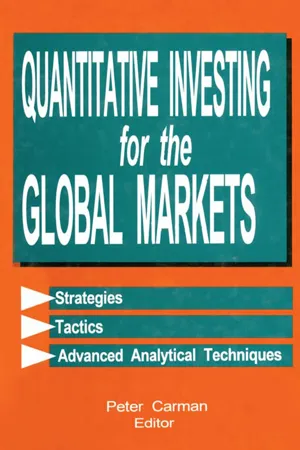
Over the past several years, the field of international investing has been transformed by a host of new, state-of-the-art techniques. Quantitative Investing forthe Global Markets is the definitive handbook for money and portfolio managers, research analysts, pension consultants, corporate treasurers, and other professionals seeking a competitive edge in the global investment marketplace. Topics include: international asset allocation; optimum diversification levels; style analysis and evaluation; market neutral strategies; global stock valuation; advanced strategies for hedging currency risk; international benchmarking; etc.
- 400 pages
- English
- ePUB (mobile friendly)
- Available on iOS & Android
eBook - ePub
Quantitative Investing for the Global Markets

The $40 Triillon Market: Global Stock and Bond Capitalizations and Returns
Director, Quantitative Analysis
The Ford Foundation,
The Ford Foundation,
Introduction
The wealth of the world is a compelling topic for at least three reasons:
■It represents the stock of resources available to the people living in the world.
■It is, in at least some abstract sense, the opportunity set for investors. The return on a market-capitalization-weighted portfolio of the financial wealth of the world, therefore, represents an all-country, all-asset benchmark that may be appropriate as a basis of comparison for the performance of large, diversified pools of assets.
■It is the market portfolio—and, consequently, the mean-variance efficient portfolio of risky assets—in the capital asset pricing model and in Richard Roll's critique of that model.
This chapter focuses on the subset of world wealth that is represented by publicly traded stocks and bonds. We present the market capitalization and historical returns of stocks and bonds in a broad sample of developed and emerging national markets. A base of information that is at the same time global (reaching across space) and historical (across time) provides the investor with a perspective that he or she cannot obtain in any other way, and that is almost invariably useful in the pursuit of that investor's specialty.
Review of Liierature
The literature on world market capitalizations and returns is relatively limited. Roll (1977) asserted that the capital asset pricing model (CAPM) is untestable because a test of the CAPM would require the measurement of period-by-period returns on the world portfolio of all risky asset classes. Such a measurement was and is not available, because the largest components of world wealth—human capital and privately held real estate—have no price-discovering markets. In a kind of response to Roll's critique, Ibbotson and Siegel (1983), and Ibbotson, Siegel, and Love (1985), measured the returns on the components of world wealth that have price-discovering markets or, in the case of real estate, periodic appraisal-based valuations. Despite their efforts, these authors admit that the assets excluded are much larger than those included. This chapter, which updates and in some ways expands on those articles has the same limitations.
Macroeconomists and government organizations have also made contributions to the study of world wealth and return. Robert J. Barro and Raymond W. Goldsmith are among the economists who have contributed to the thinking on world wealth, its size, importance, and interpretation.1 The Organisation for Economic Cooperation and Development (OECD), the International Financial Corporation (IFC), the Bank of Japan, and the U.S. Department of Commerce are representative of the organizations that have devoted resources to measuring the stocks of wealth, both physical and financial, in single countries and around the world, as well as stock prices, bond prices, and interest rates.
Data bases published by the great private data gathering organizations have had more to say about world wealth and return than academic and professional authors. In particular, all users of world equity market indices are dependent on the return and market capitalization data collected by Capital International and its successor, Morgan Stanley Capital International (MSCI); the Frank Russell Company; and the Financial Times-Actuaries (FTA) World Indices. On the fixed-income side, Salomon Brothers, Merrill Lynch, J. P. Morgan, and Lehman Brothers have made the principal contributions to the stock of useful data.
Inclusions and Exclusions
Stocks and Bonds
The decision to include stocks and bonds is easy. These assets represent the vast majority of the liquid, publicly traded securities available for purchase. Moreover, data on their capitalization and returns are widely circulated.
What parts of the world represent opportunities for would-be stock and bond holders? The spread of capitalism and capital markets has progressed to the point where the frontier is vanishingly small. Batterymarch Financial Management tracks stock market data even for Kyrgyzstan, Botswana, and Mauritius.2 The great population centers of China and India have long since joined the list of emerging markets. We would thus like to cover every country in the world, but data are limited for some countries. High-quality stock market data are available for some 47 countries; the number is smaller for bond markets.
Our coverage of stocks is guided by the Morgan Stanley Capital International (MSCI) indices, which comprise most but not all of the large and medium-sized companies in each country's economy.3 As of mid-1996, the United States was the largest country, with $6.8 trillion in stock market capitalization. The smallest was Sri Lanka, with $2 billion. Note that a few countries with regionally important economies, particularly in the former Soviet Union and in Africa, are not included in the MSCI indices; China only began to be included in November 1995.
Our current coverage of bond capitalization is guided by the Merrill Lynch publication, Size and Structure of the World Bond Market, which provides data for bonds denominated in the currencies of 35 countries, plus the European currency unit or ECU.4 The currency with the largest bond capitalization as of late 1994 is the U.S. dollar with $8.6 trillion, and the currency with the smallest is the Uruguayan peso with $300 million. Historical (as opposed to current) market capitalization data are ...
Table of contents
- Cover
- Title Page
- Copyright Page
- Dedication
- Table of Contents
- PREFACE
- CONTRIBUTORS
- 1. The $40 Trillon Market: Global Stock and Bond Capitalizations and Returns
- 2. Why Invest Globally?
- 3. Quantitative Investing
- 4. The Critical Role of Fundamental Research
- 5. Global Sector Allocation
- 6. Style-Based Country-Selection Strategies
- 7. Style Indexes: Powerful Tools for Building Global Stock-Selection Models
- 8. The Case for Global Small Stocks
- 9. The Cross-Sectional Determinants of Emerging Equity Market Returns
- 10. Prediction of Currency Movements
- 11. Portfolio Construction and Risk Management
- 12. Implementing Global Investment Strategies
- INDEX
Trusted by 375,005 students
Access to over 1.5 million titles for a fair monthly price.
Study more efficiently using our study tools.
Frequently asked questions
Yes, you can cancel anytime from the Subscription tab in your account settings on the Perlego website. Your subscription will stay active until the end of your current billing period. Learn how to cancel your subscription
No, books cannot be downloaded as external files, such as PDFs, for use outside of Perlego. However, you can download books within the Perlego app for offline reading on mobile or tablet. Learn how to download books offline
Perlego offers two plans: Essential and Complete
- Essential is ideal for learners and professionals who enjoy exploring a wide range of subjects. Access the Essential Library with 800,000+ trusted titles and best-sellers across business, personal growth, and the humanities. Includes unlimited reading time and Standard Read Aloud voice.
- Complete: Perfect for advanced learners and researchers needing full, unrestricted access. Unlock 1.5M+ books across hundreds of subjects, including academic and specialized titles. The Complete Plan also includes advanced features like Premium Read Aloud and Research Assistant.
We are an online textbook subscription service, where you can get access to an entire online library for less than the price of a single book per month. With over 1.5 million books across 990+ topics, we’ve got you covered! Learn about our mission
Look out for the read-aloud symbol on your next book to see if you can listen to it. The read-aloud tool reads text aloud for you, highlighting the text as it is being read. You can pause it, speed it up and slow it down. Learn more about Read Aloud
Yes! You can use the Perlego app on both iOS and Android devices to read anytime, anywhere — even offline. Perfect for commutes or when you’re on the go.
Please note we cannot support devices running on iOS 13 and Android 7 or earlier. Learn more about using the app
Please note we cannot support devices running on iOS 13 and Android 7 or earlier. Learn more about using the app
Yes, you can access Quantitative Investing for the Global Markets by Peter Carman in PDF and/or ePUB format, as well as other popular books in Business & Business General. We have over 1.5 million books available in our catalogue for you to explore.