![]()
Section 1
Aspects of Plant Pathology
Chapter 1: Concepts and Principles
This chapter covers the historical and contemporary issues relating to plant pathogens. First it outlines the development of scientific knowledge in plant pathology, featuring important historical issues such as the Irish potato famine, ergotism, and Dutch elm disease. The chapter then discusses the impact of disease organisms on food security, outlining the major threats to food supply chains posed by these pathogens, and introduces the role of plant biotechnology and genetically modified organisms as modern tools used to enhance the control of disease.
Chapter 2: Characterization and Taxonomy of Plant Pathogens
This chapter introduces the range of plant pathogens and explores the taxonomy of plant disease organisms, with examples of bacteria, fungi, and viruses as well as some of the other less well-known groups. The chapter also illustrates some of the key biological features of each major taxonomic group.
Chapter 3: Infection Processes
This chapter investigates the dynamics of disease infection, including mechanical and chemical processes. Issues such as enzymatic entry, production of microtoxins, important plant growth regulators, and molecular aspects of infection are discussed, as well as the processes of cellular degradation and the development of structures such as fungal haustoria.
Chapter 4: Plant Responses to Pathogens
This chapter examines how plants respond to disease, starting with the ways in which plants have evolved structural defenses against pathogenesis. It then explores how plants respond at the metabolic level, illustrated by changes in protein metabolism and the acquisition of acquired systemic resistance, and the mechanism of action of applied stimulants such as jasmonic acid and liquid seaweed extract. The chapters also looks at developments in molecular biology, such as the cell-to-cell concept, host recognition, and how this knowledge has enabled scientists to develop plant breeding programs that focus on the production of new plant lines that express novel traits which allow plants to resist disease infection.
Chapter 5: Epidemiology
This chapter looks at how climate and crop factors lead to the spread of plant disease, as well as considering the impact that climate change may have on future trends in disease outbreaks. It also explores the impact of increased genetic uniformity in cropping systems on the likelihood of major disease outbreaks, and illustrates how models in epidemiology are used to predict the course of disease spread.
![]()
Chapter 1
Concepts and Principles
In 2011 the human population reached 7 billion, and it continues to increase by approximately 73 million people a year. The majority of this increase is occurring in economically emerging countries that are typified by fragile ecosystems and subsistence agriculture. Crops in these regions are vulnerable to a range of biotic and abiotic perturbations that often result in chronic food shortages and, in worst-case scenarios, famine. Added to this vulnerability is the fact that the human population relies on 12 plant species to provide 75% of the world’s food supply, with 50% of the calories provided by three main crops, namely rice, wheat, and corn or maize. Any challenge to these main crops may have a major effect on the ability to meet the demand for food supplies for our burgeoning population.
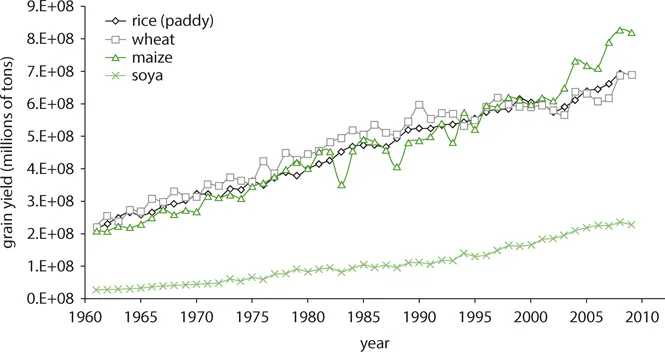
Plant pathogens make a significant contribution to reductions in crop quality and yields, and can have a profound detrimental impact on food security, particularly in those parts of the world that are challenged by food poverty. During the last 40 years, countries from the economically developed regions of the world have invested substantial sums of money and research effort in improving crop yield, and are consequently able to escape the worst effects of disease epidemics. These advances in agricultural technology have resulted in increased yields of staple food crops (Figure 1.1), and are the result of plant breeding programs that improve disease resistance, an increase in resource allocation that has led to improved yields, and improvements in agrochemicals. However, humankind now faces new threats to food security because the rate of increase in crop yields has slowed significantly since 2006, from an average increase of 3.6% per year since the mid-1960s to 1.3% per year in 2010. This decline in the rate of yield increase can be explained by a number of factors, such as losses of cropping area and climate change. However, more importantly, the plants and animals that are used by humankind are reaching their physiological maximum with regard to biological enhancement. All of these factors lead to the conclusion that there is a need for increased activity in areas of agricultural research. Indeed the Food and Agricultural Organization of the United Nations (FAO) has called for a global increase in funding of the order of US$ 85 billion.
During the last 30 years there has been a steady and continuing decline in government spending on research and development in agriculture. In particular, successive governments in the UK have undermined the agricultural sector, resulting in the closure of research institutes (for example, Long Ashton Research Station) and education centers (for example, Seale-Hayne College and Wye College) that were dedicated to the training of future farmers and agricultural researchers. This shortsighted funding strategy has resulted in a loss of skilled people to take agriculture forward in the twenty-first century and beyond. This is a pertinent and important point with regard to plant pathology. Research and training in plant pathology have declined significantly at a time when humankind must increase crop yields by 60–70% by 2050 to meet the growing demand for food supplies.
Figure 1.1 Increase in global yield of small grains during the period 1960–2010.
Plant pathogens continue to challenge crop yields. Losses to plant disease still represent 10–16% of the global harvest, and these losses occur even after the adoption of disease-resistant cultivars and the widespread use of fungicides. This last point illustrates another problem that is often overlooked, namely that plant pathogens respond rapidly to any selection pressure (for example, growing a large area of crops with a single disease-resistant gene, or use of a single active chemical compound in a fungicide) and develop resistance to the armory of weapons at our disposal to protect crops.
There are two other problems facing agriculture and thus food security. First, there is a general lack of understanding by most people of how fragile our food production systems are, and second, decreasing numbers of students are choosing to work in the agricultural sector at all levels. Again this last point is clearly illustrated in developed countries such as the UK and North America, where young school leavers and graduates perceive a career in the agricultural industry as hard work, boring, and unrewarding. It may be hard work, but there are many interesting and rewarding career opportunities in agriculture, ranging from farming to management, consultancy, policy making, and research. With regard to plant pathogens there is now a pressing need to increase activity in primary research and applied science to help to mitigate against any future damaging disease epidemics. In view of this, the aim of this book is to develop knowledge and understanding of plant pathogens.
1.1 Impact of Plant Pathogens on Humans
Historically, humankind has had to contend with plant pathogens since the origins of agriculture around 10,000–12,000 years ago...