eBook - ePub
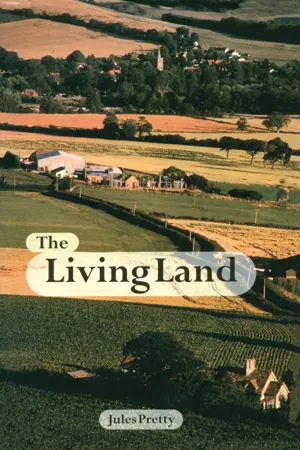
The Living Land
Agriculture, Food and Community Regeneration in the 21st Century
- 336 pages
- English
- ePUB (mobile friendly)
- Available on iOS & Android
eBook - ePub
About this book
The Living Land sets out a new 'stakeholder' vision for rural regeneration in Europe. It integrates three themes: sustainable agriculture, localised food systems and rural community development. All three offer ways of rebuilding natural and social capital, and a large 'sustainability dividend' is waiting to be released from current practices - creating more jobs, more wealth and better lives from less.
Information
Chapter 1
A Living Land for Rural Europe
What are those blue remember’d hills
What spires, what farms are those?
That is the land of lost content,
I see it shining plain,
The happy highways where I went
And cannot come again
What spires, what farms are those?
That is the land of lost content,
I see it shining plain,
The happy highways where I went
And cannot come again
A E Housman (1859—1936), from England
Recreating a Living Land
The Challenge Ahead
This book is about getting back something we have lost. It is also about creating something new we never had. We value our countryside, our rural landscapes, our wildlife. We value our rural communities and their many idyllic settings. Yet we are still losing many valued features of our natural environments, such as meadows, wetlands, woodlands, birds and other wildlife. Our rural communities are suffering too. There are fewer rural livelihood opportunities and fewer basic services. Hardship and poverty are common.
This book’s message is about getting back some of these natural and social aspects of our countryside and rural economies that we value. It is also about getting more from less by using fewer resources. We can live better in more connected communities, we can protect our natural environment, we can eat well and safely. These are simple ideas, but difficult to put into practice. According to some measures, rural communities and farmers throughout Europe are very successful. Farms are more efficient, and food is cheaper and more abundant. But this ‘success’ has come at some cost. The state of both natural resources and rural societies is vital for our welfare and economic growth. However, as soils become depleted or erode, water is polluted, trees, hedges and other habitats lost, and wildlife threatened; and as trust falls, social institutions are rendered ineffective, and reciprocity and exchange mechanisms lost, so it is increasingly difficult to sustain vibrant farming and rural communities. As these stocks of natural and social capital diminish, it becomes more difficult to make a living from what remains.
Fortunately, it is not all doom and gloom. Throughout Europe and North America, there are initiatives and experiments underway that are not only repairing the damage, but also showing that alternatives are economically viable. Sustainable agriculture works for farmers and consumers. It is also good for wildlife and other natural resources. Food can be produced in adequate amounts for all and at a quality that is both nutritious and safe. Rural communities can take a major role in their own social and economic development.
These initiatives show that there is potential for a large sustainability dividend. Using less resources and less fossil fuel, it is possible to create more wealth. Instead of depleting natural and social capital, these can be regenerated to provide everyone with enriched and varied livelihood opportunities. At the same time as birds are protected, jobs can be created. While soils are regenerated, so rural communities can become more cohesive and pleasant places to live. As less pesticide is used, so food quality improves. And as farming becomes increasingly sustainable, so a greater involvement of different groups in development processes can regenerate local democracy. This alternative vision is also about spreading the benefits from our countryside and its economies more evenly. There are many different groups who have a stake in our rural, countryside and food systems, but returns to these stakeholders differ. Some do very well, others poorly. Large farmers do proportionally much better than small family farmers, even though smaller ones may protect the environment better. Agrochemical companies, food manufacturers, processors and retailers capture much more of the value in the food system than they used to do. As a result, much less of the food pound, franc, mark, or dollar gets back to farmers and rural communities. This unevenness undermines the whole system.
The interesting fact about technologies, processes and policies that produce a more even spread of proceeds is that the whole system benefits. A multiple stakeholder approach produces a bigger and better pie. A community-based approach to development which builds on existing social and natural resources actually produces more jobs and services in rural areas than an externally driven, exogenous approach relying, in the main, on distant technologies and mobile capital. What is now clear is that sustainable agriculture can yield as much or more food than conventional systems, but does so without damaging the natural environment. It also produces more jobs and business opportunities. Community food systems capture more value for local people. Rural partnerships bring together different actors in new networks that develop mutual trust and new opportunities for exchange and reciprocity.
But none of this will happen without a helping hand. Most national and international policies do not, as yet, support a sustainability-led approach to rural development. Many say they do, since sustainability is now in fashion. But, in reality, governments are yet to create the necessary enabling conditions. Nonetheless, some have taken small steps that have already delivered a dividend — a community food security act in the US, a national food and health policy in Norway, green taxes on pesticides and fertilisers in various European countries, pesticide reduction policies in The Netherlands, and the gradual switching of payments under the Common Agricultural Policy (CAP) from food production to environmental goods and services. However, no industrialised country has a national policy framework that properly integrates these various challenges and needs. In addition, some of these advances are coming under pressure as countries have to make their internal policies compatible with the World Trade Organisation (WTO) and General Agreement on Tariffs and Trade (GATT) agreements.
Rural Europe and the Rest of the World
This book takes Europe as its primary focus and draws mainly upon recent experience throughout the industrialised countries of Europe and North America. It is intended to complement an earlier book of mine entitled Regenerating Agriculture: Policies and Practice for Sustainability and Self-Reliance, which almost entirely focused on sustainable agriculture and rural development in Africa, Asia and Latin America.
At first glance, it may appear that there is little commonality between India, Kenya or Honduras with Britain, Sweden or Spain. But the similarities of challenge and opportunity are remarkable. Of course, their national economies, political systems and social institutions are structured in different ways. But in local communities, the needs, aspirations and hopes of individuals and their families are parallel. In many ways, the improvements brought about by community-based activities in developing countries are far more advanced than those in the North. There is much to learn from this experience.
In Bangladesh and elsewhere in South Asia, the Grameen Bank system of small-scale credit has brought dignity and better welfare to hundreds of thousands of poor women and their families. Soil conservation and organic farming programmes in Kenya, working in a participatory fashion with local people, have improved environments, farm yields and diversity of produce for some 200,000 farming families. In the south Brazilian states of Parana and Santa Catarina, there have been massive increases in agricultural productivity with locally adapted and sustainable technologies for some 300,000 farming families. In Central America, 45,000 farmers in Honduras and Guatemala have tripled agricultural yields by adopting collective approaches to sustainable technology development.
In South and South-East Asia, farmer-field schools have helped some 800,000 farmers to learn systematically about the ecology of their rice fields and farms, leading to new technology development and substantial cuts in pesticide use. Despite the cuts in inputs, rice yields have increased by a small amount, perhaps 8 to 12 per cent, but the great benefit has been the extra fish, frogs and vegetables that can now be raised and grown with the rice. In Bangladesh, rice farmers now say ‘our fields are singing again’ — for 30 years they have produced only rice; now productivity has grown, but on a sustainable basis.
These are only a small selection of some recent remarkable achievements. Clearly, no single country has all the answers, whether in technology, knowledge, processes or policies. But knowing that agriculture can be both sustainable and productive at one location encourages us to identify ways to help it emerge elsewhere.
What Went Wrong in Rural Europe?
From the middle of the 20th century, most governments in Europe began to adopt policies that encouraged their farmers to produce much more food. Visions of hunger and concerns about low self-sufficiency pushed through a wide range of changes. Farmers responded by massively increasing output. Between the 1940s and 1990s, the amount of food produced on European farms grew at an unprecedented rate. Compared with the 1940s, we now produce three times the amount of wheat and barley per hectare and more than twice as much potato and sugar beet; cows now produce twice the milk per lactation.
These improvements were both extraordinary and historic. Never had such rapid growth occurred — perhaps it never will again in industrialised countries. Unfortunately, they also came at considerable cost. In the process of increasing output with greater use of non-renewable inputs, we have lost hedgerows, ponds, woodlands and other natural habitats; soils have been depleted; water polluted with pesticides and fertilisers; human health damaged by pesticides; and birds and other wildlife have been lost. In the process of making agriculture more efficient, commonly measured by the amount produced per unit input of labour or land, farms have become larger and fewer in number. Jobs have gone, and farming has become increasingly isolated both within rural communities and from its clients — the food consumers. And in the process of producing ever more food with ever increasing ‘efficiency’, we have managed also to produce some foods and food products that are harmful to our health. Yet in rural areas, natural and social environments are bound closely together. We cannot have one without the other. It is farming that has given almost every landscape, community and environment throughout Europe its distinctiveness. It is also modern farming that has taken it away.
Over the past ten years, we have seen a series of major public health and countryside issues come to dominate the food and agriculture industry. We now have the bovine spongiform encephalopathy (BSE) scare in beef and probable links to Creutzfeld—Jakob Disease (CJD); the effect of organophosphate pesticides on sheep farmers and other agricultural workers; the cloning of sheep; conflicts between landowners and the public over access to the countryside; poisonous strains of bacteria, such as Salmonella in eggs, Listeria in soft cheeses, and E coli in cooked meats; animal welfare concerns, particularly over young cows in veal crates and the live transport of sheep and cattle; residues of pesticides in our foods and drinking water; and genetically modified organisms entering the food chain. All of these have steadily undermined the confidence which the public once had in the farming industry.
Biotechnology and the genetic modification of organisms is an emerging area of concern for many. Biotechnology involves making molecular changes to living or almost-living things such as proteins; genetic engineering is the horizontal transfer of DNA from species to species. In agriculture, the first generation changes have been to incorporate genes into crops that confer resistance to a particular herbicide, or that encourage plant cells to produce materials that harm insects. In 1994, there were no genetically modified crops grown anywhere in the world. By 1997, more than 12 million hectares of genetically modified crops were cultivated, mainly in the US, and involving a quarter of all cotton, 14 per cent of soya and 10 per cent of maize.
Despite the many alleged biotechnology goods, such as the potential for reduced pesticide and fertiliser use, and the many human health benefits from ‘molecule pharming’ — the production of proteins such as insulin and blood-clotting factor in the milk of genetically-modified sheep and pigs — there are many concerns over the potential biotechnology bads (see Chapter 4). The greatest concerns are over genetic pollution, where genetically modified crops cross with wild relatives, transferring the genes into the environment. No one knows what will happen in the long term. Already resistance genes in oil seed rape are found in France to have become incorporated into wild radish. In Scotland, potatoes containing snowdrop genes that confer resistance to peach potato aphid have been found to reduce the lifespan of female ladybirds by half. Other concerns are over the potential spread of antibiotic resistance to humans from the antibiotic markers used in these crops.
Does It Matter?
What we have gained with one hand has been taken away with the other. Should we be concerned? Surely cheap and abundant food is more important than a few songbirds, or a few lost trees and ponds? Rural people have enough of the good life anyway. Why should they receive special treatment?
Remarkably, a third to a half of urban people in Britain want to move to the countryside. Most hold dear some notion of a rural idyll. They would be surprised to learn that it rarely exists. Wildlife habitats have disappeared. Birds are fewer in number. Freshwater is polluted. And while some families live in thatched cottages, with glorious flower and vegetable gardens, a quarter of rural households are under the official poverty line. A third or more parishes have no shop, pub or village hall; one half have no school; only a third still have a public transport link, even though one in eight households have no car at all. Rural communities are under growing threat across Britain. Elsewhere in Europe, particularly in southern countries, it is even more severe, with land being abandoned, families emigrating, and a growing loss of the distinctive character of farmed habitats and their valued wildlife.
Farming in Britain currently consumes more than £3 billion (some 4.3 billion ECUs) of direct subsidies every year. The Common Agricultural Policy (CAP) cost the whole EU more than 40 billion ECUs per year in the mid 1990s. Yet, at the same time, there are 18 million unemployed in Europe — few of whom have assets or the means to make a living, unlike most farmers. Farm subsidies are also inequitably spread. Big farmers receive the largest slice of the pie. Just 12 per cent of all farms produce 60 per cent of all agricultural output and, in the EU as a whole, I per cent of farms rear 40 per cent of all animals. Do taxpayers get good value for this money, or might they wish for something different?
Farming is at a crossroads. The simplest path to take is ‘business as usual’, with farming becoming more and more ‘efficient’ but less and less linked to rural communities, the environment and the urban consumers of food. If farming were to lose its public support, then it would have to make a straightforward transition. Let us have a relatively or even completely unsubsidised farming industry which competes at world market prices, with a few dominant companies farming huge fields and running giant livestock operations. In another direction, however, there lies something quite different. This future requires some imagination, even leaps of faith. It implies a future with dynamic rural economies, with sustainable systems of food production, and with cohesive rural communities. Here are places where stocks of natural capital and social capital are high, and where people like to live. As we shall see, it does not cost more to go down this route. Far from it. There is even a substantial dividend to be had. But it will be difficult. History constrains us all, and we may be unable to break free. This book sets out some of the methods for grasping the opportunities before us.
The Value of Natural and Social Capital
Aspects of Capital
We are all familiar with the term capital. It refers to the stock of materials or information that exists at a given point in time. Most commonly, we think of it as the amount of money we have, either tied up in buildings, land, cars or jewellery, or saved in a bank or pension fund. Each form of capital stock generates a flow of valuable services that may be used to transform materials or the way they interact to enhance human welfare. The wellbeing of people in a rural society depends, therefore, on the value of services flowing from the total capital stock existing in their local economy.
Although capital stock and assets take many forms, we have tended to undervalue two critical types. These are natural capital and social capital. Some kinds of capital are easy to value. We know how much a house or a car is worth. Others, though, are more difficult to assess. How much is a hedgerow worth? A cohesive rural community? Organic matter in the soil? It is difficult to answer these questions, even if we ask them in the first place.
Natural capital refers to the stocks of plants and animals and the ecosystems they make up: minerals, atmosphere and water. These stocks of capital create ‘services’ that comprise flows of material, energy and information which we can combine with manufactured and human capital to produce welfare. Natural capital is vital: it is difficult to imagine generating welfare without it. Although it is impossible to give an absolute value to some capital stocks — the atmosphere, for example, has infinite value to us — it is instructive to see how much the services that come from the capital are worth. Robert Costanza of the University of Maryland and 12 colleagues’ study (Constanza et al, 1997) of the value of the world’s ecosystem goods and services — which include water regulation and supply, climate regulation, nutrient cycling, soil formation, waste treatment, wild food production, biological control of pests, and recreation — estimate it to be in the range US$16—54 trillion per year. The best guess of $ 33 trillion is almost twice the ...
Table of contents
- Cover
- Title
- Dedication
- Copyright
- Contents
- Acronyms and Abbreviations
- Acknowledgements
- 1 A Living Land for Rural Europe
- Part I Towards Sustainable Agriculture
- Part II Towards Sustainable Food Systems
- Part III Towards Sustainable Rural Communities
- Part IV Making a Difference
- References
- Index
Trusted by 375,005 students
Access to over 1.5 million titles for a fair monthly price.
Study more efficiently using our study tools.
Frequently asked questions
Yes, you can cancel anytime from the Subscription tab in your account settings on the Perlego website. Your subscription will stay active until the end of your current billing period. Learn how to cancel your subscription
No, books cannot be downloaded as external files, such as PDFs, for use outside of Perlego. However, you can download books within the Perlego app for offline reading on mobile or tablet. Learn how to download books offline
Perlego offers two plans: Essential and Complete
- Essential is ideal for learners and professionals who enjoy exploring a wide range of subjects. Access the Essential Library with 800,000+ trusted titles and best-sellers across business, personal growth, and the humanities. Includes unlimited reading time and Standard Read Aloud voice.
- Complete: Perfect for advanced learners and researchers needing full, unrestricted access. Unlock 1.5M+ books across hundreds of subjects, including academic and specialized titles. The Complete Plan also includes advanced features like Premium Read Aloud and Research Assistant.
We are an online textbook subscription service, where you can get access to an entire online library for less than the price of a single book per month. With over 1.5 million books across 990+ topics, we’ve got you covered! Learn about our mission
Look out for the read-aloud symbol on your next book to see if you can listen to it. The read-aloud tool reads text aloud for you, highlighting the text as it is being read. You can pause it, speed it up and slow it down. Learn more about Read Aloud
Yes! You can use the Perlego app on both iOS and Android devices to read anytime, anywhere — even offline. Perfect for commutes or when you’re on the go.
Please note we cannot support devices running on iOS 13 and Android 7 or earlier. Learn more about using the app
Please note we cannot support devices running on iOS 13 and Android 7 or earlier. Learn more about using the app
Yes, you can access The Living Land by Jules Pretty Obe in PDF and/or ePUB format, as well as other popular books in Politics & International Relations & Development Economics. We have over 1.5 million books available in our catalogue for you to explore.