eBook - ePub
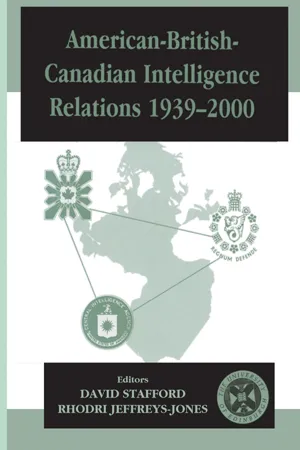
American-British-Canadian Intelligence Relations, 1939-2000
- 288 pages
- English
- ePUB (mobile friendly)
- Available on iOS & Android
eBook - ePub
American-British-Canadian Intelligence Relations, 1939-2000
About this book
This work considers, for the first time, the intelligence relationship between three important North Atlantic powers in the Twenty-first century, from WWII to post-Cold War. As demonstrated in the case studies in this volume, World War II cemented loose and often informal inter-allied agreements on security intelligence that had preceded it, and created new and important areas of close and formal co-operation in such areas as codebreaking and foreign intelligence.
Information
1
Introduction
In his contribution to this volume, Stephen Budiansky quotes a letter home from a British intelligence officer who had arrived in Washington in July 1942:
You must have noticed yourself how very many childish qualities the American male has: his taste in women, motor-cars, and drink, his demonstrative patriotism, his bullying assertion of his Rights …. Hell! anyone would think I didn’t like them.’
Later in his essay, he notes the reaction of an American counterpart a few years later: ‘What we ultimately want is independence.’
As even these brief illustrations reveal, the American-British intelligence relationship is not just interesting, but complex. If you add Canada to the formula, giving the acronym ABC, both the complexity and significance of the North Atlantic intelligence ‘triangle’ become still more evident. Yet, perhaps because of the deterring effect of complexity, ABC intelligence is an underexplored subject in spite of its intrinsic interest. True, as shown in Doug Charles’s historiographical contribution to this volume, scholarship on the ABC intelligence relationship is moving beyond its primitive, hero-worshipping stage. Instead of focusing on the real or dubious claims made for charismatic individuals, notably the Canadian William Stephenson who strove to further British-American wartime cooperation, historians have now broadened the base of their enquiries to look at problems such as cooperation in codebreaking. But the study of bilateral intelligence relations, let alone the triangular relationship, remains in its infancy.
Nevertheless, research is under way and, as documents continue to be declassified, it will no doubt gather pace. The purpose of this collection of essays is to give an airing to some of the scholarship currently in progress on various dimensions of the ABC relationship. The aim is to open up further an important field, to sort out some of the myths from the realities, to enquire into the functions of those myths, and to ventilate some hypotheses. A final objective is to bring to the fore, in the company of some senior scholars, the work of members of the new and rising generation such as Douglas Charles and Roderick Bailey.
The essays are presented in rough chronological order, and perhaps it is not a coincidence that under this formula the contributions on Canada occur at the end of the list. Does this mean that writing on Canadian intelligence history is the work of a current generation of historians that is especially concerned with recent and contemporary problems? No doubt, the establishment of the Canadian Security Intelligence Service in 1984 has stimulated interest in Canada – and at a time when documents on intelligence history are in any case becoming more available.
Whatever the explanation of this recent enthusiasm, the Canadian contributions add not just a new dimension, but fresh viewpoints. They make comparisons, but are also of comparative interest in themselves. Thus, Bruce Craig examines a major Canadian intelligence story in order to throw light from a different perspective on an alleged instance of American treason. From a close examination of the evidence in the Igor Gouzenko case, Craig argues, it cannot be confirmed (even if it cannot be refuted, either) that the American Treasury official Harry Dexter White was a Soviet secret agent.
Although he questions some of the premises behind the principle of intelligence oversight, Stuart Farson argues that the US Congress has not provided a sufficiently strong or suitable model of oversight for Ottawa to follow in the twenty-first century.
Reg Whitaker acknowledges the connections between the Soviet Union and US Communists, but notes also the fact that the Russian intelligence services avoided using North American Communists in a key espionage role – they were too sophisticated to be so obvious. He argues that the ideological affinities between Soviet Communists and their US comrades deceived American counter-intelligence into becoming obsessed with ideologically-inspired espionage. Addressing another ideological issue, he questions what he regards as the Americans’ archaic obsession with the security risk posed by homosexuals. In general, Whitaker thinks the American authorities have confused espionage with subversion.
The contributors writing on the Anglo-American intelligence relationship on the one hand shed some additional light on the obstacles in the way of cooperation, and on the other illuminate the enduring strength of the ‘special intelligence relationship’. Relationships, even between countries, depend on leaders and politicians. David Stafford reflects on the nature of the Franklin Roosevelt-Winston Churchill rapport, and other individuals like William Stephenson also strove to promote co-operation. But still others stood in its way.
Stephen Budiansky notes the initially cautious response of Britain’s codebreaking chief, Alastair Denniston, to cryptographic cooperation: Denniston observed that America’s emissary in the last war, the newly-reincarnated H.O. Yardley, was by now ‘notorious’ and had gone ‘so far as to publish the story of his cooperation in book form’. Yet, new personal bonds were forged, and David Stafford is able to show, in his Iberian case study, that World War II intelligence loyalties lasted long after the guns had fallen silent.
One of the overarching themes in this volume is that of dependency. The Canadian contributors are wary of emulative dependency on the United States in the modern era. Those concentrating on the US-UK relationship delineate American dependency on Britain at first, then a role reversal. Rhodri Jeffreys-Jones argues that American dependency on Britain was heavily mythologized in any case. Behind the myth lay a desire to boost US autonomous intelligence.
Rod Bailey’s contribution is a more detailed case study. He shows how the American Office of Strategic Services (OSS) was dependent on the British Special Operations Executive (SOE) in wartime Albania. The SOE unlike OSS had assets on the ground and in the air – but were the British already on the defensive vis-à-vis the Americans in this corner of the troubled Balkans? After the war, the British could continue to claim better assets in some spheres.
As Paul Maddrell shows, in an essay throwing rare light on the vital subject of scientific espionage, the British had assets in Cold War Germany, but were unable to pay for them. The Americans stepped in with their dollars, and he who pays the piper …
As Budiansky demonstrates, in World War II the Americans eventually aimed not just for parity with, but for ‘independence’ from, their British counterparts. They could already claim to be ahead in some areas, such as the breaking of Japanese codes. Its economy all but broken by the war and with the Americans emerging as a world power, Britain began after 1945 to assume the role of the dependent partner. Scott Lucas’s essay on US and British intelligence at the time of the Suez crisis illustrates the phenomenon of an empire in decline. The Central Intelligence Agency (CIA) had already eclipsed its British counterpart, MI6 (the Secret Intelligence Service) in its knowledge and handling of Egyptian affairs. In Egypt, the CIA was more enlightened and more respectful of the wishes of the indigenous people than its erstwhile mentor. In a desperate exhibition of post-imperial hubris, the Egyptian operatives in MI6 resorted to the fabrication of evidence and maverick behaviour.
Yet, this would not appear to have been a matter of simple chronology, with the Americans growing wiser and the British more inept in an inexorable trend. In his salutary essay on early 1960s Cuba, Jim Hershberg indicates that British intelligence was in this area at this comparatively late date more perceptive than its US counterpart. Cuba, of course, was a country in which the USA had been emotionally involved for many decades, but it was in no sense a part of the British Empire. Perhaps it was distance that conferred objectivity, here, as in the Americans’ case in Egypt.
In another similarity, Britain failed to restrain America over Cuba, just as America had failed to restrain Britain from going into Suez. Tied together in intelligence terms though America, Britain and Canada have been and continue to be, it is a loose knot. The fear of dependency gives way all too easily to a desire for autonomy, even unilateralism. It is hoped that these essays will illuminate past problems of that nature, and in so doing contribute to greater wisdom in the future.
2
The Role of British Intelligence in the Mythologies Underpinning the OSS and Early CIA
Like any event of such magnitude, World War II generated numerous myths. The purpose of this essay is to examine just two of them, both ingrained in American perceptions of British intelligence, and both instrumental in shaping the Office of Strategic Services (OSS) and the early Central Intelligence Agency (CIA). The myths may be termed, respectively, the Miracle Thesis and the Conspiracy Thesis.
At the same time, this essay will periodically refer to an incidental leitmotif, the notion of provincialism. It will touch upon two aspects of that leitmotif. First, to what degree, if at all, were the Canadians and the Scots deployed to trick their empathetically provincial American cousins into the 1939–45 war? The second aspect of provincialism has to do with role reversal. By the early stages of the Cold War, Washington had become the intelligence metropolis, and London the provincial capital.
Ray S. Cline articulated the Miracle Thesis in an influential book first published in 1977 and then republished at the start of the Reagan administration. Cline was a veteran of the OSS who then served with the CIA, rising to be Deputy Director for Intelligence by 1962. He admired the efforts of President Ronald Reagan and CIA Director William J. Casey to ‘unleash’ the CIA after restrictions placed upon it in the 1970s in the wake of revelations about such matters as assassination plots and the overthrow of democratically elected governments in Chile and Australia. An advocate of what in the jargon is called a ‘full-service’ intelligence agency, Cline thought the revival of the CIA in the early 1980s was welcome, and ‘almost a miracle’.
The original near miracle had, however, occurred 40 years earlier:
The United States was almost totally unprepared for the dangers and stresses of the 1940s in the field of intelligence as in so many others. It is almost a miracle that the United States built a creditable wartime record with its Office of Strategic Services, which served as a legacy for peacetime efforts, and then developed under the CIA during the 1950s and 1960s the best intelligence system in the world.1
Note the use of the qualifying adverb, ‘almost’. It would have been a risky business to rely on the supernatural as an explanation of the sudden transformation from a state of shameful unreadiness to one of world-class performance. Moreover, if the quantum leap from innocence to readiness could be made once, why not again? If instant intelligence preparedness were possible, there would be no case for a large, peacetime CIA, as America could be expected to achieve miracles anew, every time there was a crisis. In the view of intelligence expansionists, this would not do at all. So Cline had his explanation ready:
Churchill wanted Americans to face the strategic facts of life in their own (American) interests but also in time to save Great Britain, or at least the British fleet, from destruction. To this fact the United States in large part owed the concept of intelligence enunciated by Roosevelt in mid-1941, when the actual structure and competence of US intelligence was abysmally inadequate.2
There is more than a suggestion, in this kind of literature, that the idea of a British hand behind American intelligence was a useful one for later CIA expansionists, and the essay will return to this theme. But first, it seems appropriate to note that the idea of inadequate Americans being rescued by the British is by no means confined to CIA expansionist literature. The myth of America’s pre- 1940s intelligence innocence has had its appeal to the CIA’s critics, as well as those who wished to argue in favour of a major peacetime capability. The critics, like the expansionists, had a political agenda. Congressional investigators in the 1970s were fond of suggesting that a process of Constitutional usurpation commenced in the era of the Cold War national security state. Led by Frank Church, a Democratic aspirant to the White House and chair of the Senate intelligence enquiry, their argument was that a powerful presidency operating a whole panoply of secret operations had violated the intentions of the Founding Fathers of the Republic. Their aim was to discredit the Republican presidents, Dwight D. Eisenhower, Richard M. Nixon and Gerald Ford.3
But the Democratic majority on the Church committee needed to protect its own, the iconic Democratic presidents, Franklin D. Roosevelt and John F. Kennedy. In Roosevelt’s case, it was vital to portray Pearl Harbor as a complete surprise and intelligence failure, otherwise, they had some hard explaining to do about how the USA got into World War II. In particular, they wanted to squash conspiracy theories such as the one holding that FDR engineered a war to distract attention from his domestic economic failures. The partisan Democratic logic flowed remorselessly from this. The predicate to intelligence failure at Pearl Harbor had to be US intelligence inadequacy in the 1930s. This was the paradoxical Church Committee assumption in spite of its restrictionist approach to the 1970s intelligence community. The British-intelligence-to-the-rescue thesis is therefore bipartisan, if for contradictory reasons. Far from being eccentric, it smacks of received wisdom.4
A case can be made both for and against the idea. One important claim on the positive side is that Britain supplied America with a blueprint for the OSS and CIA. J. Edgar Hoover of the FBI reported to President Roosevelt on the workings of British intelligence on 6 March 1941.5 On 26 April, Donovan sent the president and Secretary of the Navy Frank Knox a disquisition on the same theme. Either or both of these reports may have influenced the course of American thinking regarding their own intelligence set up. Then, on 25 May, the British Director of Naval Intelligence, Rear Admiral John Godfrey, arrived in America. In his report of 28 July, he painted a bleak picture – American secret intelligence was ‘unlikely to be of much assistance for many months to come’. However, Colonel William J. (‘Wild Bill’) Donovan might prove a vehicle for improvement, if he accepted ‘a full measure of advice and co-operation from British Intelligence.’6 According to their later claims, both Godfrey and his assistant Ian Fleming of later James Bond fame on this occasion suggested the central intelligence format that gave rise in due course to the formation of the OSS (1942) and CIA (1947).7
The Canadian William Stephenson also claimed to have played a role here. Stephenson had been in New York since the summer of 1940, coordinating British intelligence. Could it be that London, possibly by a subliminal thought process but nevertheless astutely, used the ‘quiet Canadian’ because he would be less offensive to Americans than an Englishman? The ‘set a provincial to catch a provincial’ tactic may have appealed at a time when the Roosevelt administration was having trouble winning over America to the idea of intervention in Europe. (Roosevelt himself was upper crust and not reflexively friendly to Canada, but more egalitarian instincts could be ascribed to the millions of ordinary voters whose support he needed every two years).
Consistent with this idea is London’s use of Scots in cultivating America. The political scientist Denis Brogan, for example, ran the BBC in Amer...
Table of contents
- Cover
- Half Title
- Title Page
- Copyright Page
- Table of Contents
- Acknowledgments
- 1. Introduction
- 2. The Role of British Intelligence in the Mythologies Underpinning the OSS and Early CIA
- 3. OSS-SOE Relations, Albania 1943-44
- 4. Roosevelt, Churchill and Anglo-American Intelligence: The Strange Case of Juan March
- 5. The Difficult Beginnings of US-British Codebreaking Co-operation
- 6. British-American Scientific Collaboration During the Occupation of Germany
- 7. The Hidden ‘Alliance’: The CIA and MI6 Before and and After Suez
- 8. Their Men in Havana: Anglo-American Intelligence Exchanges and the Cuban Crises, 1961-62
- 9. Cold War Alchemy: How America, Britain and Canada Transformed Espionage into Subversion
- 10. A Matter of Espionage: Alger Hiss, Harry Dexter White, and Igor Gouzenko – The Canadian Connection Reassessed
- 11. Parliament and its Servants: Their Role in Scrutinizing Canadian Intelligence
- 12. American, British and Canadian Intelligence Links: A Critical Annotated Bibliography
- Abstracts
- About the Contributors
- Index
Trusted by 375,005 students
Access to over 1.5 million titles for a fair monthly price.
Study more efficiently using our study tools.
Frequently asked questions
Yes, you can cancel anytime from the Subscription tab in your account settings on the Perlego website. Your subscription will stay active until the end of your current billing period. Learn how to cancel your subscription
No, books cannot be downloaded as external files, such as PDFs, for use outside of Perlego. However, you can download books within the Perlego app for offline reading on mobile or tablet. Learn how to download books offline
Perlego offers two plans: Essential and Complete
- Essential is ideal for learners and professionals who enjoy exploring a wide range of subjects. Access the Essential Library with 800,000+ trusted titles and best-sellers across business, personal growth, and the humanities. Includes unlimited reading time and Standard Read Aloud voice.
- Complete: Perfect for advanced learners and researchers needing full, unrestricted access. Unlock 1.5M+ books across hundreds of subjects, including academic and specialized titles. The Complete Plan also includes advanced features like Premium Read Aloud and Research Assistant.
We are an online textbook subscription service, where you can get access to an entire online library for less than the price of a single book per month. With over 1.5 million books across 990+ topics, we’ve got you covered! Learn about our mission
Look out for the read-aloud symbol on your next book to see if you can listen to it. The read-aloud tool reads text aloud for you, highlighting the text as it is being read. You can pause it, speed it up and slow it down. Learn more about Read Aloud
Yes! You can use the Perlego app on both iOS and Android devices to read anytime, anywhere — even offline. Perfect for commutes or when you’re on the go.
Please note we cannot support devices running on iOS 13 and Android 7 or earlier. Learn more about using the app
Please note we cannot support devices running on iOS 13 and Android 7 or earlier. Learn more about using the app
Yes, you can access American-British-Canadian Intelligence Relations, 1939-2000 by Rhodri Jeffreys-Jones, David Stafford, Rhodri Jeffreys-Jones,David Stafford in PDF and/or ePUB format, as well as other popular books in Politics & International Relations & Military & Maritime History. We have over 1.5 million books available in our catalogue for you to explore.