eBook - ePub
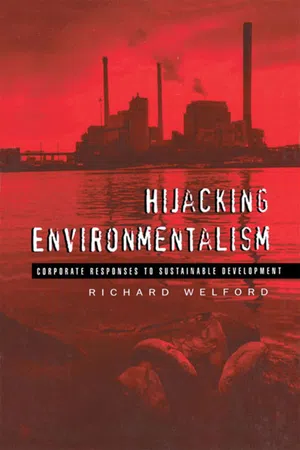
Hijacking Environmentalism
Corporate Responses to Sustainable Development
- 268 pages
- English
- ePUB (mobile friendly)
- Available on iOS & Android
eBook - ePub
About this book
This text demonstrates how businesses and institutions continue to operate outside the ecological carrying capacity of the environment, and highlights the need for participation and social innovation on their part. It asserts that senior executives and middle management in large corporations have often sought, deliberately or unconsciously, to block the advancement of environmentalism. Industry has reconstructed the more radical environmental agenda to suit its own purposes, in effect hijacking it, by taking it out of its traditional discourse and placing it in a liberal-productivist framework. The book concludes by examining the way forward for more sustainable business, presenting new models that place greater emphasis on issues such as equity and ethics.
Information
Defining the Problem
1
Introduction: What are we
Doing to the World?
Introduction: What are we
Doing to the World?
There can now be little doubt that the environmental damage caused to the planet over the last few decades has got to a point that it is causing untold damage to humans and to other species. Much of that damage is irreversible and the massive use of non-renewable resources has taken little account of the needs of future generations. The situation is getting worse, impacting on human health, biodiversity and the social infrastructure of many societies. There is now clear evidence of climate change and we are losing the areas of wilderness left on the planet at an alarming rate. Governments have demonstrated little real effort directed at reversing these trends, preferring to leave the task to the voluntary efforts of businesses, pressure groups, other non-governmental organisations and individuals.
We are now faced with a series of very tangible environmental crises. There is a serious water shortage across most of Africa, China, North America and now in parts of Europe. Global food security has declined with carryover grain stocks dropping to their lowest levels in twenty years between 1994 and 1995. Fish catches are in decline and in 1995 there was a shortfall of two million tons of rice (Brown 1995). Over 90 per cent of ancient forests in North America have been destroyed. We lose 25 billion tons of topsoil every year, the equivalent of all the wheat fields in Australia. This type of environmental unsustainability associated with continuously rising demand and a shrinking resource base now spills over into social and economic instability. Events in Rwanda, Somalia, Haiti and even former Yugoslavia have all been exacerbated by battles over access to basic resources. Human health is deteriorating and life expectancy rates in the poorest countries are in decline. The immune system of every unborn child in the world is now adversely and probably irrevocably affected by toxins in food, air and water.
How will we explain to future generations that we were responsible for all this destruction, knew it was happening and then did nothing about it? These critical losses are occurring while the world population is increasing by almost 100 million people per year. Business has to accept a very large share of the responsibility for this devastation and crisis. Businesses are central to a system which is destroying life on Earth and if we continue with this path not one area of wilderness, indigenous culture, endangered species, or uncontaminated water supply will survive the global market economy.
It is important to examine the system which has brought this about. The global economic system and its consequential unsustainable path is founded on the vestiges of modernism. This term has been used to distinguish the contemporary from traditional ways. It originally referred to the new civilization developed in Europe and North America over the last several centuries and fully evident by the early twentieth century. The models of economic development developed there have come to permeate the whole world along with the Western cultural domination which is inevitable in such a process. Modernism therefore saw new machine technologies and modes of industrial production that have led to an unprecedented rise in material living standards. The continuation of this process with an emphasis on output growth is what has become so unsustainable. This modernist Western tradition is therefore characterized by capitalism, a largely secular culture, liberal democracy, individualism, rationalism and humanism (Cahoone 1996). As a package, the modern Western model dominated by the domination of technology, science, industry, free trade, liberal productivism, neoclassical economics and a fixation with growth is certainly unique in human history. The results are easy to see: environmental destruction, anthropocentrism, the dissolution of community, the loss of individuality and diversity, the rise of alienation and the demise of tradition. Even notions of development are now simply equated with economic growth. As Shiva and Bandyopadhyay (1989) point out:
The ideology of the dominant pattern of development derives its driving force from a linear theory of progress, from a vision of historical evolution created in eighteenth and nineteenth-century Western Europe and universalised throughout the world, especially in the post-war development decades. The linearity of history, pre-supposed in this theory of progress, created an ideology of development that equated development with economic growth, economic growth with expansion of the market economy, modernism with consumerism, and non-market economies with backwardness.
Modernism, the continuation of what exists, translates into ’business as usual’. Business practices and current business education are failing us. They fail to recognize that the future will have to be very different if we are to avoid environmental and social conflict. Business seems content to see the natural system on the planet disintegrating, people starving and social structures falling apart. Business is central to the problem and must be central to the solution. There is no alternative but to change and many businesses would agree with that. The conflict is over the degree of change. To date most businesses who have begun to respond to environmental issues have done so in quite piecemeal and marginal ways. But tinkering with the system will not bring back the extinct species, donations for a prize to underpin a local environmental art competition will not cure the asthma of the painters, periodic environmental audits will not protect an indigenous population, green marketing will not replace slashed rainforests, and printing glossy annual environmental reports on recycled paper will certainly not rehabilitate thousands of square miles of dangerously contaminated land. Change has to be much more radical and much more speedy. Businesses do not like radical departures from what they know and understand. But such change is necessary and, ultimately, inevitable.
Currently, business stands at the edge of a precipice unsure about which way to turn. Its instincts tell it to stand fast and resist the risky path ahead. But it also recognizes that there is no turning back. Inevitably it is faced with an uncertain future and knows deep down that it will have to move forward into the unknown. At the moment however, it is hedging its bets by moving forward in minute steps, groping in the dark and doing everything it can to dictate the road ahead. Thus if the environment is to become centre stage, then business will want to make sure that it is its definition of the environment that we all settle on. Deeper green politics are not consistent with the other aspirations of business which will always be put before the environment.
Since there is very little analysis of what a business really is and what its place in society is (in terms of social responsibility and politics), so there is very little understanding of what it could become. And change is often resisted by shareholders, managers and others who are generally satisfied with the performance of their corporations. So many of us hold shares in large firms in one form or another and all too often pensions are based on profits and the security of our homes dependent on rising share prices. It is not surprising therefore that many people are frightened of ’rocking the boat’. Free-market capitalism is therefore not the great dynamic entity which its proponents espouse but actually creates a good degree of inertia to change. The single-minded emphasis on profit, efficiency, cost reduction and growth dwarfs issues such as employment, protection of the environment, social responsibility and sustainable development.
Businesses have yet to realize that continuation of present forms of industrial activity will simply bring about their own demise. After all, what use is profit accumulation when we are living in a decaying world? The wealthy may be able to build large fences around their property and employ security guards to keep the growing disenchanted out, but there is little they can do to clean up the air around them which is causing asthma in their children. Will industry still be happy with its lot when it has suppressed people’s immune systems to such a level that they are allergic to their products, or when their operation has become so efficient that there is no one left in work to purchase their output? When will the business world look at itself honestly and recognize that it is time to change? I suspect only after we have seen a wave of tangible disasters affecting the middle classes in the West. After all, nothing else really counts in the corporate culture.
Business stands at the edge of a massive potential transformation. Whether it grasps its new opportunities will largely dictate the extent to which humankind maintains its well-being. We are in the hands of large corporations who must be persuaded, cajoled or even forced to change. However, as will be demonstrated in further chapters of this book, few businesses have recognized the potential crisis, are committed to change or have any view at all about how to do business better. The reality is that corporations duck and dive, invest in smoke screens, hide behind science and technology and espouse gradualist, marginal solutions to societal pressures. Managers lack vision, are short on creativity, narrow in their outlooks and are driven by a naive model of the economic process. They can never admit this to themselves because that would threaten their very reason for being. Since they are successful, their narrow selfish outlook dictates that the system must be successful.
Many of us, as business educators, must share some of the blame for the inertia in business. It seems that we would rather teach our students how to read a balance sheet, how to forecast growth and how to avoid employment legislation than to know themselves and to understand, appreciate and protect the world around them. Surely, business education should be as much about personal and spiritual education as it is about the functional components of the modern industrial enterprise. I often toy with the idea that we should restructure our universities so that social work educators teach management students and management educators teach social work students. This just might result in a Pareto improvement. At the very least it would open up the minds of our future managers to the social and political ramifications of their actions and make them more sympathetic to the plight of other humans with which they share the world. At the moment they have such short-sighted, blinkered outlooks. Education is central to moving to a more sustainable economy and as a starting point Palmer (1992) lays out some basic requirements:
In an ideal situation, there would be immediate and massive expansion of environmental education at all levels, bearing in mind that education is no short-term process and that time is of the essence to the future of our planet. Such education must take account not only of the practical dimensions of sustainable lifestyles and development issues, but equally of differing values and ethical implications. A holistic understanding of natural systems and the place of human endeavour and concern within these would seem essential to the success of any policies aimed at leading the world in the direction of a sustainable future.
Business can and will have to be different. Hawken (1994) believes that we are on the verge of a transformation which will be brought about through social and biological forces that can no longer be ignored or put aside. This change will be so thorough and sweeping that business, in the future, will be unrecognizable when compared to the commercial institutions of today. That scenario is entirely possible but it is currently blocked by business itself which is risk averse and does not understand the nature of the changes occurring around it. At the moment their myopic planning cannot identify any real reason for change.
The development of capitalism with its emphasis on enterprise and private ownership has separated economics from ecology and created a dominant ideology which sees the monetary side of economics as more important than the real side. It is true that commerce has enriched countries and increased material standards of living but in so doing it has also created powerful individuals, ruling families and a corporate elite. Capitalism has pillaged the natural environment and businesses pick off the opportunities which this has created in a typical predatory manner. There is now, therefore, a dominant corporate culture which believes that natural resources are there for the taking and that environmental and social problems will be resolved through growth, scientific advancement, technology transfer via private capital flows, free trade and the odd charitable hand-out. It is undeniable that capitalism has been a great wealth creator because it has unlocked the potential to use basic natural resources and process them into valuable material objects. However, it is also undeniable that, because growth has been so rapid, current wealth is being generated by stealing it from future generations. How will future generations continue the process when there are no resources left? Can this be left to the ubiquitous free market system to sort out?
The free market purists are naive and dangerous people. They seem to have a blind belief in their system which left to its own devices is supposed to achieve the best social and environmental outcome possible. How this is possible, when such people even refuse to define what constitutes social and environmental improvement is puzzling. When Western values and Western life is implicitly seen as being more important than other alternatives, it is difficult to see an outcome which is at all sustainable, either politically or environmentally. The fact is that there are no simple solutions to our problems and that we are a long way off finding any system which can reverse long term environmental degradation and mounting social chaos. But as a starting point businesses can recognize that everything they do has an ethical dimension. Business is only one part (albeit an important part) of a world which is complex, interwoven and cannot be simplified by models of rational economic behaviour. Current business practices seem to be guided by a vague promise that we can continue to increase our standards of living, that the developing world can attain developed world aspirations and that science and technology will come to the rescue and clean up the destruction which we have caused. This is not the case. If we can simply recognize this fact then at least we have a starting point for discussion.
One of the most important lessons we must learn is that the major problems of our time are all interconnected. Individual problems cannot be dealt with in isolation, we must think systemically about the systems and structures which lead to all the problems around us. Take world population, for example. We are not going to be able to stabilize it until we are able to alleviate hunger and poverty. Similarly we are not going to be able to stop the extinction of species until we are able to help the developing world get rid of its huge economic debts. These problems are all interrelated and interlinked and we need to improve our perception of the world in terms of relatedness, interdependence and context.
The emphasis put on science and technology is one of the more damaging aspects of the dominant corporate culture. Reality goes far beyond any scientific framework to a more intuitive awareness of the oneness of all life, the interdependence of its multiple manifestations and its cycles of change and transformation. Moreover, the common Western vision of a mechanized world has created a giant chasm between economic development (normally defined in narrow output growth terms) and the individual’s spiritual nature. This is reinforced by the increasing alignment of our institutions with money and markets. The more dominant money has become in our societies, the less room there has been for any sense of spiritual bond that is the foundation of community and a balanced relationship with nature. The world of money and its associated materialistic greed has pushed out the spiritual meaning in our lives to such an extent that you, the reader, may well be thinking now that although my arguments to this point have seemed plausible, to start talkin...
Table of contents
- Cover
- HalfTitle
- Title Page
- Copyright Page
- Dedication
- About the author
- Table of contents
- Preface
- About the Contributors
- List of Figures
- List of Tables
- Part 1 Defining the Problem
- Part 2 Underlying Tensions
- Part 3 Searching for solutions
- Index
Trusted by 375,005 students
Access to over 1.5 million titles for a fair monthly price.
Study more efficiently using our study tools.
Frequently asked questions
Yes, you can cancel anytime from the Subscription tab in your account settings on the Perlego website. Your subscription will stay active until the end of your current billing period. Learn how to cancel your subscription
No, books cannot be downloaded as external files, such as PDFs, for use outside of Perlego. However, you can download books within the Perlego app for offline reading on mobile or tablet. Learn how to download books offline
Perlego offers two plans: Essential and Complete
- Essential is ideal for learners and professionals who enjoy exploring a wide range of subjects. Access the Essential Library with 800,000+ trusted titles and best-sellers across business, personal growth, and the humanities. Includes unlimited reading time and Standard Read Aloud voice.
- Complete: Perfect for advanced learners and researchers needing full, unrestricted access. Unlock 1.5M+ books across hundreds of subjects, including academic and specialized titles. The Complete Plan also includes advanced features like Premium Read Aloud and Research Assistant.
We are an online textbook subscription service, where you can get access to an entire online library for less than the price of a single book per month. With over 1.5 million books across 990+ topics, we’ve got you covered! Learn about our mission
Look out for the read-aloud symbol on your next book to see if you can listen to it. The read-aloud tool reads text aloud for you, highlighting the text as it is being read. You can pause it, speed it up and slow it down. Learn more about Read Aloud
Yes! You can use the Perlego app on both iOS and Android devices to read anytime, anywhere — even offline. Perfect for commutes or when you’re on the go.
Please note we cannot support devices running on iOS 13 and Android 7 or earlier. Learn more about using the app
Please note we cannot support devices running on iOS 13 and Android 7 or earlier. Learn more about using the app
Yes, you can access Hijacking Environmentalism by Richard Welford in PDF and/or ePUB format, as well as other popular books in Politics & International Relations & Ecology. We have over 1.5 million books available in our catalogue for you to explore.