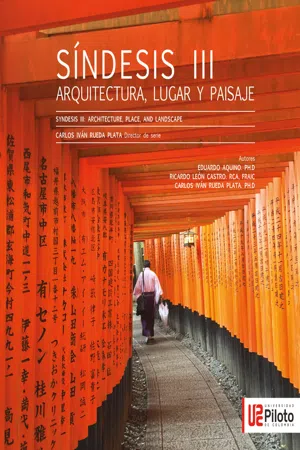
"El proyecto investigativo general de Síndesis busca abrir horizontes en los procesos metodológicos para la creación de obras arquitectónicas y proyectos de lugar y, de forma correlacionada, también para ofrecer estrategias de interpretación o re-creación por conducto de la crítica. De esta forma, la crítica retroalimenta la obra y la obra, a su vez, estimula la crítica en un proceso re-creativo que, más que circular, yo lo ilustraría como una espiral." "En esta edición de Síndesis III, se ha vinculado al proyecto el profesor Eduardo Aquino, con un capítulo en el que desarrolla una propuesta original sobre una condición de entornoplaya, no necesariamente re- lacionada con la playa como tal, en un sentido geográfico literal, sino concebida como espacio público cualitativo y lugar para el ocio crea- tivo, tan necesario para una sociedad contemporánea." "Ricardo L. Castro retorna a esta serie con un ensayo en el cual, du- rante un peregrinaje personal anual, lanza una mirada sindética desde Delfos. Allí encuentra un sinnúmero de relaciones con sus experiencias de la Capilla Campestre del Hermano Klaus diseñada por Peter Zumthor en el sur de Colonia, Alemania. La experiencia física, la "inmediatez del lugar", término acuñado por el propio Castro, combinada con la inmediatez conceptual y cultural con el "locus", sirven para entender y poder intervenir en el lugar (ya sea por medio del diseño, la escritura, la música) en una forma apropiada y contribuyen a un desarrollo del manuscrito en forma típicamente sindética." "Mi texto para Síndesis III, retoma el ejemplo ya explorado por Castro, la Capilla Bruder Klaus, para desarrollar una tesis al respecto de la relevancia que tiene la intencionalidad en el proceso creativo, e inter- pretación de la arquitectura, con orientación fenomenológica. El texto en sí es sindético, pues pone juntas — o hace una síndesis de— teorías que provienen de la literatura, la filosofía, y la arquitectura. La tesis puntual de este capítulo se centra en mostrar qué, con "instrucciones del autor" en la Capilla Bruder Klaus, Zumthor celebra los rituales poéticos de la construcción misma de la obra. La capilla se convierte" "entonces en un memorial poético de su propia construcción."
eBook - ePub
Sindesis III
Arquitectura, lugar y paisaje
- English
- ePUB (mobile friendly)
- Available on iOS & Android
eBook - ePub
About this book
Information
Topic
ArchitetturaSubtopic
Architettura generale A GAZE FROM DELPHI:BRUDER KLAUS FIELD CHAPEL |
One’s destination is never a place, but a new way of looking at things.
Henry Miller (1957)
PROLOGUE
Three interconnected ideas will unfold in this essay. They were previously introduced in different types of publications, namely a graduate thesis, a journal essay, and two chapters, published respectively in the first two issues of this series (Castro, Mellin, & Rueda, 2013; Castro et al, 2015). They appeared within a large temporal span; forty-two years, to be precise. The critical strategies, which spin off from those works seem to be appropriate at this time as elements of a syndetic analysis focusing on a modest, but undoubtedly one of the most relevant buildings erected in this century: Bruder Klaus Feld Kapelle (Brother Klaus Field Chapel), designed and built between 2001-2007 by Swiss architect Peter Zumthor, near the village of Wachendorf, in the Maechernich Region of Southern Germany.
The first concept is that of “gaining historical immediacy.” I believe that this premise should always be one of the designer’s integral and indispensable strategies in order to confront and resolve design tasks in a given place.1
Historical immediacy, consists ultimately in the knowledge of the cultural baggage, the aura resulting from the history, in all its dimensions, myths, hearsay, material elements, architecture, and topography (landscape), as it were, that exist in any given place. In the past, various kinds of narratives and imagery have helped in gaining this condition. Today the possibilities have multiplied with the tools available through the digital revolution.
However, despite what has just been suggested, I also believe that the physical immediacy acquired by confronting a place is an indispensable complement to historical or cultural immediacy. Physical immediacy, simply put, is the rapport gained by experiencing a place syn-aesthetically, over time. This relationship is defined by psychologist Kurt Lewis as a “hodological space”, a “space of possible movement” or life-space, as concretized in paths as “life-spaces” (Castro, 1999)2.
Attempting to gain physical and cultural immediacy with a place, seems to be an appropriate inquiry to nurture a syndetic understanding of such a place. This brings to mind the magnificent narratives written by the late W.G. Sebald, particularly in The Rings of Saturn (1998), which describes his ambulation along the coast of South East Anglia.3 Through this walk, complemented with uncanny photographs and illustrations, Sebald brings to light local and universal historical events. As he ironically points out:
Now, as I write, and think once more of our history, which is but a long account of calamities, it occurs to me that at one time the only acceptable expression of profound grief, for ladies of the upper classes, was to wear heavy robes of black silk taffeta or black crêpe de chine. (p. 296)
And a few lines after, marking the end of the book:
And Sir Thomas Browne, who was the son of a silk merchant and may well have had an eye for these things, remarks in a passage of the Pseudodoxia Epidemica that I can no longer find that in the Holland of his time it was customary, in a home where there had been a death, to drape black mourning ribbons over all the mirrors and all canvasses depicting landscapes or people or the fruits of the field, so that the soul, as it left the body, would not be distracted on its final journey, either by a reflection of itself or by a last glimpse of the land now being lost forever. (p. 296)
In an elucidating article, the incisive New Yorker critic, André Aciman (2016), succinctly describes Sebald’s unique and remarkable approach to literature, or is it biography, travel writing, criticism... or all of them? They are always complemented with visual imagery:
As a writer, Sebald had invented an arcane aesthetic by cobbling together things imagined and things recalled; his essays and novels challenge the idea that facts hold a greater claim to truth than misremembered faces, overlooked details or overheard gossip.
...
Photographs also play a key role in all of Sebald’s books, casting an aura of documentation and verisimilitude on the narrative, and yet they are also vague and unreliable. Blurry images and illegible handwritten notebooks emphasize the imminent extinction of objects, people, places, or buildings that are already, or perhaps always were, on their way out. (Aciman, 2016)
In architectural terms, ...
Table of contents
- Portada
- Portadilla
- Créditos
- Autores
- AGRADECIMIENTOS
- Acknowledgements
- Tabla de Contenido
- ESTUDIO INTRODUCTORIO
- DIBUJAR LA PLAYA:
- EXPERIENCIA AUMENTADA
- UNA MIRADA DESDE DELFOS:
- INTRODUCTORY STUDY
- DRAWING THE BEACH: BOUNDARY DEFORMING IN THE CONFLUENCE OF ART, ARCHITECTURE, AND LANDSCAPE
- ENHANCED EXPERIENCE BY “AUTHORIAL INSTRUCTION”: THE BRUDER KLAUS CHAPEL BY PETER ZUMTHOR
- A GAZE FROM DELPHI: BRUDER KLAUS FIELD CHAPEL
- REFERENCIAS
Trusted by 375,005 students
Access to over 1.5 million titles for a fair monthly price.
Study more efficiently using our study tools.
Frequently asked questions
Yes, you can cancel anytime from the Subscription tab in your account settings on the Perlego website. Your subscription will stay active until the end of your current billing period. Learn how to cancel your subscription
No, books cannot be downloaded as external files, such as PDFs, for use outside of Perlego. However, you can download books within the Perlego app for offline reading on mobile or tablet. Learn how to download books offline
Perlego offers two plans: Essential and Complete
- Essential is ideal for learners and professionals who enjoy exploring a wide range of subjects. Access the Essential Library with 800,000+ trusted titles and best-sellers across business, personal growth, and the humanities. Includes unlimited reading time and Standard Read Aloud voice.
- Complete: Perfect for advanced learners and researchers needing full, unrestricted access. Unlock 1.5M+ books across hundreds of subjects, including academic and specialized titles. The Complete Plan also includes advanced features like Premium Read Aloud and Research Assistant.
We are an online textbook subscription service, where you can get access to an entire online library for less than the price of a single book per month. With over 1.5 million books across 990+ topics, we’ve got you covered! Learn about our mission
Look out for the read-aloud symbol on your next book to see if you can listen to it. The read-aloud tool reads text aloud for you, highlighting the text as it is being read. You can pause it, speed it up and slow it down. Learn more about Read Aloud
Yes! You can use the Perlego app on both iOS and Android devices to read anytime, anywhere — even offline. Perfect for commutes or when you’re on the go.
Please note we cannot support devices running on iOS 13 and Android 7 or earlier. Learn more about using the app
Please note we cannot support devices running on iOS 13 and Android 7 or earlier. Learn more about using the app
Yes, you can access Sindesis III by Carlos Iván, Rueda Plata, Aquino Eduardo, Castro Ricardo in PDF and/or ePUB format, as well as other popular books in Architettura & Architettura generale. We have over 1.5 million books available in our catalogue for you to explore.