La pregunta inicial que motivó esta compilación de textos era simplemente entender qué significaba ser indígena en diferentes periodos y en dos contextos nacionales, en principio muy diferentes en términos demográficos y en su manera de gestionar a las poblaciones autóctonas, como lo son México y Argentina. Sin embargo, el resultado comprende ahora una variedad de contextos regionales y nacionales de América Latina, aun si los ejemplos de esos dos países siguen siendo mayoritarios. Este eje general de análisis puede declinarse en preguntas más específicas: ¿ser identificado o identificarse a sí mismo como indígena ha tenido siempre el mismo significado? ¿Esta categoría de identificación ha designado siempre a las mismas personas, los mismos atributos o las mismas prácticas? En otras palabras, ¿el referente social que corresponde al término «indígena» es estable y fijo? ¿O se trata, más bien, como sugiere nuestra hipótesis, de un referente móvil, cambiante e histórico? ¿Mediante qué procesos este posicionamiento se ha llenado de los contenidos sociológicos que hoy nos resultan familiares? Los autores de los textos reunidos en este volumen aceptaron formular estas interrogantes en sus campos de estudio específicos, que cubren diferentes periodos y objetos de estudio, entre el periodo de las independencias y la primera mitad del siglo xx.
eBook - PDF
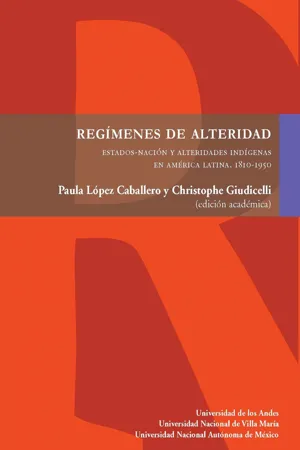
Regímenes de alteridad. Estados-nación y alteridades indígenas en América Latina, 1810-1950
Estados-nación y alteridades indígenas en América Latina, 1810-1950
- 331 pages
- English
- PDF
- Available on iOS & Android
eBook - PDF
Regímenes de alteridad. Estados-nación y alteridades indígenas en América Latina, 1810-1950
Estados-nación y alteridades indígenas en América Latina, 1810-1950
About this book
Information
Subtopic
World HistoryIndex
HistoryTable of contents
Trusted by 375,005 students
Access to over 1.5 million titles for a fair monthly price.
Study more efficiently using our study tools.
Frequently asked questions
Yes, you can cancel anytime from the Subscription tab in your account settings on the Perlego website. Your subscription will stay active until the end of your current billing period. Learn how to cancel your subscription
No, books cannot be downloaded as external files, such as PDFs, for use outside of Perlego. However, you can download books within the Perlego app for offline reading on mobile or tablet. Learn how to download books offline
Perlego offers two plans: Essential and Complete
- Essential is ideal for learners and professionals who enjoy exploring a wide range of subjects. Access the Essential Library with 800,000+ trusted titles and best-sellers across business, personal growth, and the humanities. Includes unlimited reading time and Standard Read Aloud voice.
- Complete: Perfect for advanced learners and researchers needing full, unrestricted access. Unlock 1.5M+ books across hundreds of subjects, including academic and specialized titles. The Complete Plan also includes advanced features like Premium Read Aloud and Research Assistant.
We are an online textbook subscription service, where you can get access to an entire online library for less than the price of a single book per month. With over 1.5 million books across 990+ topics, we’ve got you covered! Learn about our mission
Look out for the read-aloud symbol on your next book to see if you can listen to it. The read-aloud tool reads text aloud for you, highlighting the text as it is being read. You can pause it, speed it up and slow it down. Learn more about Read Aloud
Yes! You can use the Perlego app on both iOS and Android devices to read anytime, anywhere — even offline. Perfect for commutes or when you’re on the go.
Please note we cannot support devices running on iOS 13 and Android 7 or earlier. Learn more about using the app
Please note we cannot support devices running on iOS 13 and Android 7 or earlier. Learn more about using the app
Yes, you can access Regímenes de alteridad. Estados-nación y alteridades indígenas en América Latina, 1810-1950 by Paula López Caballero, Cristophe Giudicelli in PDF and/or ePUB format, as well as other popular books in History & World History. We have over 1.5 million books available in our catalogue for you to explore.