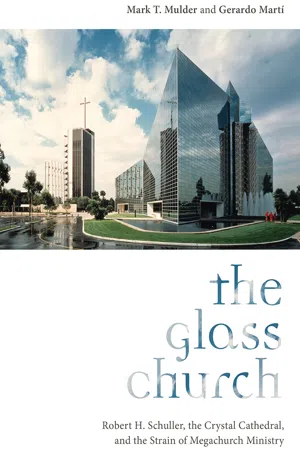
Robert H. Schuller's ministry—including the architectural wonder of the Crystal Cathedral and the polished television broadcast ofHour of Power—cast a broad shadow over American Christianity. Pastors flocked to Southern California to learn Schuller's techniques. The President of United States invited him sit prominently next to the First Lady at the State of the Union Address. Muhammad Ali asked for thepastor'sautograph. It seemed as if Schuller may have started a second Reformation. And then it all went away. As Schuller's ministry wrestled with internal turmoil and bankruptcy, his emulators—including Rick Warren, Bill Hybels, and Joel Osteen— nurtured megachurches that seemed to sweep away the Crystal Cathedral as a relic of the twentieth century. How did it come to this?
Certainly, all churches depend on a mix of constituents, charisma, and capital, yet the size and ambition of large churches like Schuller's Crystal Cathedral exert enormous organizational pressures to continue the flow of people committed to the congregation, to reinforce the spark of charismatic excitement generated by high-profile pastors, and to develop fresh flows of capital funding for maintenance of old projects and launching new initiatives. The constant attention to expand constituencies, boost charisma, and stimulate capital among megachurches produces an especially burdensome strain on their leaders. By orienting an approach to the collapse of the Crystal Cathedral on these three core elements—constituency, charisma, and capital— The Glass Church demonstrates how congregational fragility is greatly accentuated in larger churches, a notion we label megachurch strain, such that the threat of implosion is significantly accentuated by any failures to properly calibrate the inter-relationship among these elements.
Schuller preaching from atop the concession stand at the Orange Drive-in. Photo courtesy of the Joint Archives of Holland.
1
Constituency, Charisma, and Capital
I’d rather attempt to do something great and fail than to attempt to do nothing and succeed.
—Robert H. Schuller
September 14, 1980, brought yet another beautiful Sunday mornings in Southern California. The sun glinted off automobiles backed up in Garden Grove on Chapman Avenue and Lewis Street for the dedication of the new church building. The staccato static of walkie-talkies echoed off 10,000 panes of glass from the twelve-story-tall Crystal Cathedral as more than two dozen attendants attempted to efficiently solve the placement of so many cars into the parking lot puzzle. Rows of congregants in overflow-seating filled the courtyard outside the sanctuary and quietly conversed over the burbling water from “The Fountains of the 12 Apostles.” On the opposite side of the building, two eighty-foot doors silently slid open to reveal the interior of the sanctuary to an eager audience outside who preferred to attend the service from the comfort of their car, a custom cultivated since the first days of the ministry when it had been located at a drive-in theater.1
The Reverend Robert H. Schuller had planned a formal, dramatic entry, but his excitement proved too much—he moved to the chancel in his light blue vestment to bear witness as the congregation found their seats. Just prior to the start of the service, a lone woman “emerged from the massive crowd” to “reach out and touch” the minister and experience Schuller’s charisma firsthand. Gaining his attention, she gushed, “Dr. Schuller, my name is on a window in this cathedral. I now feel as if I’m somebody! I now know that I made a difference! I live on a small income, but my tithe paid off a window in two years!”2 She had joined the ranks of thousands of donors across the country and throughout the world who subsidized the construction of the cathedral—from $500 window purchases to $1,000,000 gifts.
Aerial cameras above the cathedral captured the magnitude of the star-shaped 414-foot-long church. Inside the building, television equipment streamed the start of the service; a trumpet fanfare, as if heralding a royal court, introduced the first thunderous chords of the custom-designed Hazel Wright organ.3 A short hymn later, Schuller strode to his massive marble pulpit and boomed his signature salutation, “This is the day the Lord has made; let us rejoice and be glad in it!” The minister described this moment, the official opening of his first cathedral service, as the point when he “finally crested the mountaintop.”4
After a brief greeting and only four minutes into the service, Schuller took care of business: critics had been grousing about the exorbitant cost of construction, and those in attendance and watching on television needed assurance. Would the cathedral be dedicated debt-free? In a grand and celebratory tone, the minister reported that the board had met the day before and had, in fact, instructed him to announce the good news. And lest anyone mistakenly assume that the board was simply comprised of a few local church volunteers, Schuller slowly called out—and the cameras found—every single board member, titans of banking, industry, insurance, and philanthropy, just like this:
Richard DeVos, president of the Amway Corporation;
Beurt Ser Vaas from Curtis Publishing Company in Indianapolis;
George Johnson, president of the Johnson Products Company in Chicago, Illinois;
Henry Block of the Block Brothers Firm in Canada;
Victor Andrews from Southern California;
Vern Draagt from our own church board;
John Crean, chairman of the board from Fleetwood Enterprises;
Lowell Berry of the Lowell Berry Foundation in San Francisco;
Ron Glosser, president of the Goodyear Banks in Akron, Ohio;
Bill Bailey from the legal firm in Boston, Massachusetts who, incidentally, along with his brother F. Lee Bailey, have presented to us our new pulpit bible and we’re very grateful;
Charles Cringle, senior partner of Cringle, Swift, and Grimley, Southern California’s prestigious accounting firm.
Having identified each board member, each one with a serious expression and wearing suit and tie, Schuller conveyed their message: “After they reviewed the entire Crystal Cathedral financial picture, they drafted the following resolution and have asked me to read it to you: ‘We are able to dedicate this Crystal Cathedral this morning to the glory of God with the total cost covered by cash received, pledges and promises in hand, from beautiful and responsible people. Praise God!’ ”5 Later in the service, Schuller’s son, Robert A. Schuller, read notes of congratulations sent from the U.S. president, Jimmy Carter, and former governor of California Ronald Reagan; in the midst of a presidential campaign against each other, the two candidates made it a priority to publicly demonstrate their close connection to one of the country’s premier ministers.6
A Church Empire, Skillfully Managed
By displaying his grandest building project, magnificently concluded and ostensibly paid for, Schuller proudly exhibited how he had skillfully braided together the core resources of his impressive ministry—constituency, charisma, and capital—into the premier megachurch in America. He appealed to an audience associated with achievement: younger, mostly white, upwardly mobile, middle-class families, drawn to Orange County for economic opportunity and happy to be aligned with men like Schuller and his high-profile board members. The telegenic cathedral, nothing less than a “religious landmark,” embodied the “flush times of Southern California’s Orange County” and a “physical representation of the limitless hope of the evangelical community at the time.”7 The building also testified to Schuller’s charisma of openness, positivity, and transparency—a bold monument of strength and stability charging into a confident future.
Schuller had originally arrived in Garden Grove, California, in 1955. To that point, the minister had spent his entire life in the Midwest: from Iowa to Michigan and then to Illinois. His migration to Orange County to plant a congregation for his denomination, the Reformed Church in America (RCA), serendipitously coincided with a larger tilt of the country to the Sun Belt.8 In Southern California, Schuller found a recently migrated, economically aspiring, and white middle class eager to hear his messages based on “Possibility Thinking” and his “Theology of Self-Esteem.” When the latter half of the twentieth century brought the rise of high-profile religious men (Billy Graham, Oral Roberts, Jim Bakker, Jerry Falwell, and more), Schuller carved a strategically postured identity that gave him wide appeal. The minister exuded a dynamic charisma. He knew how to raise money and execute successful building projects. His church and television ministry grew dramatically.
Success capitalized on success, and Schuller created a ministry empire. On the surface, it appeared that Schuller had created an unassailable religious industrial complex through skillful management. Every week he appeared on the Sunday morning television broadcast of Hour of Power. Thousands of church leaders made the pilgrimage to Orange County to learn the master’s principles of church management at the Robert H. Schuller Institute for Successful Church Leadership. And the campus he built around Garden Grove Community Church (GGCC) featured world-class architecture. In discussing Schuller’s landmark capital project, the Crystal Cathedral, one architectural critic remarked that the Orange County minister already had “the low-rent preachers, the Swaggarts, and the Bakkers” largely beaten. The opening of the cathedral, though, “left them for dead, like the greasy spoons trying to compete against the confidence of the McDonald’s-style fast-faith corporate steamroller.”9 Capital projects had always injected the ministry with stature and vitality, “leapfrogging Schuller over the heads of his rivals in the increasingly competitive world of televangelism.”10
Empires, though, need to be fed. Schuller sought to nourish the many branches of his empire with an unremitting emphasis on recurring high-profile projects. Early on, Schuller decided that people only gave money to successful causes—success “feeds on the image of success,” he insisted.11 In 1967 he wrote, “Nothing succeeds like success” and “No one likes to follow a loser.”12 Much like a Madison Avenue executive, Schuller concluded that the reputation of his Southern California ministry would drive growth, so the minister decided that his ministry would always be projected as a success—no matter the cost or vulnerability that it might entail. The argument has been made that Schuller himself “introduced marketing to American Christianity.”13 In appealing to a broad audience, Schuller had to assure his followers of the charismatic legitimacy of his methods. Schuller showcased from his pulpit the ability to manage his grand church as a business to millions of people weekly on television, which, in turn, diffused his congregational practices to emulators, offering a trailblazing path for “pastorpreneurs.” The spectacular building where he preached before the earnest faces of his members, the Crystal Cathedral, regularly attested to his credibility as a master of growth.
The “gospel of growth” that characterized Schuller’s ecclesial approach of more people, more buildings, and more audience, of course, has been an enduring characteristic of evangelicalism in the United States. By definition, evangelicalism emphasizes numeric growth through conversions and, therefore, champions practices that best ensure a “constant harvest,” “continual increase,” and “expanding churches.”14 Yet the American evangelical megachurch—a set of congregational characteristics that emerged alongside big-box stores, McMansions, supersized meals, and SUVs—became a manifestation of a religious imperative especially fixated on constant, ongoing, and ever expansive growth.15 Schuller’s Orange County ministry charted a formidable path in demonstrating how to achieve steadfast and dependable church growth. In the process, the minister’s approach necessitated a never-ending quest for always broadening the scope of the ministry, always a bit more room (more chairs, more buildings, more parking) for the imagined future attenders who had not yet arrived.
In Schuller’s vision, a church’s capacity must always exceed a leader’s projected plan for growth. But as new members arrive, they multiply the diversity of interest groups that must be satisfied, and pastoral messages and ministry programs need to placate more felt needs, placing increasing strain on mobilizing and engaging the loyalty of a wider constituency. Ensuring the credibility for pastoral charisma requires ever expanding infrastructure,16 which involves increased funding for buildings, programs, and staff. In a continually growing church, these all continue to spiral expansively outward as long as the resources of the ministry can sustain it.
Megachurch Strain
The final sale of all properties comprising the Crystal Cathedral Ministries to the Roman Catholic Diocese of Orange in 2012 represented the symbolic conclusion of a ministry that had spanned more than fifty years. With so much success in meeting growth expectations for so long, why did the ministry implode so quickly and so decisively? Writing to the pastors and leaders of his denomination in 1968, Schuller advised them to “always have something, a new challenge”—revealing the core principle that set the rails of his ministry agenda.17 Over his long ministry career, the end of one major project signaled the time to initiate a new plan for capital injection. Although he positioned himself as a real estate developer, constantly expanding the church grounds to house more people, the unending string of projects was designed to motivate the flow of fresh capital. Schuller always believed in—and maintained a remarkable transparency about—his strategy of letting his people know that there would always be a need for more money than he had already secured. His campaigns promoted large, idealized projects as concrete needs, all set to be realized in a not-too-distant future.
In 1975, as Schuller ramped up his pitch for the construction of the Crystal Cathedral, he officially described his “philosophy toward capital.” He approached the church as a “dynamic business for God” that “would require cash” in order to continually grow. Growth was the goal. Rather than rest on wishful thinking, Schuller planned and enacted the financing of growth, borrowing funds to accommodate a rise in members who would eventually contribute revenue to be used to pay off loans. It was a strategy of rapid growth through aggressive financing. His “philosophy toward growth” appeared in a document that also articulated Schuller’s “philosophy of capital debt”—a label that was not only more accurate but also consequential to the burden the founder intentionally placed on his ministry. In describing it, Schuller restated his central strategy, one that he said was present throughout his ministry: a commitment to borrow as m...
Table of contents
Cover
Series Page
Title Page
Copyright
Dedication
Epigraphs
Contents
Preface
Significant Dates for Robert Schuller and U.S. Politics, 1945–2015
1. Constituency, Charisma, and Capital
2. The Imperative of Church Growth
3. Migrants to Orange County, California
4. The Possibility Thinker
5. No Hippies in the Sanctuary
6. Dig a Hole, Schuller
7. Always a New Project
8. When the Glass Breaks
Coda: Ends and Beginnings
Appendix: Research Methodology
Notes
Bibliography
Index
Trusted by 375,005 students
Access to over 1.5 million titles for a fair monthly price.
Study more efficiently using our study tools.
Frequently asked questions
Yes, you can cancel anytime from the Subscription tab in your account settings on the Perlego website. Your subscription will stay active until the end of your current billing period. Learn how to cancel your subscription
No, books cannot be downloaded as external files, such as PDFs, for use outside of Perlego. However, you can download books within the Perlego app for offline reading on mobile or tablet. Learn how to download books offline
Perlego offers two plans: Essential and Complete
Essential is ideal for learners and professionals who enjoy exploring a wide range of subjects. Access the Essential Library with 800,000+ trusted titles and best-sellers across business, personal growth, and the humanities. Includes unlimited reading time and Standard Read Aloud voice.
Complete: Perfect for advanced learners and researchers needing full, unrestricted access. Unlock 1.5M+ books across hundreds of subjects, including academic and specialized titles. The Complete Plan also includes advanced features like Premium Read Aloud and Research Assistant.
Both plans are available with monthly, semester, or annual billing cycles.
We are an online textbook subscription service, where you can get access to an entire online library for less than the price of a single book per month. With over 1.5 million books across 990+ topics, we’ve got you covered! Learn about our mission
Look out for the read-aloud symbol on your next book to see if you can listen to it. The read-aloud tool reads text aloud for you, highlighting the text as it is being read. You can pause it, speed it up and slow it down. Learn more about Read Aloud
Yes! You can use the Perlego app on both iOS and Android devices to read anytime, anywhere — even offline. Perfect for commutes or when you’re on the go. Please note we cannot support devices running on iOS 13 and Android 7 or earlier. Learn more about using the app
Yes, you can access The Glass Church by Mark T. Mulder,Gerardo Martí in PDF and/or ePUB format, as well as other popular books in Theology & Religion & North American History. We have over 1.5 million books available in our catalogue for you to explore.