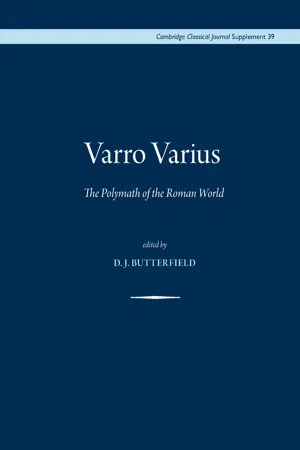
Rome produced no man more erudite, eclectic, and energetic than Marcus Terentius Varro (116-24 BC). Over a long and busy life, set against the backdrop of near-constant social and political upheaval, Varro studied and codified almost every conceivable topic for intellectual enquiry. His vast output – of at least seventy works in over 600 books – is breathtaking in its range and ambition: antiquity (in all its aspects), language, literary history, theology, philosophy, sociology, agriculture, geography, music, mathematics – to say nothing of his own poetic and satirical writings. In many of these fields Varro redefined the terms of study for the Roman world (and beyond); in some he founded a scholarly discipline and tradition without any precedent. Yet the greatest scholar of Rome has rarely enjoyed the attention he deserves from the modern world: although the fragmentary state of much of his corpus presents serious obstacles to enquiry, the extant material provides a rich and unparalleled insight into Roman scholarship of the first century BC. This volume of new essays on Varro seeks to analyze this multifaceted polymath from several angles, not only revisiting his better known writings and the problems they raise but also reconstructing his intellectual activity and its influence on the basis of insufficiently examined evidence.
- 228 pages
- English
- ePUB (mobile friendly)
- Available on iOS & Android
eBook - ePub
About this book
Information
Subtopic
Roman Ancient HistoryIndex
HistoryII
VARRO ON ROME
4 Varro’s Romespeak: De lingua Latina
Diana Spencer
What is Varro’s De lingua Latina for?1 Manuals and handbooks operate variously as DIY guides, as gatekeepers (signals of immanent complexity or specialist knowledge), as interpretative gambits and as aspirational documents of culture. This paper explores Varro’s ruinous monument to Latin, and proposes some answers to my blunt opening question.
De lingua Latina is a quirky text.2 It offers an idiosyncratic take on what Latin is, and it is also a work which exhibits the lively eccentricities of an adept antiquarian; but Varro was not simply a man of letters, and his acute nose for politics (and for survival) informs everything he says about how Romans say everything – hence this paper’s coinage, after Orwell’s ‘Doublethink’ and ‘Newspeak’: ‘Romespeak’.3 I propose De lingua Latina as a work for reading-through, so this paper samples places where the extant text’s narrative sinews are most vividly and rewardingly available. Each reading act performs a personal and acculturated translation and interpretation: indeed this is the very definition of literariness in a text. To understand what is at stake I am interested, ultimately, in teasing out how (by juxtaposition, by association, by connotation) the etymologies on parade authorise and enable the vitality of possible interpretative processes, articulating a richness and polyvalence for available Latin discourse refracted by one of Rome’s greatest scholars.
Reading De lingua Latina like a book allows multiple tiny stories (arcs) to coalesce, but this is not a straightforwardly linear narrative. Instead, we are introduced to an associatively mapped language-labyrinth, meandering toward a position on the deeply resonant politics of being in command of Latin, and identifying oneself as Roman.
So Varro On Latin is, also, no ‘random’ or hotchpotch sequence of grammatical and linguistic excursuses.4 It is (rather like his metaphor of the linguist as pathfinder, in Book 55) an exercise in generating meaning lodged in a shifting and historically charged, but also basic, principle of human existence: communication. Here, as Varro almost puts it, each individual is both scenery in someone else’s forest, and the protagonist in his own action-hero story. Language, used incisively and astutely, with the assistance of an expert guide, helps to police the best possible world for the reader-turned-speaker. Informed control over language is empowering, and it also offers a way of thinking about how and why particular groups of people unpack and organise their shared narratives and forms of expression in distinctive ways.6 There is not one answer to the question of what this text is for, but exploring its narrative qualities allows a vivid and quirky take on speaking as a Roman to emerge.
Speech is at the heart of De lingua Latina, and a deeply embedded conversation between Varro and Cicero is always a backbeat. This is a work which adds grit to their relationship – its apparent looseness in narrative momentum being offset by the overarching formal structure imposed by Varro.7 Glancing back to Cicero’s famous characterisation of Varro’s antiquarian achievements we get a tantalising glimpse of the discursive hookup between speech and narrative that Varro’s formidable body of writing commanded:
tum ego, ‘sunt’, inquam, ‘ista Varro. nam nos in nostra urbe peregrinantis errantisque tamquam hospites tui libri quasi domum deduxerunt, ut possemus aliquando qui et ubi essemus agnoscere.’ (Cic. Acad. 1.9)
Then I commented ‘Yes, that’s the case, Varro. For when we were in our very own city yet still wandering and straying as if strangers, it was your books, so to speak, that led us home, so that we were at last able to recognise who and where we were.’
In Cicero’s vision, here, Varro has apparently been guiding Romans to scrutinise the signs by which they live.8 Moreover, with Varro as pathfinder Rome is transformed into a city of readers (of Varro), who through the world of Varronian text learn to narrate themselves. As Owen Flanagan neatly puts it: ‘[humans] are inveterate story tellers … a narrative conception of the self is the “essential genre” of self-representation … A self is just a structured life.’9 Adding a late Republican Roman flavour, read ‘a self is a life constructed consciously through engagement in public discourse’. To tell and respond meaningfully to Roman stories, one needs the code, and the code-book.
This paper starts by investigating some of Varro’s own opening authorial gambits, and then moves on to pursue how sample plotlines emerge and encourage associative completion to deliver unexpected payoffs. Sections on ‘authority’ and ‘storytelling’ set up discussions of ‘action’ and ‘memory’. Retrojective vitality is, I suggest, central to the etymologophile’s long view; the development of a sense of historicity for language might be a dry and unlovely project without an eloquent mnemonic armature to give the work permanence, and, indeed, to embed its verbal networks in a cultural milieu. In this case, the construction (of narrative sense) is memorably hard graft, and makes heavy demands on readers’ associative patterning and memory.10
Reading for the poetics of language is, of course, a seriously valuable programme; writing on literary form, Kenneth Burke observed that this kind of reading transcends straightforward signification, embodying in a word (or phrase) ‘an implicit program of action’.11 Varro’s powerfully miscellaneous mode might just be, therefore, the ultimate self-fashioning tool, because without an explicit, coherent and inevitable plot, an instant’s mental relaxation can allow the thread to tangle or snap. For this reason Varro’s excavation of memory terminology works hard as a setup for this paper’s concluding suggestions. The approach adopted may itself appear miscellaneous: it is, but in an important way. It attempts to illuminate how the juxtaposition of redolent terms and unexpected genealogies encourages readers to find a unifying background texture; what emerges helps to sketch a meaningful panorama exhibiting the diversity and interconnectedness of modes of citizen expression, and their inbuilt agenda.
1. Authority
To begin at Varro’s (new) beginning. If we commence reading at the opening of the first extant book (LL 5.1), we should already be sensitised to the potential for authorship as a theme. We have been through how ‘words’ were put to (essent imposita) ‘things’ in Latin; now he spices up the new departure with a set of strong first person singular statements. What he had previously promised and achieved in Books 2–4 (institui, feci, misi) is explicitly foundational for what will follow (scribam). So here at the beginning of the new triad and (re)new(ed) dedication to Cicero, Varro also refines his position centre stage. In addition, he moves readers briskly from theoretical etymology – disciplina (textbook stuff, perhaps) – to the more concrete and real-world task of mapping what connects things (the materials of public, social existence) to Latin words. Whereas theory was to the fore in the previous books, Book 5 inaugurates a shift to the practicalities of words and their poetics in use.12
What follows is a bravura and (for De lingua Latina) well-known passage characterising the author-as-hunter, adding action-hero dynamism to the professor of linguistics, and asserting his power and control over what constitutes organised cultural (and more radically uncontrollable) communicative memories.13
Vetustas pauca non deprauat, multa tollit. Quem puerum uidisti formosum, hunc uides deformem in senecta. Tertium saeculum non uidet eum hominem quem uidit primum. Quare illa quae iam maioribus nostris ademit obliuio, fugitiua secuta sedulitas Muci et Bruti retrahere nequit. Non, si non potuero indagare, eo ero tardior, sed uelocior ideo, si quiuero. Non mediocres enim tenebrae in silua ubi haec captanda neque eo quo peruenire uolumus semitae tritae, neque non in tramitibus quaedam obiecta quae euntem retinere possent. (LL 5.5)
There are few things which the passage of time does not distort, and many which it eliminates. The one you once saw as a beautiful boy, you now see twisted by old age. The third generation does not see a person in the same way as the first saw him. Therefore those things which oblivion has taken even...
Table of contents
- Cover
- Title
- Copyright
- Preface
- Contents
- List of contributors
- Abbreviations
- Introduction: David Butterfield
- I Varro on language
- II Varro on Rome
- III Varro’s afterlife
- Bibliography
Trusted by 375,005 students
Access to over 1.5 million titles for a fair monthly price.
Study more efficiently using our study tools.
Frequently asked questions
Yes, you can cancel anytime from the Subscription tab in your account settings on the Perlego website. Your subscription will stay active until the end of your current billing period. Learn how to cancel your subscription
No, books cannot be downloaded as external files, such as PDFs, for use outside of Perlego. However, you can download books within the Perlego app for offline reading on mobile or tablet. Learn how to download books offline
Perlego offers two plans: Essential and Complete
- Essential is ideal for learners and professionals who enjoy exploring a wide range of subjects. Access the Essential Library with 800,000+ trusted titles and best-sellers across business, personal growth, and the humanities. Includes unlimited reading time and Standard Read Aloud voice.
- Complete: Perfect for advanced learners and researchers needing full, unrestricted access. Unlock 1.5M+ books across hundreds of subjects, including academic and specialized titles. The Complete Plan also includes advanced features like Premium Read Aloud and Research Assistant.
We are an online textbook subscription service, where you can get access to an entire online library for less than the price of a single book per month. With over 1.5 million books across 990+ topics, we’ve got you covered! Learn about our mission
Look out for the read-aloud symbol on your next book to see if you can listen to it. The read-aloud tool reads text aloud for you, highlighting the text as it is being read. You can pause it, speed it up and slow it down. Learn more about Read Aloud
Yes! You can use the Perlego app on both iOS and Android devices to read anytime, anywhere — even offline. Perfect for commutes or when you’re on the go.
Please note we cannot support devices running on iOS 13 and Android 7 or earlier. Learn more about using the app
Please note we cannot support devices running on iOS 13 and Android 7 or earlier. Learn more about using the app
Yes, you can access Varro varius by D.J. Butterfield in PDF and/or ePUB format, as well as other popular books in History & Roman Ancient History. We have over 1.5 million books available in our catalogue for you to explore.