IoT
  1. 381 pages
  2. English
  3. ePUB (mobile friendly)
  4. Available on iOS & Android
eBook - ePub

About this book

IOT: Security and Privacy Paradigm covers the evolution of security and privacy issues in the Internet of Things (IoT). It focuses on bringing all security and privacy related technologies into one source, so that students, researchers, and practitioners can refer to this book for easy understanding of IoT security and privacy issues.

This edited book uses Security Engineering and Privacy-by-Design principles to design a secure IoT ecosystem and to implement cyber-security solutions. This book takes the readers on a journey that begins with understanding the security issues in IoT-enabled technologies and how it can be applied in various aspects. It walks readers through engaging with security challenges and builds a safe infrastructure for IoT devices. The book helps readers gain an understand of security architecture through IoT and describes the state of the art of IoT countermeasures. It also differentiates security threats in IoT-enabled infrastructure from traditional ad hoc or infrastructural networks, and provides a comprehensive discussion on the security challenges and solutions in RFID, WSNs, in IoT.

This book aims to provide the concepts of related technologies and novel findings of the researchers through its chapter organization. The primary audience includes specialists, researchers, graduate students, designers, experts and engineers who are focused on research and security related issues.

Souvik Pal, PhD, has worked as Assistant Professor in Nalanda Institute of Technology, Bhubaneswar, and JIS College of Engineering, Kolkata (NAAC "A" Accredited College). He is the organizing Chair and Plenary Speaker of RICE Conference in Vietnam; and organizing co-convener of ICICIT, Tunisia. He has served in many conferences as chair, keynote speaker, and he also chaired international conference sessions and presented session talks internationally. His research area includes Cloud Computing, Big Data, Wireless Sensor Network (WSN), Internet of Things, and Data Analytics.

Vicente García-Díaz, PhD, is an Associate Professor in the Department of Computer Science at the University of Oviedo (Languages and Computer Systems area). He is also the editor of several special issues in prestigious journals such as Scientific Programming and International Journal of Interactive Multimedia and Artificial Intelligence. His research interests include eLearning, machine learning and the use of domain specific languages in different areas.

Dac-Nhuong Le, PhD, is Deputy-Head of Faculty of Information Technology, and Vice-Director of Information Technology Apply and Foreign Language Training Center, Haiphong University, Vietnam. His area of research includes: evaluation computing and approximate algorithms, network communication, security and vulnerability, network performance analysis and simulation, cloud computing, IoT and image processing in biomedical. Presently, he is serving on the editorial board of several international journals and has authored nine computer science books published by Springer, Wiley, CRC Press, Lambert Publication, and Scholar Press.
Frequently asked questions

Yes, you can cancel anytime from the Subscription tab in your account settings on the Perlego website. Your subscription will stay active until the end of your current billing period. Learn how to cancel your subscription.
No, books cannot be downloaded as external files, such as PDFs, for use outside of Perlego. However, you can download books within the Perlego app for offline reading on mobile or tablet. Learn more here.
Perlego offers two plans: Essential and Complete
  • Essential is ideal for learners and professionals who enjoy exploring a wide range of subjects. Access the Essential Library with 800,000+ trusted titles and best-sellers across business, personal growth, and the humanities. Includes unlimited reading time and Standard Read Aloud voice.
  • Complete: Perfect for advanced learners and researchers needing full, unrestricted access. Unlock 1.4M+ books across hundreds of subjects, including academic and specialized titles. The Complete Plan also includes advanced features like Premium Read Aloud and Research Assistant.
Both plans are available with monthly, semester, or annual billing cycles.
We are an online textbook subscription service, where you can get access to an entire online library for less than the price of a single book per month. With over 1 million books across 1000+ topics, we’ve got you covered! Learn more here.
Look out for the read-aloud symbol on your next book to see if you can listen to it. The read-aloud tool reads text aloud for you, highlighting the text as it is being read. You can pause it, speed it up and slow it down. Learn more here.
Yes! You can use the Perlego app on both iOS or Android devices to read anytime, anywhere — even offline. Perfect for commutes or when you’re on the go.
Please note we cannot support devices running on iOS 13 and Android 7 or earlier. Learn more about using the app.
Yes, you can access IoT by Souvik Pal, Vicente García Díaz, Dac-Nhuong Le, Souvik Pal,Vicente García Díaz,Dac-Nhuong Le in PDF and/or ePUB format, as well as other popular books in Computer Science & Computer Science General. We have over one million books available in our catalogue for you to explore.

Information

1 Intrusion Detection and Avoidance for Home and Smart City Automation in Internet of Things

M. Gowtham, H. B. Pramod, M. K. Banga, and Mallanagouda Patil
Contents
1.1 Introduction
1.2 Key Modules and Components of an IoT Scenario
1.3 Global Scenario
1.4 Prominent Search Engines for Indexing IoT Devices
1.5 Shodan: An IoT Search Engine
1.5.1 Key Points of Shodan
1.5.2 Data Extraction Using Shodan
1.5.3 Searching Web Cams at Traffic Lights, Airports, Homes, and Offices
1.6 Attacks on IoT Environments
1.6.1 Open Source Frameworks for Monitoring and Programming of IoT Scenarios
1.7 IoT-Integrated Secured Telemedicine Delivery in Smart Cities
1.7.1 Advantages of the Secured Telemedicine Framework
1.8 Blockchain-Based Secured Mechanisms for Security with Home Automations and Smart Cities
1.8.1 Key Aspects of Blockchain
1.8.2 Usage Aspects of Blockchain for Smart Cities and Home Automations
1.8.3 Generation of Hash Values Using Blockchain Implementation
1.8.4 IoT-Enabled Blockchain for Secured Scenarios
1.9 Conclusion
References

1.1 Introduction

With the huge escalation in the deployments and adoption of smart gadgets, devices in the wireless environment are vulnerable to huge security issues and lack mechanisms against hacking (Cui and Moran, 2016; Wortmann and Flüchter, 2015; Islam et al., 2015). Nowadays, almost every person has at least one smart gadget whether it is a smart phone, smart health gadget or any other (Dastjerdi and Buyya, 2016). These devices are quite open to the Internet of Things (IoT) search engines and need to be enforced with a higher degree of security (Al-Fuqaha et al., 2015; Li et al., 2015; Wortmann and Flüchter, 2015).
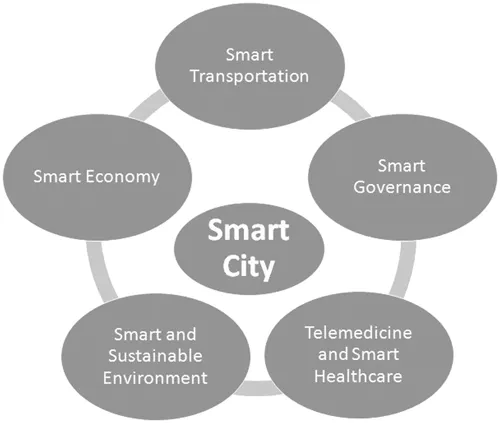
Figure 1.1 depicts the key perspectives for the deployment of an IoT-based city environment with automation and effectual outcomes for the assorted domains. The following includes the key implementation perspectives:
Images
FIGURE 1.1 Key perspectives for deployment of IoT-based smart city.
  • Smart city
    • Smart roads
    • Smart traffic lights
  • Industrial applications
    • Ozone presence
    • Smart grids
    • Industrial disaster prediction
  • Smart home
    • Wearables
  • Smart water
    • Chemical leakage detection
    • Portable water monitoring
    • Pollution-level analysis
    • River floods
  • Retail
    • Industrial control systems
  • Environment protection with sustainable resources
    • Sea-based disaster prediction
    • Air pollutions
    • Forest fire detection
    • Avalanche and landslide prevention
    • Earthquake detection
    • Snow-level monitoring
  • Digital health and telemedicine
    • Ultraviolet radiation
    • Patient surveillance
  • Smart agriculture
    • Soil quality measurement

1.2 Key Modules and Components of an IoT Scenario

The key components of an IoT scenario includes the following:
  • Cloud
  • Things or devices or gadgets
  • User interface
  • Gateway
  • Interfacing modules
  • Networks
  • Storage panel
  • Security mechanisms
  • Communication platform

1.3 Global Scenario

Following are excerpts from assorted research datasets available on different analytics patterns. Statista is one of the prominent research portals in which the authenticated datasets and evaluations are presented.
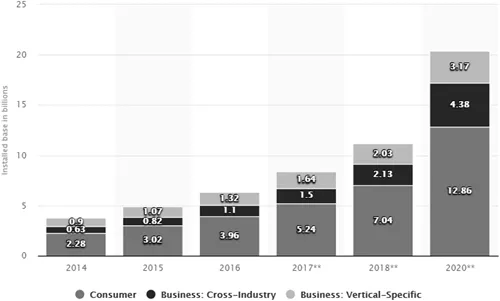
From the extracts of Statista, Figure 1.2 presents the huge usage of IoT-based deployments and it is rapidly increasing because of the usage patterns in assorted domains.
Images
FIGURE 1.2 Installed Internet of Things (IoT) scenarios from year 2014 to 2020 in billions.
Figure 1.3 depicts usage patterns of tablets in assorted locations from the year 2014 to the year 2019, and the figures are elevating. Because of these figures, it becomes necessary to enforce security mechanisms for IoT- and wireless-based environments.

1.4 Prominent Search Engines for Indexing IoT Devices

Following are key Internet of Things Search Engines (IoTSE) used by enormous organizations and the hacker loopholes in web cams with other IP-based devices. These portals index smart gadgets, servers, web cams and many other devices.
  • shodan.io/
  • iotcentral.io
  • censys.io/
  • thingful.net/
  • iotcrawler.eu/
  • iotscanner.bullguard.com/
  • um.es/iotcrawler/

1.5 Shodan: An IoT Search Engine

Shodan (McMahon et al., 2017; Samtani et al., 2018; Arnaert et al., 2016; Wright, 2016) is one of the key IoT search engines that is widely used to identify and recognize open systems in IoT scenarios. Using Shodan, as in Figure 1.4, any web cam o...

Table of contents

  1. Cover
  2. Half-Title
  3. Series
  4. Title
  5. Copyright
  6. Contents
  7. Preface
  8. About the Book
  9. Editors
  10. Contributors
  11. Chapter 1 Intrusion Detection and Avoidance for Home and Smart City Automation in Internet of Things
  12. Chapter 2 Heterogeneous Intelligent Transportation Systems: Review of Cybersecurity Issues, EU Regulations, and Economics
  13. Chapter 3 Fog Platforms for IoT Applications: Requirements, Survey, and Future Directions
  14. Chapter 4 IoT-Based Smart Vehicle Security and Safety System
  15. Chapter 5 Smart Attendance Monitoring IoT-Based Device Using Cloud Services
  16. Chapter 6 Encryption of Data in Cloud-Based Industrial IoT Devices
  17. Chapter 7 Cyber Attack Analysis and Attack Patterns in IoT-Enabled Technologies
  18. Chapter 8 A Review of Cyber Attack Analysis and Security Aspect of IoT-Enabled Technologies
  19. Chapter 9 Authentication of Devices in IoT
  20. Chapter 10 Software-Defined Networks and Security of IoT
  21. Chapter 11 RSA-Based Remote User Authentication Scheme for Telecare Medical Information System
  22. Chapter 12 Illegitimate EPR Modification: A Major Threat in IoT-Based Healthcare System and Its Remedy through Blind Forensic Measures
  23. Chapter 13 IoT: Foundations and Applications
  24. Chapter 14 Physical Layer Security Approach to IoT
  25. Chapter 15 Tenable Irrigation System with Internet of Things
  26. Chapter 16 Privacy and Security Challenges Based on IoT Architecture
  27. Index