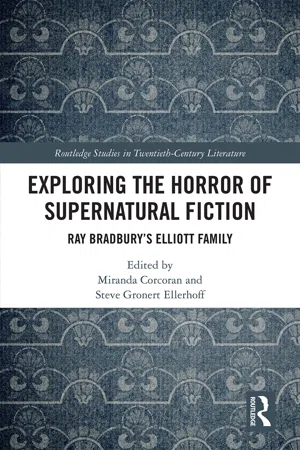
Detailing the adventures of a supernatural clan of vampires, witches, and assorted monstrosities, Ray Bradbury's Elliott family stories are a unique component of his extensive literary output. Written between 1946 and 1994, Bradbury eventually quilted the stories together into a novel, From the Dust Returned (2001), making it a creative project that spanned his adult life. Not only do the stories focus on a single familial unit, engaging with overlapping twentieth-century themes of family, identity and belonging, they were also unique in their time, interrogating post-war American ideologies of domestic unity while reinventing and softening gothic horror for the Baby Boomer generation. Centred around diverse interpretations of the Elliott Family stories, this collection of critical essays recovers the Elliotts for academic purposes by exploring how they form a collective gothic mythos while ranging across distinct themes. Essays included discuss the diverse ways in which the Elliott stories pose questions about difference and Otherness in America; engage with issues of gender, sexuality, and adolescence; and interrogate complex discourses surrounding history, identity, community, and the fantasy of family.
eBook - ePub
Exploring the Horror of Supernatural Fiction
Ray Bradbury’s Elliott Family
- 230 pages
- English
- ePUB (mobile friendly)
- Available on iOS & Android
eBook - ePub
Exploring the Horror of Supernatural Fiction
Ray Bradbury’s Elliott Family
About this book
Information
1 Positioning From the Dust Returned in the Bradbury Canon
Christopher Tuthill
Introduction
In Ray Bradbury’s Green Town, readers are introduced to a nostalgic, perhaps rose-colored vision of small-town America in the 1920s, when young Ray was growing up in Waukegan, Illinois. Dandelion Wine (1957), his popular autobiographical novel, is so beloved by generations of readers and has had such a huge cultural impact that the Apollo 15 astronauts named a moon crater, Dandelion Crater, after it (Aggelis 2004, p. 124). In Douglas Spaulding, Ray’s twelve-year-old doppelganger, readers see something of a childhood ideal of youthful enthusiasm and love for family and small-town life, and though the novel has its dark moments with the Lonely One and some discussions of death, the book is nonetheless saturated with sentimental anecdotes and nostalgia for an American past that may be seen as more fantastic than realistic. Something Wicked This Way Comes (1962), with its supernatural carnival and themes of good and evil, shows Green Town in a more sinister light, with less of the sentimentalism of Dandelion Wine, as we follow the adventures of Will Halloway and Jim Nightshade, two boys who are at the end of childhood. Yet still, even with Mr. Dark and his skillful manipulations of the town, we have a counterpoint with Charles Halloway, Will’s father, who epitomizes paternal love and becomes his son’s defender and protector. Both novels are tales of growing up, approached from different viewpoints, and set in America’s, and Bradbury’s own, mythical past, in Green Town. They lovingly portray the town, and Bradbury’s family, as sympathetic, kind people, battling time, age, and the dark carnival that comes to town.
It is hard to overstate how important Green Town is to Bradbury’s thought and his career. He published stories set there from the 1940s all the way until Farewell Summer was released sixty years later, in 2006. The autobiographical nature of these tales can be seen as his “bones in the soup”—to borrow a phrase from JRR Tolkien—from which he mined an entire mythical world (Tolkien 2008, pp. 39–40). Though Tolkien meant that we shouldn’t examine fantasy too closely, lest we see its metaphorical “bones,” it is instructive to view Bradbury’s creation of Green Town as a way to explore his own childhood in Waukegan, Illinois. Wayne Johnson has written of Dandelion Wine that Bradbury “had come back to haunt his childhood memories that for many years had been haunting him” (Johnson 1980, p. 27). Through Douglas Spaulding, we get a sense of how a young, enthusiastic Bradbury engaged with both his family and his town, full of love and optimism, though also tinged with sadness. And through Will Halloway, we see a slightly older, yet no less enthusiastic young boy, excited by carnivals and dark secrets, his deep friendships, and his relationship with his father. It is interesting that The Halloween Tree (1972), another Bradbury novel, would explore some of these same things as well, though not in Green Town.
From the Dust Returned can in many ways be seen as an addition to these Green Town stories. Bradbury had been working on the stories that comprise this 2001 collection for many decades. He spoke to Charles Addams and his editor Don Congdon as early as 1946 about this project, which he envisioned as a family reunion of vampires. Together, Addams and Bradbury hoped to create a seasonal book of Halloween tales, though the project was shelved for nearly half a century, as we will see. I would like to examine the Green Town novels Dandelion Wine and Something Wicked This Way Comes, and look at them in relation to From the Dust Returned, to demonstrate how this late career fix-up novel was informed by the rest of Bradbury’s work, and how we can think about the book in relation to Green Town, and to his whole career. There are many similarities between the Elliott Family and the characters we see in Green Town, from Douglas Spaulding and his family, to Will Halloway and his father. Though it may seem that the overtly Gothic Elliott stories share little in common with the nostalgia and sentimentality of Green Town, the two sets of stories have much in common and From the Dust Returned can be seen as an extension of Bradbury’s exploration of his own childhood memories, and a fitting capstone to his career. In the Elliotts, he found a perfect way to wed his love of childhood wonder with his own enthusiasm for the dark and mysterious Halloween worlds he was so prolific in creating. When read together with these earlier novels, From the Dust Returned can also be seen as an extension or addendum to the Green Town books.
Dandelion Wine
Bradbury’s first Green Town book is a fix-up novel first published in 1957 and comprised of stories he had been publishing since 1946. Dandelion Wine is a tale of growing up, of a summer of innocence for Douglas Spaulding that leads, through fantastic, sentimental, and macabre tales, to his meditations on death. Many scenes and characters throughout the book deal with aging and the passage of time. For example, Douglas’s grandfather and Douglas’s love for him (and his knowledge by the end of the book that grandfather may be close to death), Mrs. Bentley and her insistence that she has always been old, the aged Colonel Freeleigh whom the boys deem to be a Time Machine, and Leo Auffman and his happiness machine all give the reader a sense of mortality, and of the fantastic in this small town in 1928, as well as the impression of how sensitive and inquisitive Douglas is, and how the steady march of time is affecting him. As well, the introduction of the Lonely One, the stalking murderer who was based on an actual criminal from Waukegan, brings a sense of foreboding to the town, even as Douglas often seems preoccupied with things like new tennis shoes, harvesting fox grapes, and other ecstasies of a twelve-year-old in a Midwestern town.
Bradbury has said that Dandelion Wine is
A rummage through a fabled attic or basement storehouse … I am not saying those were happier days, they were not. But I am saying that those days existed, look at them, know them, see them as well as you can,
and further states that “I was doing more than time-traveling fueled by nostalgia” (Aggelis 2004, pp. 22–3). Early in the novel, Douglas proclaims to himself, “I’m really alive! I never knew it before, or if I did, I don’t remember” (Bradbury 2001a, p. 10). Much of what follows in the novel can be seen as Douglas’s celebration of life, and of the life of this small town. Lahna Diskin describes this awakening as a kind of “epiphany, a connection, a communion with the natural world” (Diskin 1980, p. 130). All of Douglas’s experience, and the support he receives from friends and family, complements his boundless enthusiasm for life. When Douglas says he’s not sure what he’ll be when he grows up, before giving him a pair of tennis shoes, Mr. Sanderson at the Shoe Emporium replies, “Anything you want to be, son, you’ll be. No one will ever stop you” (Bradbury 2001a, p. 26). With his friends, Douglas explores the town and gets into fantastic adventures. His friend Charlie Woodman breathlessly declares Colonel Freeleigh, an old Civil War veteran, a Time Machine, and together they listen in rapt attention as he regales the boys with stories of his soldiering days. Freeleigh was apparently “a composite of the Civil war veterans Ray recalled marching in Waukegan parades when he was a child” (Weller 2005, p. 242). The ravine, another real-life feature of Waukegan, and the Lonely One fire the boys’ imaginations to the point that when he is declared caught, they don’t believe the account, thinking the Lonely One has some kind of supernatural powers. The dandelion wine itself is seen by Douglas as a kind of magic elixir, “summer caught and stoppered”, and he reflects that “Since this was going to be a summer of unguessed wonders, he wanted it all salvaged and labelled” (2001a, p. 14).
For a twelve-year-old, this is heady stuff. Knowing that the summer would be full of such wonders and ruminating on life and death so consciously may be precocious, but it is Bradbury’s skill as a writer that allows this all to work together. We know we’re not in plain old Waukegan, but in a fantastic world of childhood exuberance and energy, one that, like summer, must eventually end. Hints of darkness, sadness and death are entwined with the more upbeat scenes in the book. Bradbury explores death through the use of the Lonely One, of whom we first hear through Miss Lavinia and her friends, and later through Douglas’s worrying mother. Tom, his brother, accompanies Mrs. Spaulding to the ravine, concerned that Douglas is late to return home, and Tom reflects that all the happiness that they experience is “threatened by an ogre called Death” and that they are “so dark, so far away from everything” (2001a, pp. 46–7). In this moment, we see the family in terror that Douglas has been lost to the Lonely One, but Douglas soon reappears, to their relief, though his mother says he’ll get a “licking” (2001a, p. 47). While he starts off the book as innocence personified, Douglas slowly starts to think about mortality himself. After speaking with seventy-two-year-old Mrs. Bentley, who claims she was always old, Douglas decides that “old people never were children” (2001a, p. 77). Late in summer, he is afflicted with a fever and only with the help of Mr. Jonas’s magic elixir is he able to recover. He confronts the idea of his own mortality, writing in his tablet: “SOME DAY, I DOUGLAS SPAULDING, MUST DIE” (2001a, p. 210). This awakening to death is a kind of mirror image of his earlier awakening to life. Later, we also see Timothy in From the Dust Returned ruminating on mortality in a very different way; rather than fearing death, Timothy embraces it in the hopes of becoming more like his family.
Bradbury also explores loss in a more mundane, earthly way through Douglas’s friend, John Huff, who is described glowingly as a perfect ideal of boyhood, whose feats of athletic prowess included jumping over “six foot orchard walls”, hitting baseballs into the trees, and who is faster and stronger than any boy Douglas knows: “the only god living in the whole town of Green Town, Illinois” (2001a, p. 114). This beloved friend is moving away, and in a brief, poignant chapter, Douglas tries to accept the reality that he is losing a friend. He insists first that the two boys will see each other every week, but when he learns the distance separating them will be eighty miles, he suggests they could call each other instead. John worries that he’ll soon forget everything about Green Town, so the boys play a memory game, but soon find that they can’t even remember the color of each other’s eyes (2001a, pp. 117–8). John eventually abandons their games to return home, since his family is getting ready to depart. In a fit of sadness and anger at this loss, Douglas shouts, “You’re no friend of mine! Don’t come back now, ever!” (2001a, p. 124). He goes home and seeing his younger brother, Tom, asks, “You may be my brother and maybe I hate you sometimes, but stick around, all right?” (2001a, p. 125). This tender, emotional scene is handled so sweetly, positioned between other chapters that deal with the fantastic, that the effect is to ground the reader in the reality of Green Town, and these boys struggling to grow up. For we know, of course, that much of Green Town is from Bradbury’s own experience.
In his 1974 introduction to Dandelion Wine, Bradbury relates a story of his grandfather and the fire balloon they released together on July 4, 1925, when Ray was six. He writes that it is one of the last memories he has of his grandfather, that his own eyes were “filled with tears, because it was all over, the night was done, and I knew there would never be another night like this” (p. xiv). Ray’s reminiscence about his grandfather is mirrored in the book’s final pages, as Tom proclaims he will never forget the summer of 1928, that “I’ll remember what happened on every day of this year, forever”, and continues to ecstatically relate all the summer’s many adventures, as seen through the eyes of a ten year old. His grandfather replies, “It was over before it began”, but when Tom protests, Grandpa says, simply, “sure you will, Tom” (2001a, pp. 263–4). The ritual of making the dandelion wine, Tom says, is a “swell way to save June, July, and August” (2001a, p. 263). Here, we see Tom distilling the essence of this novel, in which Bradbury, through Douglas, was honoring the memories of his family and the wonder and mystery of his childhood. The dandelion wine in this ritual seems central to understanding Bradbury’s project. Finally, Tom, Douglas, and grandpa “carry out the last few rituals of summer, for they felt now the final day, the final night had come”, and as the chilly weather beckons, “the new cold touched Grandfather’s skeleton first” (2001a, pp. 264–5). Again, this recalls Douglas’s awareness of death, and implies his Grandpa’s closeness to it. Though Dandelion Wine explores themes of death, maturation, and the passage of time, it does so in a mostly sentimental, optimistic way. Green Town is a stand-in for a bygone, nostalgic memory of America that has no doubt resonated with many readers, no matter how artful or fantastic Bradbury might have made it seem. His sentimentality and his deep love for his family comes through strongly in this work, and through the eyes of Douglas and his brother Tom in their adventures.
Something Wicked This Way Comes
The publication of Bradbury’s next Green Town book, and what is often considered his most complete, satisfying novel, came in 1962, when Bradbury was in the midst of changing publishers. Tired of what he felt was Doubleday’s lack of support for his work, Bradbury, with the help of his agent, Don Congdon, moved to Simon & Schuster to publish the novel. In their work on the publication history of this book, Jonathan R. Eller and William F. Touponce demonstrate that Bradbury had been thinking about such a novel for many years, and point out that even the title of his first collection, Dark Carnival, hints at what was to come (Eller 2004, p. 155). Bradbury had wanted to write a short story called “Carnival” for the Dark Carnival collection, but it didn’t make the cut (Weller 2005, p. 258). Initially, Bradbury’s idea was to write a screenplay for the project, and he had written a draft of it as early as 1955 (Eller 2004, p. 158). For years, Bradbury had an idea about a magical carousel that sent its riders through time and had even thought of writing a novel based on the concept (Weller 2005, p. 258). The supernatural carnival set in Green Town, complete with a magical carousel, two demonic carnival owners, and two young boys, eventually made its way into print as Bradbury’s debut novel for his new publishing house.
There are some significant differences to the Green Town we encounter in Something Wicked This Way Comes when compared to Dandelion Wine. First, and most importantly, the more innocent Douglas and Tom Spaulding have become the slightly older Will Halloway and Jim Nightshade, who are both almost fourteen, best friends who live next door to each other a...
Table of contents
- Cover
- Half Title
- Series Page
- Title Page
- Copyright Page
- Dedication
- Table of Contents
- List of Figures
- List of Contributors
- Acknowledgments
- Introduction
- 1 Positioning From the Dust Returned in the Bradbury Canon
- 2 Spiritual Threads of Memory, Meaning, and Mild Monstrosity: The Evolutionary Wanderings of Ray Bradbury’s Elliott Family
- 3 “Homecoming” and the Imaginary Attic
- 4 “I’ll Be in Every Living Thing in the World Tonight”: Adolescent Femininity and the Gothic Uncanny in Bradbury’s “The April Witch”
- 5 “Other Ways of Being”: Ray Bradbury’s “The April Witch” in Conversation with Jamaica Kincaid’s “In the Night” and Leonora Carrington’s “The Seventh Horse”
- 6 The Other in the Self: A Hermeneutics of Otherness in Ray Bradbury’s “The Traveller”
- 7 Dark Ecology in From the Dust Returned
- 8 Remembrance of Death, Family, and Place in Ray Bradbury’s “Homecoming”
- 9 Innovating Nightmares: Ray Bradbury’s Elliott Family and the Horror of Technology in Modern American Capitalism
- 10 “Inverted and Dark and Mildly Different”: Gothic Domestic Relations in Ray Bradbury and Shirley Jackson
- 11 “No Place in All Europe for Him”: Monstrous Migrations in the Family Gothic
- 12 Family Fantasy and the Family: Divining the Elliotts through Depth Psychology and the Phenomenology of the Fantastic
- Appendix: The Elliott Family Bibliography
- Index
Trusted by 375,005 students
Access to over 1.5 million titles for a fair monthly price.
Study more efficiently using our study tools.
Frequently asked questions
Yes, you can cancel anytime from the Subscription tab in your account settings on the Perlego website. Your subscription will stay active until the end of your current billing period. Learn how to cancel your subscription
No, books cannot be downloaded as external files, such as PDFs, for use outside of Perlego. However, you can download books within the Perlego app for offline reading on mobile or tablet. Learn how to download books offline
Perlego offers two plans: Essential and Complete
- Essential is ideal for learners and professionals who enjoy exploring a wide range of subjects. Access the Essential Library with 800,000+ trusted titles and best-sellers across business, personal growth, and the humanities. Includes unlimited reading time and Standard Read Aloud voice.
- Complete: Perfect for advanced learners and researchers needing full, unrestricted access. Unlock 1.5M+ books across hundreds of subjects, including academic and specialized titles. The Complete Plan also includes advanced features like Premium Read Aloud and Research Assistant.
We are an online textbook subscription service, where you can get access to an entire online library for less than the price of a single book per month. With over 1.5 million books across 990+ topics, we’ve got you covered! Learn about our mission
Look out for the read-aloud symbol on your next book to see if you can listen to it. The read-aloud tool reads text aloud for you, highlighting the text as it is being read. You can pause it, speed it up and slow it down. Learn more about Read Aloud
Yes! You can use the Perlego app on both iOS and Android devices to read anytime, anywhere — even offline. Perfect for commutes or when you’re on the go.
Please note we cannot support devices running on iOS 13 and Android 7 or earlier. Learn more about using the app
Please note we cannot support devices running on iOS 13 and Android 7 or earlier. Learn more about using the app
Yes, you can access Exploring the Horror of Supernatural Fiction by Miranda Corcoran, Steve Gronert Ellerhoff, Miranda Corcoran,Steve Gronert Ellerhoff in PDF and/or ePUB format, as well as other popular books in Literature & Literary Criticism. We have over 1.5 million books available in our catalogue for you to explore.