Cappadocia was a place of co-habitation of Christians and Muslims, until the Greco-Turkish Population Exchange (1923) terminated the Christian presence in the region. Using an interdisciplinary approach drawing on history, political science and anthropology, this study investigates the relationship between tolerance, co-habitation, and nationalism. Concentrating particularly on Orthodox-Muslim and Orthodox-Protestant practices of living together in Cappadocia during the last fifty years of the Ottoman Empire, it responds to the prevailing romanticism about the Ottoman way of handling diversity. The study also analyses the transformation of the social identity of Cappadocian Orthodox Christians from Christians to Greeks, through various mechanisms including the endeavour of the elite to utilise education and the press, and through nationalist antagonism during the long war of 1912 to 1922.
eBook - ePub
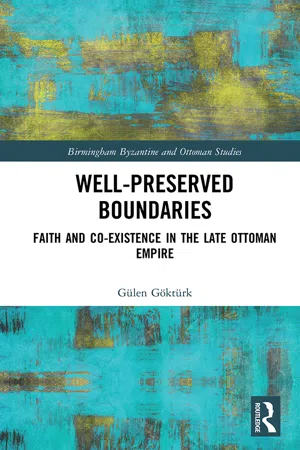
Well-Preserved Boundaries
Faith and Co-Existence in the Late Ottoman Empire
- 176 pages
- English
- ePUB (mobile friendly)
- Available on iOS & Android
eBook - ePub
1 Ottoman tolerance reconsidered
We are surrounded by nostalgic sentiments, triggered by personal archeology, investigating our individual past in the identity-oriented world of the post-Cold War era. The nostalgia for ancestral lands that no longer exist, that never existed, or longing for some phantasmagoric past, is closely associated with the reinvention of identity. Nowadays, we frequently ask ourselves who we are. Why is it that modern individuals are so preoccupied with inventing or discovering new identities for themselves? With the dissolution of the Soviet Union in 1991, identity politics replaced the ideological politics of the Cold War era. Identity politics did not, of course, appear suddenly as a result of the weakening of ideological politics. They have actually existed for a long time. Scholars date the beginning of identity politics to the civil rights movement of Martin Luther King Jr., the Black Power movement and global anti-colonial movements, where activists called for a new collective identity to counterbalance White imperialism. When the Cold War ended, identity politics became much more popular than in the past. Interestingly, not only those of lower status but also other individuals invented new ways to show their particular identity: they established foundations and societies in their ancestral hometowns, celebrated with feasts, opened museums, performed arts focusing on specific identity traits and initiated a new form tourism that essentially amounted to nostalgic pilgrimages to places of origin.1
The activities of the associations (σύλλογοι) of the Cappadocian Greeks in Greece such as Gavoustima (see introduction) all came about in the post-Cold War era. The contemporary story of the Cappadocian Greeks is not the concern of this book. I focus primarily on the historical community of the Cappadocian Christians in the last decades of the Ottoman Empire – and I only give the above example to show that talk of “origins” and “identity” still prevails, not only in immigrant countries like the U.S. and Canada but also in nation-states like Greece. The only distinction is that Cappadocians do not make any political demand of the Greek government other than freely celebrating their identity. For many identity groups,2 this is not the case. They are mostly preoccupied with demands for recognition and representation, which in turn create a huge debate concerning the dilemma between balancing the liberal ideal of individual liberty and group autonomy.
In the last twenty years or so, scholars in Western liberal societies have produced ideas to reconcile group demands and group autonomy with individual liberty and individual autonomy in an effort to attain justice. This dilemma opened to discussion liberalism’s flaws and shortcomings when it comes to dealing with diversity, and introduced different theories of justice to Western politics. In this process, scholars from various schools rediscovered forms of living together in remote geographies and in the histories of faraway countries and revived debates about possible ways of cohabitation in nations in turmoil. The Ottoman “millet system” is one of those historical examples of group autonomy and religious tolerance rediscovered in the West.3
“Ottoman romanticism” is, however, a relatively new phenomenon in Turkey. Until recently, the official historiography had a nonsensical tendency to underestimate anything that belonged to the Ottoman past. Today, the river flows in the opposite direction, and this situation generates ahistoric studies and discussions and non-scientific perspectives both toward the past and the present. In parallel with Western scholarship references to the Ottoman experience of pluralism, some scholars and politicians in Turkey are driving a discourse about contemporary Ottoman tolerance. In other words, these scholars and politicians support their theses of Ottoman tolerance with the studies in the West and regard the Ottoman way of dealing with pluralism as a remedy to Turkey’s current minority problems, including the political demands of Kurds, the religious accommodation of Alawites and Assyrians, the violation of the minority rights of Greeks, the Armenians, the Jews and the stigmatizing language used against all minorities, including the Roma. There are two problems with this: first, they use “tolerance” as a free-floating concept without any analysis of what it implies in both pre-modern and modern times; second, they offer an imitation of historical cases as a means of solving the identity claims of today.
I claimed previously that if we were to talk about peaceful living together and tolerance in the Ottoman context, Cappadocia would be the best-suited example compared to other regions of the Ottoman Empire. For example, in Lebanon there was sectarian warfare between Maronite Christians and Druzes in 1860; in the Balkans, peasant revolts turned into nationalist movements of Serbs, Greeks, Bulgarians and Albanians; in Crete, despite the presence of kinship ties, Christians and Muslims were at each other’s throats; on the Western shores of Anatolia, Cretan refugees were in conflict with local Greeks; there are many other examples. In Cappadocia, there was no turmoil or visible clash between different religious groups until the very last decades of the Empire, and so it presents a great example of religious diversity because of its inclusion of Sunni and Alawite Muslims, Orthodox Christians, Armenians, Protestants and foreign missionaries. As such, it is a perfect example to study tolerance and cohabitation in the Ottoman context and consequently offers an ideal case study to open for debate the practicality of “Ottoman tolerance” in today’s Turkey.
To employ modern concepts like tolerance and multiculturalism might not seem appropriate for a book that is occupied with a historical community and I completely agree with the criticism that argues that it is often futile and anachronistic to evaluate historical situations and events using modern concepts. In contemporary evaluations, however, tolerance is repeatedly used in the Ottoman context, referring to the “peaceful co-existence” of different religious groups, where it is portrayed as an ideal world to be emulated in today. However, a detailed discussion of the term has not been attempted until recently. I therefore argue that in order to address tolerance, this notion must be discussed both in terms of religious tolerance and as a modern liberal concept, taken from a study that aims to respond to and challenge an understanding of a historical model purporting to provide solutions to today’s minority issues.
This is not an easy task for two reasons. First of all, except for notions of pre-modern religious tolerance, tolerance discussions are conducted in the context of liberal democratic societies. These debates take liberal democracies as givens and envisage a kind of ideal world which is usually inadequate in the face of the complex poly-cultural realities of life, as well as in terms of diversity of identity/affinity groups, inner heterodoxies, permeability of group boundaries and irremediable characteristics of identities. Additionally, critical theories of tolerance are occupied with the replacement of this system altogether and with attempting to make fundamental transformations to society and in its norms in a range, from its constituting principles to its basic codes of relationship between diverse human beings. Therefore, the pre-modern Ottoman world remains totally alien to contemporary tolerance debates for a very basic reason: it was not a liberal democratic country; rather, it was a pre-modern monarchy.
Second, and leaving aside the critiques of a liberal capitalist system, in contemporary liberal states justice is an end, an objective to be reached by setting fundamental rights of freedom and equality for every citizen. But for the Ottoman Empire, justice was a tool, a means to preserve the hegemony of the dynasty over its subjects. Therefore, we are again talking about two completely different systems. The only resemblance is that in both systems tolerance is required as a means to minimize conflict and ensure continuity, even though the scope of the concept is different. In the Ottoman context, tolerance is a form of “religious tolerance” (in a non-Lockean sense). Only religious diversity was tolerated and even this type of tolerance was limited to “the peoples of the book” in line with Islamic rule. In the Ottoman tradition, there was no room for heresies and heretics of any religion. People could exist as long as they belonged to a religious community. For contemporary liberal societies, however, we can talk about super-diversity and accordingly, tolerance has been discussed in a broader context and some scholars even think of replacing tolerance with the idea of recognition or respect.
Considering these pitfalls, how can one possibly apply contemporary tolerance debates to benefit a historical study? In the first place, contemporary tolerance disputes strengthen my position that romanticizing the Ottoman experience as an example for contemporary minority problems is pointless because Ottoman tolerance was totally irrelevant to contemporary needs. Second, such debates help us to unsettle our general point of view about the concept of tolerance, which is often employed arbitrarily and regarded positively. Accordingly, we need to analyze and understand the Ottoman interpretation of tolerance from a more sophisticated perspective. Last, this will provide a basis to build a comparative perspective between past and present without committing the error of anachronistically judging the past with present ideals, and imitating past practices for current problems of diversity.
Tolerance
Tolerance4 is a thick concept with different layers each evoking different meanings that can be considered either positive or negative depending on one’s political stance. One can either take it as a core of liberalism or as that of fascism. While in Western scholarship it is mostly seen as a liberal value and a civilizational virtue that each liberal individual should carry, it is regarded as the dominance of the powerful over the weak by critical theory. By its nature, tolerance does not have a unified meaning across nations and cultures. It is attached to different objects in different national contexts5 including groups with various identity or interest demands like religion, race, ethnicity, sexual tendency, patriarchy, environmental concerns and so on.
Tolerance is complicated by the dichotomy between tolerance in public versus private spheres; we can call the former positive tolerance and the latter negative tolerance. The question here is to what extent we can tolerate differences. Do we tolerate them as long as they remain in the private sphere (negative tolerance), or are there any mechanisms to appreciate diversity in the public sphere (positive tolerance)? I believe asking a few questions might be helpful in attempting to develop a perspective for the term tolerance:
- Who are the objects of tolerance?
- Do people need to tolerate those whom they appreciate and like?
- What are the different levels of tolerance?
- Is it inherently a power relationship?
- Is tolerance a middle way between rejection and assimilation?
- Do two equally powerful people/groups tolerate each other?6
Toleration, as a term, was first coined by Locke as “religious tolerance” in his 1689 A Letter Concerning Toleration to his friend Philipp van Limborch. In the letter, Locke described the Christian virtues of charity and love and criticized the insistence of penalizing these beliefs, which he considered to be against Christianity. For him, no one who follows Christ and his teachings is a heretic, and tolerating those who have different religious views is compatible with the Gospel. Corresponding with this view, he offered to distinguish between religious and political matters and to define the boundary between religion and commonwealth, which for him was an association of people constituted solely for the purpose of preserving and promoting civil goods like life, liberty, physical integrity, freedom from pain, external possessions (including money) and the necessities of life. The ruler is solely responsible for civil goods, and the care of souls cannot belong to him. Locke states that neither persons, nor churches, nor even commonwealths can have any right to attack another’s civil goods or steal another’s worldly assets on the pretext of religion. And the ruler, who plays the most important part in toleration, cannot use sanctions of civil law to enforce any ecclesiastical rites or ceremonies in the worship of God, nor can he prohibit any ritual performed by any church. Ba...
Table of contents
- Cover
- Half Title
- Series Page
- Title Page
- Copyright Page
- Dedication
- Table of Contents
- List of figures
- Acknowledgments
- Introduction
- 1. Ottoman tolerance reconsidered
- 2. Maintaining boundaries: Faith and co-existence in late Ottoman Cappadocia
- 3. The path toward nationalism
- 4. Halasane ta pragmata (Things spoiled)
- 5. Tolerating the heretics: The distinctive case of the Greek Protestants
- Conclusion
- Bibliography
- Index
Trusted by 375,005 students
Access to over 1.5 million titles for a fair monthly price.
Study more efficiently using our study tools.
Frequently asked questions
Yes, you can cancel anytime from the Subscription tab in your account settings on the Perlego website. Your subscription will stay active until the end of your current billing period. Learn how to cancel your subscription
No, books cannot be downloaded as external files, such as PDFs, for use outside of Perlego. However, you can download books within the Perlego app for offline reading on mobile or tablet. Learn how to download books offline
Perlego offers two plans: Essential and Complete
- Essential is ideal for learners and professionals who enjoy exploring a wide range of subjects. Access the Essential Library with 800,000+ trusted titles and best-sellers across business, personal growth, and the humanities. Includes unlimited reading time and Standard Read Aloud voice.
- Complete: Perfect for advanced learners and researchers needing full, unrestricted access. Unlock 1.5M+ books across hundreds of subjects, including academic and specialized titles. The Complete Plan also includes advanced features like Premium Read Aloud and Research Assistant.
We are an online textbook subscription service, where you can get access to an entire online library for less than the price of a single book per month. With over 1.5 million books across 990+ topics, we’ve got you covered! Learn about our mission
Look out for the read-aloud symbol on your next book to see if you can listen to it. The read-aloud tool reads text aloud for you, highlighting the text as it is being read. You can pause it, speed it up and slow it down. Learn more about Read Aloud
Yes! You can use the Perlego app on both iOS and Android devices to read anytime, anywhere — even offline. Perfect for commutes or when you’re on the go.
Please note we cannot support devices running on iOS 13 and Android 7 or earlier. Learn more about using the app
Please note we cannot support devices running on iOS 13 and Android 7 or earlier. Learn more about using the app
Yes, you can access Well-Preserved Boundaries by Gülen Göktürk in PDF and/or ePUB format, as well as other popular books in History & European History. We have over 1.5 million books available in our catalogue for you to explore.