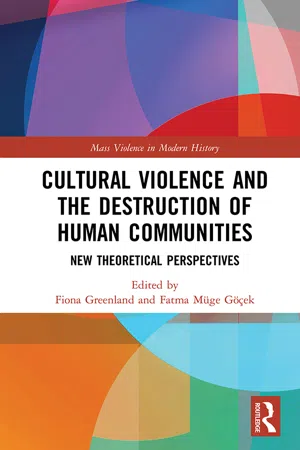
This volume brings together leading sociologists and anthropologists to break new ground in the study of cultural violence. First sketched in Raphael Lemkin's seminal writings on genocide, and later systematically defined by peace studies scholar Johan Galtung, the concept of cultural violence seeks to explain why and how language, symbols, rituals, practices, and objects are so frequently in the crosshairs of socio-political change. Recent conflicts in the Middle East, Africa, and Central Asia, along with renewed public interest in the repertoire of violence applied to the control and erasure of indigenous populations, highlights the gaps in our understanding of why cultural violence occurs, what it consists of, and how it relates to other forms of collective violence.
eBook - ePub
Cultural Violence and the Destruction of Human Communities
New Theoretical Perspectives
- 204 pages
- English
- ePUB (mobile friendly)
- Available on iOS & Android
eBook - ePub
Cultural Violence and the Destruction of Human Communities
New Theoretical Perspectives
1 Introduction
Since the decline of traditional warfare, violence has diversified in its repertoire and has taken hold in all manner of social life. The late-modern era can be characterized as the period when intra-state violence left the battlefield, moving into the village, marketplace, and museum, with multi-media platforms used for propaganda. While warring armies have always plundered civilian populations to suppress resistance and gather the victors’ spoils, modern ex-camporum violence is not the aftermath of, nor appendage to war, but rather its epicenter, with its own logic of destruction. Formal war is unnecessary and even undesirable in this context. Scholarly work has tended to look at this development by concentrating on two primary forms of violence: direct violence is harmful force aimed at human beings, whether rape, murder, maiming, or torture; while indirect violence is the sustained attack on individual agency through continual undermining of values, ideas, and roles. Largely absent from this scholarship is cultural violence, which has a distinct ontology.
The term “cultural violence” was defined by Johan Galtung as one of three primary forces of violence that act together to control social outcomes and inflict harm (Galtung 1990). Along with structural violence (the inequality and exploitation that is built into the social system) and direct violence (rape, murder, hate speech, and other physical injuries), cultural violence, he argued, refers to “those aspects of culture […] that can be used to justify or legitimize direct or structural violence” (Galtung 1990: 291). This line of inquiry examines the harmful force exerted by one ethnic group against another because of perceived threats to the perpetrators’ identity, autonomy, or survival (Luft 2015; Wimmer 2002). Galtung thus theorizes cultural practices as a causal factor in violence, inviting further work on violence directed at culture itself. There are several important questions that remain unanswered, principally, “Why are cultural practices and objects so often enlisted in the project of dominating human communities? And how does this phenomenon relate to direct violence?” Galtung provides clues about how to proceed in answering these queries in his earlier work (Galtung 1969: 169, 173). He initially discusses structural violence in terms of its physical and psychological dimensions on the one side, and with or without objects on the other. His discussion of these aspects of violence already signals his later focus on cultural violence, in that he differentiates “violence that works on the body” from “violence that works on the soul” (Ibid. 169). In terms of objects, he asks rhetorically if the destruction of things can be considered violence (Ibid. 170). Galtung’s answer is in the affirmative: he argues this can be seen as psychological violence as “the destruction of things as a foreboding or threat of possible destruction of persons, and the destruction of things as destruction of something very dear to persons referred to as consumers or owners”. It is especially the impact on the victims that violence against objects produces that needs to be analyzed further. All too often, the discourse on violence is constructed from the vantage point of the perpetrator rather than the victim. It is imperative to approach and narrate violence from the standpoint of the victim in order to fully capture its cultural dimension.
A second major perspective on cultural violence comes from the work of Raphael Lemkin, the lawyer and legal theorist who survived the Nazi persecution of Polish Jews and coined the term “genocide”. Lemkin’s considerable contribution to international human rights work has been carefully studied elsewhere. What has received less attention is his work on the cultural components of genocide. For Lemkin, sustained attacks on a group’s language, collective memory, built environment, and distinctive practices complemented direct violence and “crippled” the group’s continuing existence. “Genocide in the cultural field”, Lemkin argued, could take the form of attacking a group’s language, practices, stories, traditions and social institutions (Lemkin 1944: xi–xii). These prohibitions and substitutions unfold through time and are effective at crippling precisely because they appear at first to be innocuous or even bureaucratically rational actions.
Cultural violence, in Lemkin’s view, should not be thought of as a softer version of direct violence. As a strategy of genocide, it is just as pernicious and, in the longer-term, more destabilizing for a group than murder because of its permanent, corrosive impact on a group’s social ontology. Without cultural practices, a group loses its social compass – its sense of identity, or its place in the world. It loses the possibility of being. To take one of several possible examples, the persecution of the Crow people by the US Government in the 1800s involved a totalizing prohibition against traditional Crow practices. The coup stick had long been the principal marker of manhood among the Crow, but as the Crow population was decimated and the survivors corralled into reservations, the meaning of the stick was forgotten. The unintelligibility of this object today is a metaphor for the erasure of Crow culture, for the way in which the group’s “entire structure of evaluating the world [ceased] to make sense” (Lear 2006: 83). It is still possible to find a coup stick in a museum, but it exists outside the social structure that animated it in the first place. Without the myths, ceremonies, and special handling of the Crow community, the stick is no longer a rite of passage but rather an index of social death. What the Crow people know, and what Galtung and Lemkin insisted on through their work, is that formal war is insufficient to destroy a human community. Cultural violence completes the task.
The chapters in this volume build on these and other ideas, offering the first comprehensive social scientific discussion of cultural violence. The volume’s production coincides with particular episodes of cultural violence, noteworthy for their degree but sadly familiar in their kind. The Syrian civil war brought about 400,000 civilian deaths and unmeasurable suffering through chemical attacks, torture, imprisonment, rape, exile, and homelessness. It brought, too, an articulated program of cultural violence at the hands of one of the civil war’s most notorious insurgent groups, the Islamic State in Iraq and Syria (ISIS). At least as early as July 2014, ISIS was deliberately attacking sites and structures with cultural and historic significance. The group was ecumenical in its destruction, targeting Shi’a, Sufi, and Sunni shrines and mosques, Yazidi churches and marketplaces, synagogues, and ancient temples, museums, and archaeological sites. Far from limiting itself to symbolic gestures of domination and intimidation, ISIS went to the roots of pluralistic culture and humanistic values, destroying the texts, spaces, and individuals associated with their expertise. One of the authors, Fiona Rose Greenland, found an explanatory gap in social theory for the type of violence practiced by ISIS, and developed a concept of ontological violence that accounts for the phenomenon of meaning-making obliteration. Already familiar with cultural violence in the Middle East, Fatma Müge Göçek saw something different in the Syrian conflict: the postcolonial instrumentalization of Islam embedded in a context of extreme violence and terrorism. It was their conversation on how to explain sociologically what had happened and why that led to the concept of cultural violence and, with it, the necessity to fully articulate the content and boundaries of this particular type of violence in an edited volume.
In this Introduction, we first contextualize the analysis of violence; a discussion of the concept of violence in the social sciences leads to the analysis of violence in the sociological literature. We then move on to the original contributions this volume makes, split into three sections: an analysis of the repertoires of violence beyond the physical, followed by a section centering on the discussion of cultural violence, and another on its contribution to the destruction of communities. The Introduction concludes with an outline of the book, succinctly summarizing and contextualizing each chapter within this sociological framework.
Concept of violence in the social sciences
Definition, history, and approaches
In terms of the history and approaches to the academic study of violence, sociologists typically trace the analysis of violence back to initial analyses of individual acts of crime, thereby equating violence with crime.1 What often follows is a functional explanation, underscoring how crime often contributes positively to the functioning of society by generating moral solidarity and by reinforcing dominant norms and values. It is important to stress at that juncture that violence sociologically analyzed is not individual, but rather collective. Also significant here is the connection made between violence and power, in that those social groups exercising collective violence do so through resorting to their collective power.
Bringing in power first leads to the introduction of violence not as a concept in and of itself, but rather as a consequence. Scholars that approach collective power draw attention to structural factors, such as power inequalities within society on the one side and the concentration of power in the political institution of the state on the other. Social scientists including Barrington Moore, Charles Tilly and Michael Mann therefore highlight the role of the state in monopolizing and executing collective violence, where collective violence in the form of war making and state making enforce one another.2 Likewise, Hannah Arendt differentiates power from violence, arguing that “the rule of law resting on the power of the people (read power) would put an end to the rule of man over man (read violence)”.3 Once again, the state and its legal institutions are shown as each and every time overpowering the temporary insanity of collective violence. Mark Mazower criticizes the assumption that is inherent in this structuralist analysis, that collective violence emerges temporarily during periods of transition and eventually disappears once peace starts to reign in all states and societies.4 Such criticism leads to the question as to why collective violence has not been adequately analyzed in and of itself, not as a state of exception, but rather as an inherent aspect of human existence. In summary then, in the social science literature, the initial individual focus on crime and the ensuing structural focus on the state eventually lead to the contemporary depiction of collective violence as inherent in human life in general and in ethnicity in particular.
Dan Stone5 and Giorgia Dona6 best articulate this contemporary stand of collective violence as a principal component of states and societies. Stone conjectures that collective violence was marginalized in the study of modern societies because
violence that serves no profitable purpose is believed to have been eradicated. Although this is not actually the case, it means that when violence … does occur, it explodes … Then, however, it disguises itself because perpetrators of violence cannot admit that they have deviated from the aspirations of their society … because of modernization’s rhetoric of self-styled civility, it refuses to admit the fact.7
As what we aspire to clouds over the violence immersed in the actual nature of all societies, we are blinded to collective violence. Dona takes this approach a step further by arguing that “violence has been a neglected topic in sociological research because of the dominant pacifist stand of western modernity”.8 Hence, Dona systematically analyses Stone’s blinded cognition back through another route to the classics, emphasizing the lineage of Marx, Durkheim, Weber, and Simmel through alienation, anomie, the iron cage, and anonymity.9 Even though these social thinkers were initially ambivalent about living in modern society, what was witnessed during the second half of the twentieth century, in general, and the Cold War era, in particular, led to an almost exclusive emphasis on the positive side of modern societies. In the aftermath of the two wars that devastated the world, they highlighted pacifist, peaceful approaches.10 Violence was thus turned into an abnormality soon to be eliminated. This is why, Dona contends, most sociologists omit collective violence from their central problematic. Also significant at this juncture is the postcolonial criticism of Jörg Meyer,11 who posits that contemporary western protagonists of modernity naturalize the violence they commit in non-Western contexts in the name of the peace they are supposed to be pursuing. In this case, they are blinded to collective violence that they themselves commit elsewhere in the world in the name of peace.
There are three exceptions to this pattern in sociology, however. First, Zygmunt Bauman12 argued the Holocaust was not an aberration, but instead a direct product of the rationalization process of modernity. As such, violence is a constitutive part of the human condition under modernity and needs to be included as a core concept in sociological analysis.13 Second, Andreas Wimmer14 posited that ethnic conflict was the basis of modernity itself. We add to Wimmer’s work those of Rogers Brubaker15 and Michael Mann16 because they complement each other. While Wimmer focuses on the politics of ethnic boundary making in general and the emergence of exclusions with the transition from empire to nation-state in particular, Mann problematizes the concept of ethnicity by arguing that even though common culture and common descent are often given as the two characteristics ethnic groups share, what these mean, how important they are, and how they connect to power changes across time and space. Brubaker ta...
Table of contents
- Cover
- Half Title
- Series Page
- Title Page
- Copyright Page
- Table of Contents
- List of figures and tables
- List of contributors
- 1. Introduction
- PART I: Definitions and parameters
- PART II: Epistemological dimensions
- PART III: Spatial and material dimensions
- Index
Trusted by 375,005 students
Access to over 1.5 million titles for a fair monthly price.
Study more efficiently using our study tools.
Frequently asked questions
Yes, you can cancel anytime from the Subscription tab in your account settings on the Perlego website. Your subscription will stay active until the end of your current billing period. Learn how to cancel your subscription
No, books cannot be downloaded as external files, such as PDFs, for use outside of Perlego. However, you can download books within the Perlego app for offline reading on mobile or tablet. Learn how to download books offline
Perlego offers two plans: Essential and Complete
- Essential is ideal for learners and professionals who enjoy exploring a wide range of subjects. Access the Essential Library with 800,000+ trusted titles and best-sellers across business, personal growth, and the humanities. Includes unlimited reading time and Standard Read Aloud voice.
- Complete: Perfect for advanced learners and researchers needing full, unrestricted access. Unlock 1.5M+ books across hundreds of subjects, including academic and specialized titles. The Complete Plan also includes advanced features like Premium Read Aloud and Research Assistant.
We are an online textbook subscription service, where you can get access to an entire online library for less than the price of a single book per month. With over 1.5 million books across 990+ topics, we’ve got you covered! Learn about our mission
Look out for the read-aloud symbol on your next book to see if you can listen to it. The read-aloud tool reads text aloud for you, highlighting the text as it is being read. You can pause it, speed it up and slow it down. Learn more about Read Aloud
Yes! You can use the Perlego app on both iOS and Android devices to read anytime, anywhere — even offline. Perfect for commutes or when you’re on the go.
Please note we cannot support devices running on iOS 13 and Android 7 or earlier. Learn more about using the app
Please note we cannot support devices running on iOS 13 and Android 7 or earlier. Learn more about using the app
Yes, you can access Cultural Violence and the Destruction of Human Communities by Fiona Greenland,Fatma Müge Göçek in PDF and/or ePUB format, as well as other popular books in History & Modern History. We have over 1.5 million books available in our catalogue for you to explore.