How did labor NGOs come into existence in contemporary China? How do labor activists act – or not act – when the limits of state tolerance are unclear? With a focus on labor NGOs in South China and Western funding agencies, this book sets out to address these questions by investigating the dynamics of state control in post-socialist China since the 1970s, in which rapid economic and social transformations have cultivated an environment of uncertainty.
Taking uncertainty as an analytical space, productive of emergent practices and discourses, this book draws on original fieldwork and interviews to study the lived experiences of different actors throughout the labor NGO community, the foreign donors trying to bring about change, and the networks of social relationships being strategically reconfigured.
Doing Labor Activism in South China offers an ethnography of the Chinese state that reveals an intimate and complicit modality of self-governing, demonstrating how neoliberal ideas are at once represented by international development and deflected in grassroots development. It will be useful to students and scholars of Social Anthropology and Urban Ethnography, as well as Political Science and Chinese Studies more generally.
In recent decades, there has been increased interest in addressing the problem of the limits of the “field” as well as the empirical, theoretical, ethical, and, not the least, emotional challenges that fieldworkers are bound to encounter (Marcus 1995; Gupta & Ferguson 1997a, 1997b; Tsing 2005; Kalir 2006; Cerwonka & Malkki 2007; Rabinow et al. 2008; Faubion & Marcus 2009). In relation to these discussions, two programmatic statements by George Marcus have been the most notable methodological development and relevant to my own fieldwork in China: multisited fieldwork (Marcus 1995) and fieldwork as a research design process (Marcus 2009: 1–34). My study is centered on five labor NGOs both in mainland China and Hong Kong, so multisited fieldwork is a necessary methodological strategy. Given the politically sensitive nature of my research project, my fieldwork experience also becomes a research design process in which I had to, for example, adopt the practice of gossip to negotiate access and locate the field of my study, which could only be made visible conceptually and ethnographically in the process of fieldwork.
At the center of my study is the notion of uncertainty, which serves as an analytical tool for locating “emergent problem spaces” (Samimian-Darash & Rabinow 2015: 1) in which I examine how labor NGOs negotiate and manage uncertainty of the limits of state tolerance. In this chapter, I want to address how the notion of uncertainty serves a methodological purpose in this study. I trace, examine, and reflect on the conditions as well as the processes in which I negotiated access to and situated the field of this study as well as my own positionality as an ethnographer. With a focus on how I used gossip as an ethnographic practice, I demonstrate a processual view on fieldwork and conceptualize fieldwork as a process that invariably involves contending, intervening, improvising, and bridging the theoretical as well as the empirical.
Situating the field
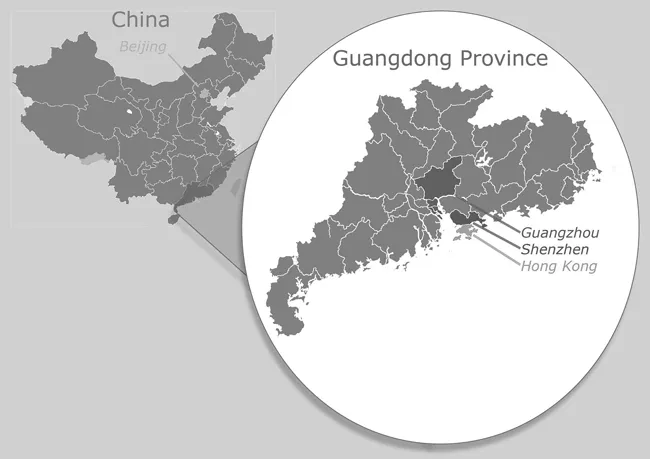
I conducted ethnographic fieldwork predominantly in the province of Guangdong in South China (see Figure 1.1), the very first site of economic experimentation under economic reform initiated by Deng Xiaoping.
Figure 1.1 Map graphic by Jonathan Howell, using the following maps via Wikimedia Commons: China—By Wlongqi—Own work, CC-BY-SA-3.0, https://commons.wikimedia.org/w/index.php?curid=19242509 accessed August 10, 2016. Guangdong Province—By NordNordWest/Wikipedia, CC-BY-SA-3.0-DE, https://commons.wikimedia.org/wiki/File:China_Guangdong_location_map.svg accessed August 10, 2016. From: http://creativecommons.org/licenses/by-sa/3.0/de/legalcode accessed August 10, 2016.
Known as “socialism with Chinese characteristics,” Deng’s program set out to allow a market mechanism to grow within a socialist territory. Adopting a pragmatic attitude toward national development, Deng refused to follow the Maoist doctrine, characterized as scientific socialism, that any economic strategy should be justified by the doctrines of Marx and Engels before being put into practice. Deng and the Party legitimized their reform program by noting that the reorganization of the economy followed the natural laws of the market and thus is rational and scientific, which serves to achieve the socialist ends of national economic prosperity, social stability, and prestige in the global arenas of economy and politics. In order to restore the national economy after the ten catastrophic years of the Cultural Revolution, Deng believed that socialist development should be approached practically and flexibly with realistic goals. Deng’s main concern was the concrete outcomes of implementing any economic strategy.
The reform program started with a focus on foreign direct investment and export-oriented manufacturing. China’s leadership first established four special economic zones in four cities (Shantou, Shenzhen, Zhuhai, and Xiamen) in the provinces of Guangdong and Fujian, located in the southern corner of the country. Guangdong and Fujian were used by the central state as a site of economic experimentation or “a testing stone thrown in the dark to get a reaction for determining what should be done next” (Lin 1997: 59). Not only do the experiments clearly demonstrate the pragmatic approach of Deng’s reform program, but they also demonstrate that Chinese leadership did not have a clear and detailed blueprint for implementing the economic reforms (Naughton 1995: 5). This also created a condition as well as ethos of uncertainty where economic, social, and legal parameters were in flux, a topic to be discussed in Chapter 3. The experiments in Guangdong and Fujian have been so successful that they have changed the positions of Guangdong and Fujian in the hierarchy of provincial significance, from backwater places to the first provinces in China under reform to receive foreign investment. Moreover, the success in Guangdong and Fujian has also led to a series of special open cities and development zones that have gradually expanded the scope of the economic reforms. The success of these two provinces as sites for production of exports and accumulation of capital has paved the way for the special economic zone model to develop into an urban formula in China (Bach 2011, 2017).
Compared to other regions in China, the Pearl River Delta region, the main fieldsite of this study, is distinguished by its leading role in attracting foreign capital investment and export production. The definition of what this region encompasses geographically has gone through several changes. The first official definition of this region came in 1985 when the delta was officially announced as an open economic region to be offered preferential treatment to foreign investors. According to this official definition, the Pearl River Delta included four municipalities (Foshan, Jiangmen, Zhongshan, and Dongguan) and 13 counties (Doumen, Bao’an, Zengcheng, Panyu, Nanhai, Shunde, Gaoming, Heshan, Xinhui, Taishan, Kaiping, Enping, and Sanshui) (Lin 1997: 79). In 1987, another new definition of the delta came about and its geographic area was expanded further to include three more municipalities (Qingyuan, Huizhou, and Zhaoqing) and eight counties (Huaxia, Chonghua, Huiyang, Huidong, Boluo, Gaoyao, Sihui, and Guangning) (Lin 1997: 80).
It should be noted that both the 1985 demarcation and the 1987 designation of the Pearl River Delta were made mainly for the purpose of attracting foreign investment. No administrative authorities were set up to govern this region. More crucially, neither Guangzhou, which has traditionally been the main economic center of the delta, nor Shenzhen and Zhuhai, two special economic zones, were included in the 1985 and 1987 official definitions of the delta since they had already been granted special power and status to manage foreign economic affairs (Lin 1997: 80). However, some scholars think it is inappropriate to separate Guangzhou, Shenzhen, Zhuhai and even Hong Kong and Macao from the Pearl River Delta (Lin 1997), a stance shared in this study. As such, in this study, the Pearl River Delta region refers to the areas specified in both the 1985 and 1987 definitions as well as Guangzhou, Shenzhen, Zhuhai, Hong Kong, and Macao.
As one of the most populous and agriculturally productive regions in China, the Pearl River Delta has long been the country’s southern gateway for foreign trade and sea transportation. This region was chosen as the first target of the central government’s reform program partly due to its geographic isolation in relation to the political center of Beijing and the economic hub of Shanghai. Its remoteness is further accentuated by the presence of high mountains, which physically separate the delta from the vast territory of the country (Lin 1997: 83).
With the advancement of modern telecommunications and transportation, these high mountains may not pose a major concern. However, the physical barrier of the mountains has been a crucial element in shaping the historical development of the region (ibid.). As geographer George C. S. Lin notes,
It is such remoteness that has given the local people considerable flexibility in seeking development, and, in some circumstances, the possibilities of rebellion or revolution, as evidenced by the 1910 republican revolution led by a delta native, Dr. Sun Yat-sen.
Indeed, the ability to strategically deploy the geographical as well as political positions of remoteness into an advantage has resulted in some crucial revolutionary movements in China in the twentieth century that had important bases of activism in the coastal cities of southern China and networks of support among the overseas Chinese, not least Guangzhou (Cartier 2008 [2001]: 143–175). In a similar vein, the geographic remoteness of the Pearl River Delta has allowed the labor NGOs, activists, and foreign donors to navigate more flexibly through policy space where they can maneuver to find space for activism. This is an important historical and geographic context against which the high concentration of labor NGOs in the Pearl River Delta and their connections with the international community, particularly in and via Hong Kong, are to be understood.
The NGO form
As I wrote this chapter in 2015, nongovernmental organizations (NGOs) have already been a highly visible feature across many societies and become increasingly normalized as key players in national and global politics (Pan 2016). NGOs have been around for at least two centuries (Davies 2014), but from the late 1980s, a global associational explosion with a particular enthusiasm for NGOs as a form of organizing and acting collectively started to captivate the imagination of researchers and policymakers (Fisher 1997: 440). Two reasons account for this keen interest. The first has to do with the political transformation that had taken place in Eastern Europe and Latin America where the idea of civil society was reexplored by activists. NGOs were seen as part of a growing civil society that could engage with the state (Fisher 1997; Schuller & Lewis 2014). In this post-Cold War context, NGOs were valued to be able to contribute to the democratizing processes (Huntington 1991; Fisher 1997: 444). The second reason is the rise of the so-called new public management in advanced capitalist countries that supported the rolling back of the state and public services. In other words, there was a paradigm shift in governance toward more flexible forms of “good governance” promoted by international development agencies such as the World Bank that favored NGOs as important private actors within the wider neoliberal restructuring (Fisher 1997: 444; Schuller & Lewis 2014: 1). NGOs have been hailed as a “magic bullet” that will simply find its target and cure the ills that have befallen the development processes (Edward & Hulme 1996: 3–16).
NGOs are now well established as an institutional form that works with a whole range of diverse issues and areas concerning development, humanitarian aid, human rights, labor rights, women’s welfare and empowerment, health, and environment. It seems as if every agenda and political project has a corresponding NGO. The proliferation and diversity of NGOs around the globe has led many to interrogate the nature and functioning of NGOs, the impact NGOs have on nations and states, and, ultimately, the role of NGOs in shaping global and local configurations of power and inequality. Interestingly, despite their diversity and heterogeneity, NGOs are viewed as a unified phenomenon whether they are taking up some aspects of the state or corporations. Nevertheless, it is also precisely the expansion and diversity of NGOs that has complicated efforts to comprehend and theorize such an institutional form (Bernal & Grewal 2014; Lewis & Schuller 2017). As such, some scholars also suggest that discussions on NGOs should focus not so much on the assessments of the work done by NGOs as on the nature of the NGO as a form of organizing, that is, “the NGO form” (Bernal & Grewal 2014: 6–11).
The scholarship on NGOs remains divided. A large body of literature sees NGOs as an instrumental and apolitical tool that can be wielded to achieve various development goals. NGOs are imagined to have the ability to transfer training and skills that educate and help individuals and communities to compete in markets, to provide social welfare services to people who are marginalized by the markets, and to advance democratization and the growth of civil society (Frantz 1987; Fowler 1991; Fisher 1997; Mehra 1997). For some scholars, NGOs are civil society organizations that emerge in opposition to the state and provide important checks to state power (Bratton 1989; Clarke 1998). In this perspective, NGOs are viewed as an important alternative to the state under some circumstances such as reducing the costs of developing countries’ institutional weaknesses (World Bank 1991). Some researchers also contend that NGOs are best understood as agents or consequences of neoliberalism and play an active role in expanding globalization processes and forming part of a “contemporary neoliberal aid regime” (Schuller 2009: 84).
More critical perspectives on the relationship between NGOs and development have emerged since the early 2000s. Some scholars view NGOs as being coopted by neoliberal institutions (Kamat 2004), others place NGOs within the transnational circuit of neoliberal power (Grewal 2005), and still others see NGOs as being caught in a double bind negotiating relations with funding agencies, governments, and neoliberal processes while trying to work with the disenfranchised communities that they intend to serve. In an even more political register, some development critics emphasize NGOs’ potential for posing challenges to as well as bringing forth transformations of relationships of power. Here, NGOs are seen to be able to engage in a struggle for moral and political autonomy from the state, political parties, and the interests of the development industry (Friedman 1992; Lind 1992). In this view, NGOs and activists are not deemed as part of a growing civil society that engages with the st...
Table of contents
Cover
Half Title
Series Page
Title Page
Copyright Page
Table of Contents
Acknowledgments
A note on names, translations, and currency issues
Introduction
1 Locating uncertainty
2 Pragmatic state, precarious labor
3 Uncertainty at work
4 The politics of mingan
5 Intimating secrecy
6 Collective action
Conclusion: laboring through uncertainty
Index
Trusted by 375,005 students
Access to over 1.5 million titles for a fair monthly price.
Study more efficiently using our study tools.
Frequently asked questions
Yes, you can cancel anytime from the Subscription tab in your account settings on the Perlego website. Your subscription will stay active until the end of your current billing period. Learn how to cancel your subscription
No, books cannot be downloaded as external files, such as PDFs, for use outside of Perlego. However, you can download books within the Perlego app for offline reading on mobile or tablet. Learn how to download books offline
Perlego offers two plans: Essential and Complete
Essential is ideal for learners and professionals who enjoy exploring a wide range of subjects. Access the Essential Library with 800,000+ trusted titles and best-sellers across business, personal growth, and the humanities. Includes unlimited reading time and Standard Read Aloud voice.
Complete: Perfect for advanced learners and researchers needing full, unrestricted access. Unlock 1.5M+ books across hundreds of subjects, including academic and specialized titles. The Complete Plan also includes advanced features like Premium Read Aloud and Research Assistant.
Both plans are available with monthly, semester, or annual billing cycles.
We are an online textbook subscription service, where you can get access to an entire online library for less than the price of a single book per month. With over 1.5 million books across 990+ topics, we’ve got you covered! Learn about our mission
Look out for the read-aloud symbol on your next book to see if you can listen to it. The read-aloud tool reads text aloud for you, highlighting the text as it is being read. You can pause it, speed it up and slow it down. Learn more about Read Aloud
Yes! You can use the Perlego app on both iOS and Android devices to read anytime, anywhere — even offline. Perfect for commutes or when you’re on the go. Please note we cannot support devices running on iOS 13 and Android 7 or earlier. Learn more about using the app
Yes, you can access Doing Labor Activism in South China by Darcy Pan in PDF and/or ePUB format, as well as other popular books in Social Sciences & Political Economy. We have over 1.5 million books available in our catalogue for you to explore.