This book investigates how social media are reconfiguring dying, death, and mourning. Taking a narrative approach, it argues that dying, death, and mourning are shared online as small stories of the moment, which are organized around transgressive moments and events with motivational, participatory, or connective scope. Through the different case studies discussed, this book presents an empirical framework for analyzing small stories of dying, death and mourning as practices of sharing which become associated with specific modes of affective positioning, i.e. modulations of different degrees of distance or proximity to the death event and the dead, the networked audience(s), and the affective self. The book calls for the study of affect as integral to narrative activity and opens up broader questions about how stories and emotion are mobilized in digital cultures for accruing audiences, value (social or economic), and visibility. It will be of interest to researchers in narrative analysis, the anthropology and sociology of emotion, digital communication, media and cultural studies, and (digital) death and dying.
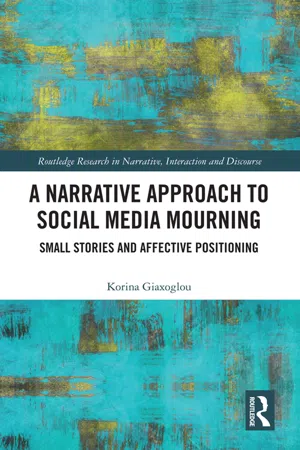
eBook - ePub
A Narrative Approach to Social Media Mourning
Small Stories and Affective Positioning
- 224 pages
- English
- ePUB (mobile friendly)
- Available on iOS & Android
eBook - ePub
A Narrative Approach to Social Media Mourning
Small Stories and Affective Positioning
1
Introduction
Why Mourning?
Mourning is the reckoning with death, the dead, and the self with(in) and with(out) the other. This reckoning is poignantly illustrated in Jacques Derrida’s (2001) essay-tributes to fourteen of his eponymous friends and colleagues, among whom Roland Barthes, Paul De Man, Michel Foucault, and Louis Althusser. In his work of mourning, Derrida enacts his memorial gestures to those who passed away before him, as if walking on a tightrope between the refusal to speak and the need to speak of his dead friends; between inscribing death as something absolutely unique and yet as something shared and public, subject to the iterations of conventional rhetorical moves. Derrida’s reflections exemplify the double-edged nature of mourning as a personal response to loss and a responsibility to the dead and their memorialization.
In mourning the singular and the iterable, the personal and the social are weaved together, providing a unique window to the practices and politics of how subjects, affective relationalities, and socio-political bodies are formed. It is this intricate connectedness of the personal, the social, and the political that has turned mourning into an object of academic study across different disciplines, as much as into a topic of public interest.
As seventeenth-century French author François de la Rochefoucauld, notes “death, like the sun, cannot be looked at steadily or directly” (cited in Manning, 2009, p. 379). The question is, then, what kinds of ‘filters’ are made available in different societies for ‘looking’ at death, dying, and bereavement at various degrees of distance. One such common filter, for example, is talking about death: Even though the raw experience of dying and grieving may be more difficult to put into words and share with others, talking about death as an event, e.g. a funeral, a memorial ceremony, or a media event, often makes for an engaging topic of conversation or story material that allows death to be embedded, at least in part, to the everyday – even if, often, at some distance from the painful realities it can evoke.
The recognition that some aspects of death are routinely talked about in specific contexts – in line with local conversational norms – suggests that death is not as much of a taboo or ‘banished’ as it has often been assumed (see Gorer, 1955; Ariès, 1981, pp. 579–583). As Jupp and Walter (1999) note, the death-as-taboo thesis has become something of a journalistic cliché, a conventional formula used to frame public discussions on death in terms of an assumed need to discuss it more openly – consider, for example, the motto ‘Let’s talk about death’ featured in many Death Café events.1 This idea has been also pervading the public discourse about grief – consider, for example, the online support network ‘Let’s talk about loss: talking through the taboo2’ (for a more detailed discussion of the death-as-taboo thesis, see Chapter 2).
If, however, death and mourning were banished, forbidden, or hidden, it would be invisible. And yet, death is all around. As Tony Walter points out (2014), the need to talk about death or mourning does not really emerge from its ‘repression’ in contemporary society. It is, rather, motivated by the need to make sense of the ongoing and substantial changes in dying, mourning rituals, and beliefs about the afterlife, as well as by an incessant need to reflect on the implications of death for personal and social life. Other scholars have also pointed out the importance of approaching death not so much as ‘taboo’ but in relation to the particular structures that configure the ways we encounter and experience it (see for example Noys, 2005, p. 3).
In this book, death, dying, and mourning are approached as tellable, narratable, and thus, visible in social life under particular conditions of tellership and participation, which are worthy of empirical investigation. My aim is to shed light onto the narrative, affective, and identity modes, which are constituted by – as much as they constitute – the diverse and changing frames for tellership and participation in mourning. The chapters that follow focus specifically on mourning in social media contexts inspired by the narrative approach to interaction and social media communication known as the small stories research paradigm (Georgakopoulou, 2015; see Chapter 3 for a discussion of this approach). Taken together, the chapters of this book address the question of how contemporary technologies of communication and connectedness online are mobilized for dealing with the end of life, for remediating existing rituals, story forms, and affective norms for mourning and memorialization, and for assessing technologies’ potential and limits.
Mourning and Social Media
The questions addressed in this book resonate with ongoing scholarly and public debates on the opportunities and the risks of internet technologies or the “unintended negative consequences of benevolent design” as the creator of the web, Tim Berners-Lee (2019, n.p.), puts it. These debates are not new, given that the technologies we live with are not entirely new, either. In her introduction to the edited collection on Networked Self and Birth, Life and Death, Papacharissi (2019) notes that we have always lived – and died – with technology or techne, i.e. the art of getting through everyday life by doing things in optimal, imaginative, and gratifying ways; and all too often, our worries about technology have reflected and continue to reflect our misunderstanding of our complex relationship to it (p. 1).
As is the case with every technology, digital technologies of communication and sharing through computers, mobile devices, and social media applications have been reconfiguring existing modes for the production of events, stories, and subjectivities (in parts of the world with access to these technologies). These modes are inflected by – as much as they inflect – the ways in which ‘new’ media refashion or remediate prior media forms (Bolter and Grusin, 1999, p. 273) in the broader contours of dominant and emerging social structures.
The impact of structures on social life has been described under various labels branding societies, for example, as network societies (Castells, 2004) or cultures of participation (Jenkins, 2006) and connectivity (van Dijck, 2013). These descriptions, appealing as they may seem to be, are grounded in a culturist approach to the internet and make part of the positive techno-social imaginaries of the so-called Information Age (Castells, 2000). As Fuchs (2014, pp. 60–61) notes, culturalist approaches tend to reify and overstate the creativity and agency of users on the web, while underplaying the commodification and exploitation of such creativity. And yet, the commodification of users’ online activity is increasingly intensified in the so-called Age of Sharing, where the positive connotations of sharing serve to reinforce at the same time as to camouflage the commercial aspect of social media platforms (John, 2017, p. 64). The rhetorical mobilization of personal and relational vocabulary for commercial ends is further attested in the recent rebranding of the Information Age in current business and technology writing as the Age of Experience (BA Times, 2019; Tech Crunch, 2016). The buzzword is used to foreground the potential of sharing the moment for creating ‘experiences’, which foster strong emotional interconnections as well as help to increase the social and monetary value of shared content. Such emotion-tinted ‘experiences’ are constitutive of ‘visceral data’, i.e. affective states, such as ‘flow’, ‘engagement’, and ‘boredom’, generated in the use of technological devices and circulated via them (Powell, 2018, pp. 13–14).
The emphasis on generating and disseminating emotion attests to the broader importance that emotion has been accumulating in everyday and professional domains (Illouz, 2007) as well as in the media, where they form the basis of aesthetic experience, entertainment, but also collective identities, values, and modes of action (Eder et al., 2019). Anne-Cécile Robert (2018) discusses this turn to emotion and addresses the discontents of what she calls “the emotion doctrine” (echoing Naomi Klein’s ‘shock doctrine’, 2008), whereby catastrophes are put to the service of capitalist reproduction, dominating the news and fostering tears over reasoned reflection and meaningful social and political action.
While Robert’s approach takes a critical pessimist angle on the emotionalization of society in and through media events, this book takes a more nuanced, empirical angle on such phenomena drawing on evidence from social media, which have been acknowledged as an important affective platform for communication about illness, death, and mourning (Stage and Hougaard, 2018). The practices that will be discussed are viewed as intricately connected to processes of mediatization and social-mediatization, which are briefly discussed in the remainder of this introduction in relation to death, dying, and mourning.
Mediatization
Mediatization is a sensitizing concept, which is useful insofar as it helps draw attention to the media’s increasing permeation of “all aspects of private, social, political, cultural and economic life, from micro (individual) to the meso (organizational) and the macro (societal) level of analysis” (Strömbäck and Esser, 2014, p. 10). Mediatization processes impact the way we approach death, given that they entail specific frames for encountering and experiencing death. As Jacobsen (2016) notes, in contemporary culture, death (often gory and dramatic) is exposed and made instantaneously available globally through the screens of television, computer, or mobile phone, calling forth momentary affective reactions on the part of the viewers. This “spectacular death”, which “inaugurates an obsessive interest in appearances that simultaneously draws death near and keeps it at arm’s length” (p. 10), textures the new mediated and mediatized visibility of death and mourning.
This visibility is always selective, and it is revealing of dominant forms of thanatopolitics, whereby some types of death attract high levels of visibility and turn into media spectacles (see Kellner, 2002), reinforcing the grievability of certain lives over that of others (Butler, 2004). Poignant examples of media spectacles of death in recent times have been the September 11, 2001 attacks against targets in the United States and more recently, the attacks across different targets in Europe from 2015 to 2017, which have taken a terrible toll on human life and called forth widespread public mourning. In the extensive media coverage of these disasters, mourning has been recurrently mobilized as a resource for national unity and as a political communication strategy of confidence building and grief management (Sontag, 2001). As Edwards and Martins (2004) note, sharing sympathy or pity and negotiating public solidarity has been typically articulated along the drawing up of sharp distinctions between ‘us’ and ‘them’, as part of broader practices of negotiating and discursively constructing “the boundaries of identity” (p. 153) and creating collective identities, i.e. “conceptual structures comprising beliefs and knowledge, norms and values, attitudes and expectations as well as emotions, […] reinforced and negotiated in discourse” (Koller, 2012). In other words, in conditions of a heightened sense of fear, death and mourning become key resources for displaying emotional alignment (or disalignment) with specific groups of people, values, and moral stances.
The mobilization of death and mourning in contemporary media has been (re)producing a sense of intimacy at a distance fostered by modern mass media, especially radio and TV (Horton and Wohl, 1956, p. 215 cited in Montgomery, 1999, p. 5).3 As Jacobsen (2016) notes, “spectacular death” is something that we witness at a safe distance with equal amounts of fascination and abhorrence, we wallow in it and want to know about it without getting too close to it” (p. 10).
The media coverage of large-scale death events, such as attacks and disasters, especially since 2001, and their extension to immediate reactions on social media have further pushed this blending of intimate styles with the public construal of mourning as a collective affective experience.
Social Mediatization
Social media audiences witness death events through shared stories (Page, 2018), which are opened up to public scrutiny as well as to ecstatic modes of affective participation (see Chouliaraki, 2006; Papacharissi and de Fatima Oliveira, 2012; Giaxoglou, 2018). Shared stories emerge in – and through – media events reconfigured into hybrid media events, where elements of ceremonial and vernacular mass communication forms converge in complex networks of mass media, internet-based, and mobile communication technologies; hybrid media events...
Table of contents
- Cover
- Half Title
- Series Page
- Title Page
- Copyright Page
- Dedication Page
- Contents
- List of Figures
- List of Tables
- List of Image
- Acknowledgements
- 1 Introduction
- 2 Histories of Mourning
- 3 A Small Stories Approach to Social Media Mourning
- 4 Small Stories of Illness and Dying on YouTube
- 5 Small Stories of Everyday Mourning on Facebook
- 6 Small Stories of Ecstatic Mourning on Twitter
- 7 Visual Small Stories of Mourning on Twitter
- 8 Small Stories of Mourning and Affective Positioning
- Index
Trusted by 375,005 students
Access to over 1.5 million titles for a fair monthly price.
Study more efficiently using our study tools.
Frequently asked questions
Yes, you can cancel anytime from the Subscription tab in your account settings on the Perlego website. Your subscription will stay active until the end of your current billing period. Learn how to cancel your subscription
No, books cannot be downloaded as external files, such as PDFs, for use outside of Perlego. However, you can download books within the Perlego app for offline reading on mobile or tablet. Learn how to download books offline
Perlego offers two plans: Essential and Complete
- Essential is ideal for learners and professionals who enjoy exploring a wide range of subjects. Access the Essential Library with 800,000+ trusted titles and best-sellers across business, personal growth, and the humanities. Includes unlimited reading time and Standard Read Aloud voice.
- Complete: Perfect for advanced learners and researchers needing full, unrestricted access. Unlock 1.5M+ books across hundreds of subjects, including academic and specialized titles. The Complete Plan also includes advanced features like Premium Read Aloud and Research Assistant.
We are an online textbook subscription service, where you can get access to an entire online library for less than the price of a single book per month. With over 1.5 million books across 990+ topics, we’ve got you covered! Learn about our mission
Look out for the read-aloud symbol on your next book to see if you can listen to it. The read-aloud tool reads text aloud for you, highlighting the text as it is being read. You can pause it, speed it up and slow it down. Learn more about Read Aloud
Yes! You can use the Perlego app on both iOS and Android devices to read anytime, anywhere — even offline. Perfect for commutes or when you’re on the go.
Please note we cannot support devices running on iOS 13 and Android 7 or earlier. Learn more about using the app
Please note we cannot support devices running on iOS 13 and Android 7 or earlier. Learn more about using the app
Yes, you can access A Narrative Approach to Social Media Mourning by Korina Giaxoglou in PDF and/or ePUB format, as well as other popular books in Business & Media & Communications Industry. We have over 1.5 million books available in our catalogue for you to explore.