Home Gardens for Improved Food Security and Livelihoods demonstrates how home gardens hold particular significance for resource-poor and marginalized communities in developing countries, and how they offer a versatile strategy toward building local and more resilient food systems.
With food and nutritional security being a major global challenge, there is an urgent need to find innovative ways to increase food production and diversify food sources while increasing income-generating opportunities for communities faced with hunger and poverty. This book shows that when implemented properly, home gardens can become just such an innovative solution, as well as an integral part of sustainable food security programs. It provides a conceptual overview of social, economic, environmental and nutritional issues related to home gardening in diverse contexts, including gender issues and biodiversity conservation, and presents case studies from Africa, Asia and Latin America highlighting home gardening experiences and initiatives. The volume concludes with a synthesis of key lessons learned and ways forward for further enhancing home gardens for sustainable food security and development.
This book will be a useful read for students and scholars working on local food systems, food security, sustainable development and more broadly development strategy.
1 Understanding the global practice of home gardening
D. Hashini Galhena Dissanayake
Home gardens have been an integral part of local farming and food systems since the beginning of civilization. The very beginning of modern agriculture dates back to subsistence production systems that began in small garden plots around the household. In fact, domestication and conservation of crops, especially horticultural crops, began in home or kitchen gardens, hence the word “horticulture” is derived from the Latin words hortus meaning garden and cultūra meaning cultivation. In establishing gardens, ancient Egyptians were attentive to the symbolical meaning and form (Wilkinson, 1994). An assortment of vegetable, fruit and root crops, flowers and vines were selected and planted accordingly (Janick, 2002). The Mayans discovered and perfected the practice of multi-cropping in their gardens (von Baeyer, 2010). The Greeks and Romans maintained kitchen gardens next to their households. The Greeks applied gardening knowledge and practices of the Persians and fine-tuned gardening techniques such as enclosed growing, grafting, budding and rotation. Across the world, home gardens have persistently endured the test of time and continued to play an important role in providing food and income for families (Marsh, 1998).
Defining home gardening
Home gardening is practiced widely all over the world. In literature, home gardens are referred to as kitchen, backyard, dooryard, household, homestead and mixed gardens as well as farmyard enterprise and compound cultivation (Niñez, 1987; Fresco and Westphal, 1988; Midmore et al., 1991). Many definitions of home gardens can be found in literature derived through spatial observation and field research. G.J.A. Terra pioneered the literature on home gardens in the early 1950s with his publications on “Mixed Garden Horticulture in Java” and defines the home garden as “an area of land, individually owned, surrounding a house and usually planted with a mixture of perennials and annuals” (Terra, 1954).
Home gardens are predominantly small-scale subsistence agricultural system and are found across the rural, suburban, and urban landscape (Niñez, 1987; Nair, 1993). Vera Niñez (1987) composes a more elaborate definition that attempts differentiate home gardens from other agricultural production systems and states,
“the household garden is a small-scale production system supplying plant and animal consumption and utilitarian items either not obtainable, affordable, or readily available through retail markets, filed cultivation, hunting, gathering, fishing, and wage earning. Household gardens tend to be located close to dwelling for security, convenience, and special care. They occupy land marginal to field production and labor marginal to major household economic activities. Featuring ecologically adapted and complementary species, household gardens are marked by low capital input and simple technology.” Another scholar writes that home gardens are “cropping systems characterized by the permanent use of small, mostly fenced, plots at a short distance from the homestead with a variable number of annual, biennial and/or perennial intercrops giving rise to a multi-story physiognomy.”
(Fresco and Westphal, 1988, p. 405)
Instead of providing any definition or accepting those of others, some authors merely describe home gardens as “intimate, multi-story combinations of various trees and crops, sometimes in association with domestic animals, around homesteads” (Kumar and Nair, 2004, p. 135). Some authors identify home gardens as an integral part of the local land-use system and the watershed (Fresco and Westphal, 1988) and part of the larger agricultural landscape: “home gardens are microenvironments within a larger farming system that contain high levels of species diversity and may contain crop species or varieties of species different from those found in surrounding agroecosystems” (Eyzaguirre and Linares, 2004). Other definitions illustrate the home garden as a parcel of land near the family dwelling that spreads vertically and horizontally that serves multiple purposes, holding multiple species of crops and animals (Photo 1.1). For instance, Hoogerbrugge and Fresco (1993) state that “a home garden is a small-scale, supplementary food production system by and for household members that mimics the natural, multi-layered ecosystem.” This refers to a perpetual and subsistent food system with the primary goal to fulfill and supplement household needs.
Photo 1.1 A typical home garden in the humid tropics
Source: D. H. Galhena Dissanayake.
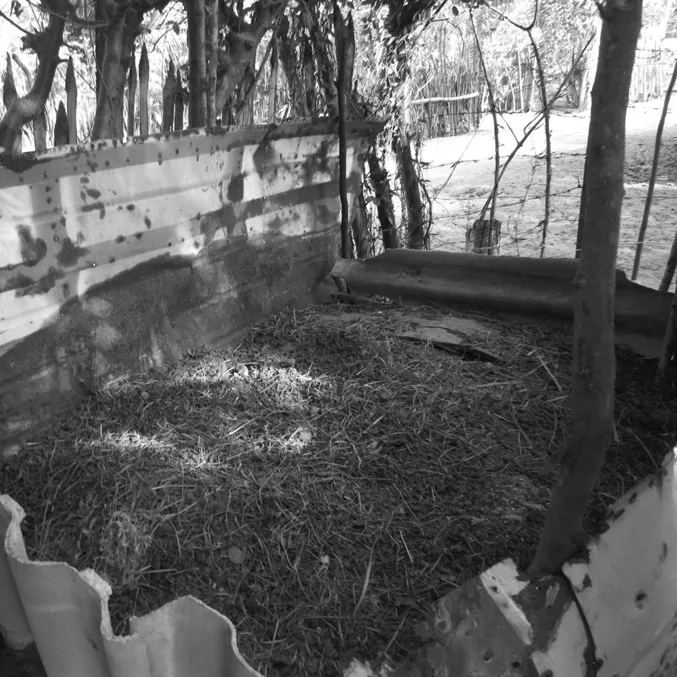
The diverse plants and animal products from home gardens have multiple uses. For instance, herbs and weeds are often used in indigenous medicines and teas and as aromatics, seasonings, dyes, green vegetables and fibers for weaving (Buchanan, 2012; Gökçebağ and Özden, 2017). The livestock in the home garden provides a source of protein-rich food, alternative fuel and energy, and fertilizer and manure for composting (Pulami and Paudel, 2004). Compost containing livestock, kitchen and yard waste is often the primary source of nitrogen (N), phosphorus (P), potassium (K) and organic matter for the home garden (Photo 1.2). Though output from the home gardens is mainly intended for family consumption, the surplus output from the home garden can be sold for additional income (Mendez et al., 2001; Yiridoe and Anchirinah, 2005; Sthapit et al., 2006; Ferdous et al., 2016). In addition to these obvious outcomes, home gardens provide several ecological benefits, from air purification to preservation (Galluzzi et al., 2010; Calvet-Mir et al., 2016). As such, there is much complexity to what the home gardens can do, which perhaps explains the lack of consensus among scholars on a universal definition.
Photo 1.2 Composting pile in home garden
Source: D. H. Galhena Dissanayake.
Factors that characterize home gardens
The body of literature defining home gardens has continued to expand extensively to integrate characteristic variations across space, species diversity and composition, range of functions, cultural values, social and economic impacts, conservation and environmental aspects, adding various dimensions and perspectives to the discourse (Kumar and Nair, 2004; Galluzzi et al., 2010; Push-pakumara et al., 2012; Langellotto, 2014; Igwe et al., 2014). There is also a growing body of literature showcasing the gender-related issues surrounding home gardens (Zypchyn, 2012; Schreinemachers et al., 2015; Nguyen et al., 2017). However, as Gupta (1989) pointed out, literature on home gardens at times may not adequately reflect the values and opinions of the home gardener, as the background, gender and predispositions of the scholars take precedence and influence the way various arguments around home gardens are presented. Given this background, attempts to characterize home gardens include some biases resulting from limitations in the research design, sampling and interview process, and reporting. Mitchell and Hanstad (2004), referring to research by Brownrigg (1985) and Marsh (1998), provide five attributes to a home garden: (1) it is located near the residence; (2) it occupies a small area; (3) it contains a high diversity of plants; (4) it provides a supplemental source of food and other materials for family consumption and income generation; and (5) it is a practice that the poor can easily adopt. Moreover, they are described to be low input and low management production systems (Huai and Hamilton, 2009; Gautam et al., 2009).
Home gardens are generally viewed as agroforestry units, small-scale food systems or both (Torquebiau, 1992; Maroyi, 2009; Pushpakumara et al., 2012). They are delimited by physical demarcations such as live fences or hedges, fences, ditches or boundaries established through mutual understanding. Based on the ecology, home gardens may be of two categories: tropical or temperate (Niñez, 1985). There is a plethora of research and case studies focusing on tropical home gardens, primarily in Central and South America (Del Angel-Pérez and Mendoza, 2004; Albuquerque et al., 2005; Perrault-Archambault and Coomes, 2008; Vazquez-Garcia, 2008; Aguilar-Støen et al., 2009). There is also a growing body of literature highlighting various dimensions of home gardens from Asia (Perera and Rajapakse, 1991; Talukder et al., 2000, 2006; Abdoellah et al., 2001; Cai et al., 2004; Ali, 2005; Sunwar et al., 2006) and Africa (Tchatat et al., 1996; Drescher et al., 1999; High and Shackleton, 2000; Faber et al., 2002; Faber and Wenhold, 2007; Maroyi, 2009). Home gardens in temperate areas have also been discussed widely (Cleveland et al., 1985; Seeth et al., 1998; Agelet et al., 2000; Thompson et al., 2003; Morton et al., 2008; Jesch, 2009; Rigat et al., 2009; Aceituno-Mata, 2010; Bassullu and Tolunay, 2010; Reyes-García et al., 2010; Calvet-Mir et al., 2012). Several studies focus on home gardens in industrialized countries (Cleveland et al., 1985; Bleasdale et al., 2011). Depending on the location, home gardening is practiced year-round or seasonally.
Several articles note that home gardens share some similarities across space, and yet they maintain some differentiation with regards to structure, functionality and composition (Fernandes and Nair, 1986; Soemarwoto and Conway, 1991; Torquebiau, 1992). In addition to the natural ecology of the location, such variation is due to factors such as family assets base (land, capital, etc.), inputs access (seeds, labor, etc.), know-how, enthusiasm and preferences (Christanty et al., 1986; Asfaw, 2002). Wiersum (2006),...
Table of contents
Cover
Half Title
Series Page
Title Page
Copyright Page
Dedication Page
Contents
Preface and Acknowledgement
List of tables, figures, boxes and photos
List of contributors
Foreword
1 Understanding the global practice of home gardening
2 Home gardens for nutritional security of men, women and children
3 Keeping it close to home: home gardens and biodiversity conservation
4 Gender and home gardens: toward food security and women’s empowerment
5 Home gardens for better health and nutrition in Mozambique
6 Home garden experiences in Costa Rica
7 Bio-innovations toward sustainable agriculture: success stories from India
8 Home gardens as a resilience strategy for enhancing food security and livelihoods in post-crisis situations: a case study of Sri Lanka
9 Complementarity between the home gardening and livestock production systems in Nepal
10 Kitchen vegetable gardens for food and nutritional security of the poorest in rural India – experiences of the Aga Khan Rural Support Programme
11 Lessons learned and the way forward on home gardens
Index
Trusted by 375,005 students
Access to over 1.5 million titles for a fair monthly price.
Study more efficiently using our study tools.
Frequently asked questions
Yes, you can cancel anytime from the Subscription tab in your account settings on the Perlego website. Your subscription will stay active until the end of your current billing period. Learn how to cancel your subscription
No, books cannot be downloaded as external files, such as PDFs, for use outside of Perlego. However, you can download books within the Perlego app for offline reading on mobile or tablet. Learn how to download books offline
Perlego offers two plans: Essential and Complete
Essential is ideal for learners and professionals who enjoy exploring a wide range of subjects. Access the Essential Library with 800,000+ trusted titles and best-sellers across business, personal growth, and the humanities. Includes unlimited reading time and Standard Read Aloud voice.
Complete: Perfect for advanced learners and researchers needing full, unrestricted access. Unlock 1.5M+ books across hundreds of subjects, including academic and specialized titles. The Complete Plan also includes advanced features like Premium Read Aloud and Research Assistant.
Both plans are available with monthly, semester, or annual billing cycles.
We are an online textbook subscription service, where you can get access to an entire online library for less than the price of a single book per month. With over 1.5 million books across 990+ topics, we’ve got you covered! Learn about our mission
Look out for the read-aloud symbol on your next book to see if you can listen to it. The read-aloud tool reads text aloud for you, highlighting the text as it is being read. You can pause it, speed it up and slow it down. Learn more about Read Aloud
Yes! You can use the Perlego app on both iOS and Android devices to read anytime, anywhere — even offline. Perfect for commutes or when you’re on the go. Please note we cannot support devices running on iOS 13 and Android 7 or earlier. Learn more about using the app
Yes, you can access Home Gardens for Improved Food Security and Livelihoods by D. Hashini Galhena Dissanayake,Karimbhai M. Maredia in PDF and/or ePUB format, as well as other popular books in Technology & Engineering & Sustainable Development. We have over 1.5 million books available in our catalogue for you to explore.