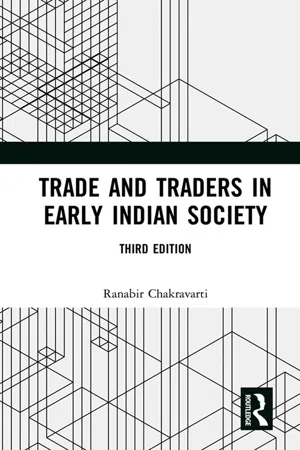
Highlighting diverse types of market places and merchants, this book situates the commercial scenario of early India (up to c. ad 1300) in the overall agrarian material milieu of the subcontinent. The book questions the stereotypical narrative of early Indian trade as exchanges in small quantity, exotic, portable luxury items and strongly argues for the significance of trade in relatively inexpensive bulk commodities – including agrarian/floral products – at local and regional levels and also in long distance trade. That staple items had salience in the sea-borne trade of early India figures prominently in this book which points out that commercial exchanges touched the everyday life of a variety of people. A major feature of this work is the conspicuous thrust on and attention to the sea-borne commerce in the subcontinent. The history of Indic seafaring in the Indian Ocean finds a prominent place in this book pointing out the braided histories of overland and maritime networks in the subcontinent. In addition to three specific chapters on the maritime profile of early Bengal, the third edition of Trade and Traders in Early Indian Society offers two new chapters (14 and 15) on the commercial scenario of Gujarat, dealing respectively with an organization of merchants during the early sixth century ad and with the long-term linkages between money-circulation and overseas trade in Gujarat c. ad 500-1500). A new preface to the Third Edition discusses the emerging historiographical issues in the history of trade in early India. Rich in the interrogation of a wide variety of primary sources, the book analyses the changing perspectives on early Indian trade by taking into account the current literature on the subject.
- 328 pages
- English
- ePUB (mobile friendly)
- Available on iOS & Android
eBook - ePub
Trade and Traders in Early Indian Society
CHAPTER 1
Introduction
The eleven chapters which give this book its present shape are the outcome of the author’s sustained interests in the history of trade in early India. Seven published and four unpublished essays were written in a span of thirteen years, from 1987 to 2000, though most of them belonged to the nineties of the last century. The four hitherto unpublished chapters are the Chapter 1: ‘Introduction’, Chapter 7: ‘Seafaring in the Bengal Coast: The Early Medieval Scenario’, Chapter 10: ‘The Peṇṭhā as a Centre of Trade in the Deccan c. AD 600–1300’ and Chapter 11: ‘Nakhuda Nuruddin Firuz at Soinnath: AD 1264’. The very title of this book makes it amply clear that trade with its various aspects and dimensions forms the common theme of all the chapters. Considering the great dependence of Indian people on agriculture for millennia, it is hardly surprising that the principal thrust in the social and economic historiography of early India would be towards the study of its agrarian milieu. The non-agrarian sector of the economy is therefore often viewed as secondary to the mainstream agrarian economy. This does not however imply that the non-agrarian sector of early Indian economy has been marginally treated in the economic historiography. Crafts, trade and urban centres—the principal facets of the non-agrarian sector of the economy—of early India have indeed attracted sustained attention of historians. After all, early Indian thinkers themselves were certainly aware of the importance of trade or vāṇijya as an occupation. The academic discipline vārttāśastra, so called certainly because of its association with vṛtti or livelihood, included in it vāṇijya or trade along with kṛṣi (agriculture) and paśupālana (cattle keeping and animal husbandry). The Kauṭilīya Arthaśāstra recommends the study of vārttāśastra along with Ānvikṣikī (Philosophy), Trayī (Vedic literature) and Daṇḍanīti (Statecraft) for a prince who would be subsequently become a ruler (I.4.1–4).
There is a long history of lively interests of scholars in the history of trade and urban development in early India. The historiography of early Indian trade also shows a distinct preference for the study of longdistance trade—both overland and overseas—the study of exports and imports, the survey of routes of communication and the enlisting of early Indian ports, especially their possible identifications on a modern map. The other common feature in this historiography is to present urban centres almost invariably as thriving commercial centres and to hold commercial exchanges as the principal causative factor towards urbanization. Without belittling the importance of this conventional narrative approach to the history of trade, it must be emphasized that an understanding of trade and urban centres can hardly be delinked from the agrarian sector. Significantly enough, the expression ‘agro-cities’ has been used to characterize early Indian urban centres.
II
The present volume on trade of course takes into account trade routes, items of export and import and ports in early India. These aspects of trade are presented here not as frozen elements but rather as changing characters, and it is their variations which is strongly emphasized. A few words about the plan of the volume and thematic linkages among chapters may be in order. Some repetitions and overlaps in the treatment of these essays in such a collection as this is perhaps unavoidable. The second chapter surveys the socio-economic situation in India during nine centuries (c. 600 BC-AD 300) which saw extremely important changes in social, economic, political and cultural fields. It delves into the pattern of urban development which assumed a pan-Indian character during the five centuries (200 BC-AD 300), generally labelled as the post-Mauryan period. The spread of urban centres is viewed here as an indicator of growing complexities in society. The proliferation of urban centres often coincided also with the spread of territorial polities in areas which had not hitherto experienced state formation. Such a process, occurring notably in trans-Vindhyan India in the post-Maurya times, speaks of the transformation of the society from a relatively simpler to a more complex stage. The growth of cities during the second urbanization in Indian history coincided with brisk trade, especially long-distance trade of India with areas abroad. But the generation and availability of agricultural surplus seems to have been the principal causative factor for the spurt of urban centres, to which trade provided an additional fillip.
A major thrust of this book is to explore various types of market places and merchants which are often treated as undifferentiated and blanket categories in conventional economic historiography. A few words about perceptions of trade centres may be presented here. Three chapters in this book highlight the diversities of centres of exchange which are the principal arena of merchants’ activities (Chapters 4, 9. and 10). Like different categories of merchants (discussed later), various types of market places also appear in our sources, like those in a nagara or pura (large urban centre), a puṭabhedana (literally, where boxes of commodities were unsealed), nigama (a market centre in between a village and a city), pattanagāma, paṇyapattana/paṭṭinam, velākula (a port), maṇḍapikā (present day mandis in north India), peṇṭhā/piṇṭhā/peṁṭa (cf. modern peṭh in the Deccan and south India). The Tamil Sangam literature informs us of market places held during the day (nālaṅgāḍi) as well as in the evening (allaṅgāḍi); these were located in the area between the coastal tract (maruvurppakkam) and the residential area (paṭṭinappakkam).1 A close study of the puṭabhedana as an exchange centre is available in Chapter 4. It is true that the puṭabhedana figures mostly in literary sources belonging to the second half of the first millennium BC.2
Of large centres of trade in early India mention must be made of ports (velākula in Sanskrit and paṭṭanam/paṭṭinam in Tamil) which dotted both the coasts of India. Ports of early historical times, especially from c. 200 BC to AD 300, figure in Chapter 2 often in the context of India’s long-distance seaborne commerce both with the eastern Mediterranean region and South-East Asia. A distinctive shift in the studies in seaborne trade and ports of India during the last two decades is visible in the increasing utilization of archaeological materials. Roman trade with India, for instance, was primarily studied with reference to the The Periplus of the Erythraean Sea, the Natural History of Pliny and the Geography of Ptolemy. Mortimer Wheeler’s excavation at Arikamedu firmly introduced field archaeological materials as sources to the study of Roman trade with India. In recent times, Vimala Begley’s fresh examinations of the Arikamedu materials demonstrate that the Rouletted Ware throws light actually on the network among ports along the entire length of the eastern sea-board during 200 BC-AD 200.3 The study of amphorae also provides concrete proofs of India’s trade with the Roman empire. An eloquent testimony to India’s role in the trade with the Roman empire is available in a mid-second century AD loan contract document on a papyrus recording the export of Gangetic nard, excellent textile, ivory and tusks on board the ship Hermopollon which was lying at anchor at the celebrated port of Muziris in Malabar. All these were luxury items on which was imposed a customs duty of 25 per cent at the Roman warehouse in Alexandria. Lionel Casson who made a masterly translation and study of this loan contract document4 has also examined afresh Pliny’s account of the development of maritime-routes between India and the West. He suggests that the most improved stage of voyages brought mariners and merchants from a Red Sea port to Malabar in as quick a time as twenty days, which was earlier thought to have taken forty days.5 There are also new developments in the study of the alterations of the monsoon wind system (known as Etasian and Hippalus wind in the Classical literature) which greatly influenced the shipping and navigation patterns in the Indian Ocean. Mazzarino shows that the commonly known hipalus (hippalus) wind, mentioned by Pliny, is actually a misreading of the term hypalum. His reading implied that the wind system was so named not after the Greek sailor Hipplaus, but that the term hypalum stood for seasonal south-west wind.6 Profound scholarship is writ large in the textual comparison between Classical accounts and the Sangam literature on commerce between India and the Roman empire by Romanis.7 Romila Thapar establishes the signal importance of pepper of Malabar, the black gold, in the seaborne trade with the Roman empire; this set the trend for the enormous demand for Malabarese pepper in Europe even up to the early modern times.8
To what extent such widespread trade contacts were conducive to urban development in India is a problem that has demanded considerable scholarly attention. It has already been stated that the five centuries spanning from 200 BC to AD 300 witnessed simultaneous growth of trade, urbanism and territorial states on a pan-Indian scale and to an unprecedented degree. The Deccan and the far south particularly experienced the formation of urban and state society in the post-Maurya period, prior to which there existed virtually no major urban centre and a mahajanapada-like territorial polity in trans-Vindhyan areas. The epicentre of this spread of urban and state society over the greater parts of the subcontinent is generally located in the Ganga valley, and more precisely in the middle Ganga plains, which witnessed the formation of ‘primary’ states and urban centres around the sixth-fifth centuries BC. The pattern of city formation and state formation seen in the Ganga valley was subsequently replicated in the trans-Vindhyan India largely on account of the penetration of the material culture of the Ganga valley into the Deccan and south India following the expansion of the Magadhan power under the Mauryas. Judged from this angle, the emergence of urban centres and territorial states in the Deccan and the far south may represent what anthropologists consider as the formation of ‘secondary’ states and urban centres. It has been further argued that trade, particularly long-distance commerce, plays an important role in the process of secondary urban centres and state societies.9 Dilip K. Chakrabarti’s survey of urban centres up to c. AD 500, largely on the basis of excavated and explored materials, highlights the role of the growth of population, settlement of specialized craftsmen and occupational groups and trade in the making of early historical urban centres. He also considers that many or even most of the major cities were leading religious centres too. Champakalakshmi argues that the spurt of urban centres in Tamilakam during the early centuries of the Christian era can be seen in the marutam (fertile agricultural tracts in major rivers valleys) and neital (coastal area) regions, the latter particularly famous for the paṭṭinams or ports. These ports were the principal points of long-distance trade which mainly revolved around transactions in luxury and exotic items. A thorough examination of the Sangam texts leads her to argue that daily requirements transacted at local level exchange centres were subsistence oriented and not traded in bulk. She therefore explains the growth of urban centres in Tamilakam during early historical times as a result of externa...
Table of contents
- Cover
- Half Title
- Title Page
- Copyright Page
- Dedication Page
- Contents
- Preface to the Third Editions
- Preface to the Second Edition
- Acknowledgements
- List of Abbreviations
- 1. Introduction
- 2. Early Historical India: A Study in its Material Milieu (c. 600 BC-AD 300)
- 3. Merchants and Other Donors at Ancient Bandhogarh
- 4. The Puṭabhedana as a Centre of Trade in Early India
- 5. Rājaśreṣṭhī
- 6. Maritime Trade and Voyages in Ancient Bengal
- 7. Vaṅgasāgara-saṁbhāṇḍāriyaka: A Riverine Trade Centre of Early Medieval Bengal
- 8. Seafaring in the Bengal Coast: The Early Medieval Scenario
- 9. Trade at Maṇḍlapikās in Early Medieval North India
- 10. The Peṇṭhā as a Centre of Trade in the Deccan c. AD 600–1300
- 11. Nakhuda Nuruddin Firuz at Somanātha: AD 1264
- 12. Information, Exchange and Administration: Case Studies from Early India
- 13. An Enchanting Seascape: Through Epigraphic Lens
- 14. Three Copper Plates of the Sixth Century CE
- 15. Gujarat’s Maritime Trade and Alternative Moneys (c. 550–1300 CE)
- Bibliography
- Index
Trusted by 375,005 students
Access to over 1.5 million titles for a fair monthly price.
Study more efficiently using our study tools.
Frequently asked questions
Yes, you can cancel anytime from the Subscription tab in your account settings on the Perlego website. Your subscription will stay active until the end of your current billing period. Learn how to cancel your subscription
No, books cannot be downloaded as external files, such as PDFs, for use outside of Perlego. However, you can download books within the Perlego app for offline reading on mobile or tablet. Learn how to download books offline
Perlego offers two plans: Essential and Complete
- Essential is ideal for learners and professionals who enjoy exploring a wide range of subjects. Access the Essential Library with 800,000+ trusted titles and best-sellers across business, personal growth, and the humanities. Includes unlimited reading time and Standard Read Aloud voice.
- Complete: Perfect for advanced learners and researchers needing full, unrestricted access. Unlock 1.5M+ books across hundreds of subjects, including academic and specialized titles. The Complete Plan also includes advanced features like Premium Read Aloud and Research Assistant.
We are an online textbook subscription service, where you can get access to an entire online library for less than the price of a single book per month. With over 1.5 million books across 990+ topics, we’ve got you covered! Learn about our mission
Look out for the read-aloud symbol on your next book to see if you can listen to it. The read-aloud tool reads text aloud for you, highlighting the text as it is being read. You can pause it, speed it up and slow it down. Learn more about Read Aloud
Yes! You can use the Perlego app on both iOS and Android devices to read anytime, anywhere — even offline. Perfect for commutes or when you’re on the go.
Please note we cannot support devices running on iOS 13 and Android 7 or earlier. Learn more about using the app
Please note we cannot support devices running on iOS 13 and Android 7 or earlier. Learn more about using the app
Yes, you can access Trade and Traders in Early Indian Society by Ranabir Chakravarti in PDF and/or ePUB format, as well as other popular books in History & Indian & South Asian History. We have over 1.5 million books available in our catalogue for you to explore.