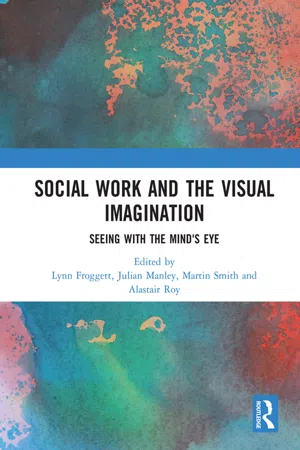
Social Work and the Visual Imagination
eBook - ePub

Social Work and the Visual Imagination

Seeing with the Mind's Eye

  1. 162 pages
  2. English
  3. ePUB (mobile friendly)
  4. Available on iOS & Android
eBook - ePub

Social Work and the Visual Imagination

Seeing with the Mind's Eye

About this book

Images are inscribed in the memory more easily than words, and some remain with the viewer for a lifetime. Combining hindsight, insight and foresight, the chapters in this book turn a spotlight onto various aspects of health, social work and socially engaged arts practice. The visual imagination is evoked in this book to help practitioners see beneath the surface of contentious and problematic issues facing human services today. Risk assessment, child sexual abuse, work-life balance, old age, dementia, substance misuse, recovery, sex work, homelessness, isolation, biography, death and dying, grief, loss, vulnerability, care, and the function of the museum as a preserver of memory, all come under the sustained gaze and examination of the contributors. Grounded in the arts and humanities, the visual sense as a gateway to empathy is explored throughout these chapters. References are included to visual art, curating dramatic performance, poetry, film, dance, photography, diary entries, and public exhibitions. In an age when people increasingly compose their lives by staring into various screens, this book celebrates the visual modality that can humanise services with 'human-seeings'.

This book was originally published as a special issue of the Journal of Social Work Practice.

Trusted by 375,005 students

Access to over 1.5 million titles for a fair monthly price.

Study more efficiently using our study tools.

Information

Publisher
Routledge
Year
2020
eBook ISBN
9780429664656
Topic
Art
Subtopic
Art General
Martin Smith

LOOKING INTO THE SEEDS OF TIME. VISUAL IMAGERY IN MACBETH AND ITS RELEVANCE TO SOCIAL WORK PRACTICE, SUPERVISION AND RESEARCH

This article draws attention to ways in which a close reading of Shakespeare’s Macbeth and careful consideration of its visual imagery can inform social work practice, supervision and research. Elements of social work practice including risk assessment, ‘thinking the unthinkable’ and disguised compliance are discussed in the context of quotations from the play. The part played by reassurance and the desire to reassure in the supervisory relationship are illustrated in the context of psychodynamic and cognitive-behavioural theories. Examples are cited from both historical research which influenced the formation of Attachment Theory, and contemporary research. These works highlight the importance of looking and seeing and the subsequent value of reflecting on reactions/responses of the viewer to what has been seen. Sleep disturbances and intrusive dreams (pictures of the night) are discussed. The article concludes that close reading and analysis of Macbeth have much of value to offer busy social workers.

Introduction. “And that which should accompany old age …”

Many years ago, when starting out on my social work training, I encountered the ravages of dementia for the first time. One of my placements when qualifying was on a long-stay ward in a psychiatric hospital where I saw shells of older people moving around, perplexed and confused, through the day and the night. People who were physically present but mentally absent, lost ‘in a world of their own’, lost, trying to find their way back home, lost, in time and space, lost … I read a lot about ‘senile dementia’ as it was then called, wise words by erudite writers, knowledgeable doctors, experienced medical practitioners. I also read Shakespeare’s Macbeth (Bevington, Kahn, & Holland 2007). Towards the end of the play, Macbeth is looking back over what has happened to him. He reviews his high hopes, followed by the ever wider-ranging disaster of getting what he thought he wanted along with his increasingly psychotic murderousness to achieve his ends. He comments that he has lived long enough, his way of life has withered and died;
And that which should accompany old age, / As honor, love, obedience, troops of friends, / I must not look to have, but in their stead, / Curses … (V, iii, 26–29).
These words resonated me with more powerfully, deeper and for far longer than any of the wise words I read in social work or medical text books. Although the older people I met on the ward had not lived lives anything like Macbeth’s, they had reached old age to encounter not honour, but indignity, not love so much as the duty of the staff caring for them, not obedience, but being manoeuvred to conform with what was expected from them, not troops of friends but rarely a single visitor. The ‘curses’ of dementia replaced the idealised aspects of the wise, benign and respected old age envisaged by Macbeth. Although I could not and cannot explain entirely why, I thought and still think that these words of Shakespeare’s ‘opened me up’ to empathise with the people I was working with in a way that I would not have experienced without them. This was an early indication to me of the influence that Literature generally and Shakespeare particularly can have on those training, working and researching in the caring professions. In this article, I will concentrate on Macbeth to illustrate this potential. I begin with a brief plot summary.
Macbeth and his good friend, Banquo return victorious from battle to encounter three witches (weird sisters) on a ‘blasted heath’ in Scotland. At the time, Macbeth is already Thane of Glamis and the first witch hails him as such. The second witch hails him as Thane of Cawdor and the third witch tells him he “shalt be king hereafter” (I.iii.50). The witches tell Banquo he will not be king himself but that his children will be kings. Shortly after being told by the witches that he will be Thane of Cawdor, this title is bestowed on him by King Duncan. Macbeth writes of his experiences to his wife, Lady Macbeth and they conspire together to kill Duncan as he sleeps in their castle. Macbeth takes the throne and Duncan’s sons flee the country. Macbeth has no children so wonders about succession. He fears the predictions the witches made to Banquo so arranges to have him killed. He attempts also to have Banquo’s son, Fleance, killed but Fleance escapes. Macbeth fears for his position so goes to consult the witches about his future. They tell him he should beware Macduff (a Scottish lord), that he cannot be harmed by a man ‘born of woman’ (i.e. by way of a ‘natural birth’) and that he will not be vanquished until Birnam wood comes to Dunsinane Hill. Attempting to protect his position, Macbeth orders further murders of Lady Macduff and Macduff’s children. The consequences of her actions weigh on Lady Macbeth’s mind to the extent that she goes mad and kills herself. Eventually, Macduff catches up with Macbeth and kills him. It transpires that Macduff was born by caesarean section.
I now go on to highlight extracts from the play and consider how these have relevance for social work practice, supervision and research. My hope is that by considering the text in some detail it will be possible to reach an enlarged and enhanced understanding of what we do as social workers by way of words which inform and ‘open up’ our work in a similar way to which the quotation above did for me, all those years ago.

Social work practice. “There’s daggers in men’s smiles”

Much social work thinking and practice is pervaded by the ubiquity of risk assessment (Gillingham 2016). Will this parent go on to harm (or kill) their child if the child is not removed? Will this person be a danger to themselves and/or others if not detained compulsorily under the Mental Health Act 1983? Will this older person be safe if left alone at home rather than be admitted into full time care? Social workers are frequently attempting to predict the future on the basis of what they know (or think that they know) and what they believe will happen next. Speaking to the witches at the beginning of the play Banquo says to them;
If you can look into the seeds of time, / And say which grain will grow and which will not, / Speak then to me … (I.iii.58–60).
Although I am yet to see these words feature in a social worker’s risk assessment, essentially, this is what social workers are trying to do – examine the ‘seeds of time’ to make an informed and considered judgement about which are likely to grow and which to wither.
The witches tell Macbeth three things; he is Thane of Glamis, he is Thane of Cawdor and he shall be king. The three witches represent the past, present and future aspects that should be considered when undertaking risk assessments. Macbeth knows already he is Thane of Glamis. This is ‘past’ knowledge he already has. At the point at which he meets the witches the King has ordered that he should be made Thane of Cawdor but Macbeth does not yet know this. This represents knowledge that is presently available but, as yet, unknown. The third prediction is the most tricky one. This could happen – and this then raises the question of what social workers might do or might not do to bring about or avoid certain outcomes. Being told that he will be king sets Macbeth on a course which ruins all he has. He has no chance to enjoy the “Golden opinions from all sorts of people” (I.vii.33) that he has recently attracted as a result of his skill and prowess as a soldier. How does the knowledge that something ‘might happen’ or ‘could happen’ influence social workers into contributing to bringing into being the possible outcome predicted? Confronted with the need to complete a risk assessment, like Lady Macbeth, social workers are facing an “ignorant present” attempting to “feel the future in the instant” (I.v.53, 54).
The social control aspects of social work centre around the need for safety as a pervading theme and emphasise evidenced-based safe practice. When things go wrong and people are seriously injured or killed, or even when there is a ‘near miss’ the judgement and risk assessment skills of social workers are called into question, sometimes by means of a Serious Case Review. Once Macbeth is king he reflects on the precariousness of his position and the temporary nature of what he has, “To be thus is nothing; / But to be safely thus. Our fears in Banquo / Stick deep …” (III.i.47–49). Like Roman emperors and Egyptian pharaohs of old, Macbeth is not satisfied with what he has in the present in this world. He wants to ensure it continues (in the case of the emperors and pharaohs this extended into wanting to see their influence continuing into the afterlife). For social workers, there is always a difficult decision and nuanced risk assessment yet to be made. However accurate, a risk assessment proves to be in relation to a particular person at a point in time there is always another dilemma to face, another risk to be assessed, another decision to be made. In this respect, I recognise Macbeth’s wish “to be safely thus” as a heartfelt but unrealistic hope.
In considering the possible outcomes from acting or not acting social workers need to anticipate the consequences of what might result from their decision(s). This entails thinking about what people are, or might be, capable of. In the depiction of Lady Macbeth, Shakespeare shows us a woman and mother thinking of killing her children to get what she wants,
Come you spirits / That tend on mortal thoughts, unsex me here, / And fill me from the crown to the toe top-full / of direst cruelty. Make thick my blood, / Stop up th’ access and passage to remorse, …/… Come to my woman’s breasts, / and take my milk for gall, you murd’ring ministers (I.v.37–45).
On hearing details of how some children are tortured, abused and killed by those supposed to be caring for them a common public reaction is expressed in the form of incredulity, ‘How could a woman/ mother do that or allow that to happen to her child?’ It seems ‘unthinkable’, beyond belief. In the character of Lady Macbeth, Shakespeare shows it is part of being human to entertain these thoughts as possibilities. She asks to be freed from the limitations of her ‘sex’ and instead filled up with cruelty so that there is no room left for anything else. She wants remorse and conscience to be obliterated. Earlier on she had chided her husband for being too full of the “milk of human kindness” (I.v.14) and here she wants her own breast milk, that which should enable growth and life, to be turned to gall (bile). This perversion of what might be called a ‘maternal instinct’ is an example of what Klein (1998) described as the bad breast supplanting the good breast; the breast that restricts and denies supplanting that which sustains and enhances.
Later in the play Lady Macbeth continues,
I have given suck, and know / How tender ‘tis to love the babe that milks me: / I would, while it was smiling in my face, / Have plucked the nipple from his boneless gums, / And dashed the brains out, had I so sworn as you / Have done to this (1.vii.54–58).
In the play, it is significant that Macbeth and Lady Macbeth have no children. In this extract, Lady Macbeth is referring to a previous child of hers, either one she no longer has any contact with, or a child that has died (and, if so, this suggests the question of how it died). Unusually for her she refers to a state of tenderness and she draws a picture of maternal reverie as a mother breastfeeds a baby who smiles up at her. She then describes pulling the breast from the baby’s mouth, thus denying the baby the milk it needs to thrive. Further, she describes going on to smash out the baby’s brains having just fed it. Again, in this vivid picture drawn in these few lines Shakespeare shows us the perversion of the maternal instinct, the love that most mothers have, or are expected to have, for their children. The image of corrupted milk re-appears later in the play when Lady Macbeth drugs the possets (warm milky drinks) of the grooms who attend Duncan while he sleeps, thus making it possible for Macbeth to kill him (II.ii.7).
Blaming social workers when children die is nothing new. The title of Valentine’s classic paper, ‘The social worker as bad object’ (Valentine 1994) which considers denigration of social workers in and by the media in the aftermath of child deaths, written over twenty years ago, brings to mind Klein’s ‘bad breast’. In Serious Case Reviews, the emphasis is frequently on failures by professionals (usually social workers) to prevent bad things from happening. There is often less emphasis on the capacity a parent or carer might have to harm or kill the child in their care. Recognition and deeper analysis of these tendencies and the thoughts that provoke them would make a welcome addition to the ‘lessons learned’.
On discovering the death of Duncan, Macduff cries, “Confusion (i.e. destruction) now hath made his masterpiece!” (II.iii.60). In order to appreciate more fully, the capacity people might have for harming or killing children in their care Freud’s concept of the death instinct is helpful. He writes of:
a force which defending itself by every possible means against recovery and which is absolutely resolved to hold onto illness and suffering … It is not a question of an antithesis between an optimistic and a pessimistic theory of life. Only by the concurrent or mutually opposing action of the two primal instincts – Eros and the death instinct – never by one or the other alone, can we explain the rich multiplicity of the phenomena of life (Sandler 1991, pp. 29, 30).
The ‘Never Again!’ headlines in newspapers which are (ironically) repeated over successive years following tragedies of children being killed by those expected to care for them might be set in a more realistic context by a greater recognition of the characteristics portrayed for us in the character of Lady Macbeth. Sometimes social workers and other professionals do fail children they are charged to protect and lessons should be learned and applied from these failures. Sometimes, however, the more destructive and less palatable aspects of being human are responsible, rather than the failures of social workers, and these generally receive less attention. The theme of infanticide continues throughout the play as Macbeth attempts, but fails, to have Banquo’s son, Fleance, killed. He orders the deaths of Macduffs children and, even at the end of the play, kills Young Siward, leaving another father mourning the death of a son.
A recurring theme that makes social work particularly difficult and which has been identified in those that go on to harm themselves and/or others is that of ‘disguised compliance’. This has been apparent not only in parents/carers of children who have later been harmed or killed but also in mental health service users.
Those caring for a child might give the impression of understanding concerns about that child and being willing to address these concerns when, in fact, they have no real intention of doing so. However, they know it is in t...

Table of contents

  1. Cover
  2. Half Title
  3. Title Page
  4. Copyright Page
  5. Contents
  6. Citation Information
  7. Notes on Contributors
  8. Introduction
  9. 1. Looking into the seeds of time. Visual imagery in Macbeth and its relevance to social work practice, supervision and research
  10. 2. Visual imagination, reflexivity and the power of poetry: inquiring into work–life balance
  11. 3. Imagining transitions in old age through the visual matrix method: thinking about what is hard to bear
  12. 4. Re-imagining dementia using the visual matrix
  13. 5. Recovery and movement: allegory and ‘journey’ as a means of exploring recovery from substance misuse
  14. 6. Walking with Faye from a direct access hostel to her special place in the city: walking, body and image space. A visual essay
  15. 7. The cold truth: art as fulcrum for recovery in participants and for civic change
  16. 8. Creative relations
  17. 9. Deleuze, art and social work
  18. 10. Accounting for the museum
  19. Afterword
  20. Index

Frequently asked questions

Yes, you can cancel anytime from the Subscription tab in your account settings on the Perlego website. Your subscription will stay active until the end of your current billing period. Learn how to cancel your subscription
No, books cannot be downloaded as external files, such as PDFs, for use outside of Perlego. However, you can download books within the Perlego app for offline reading on mobile or tablet. Learn how to download books offline
Perlego offers two plans: Essential and Complete
  • Essential is ideal for learners and professionals who enjoy exploring a wide range of subjects. Access the Essential Library with 800,000+ trusted titles and best-sellers across business, personal growth, and the humanities. Includes unlimited reading time and Standard Read Aloud voice.
  • Complete: Perfect for advanced learners and researchers needing full, unrestricted access. Unlock 1.5M+ books across hundreds of subjects, including academic and specialized titles. The Complete Plan also includes advanced features like Premium Read Aloud and Research Assistant.
Both plans are available with monthly, semester, or annual billing cycles.
We are an online textbook subscription service, where you can get access to an entire online library for less than the price of a single book per month. With over 1.5 million books across 990+ topics, we’ve got you covered! Learn about our mission
Look out for the read-aloud symbol on your next book to see if you can listen to it. The read-aloud tool reads text aloud for you, highlighting the text as it is being read. You can pause it, speed it up and slow it down. Learn more about Read Aloud
Yes! You can use the Perlego app on both iOS and Android devices to read anytime, anywhere — even offline. Perfect for commutes or when you’re on the go.
Please note we cannot support devices running on iOS 13 and Android 7 or earlier. Learn more about using the app
Yes, you can access Social Work and the Visual Imagination by Lynn Froggett,Julian Manley,Martin Smith,Alastair Roy in PDF and/or ePUB format, as well as other popular books in Art & Art General. We have over 1.5 million books available in our catalogue for you to explore.