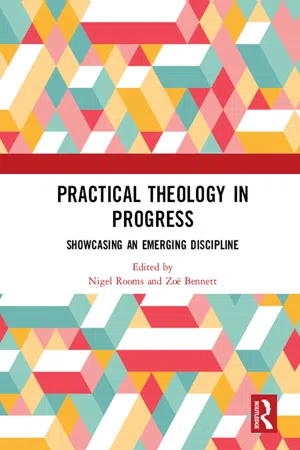
Practical Theology has emerged as an important discipline in recent decades, making a major contribution both in the academy and amongst reflective practitioners on the ground. The Journal Practical Theology celebrated its tenth anniversary in 2018 and this book presents ten journal articles chosen from over 180 that were published in that period. Reflecting on the progress the discipline has made and indicating some future directions in the field, the book is a 'showcase' of examples of good practical theology utilising a wide range of methodologies and written by an interesting cross-section of authors from a variety of backgrounds. This is a book which answers the question 'what is practical theology?' with real live examples that are accessible, readable and engaging.
eBook - ePub
Practical Theology in Progress
Showcasing an emerging discipline
- 198 pages
- English
- ePUB (mobile friendly)
- Available on iOS & Android
eBook - ePub
Practical Theology in Progress
Showcasing an emerging discipline
About this book
Information
Preface to Chapter 1
At the start of the life of Practical Theology, as it emerged organically from Contact: Practical Theology and Pastoral Care, the Editorial Board was committed to embracing, honouring and representing in the journal three overlapping forms of theology: pastoral theology, practical theology, and public theology. This was and is important, as there was a fear around that a move to the terminology of ‘practical theology’, allied to a determination that this new journal should be able to carry the weight of being the journal of choice for those in the academic field of practical theology, would alienate the journal from pastoral practitioners, and make it uninteresting and inaccessible to them. Over the last ten years the scene has hugely changed, with both the British and Irish Association of Practical Theology and the journal itself now replete with those who are both practitioners and academically reflective – reflective practitioners and researching professionals, sometimes, but not always, engaged in work for a DMin, DProf or other form of research and writing in practical theology.
Jenny Gaffin’s article from the third issue of the first volume in 2008 feels like a forerunner of this movement. In her article Gaffin considers ‘the experience of developing a lesbian, gay, bisexual and transgender (LGBT) Interfaith Project, for the charity Kairos in Soho from 2001-2005’. Firmly and confidently (for all the language of ‘bumbling’!) rooted in her pastoral ministry, she explores this in a deeply self-reflexive way. Here again she anticipates what has become in recent years a key theme in practical theology – critical subjectivity and reflexivity. We now know we cannot leave ourselves off the page, not only because to do so is to ignore our own ideological captivity, but because self-reflexivity produces useful knowledge, as this article so richly demonstrates. Her reflexivity, like the experience of looking at one’s reflection in Anish Kapoor’s Bean in Chicago, forces attention to context, changes, and distortions and does not allow some straightforward reading as if in a simple mirror.
‘Theory’ is a complex notion. Although the roots of the word are in contemplation and clear seeing, it has come to signify in academic circles abstraction, conceptualization and other long words normally also ending in ‘ization’. It does not have to be this way. Totally committed to the particularity of the situation and the ‘complexity of the moment’, Gaffin uses her wide and deep engagement with other writers and thinkers (‘the literature’) not to systematise but to look at things freshly, from a new angle, critically and more deeply. She thus becomes a wiser bumbling pastoral worker, though interestingly she doesn’t use this word, which has become so de rigeur in recent practical theology, with the use of the idea of phronesis and the prominence of ‘Christian practical wisdom’.
One person on whose work Gaffin draws is Jonathan Sacks. In his Templeton Prize lecture at the Annual Meetings of the American Academy of Religion and the Society of Biblical Literature in San Antonio, Texas, in November 2016 Sacks stated:
The solution that worked in the West from the 17th to the 20th centuries namely secularization is not going to work in the 21st century because ours is an age of desecularization. We’re far from being deprived of power. There are many parts of the world in which religion is seizing and regaining political and military power.
He went on to say to the scholars of religion and religious practitioners in his audience that we had something crucial to offer: the re-reading of our religious texts, the recovery of our sense of religious complexity, and the need to think through ‘what it means to live in the conscious presence of difference’. Sitting listening to him alongside two veteran practical theologians, I was struck how pertinent his words were to the task of our discipline – the attention to both ancient text and contemporary context in the life and death situation of difference and violence.
Gaffin’s article offers something significant to this task, not least because its practical location and subject matter concern both sexuality and interfaith relationships. Recent issues of the journal have carried several articles on the former topic (1.2, 2.1, 3.1,10.2 x2, 10.3). Our hope for the future is that interfaith issues, so crucial for our contemporary society, might take a greater prominence, and indeed that practical theologians from a wider variety of faiths might themselves feel comfortable in publishing in our journal.
The Bumbling Pastoral Worker: Theological Reflections on a Lesbian, Gay, Bisexual, Transgender Interfaith Project
Jenny Gaffin
ABSTRACT
This article examines the complexity of pastoral ministry in a lesbian, gay, bisexual, transgender (LGBT) interfaith context. The author was involved in developing an LGBT interfaith project in Soho from 2001 to 2005, which involved Buddhist, Jewish, Christian and Muslim participants. Drawing on interviews conducted with participants, the study offers insights into the provisional and practical nature of the relationships that formed in the LGBT interfaith group. It reveals the need for a theology that is open to being continually challenged by fresh levels of human complexity, that is attuned to the rapidly changing needs of the present moment, and that sits comfortably with its own provisionality. To this end it develops the working model of the “bumbling pastoral worker” as a response to the complexity and transience of my practical context.
This article is a theological reflection upon the experience of developing a lesbian, gay, bisexual and transgender (LGBT) Interfaith Project, for the charity Kairos in Soho from 2001–2005. The charity has changed its goals since, but at the time existed to promote “well being of body, mind and spirit for lesbians, gay men and their friends.” It was founded by a Methodist Minister, Revd Neil Whitehouse, and because of his work it had significant contacts with gay religious people, particularly from the Muslim, Christian, Buddhist and Jewish traditions. The interfaith project began in the wake of 11 September, 2001, when LGBT members of faith traditions connected with the charity were exceptionally conscious of the threat posed to them by fundamentalist religion,1 and were eager to break down divisions between the different faith traditions. My specific task was to bring together LGBT members of the Buddhist, Jewish, Muslim and Christian faiths, in order to explore what mileage there was in exploring issues of religion and sexuality together. The initial consultation period led to a series of public discussion groups on the subject of faith, sexuality and politics. Out of the larger group, we then formed a small subgroup of experienced religious practitioners, which we called RAGS (Religions Addressing Gender and Sexuality). This group engaged in pastoral work, acted in a consultancy capacity on request, including to one major City Council, gave talks, and aimed specifically “to challenge homophobia in religious communities and fear of religion within the gay community.”
While my role within RAGS was one of facilitation, my funding came from the Methodist Church, who employed me as a lay worker. It was therefore incumbent upon me to reflect theologically upon the work in which I was engaged. In this article I offer a brief account of the complex setting in which I worked. From this, I reveal the need for a theology that is open to being continually challenged by fresh levels of human complexity, that is attuned to the rapidly changing needs of the present moment, and that sits comfortably with its own provisionality. I develop the working model of the “bumbling pastoral worker” as a response to the complexity and transience of my practical context.
A Context of Exclusion
During the years I worked in the LGBT interfaith context, I was immersed in the painful stories of people who had suffered as a result of prejudice against some integral aspect of their identity. Often this prejudice came from within the heart of their family, their faith tradition, or the LGBT community itself. I heard from Muslim men who had been thrown out of their family for entering a committed relationship with a man, from women being physically assaulted for walking down the street wearing Hijab, from lesbians being sidelined by men within LGBT organizations. I heard of threats of physical violence and even death threats against people who dared to be openly religious and gay. In some instances the violence was very public, as in the case of the murder of gay trainee Rabbi Andreas Hinz in 2002. All of these stories were told in the consciousness that Kairos’s offices were above the Admiral Duncan pub, which had been victim of a homophobic bombing in 1999, and whose barman David Morley was subsequently murdered in 2004.
My knee-jerk response to this was to try to do two things: to create a theology of inclusivity so watertight that nobody would have any justification for prejudice of any kind; and to try to create an environment in which people were so comfortable with themselves and with one another that the problem of exclusion simply did not arise. As regards a watertight theology of inclusivity, I would argue that there can never be any such thing. Any group, secular or religious, that tries to formulate an inclusive stance always ends up placing boundaries in different places and excluding different groups of people. “Inclusive” simply means including those people who share our values, rather than including everybody. An extreme example of this is the Gay and Lesbian Humanist Association (GALHA), a secular group which campaigns vociferously for the rights of lesbians and gay men. This group advocates an aggressively liberal agenda, but in the process somehow ends up continually attacking religious people, as can be seen from a quick glance at the headings of their Spring 2005 newsletter (GALHA online at http://www.galha.org/glh/243/index.html). This edition includes the following: “Don’t Send Me Back: Ramzi Isalam Escaped Murder by Islamic Fundamentalists in Algeria, and Is Fighting to Be Granted Asylum in Britain. Here He Tells Us his Story”; “A Homophobe to his Last Dying Breath—in an Alternative ‘Obituary’ for Pope John Paul II, Peter Tatchell Calls for an End to the Vatican’s Crusade against Tolerance”; “Acceptance? Keep Waiting—for Eternity: With Christian Traditions of Loathing the Body and Regarding Anything Sexual as the Work of the Devil, Is There Any Wonder, Asks Matthew Thompson, That the Christian Right Hate Us So Much?” GALHA believes that religion and tolerance are incompatible, and therefore, paradoxically, will not tolerate religion.
It is easy to mock this position, but my own attempt at formulating an inclusive theology, and putting that inclusivity into practice through the LGBT interfaith group, proved painfully flawed. RAGS formed in the hope of promoting understanding and peaceful dialogue between sections of society that are generally taken to be mutually hostile. Despite this explicit aim, forming the group proved to be a complex and contested process. The group initially chose the name “Queer Interfaith Coalition,” but this proved contentious. In favour of the name were Adnan Ali,2 a Pakistani Muslim, who said simply, “Queer is American, LGBT is European. To me they’re both new things. In my culture, in my language, there’s no word for lesbian or gay so for me it’s the same.” For John, an Anglican Priest, the word held power: “I think anything that reclaims words of abuse for our own use is the way to rob them of their power.” On the other hand, Rabbi Sheila Shulman objected to the word because it glossed over tensions within the gay scene: it had “no history, no politics . . . And I do think it obscures the very real feminist issues that are still around.” For Rabbi Mark Solomon, the word was unhelpful because it still resonated as a term of abuse, and he felt it would not find sympathy within his synagogue: “I can talk to my synagogue about being part of the Jewish gay and lesbian group for instance. Whether I would be comfortable talking to the synagogue council about the ‘Queer Interfaith Coalition’—well, I wouldn’t frankly.” Differences in age, religious location, gender and cultural context meant that people came to the group with very different agendas.
The closest we came to identifying a set of goals or ground rules came through an assumption summarized by Revd Bernard Lynch, a Catholic Priest: “obviously there would have to be, and is within our group, a total agreement that anything that would be injurious, physically, psychologically, spiritually, of the self or other could not be part of our struggle for freedom.” Underlying this ideal was the realization that we ourselves were guilty of exclusion. In some cases, this exclusion was quite conscious: one participant in the group asked, in reference to more right wing strands of her religious tradition, “why do I have to talk to a bunch of fundamentalist nutcases?” At other times, the exclusion was more subtle, based on unspoken assumptions about gender or sexual norms. We never, for example, explored the possibility of inviting a transvestite to join the group, and we never engaged deeply with the S/M scene, although this is obviously part of the scene in Soho. There was also some unease about “spirituality” in a broad sense, which manifested itself in a regular reassertion of the value of the historical nature of our respective traditions. My personal anxiety on this front expressed itself in my unwillingness to engage with an “interfaith minister” who worked with all religious people without being rooted in one particular tradition. Added to those conversations that we did not seek out, there were conversations that we wished to have but which never took place. We had only passing contact with Hindu and Sikh members of the group, and never managed to reach Black Christian groups. This was not for want of trying! It could have simply been bad luck, but it could also indicate that the kind of conversations in which we were engaged, or the language we used, excluded particular groups of people, such as those who prefer to call themselves “men who have sex with men” rather than use the label “gay.”3
So even in an LGBT interfaith group working with such a high degree of diversity, there were spoken and unspoken boundaries to the kinds of diversity with which we were willing to engage, and there were people with whom we were unable to communicate deeply. I say this less to lament the many shortcomings of the experiment in which we were engaged, but rather to demonstrate that even as members of the group aspired to openness and tolerance, inscribed within that very act was a process of exclusion and closure to dialogue. Any practical theology that seeks to engage with diversity must start with the recognition that no matter how good the intentions, there will never be a theory that can account for the needs of all people, and there will never be a social setting in which exclusion does not take place at some level.
A Theology of Listening
The challenge, then, cannot be how to create an environment in which all people’s interests are met at all times. It must rather be how to respond helpfully to the fact that exclusion and marginalization are inevitable features of our increasingly diverse communities, and to the fact that patterns of exclusion and marginalization are in constant flux due to the ongoing process of negotiation of the complex elements of human identity. Any theology that emerges must be open to recognizing and preventing exclusion, and have an in-built flexibility to be able to respond to the constantly changing patterns of exclusion. This is where pastoral workers are in a privileged and necessary position, because, working on the ground, they are exceptionally well placed to recognize and respond to the ever-changing nuances of people’s lives. A theology of listening is required that will enable a pastoral worker to register the experience of those people who find themselves marginalized, to make the issues visible, and to be continually alert to those times when the patterns of exclusion shift and they need to be focused on another person or group of people. Here, however, there lies a practical problem. If the exclusion is by its nature covert, and perhaps entirely unknown to the pastoral worker due to nuances of language or context, or due to prejudices inscribed within their religious tradition of which they are unaware, how do they go about recognizing the potential for violence that their words and actions contain?
Jonathan Sacks describes this challenge, and begins his response to it, by arguing the need for a theology of “spiritual generosity”:
The global age has turned our world into a society of strangers. That should not be a threat to our identity but a call to a moral and spiritual generosity more demanding than we had sometimes supposed it to be. Can I, a Jew, recognise God in one who is not in my image: in a Hindu or Sikh or Christian or Muslim or an Eskimo from Greenland talking about a melting glacier? Can I do so and not feel diminished but enlarged? What then becomes of my faith, which until then had bound me to those who are like me, and must now make space for those who are different and have another way of interpreting the world? (Sacks, 2003: 17–18).
Sacks describes a shrinking world. In modern day Britain in general, and in Soho in particular, we live in community with people who are so different from us that their day-to-day concerns would not enter our heads. Yet we live alongside them in the recognition that that their needs are intricately bound up in our own, in ways that may well be beyond our immediate grasp. For Sacks, the necessary religious response is to adopt an attitude of “spiritual generosity,” in which we all make room within our lives and within our faiths for the fresh insights that emerge out of encounters with strangers that can be profoundly unsettling. I applaud this ideal, but it carries within it the now-familiar problem of how to engage in creative dialogue with those who stand opposed to the whole notion of communication. Sacks elsewhere describes society as “a conversation scored for many voices” (2003: 84). On the surface of it, this sounds like a beautifully harmonious image. But, as we have seen, the more voices that are added to this conversation, the greater the risk of hearing a good deal of discordance, or that some people will opt out of the conversation altogether. Those who dare to listen for voices that have been silenced or ignored by the mainstream, risk becoming aware of voices which, they feel, simply should not be allowed to speak. Democratic principles, and the celebration of diversity, come unstuck at the point at which they nurture voices that threaten to destroy every other voice within the conversation.
Martin Forward offers a slightly different model of engagement, by providing this example of successful interfaith encounter which worked for all the wrong reasons:
A decade or so ago, Archbishop Trevor Huddlest...
Table of contents
- Cover
- Half Title
- Title Page
- Copyright Page
- Table of Contents
- Citation Information
- Notes on Contributors
- Preface
- Introduction
- 1. The Bumbling Pastoral Worker: Theological Reflections on a Lesbian, Gay, Bisexual, Transgender Interfaith Project
- 2. Holy Sofas: Transformational Encounters between Evangelical Christians and Post-Christendom Urban Communities
- 3. Reflections on Autistic Love: What Does Love Look Like?
- 4. Autism and Love: Learning What Love Looks Like—a Response
- 5. Values-based Reflective Practice: A Method Developed in Scotland for Spiritual Care Practitioners
- 6. Terrorism: An Incarnational Response - An Interview with Andrew Pratt
- 7. Seeking Wisdom in Practical Theology: Phronesis, Poetics and Everyday Life
- 8. Living Baptismally: Nurturing a Spirituality for Priestly Wellbeing
- 9. Contemporary Christian Dream Interpretation: Awakening the Interest of Practical Theologians
- 10. Practical Theology and the Common Good—Why the Bible is Essential
- 11. Bodies and Behaviours: A Study of Body Image in Adolescent Girls and the Canadian Church
- Conclusion: Diversity, Diversification and Unifying Features in Contemporary and Future Practical Theology
- Index
Trusted by 375,005 students
Access to over 1.5 million titles for a fair monthly price.
Study more efficiently using our study tools.
Frequently asked questions
Yes, you can cancel anytime from the Subscription tab in your account settings on the Perlego website. Your subscription will stay active until the end of your current billing period. Learn how to cancel your subscription
No, books cannot be downloaded as external files, such as PDFs, for use outside of Perlego. However, you can download books within the Perlego app for offline reading on mobile or tablet. Learn how to download books offline
Perlego offers two plans: Essential and Complete
- Essential is ideal for learners and professionals who enjoy exploring a wide range of subjects. Access the Essential Library with 800,000+ trusted titles and best-sellers across business, personal growth, and the humanities. Includes unlimited reading time and Standard Read Aloud voice.
- Complete: Perfect for advanced learners and researchers needing full, unrestricted access. Unlock 1.5M+ books across hundreds of subjects, including academic and specialized titles. The Complete Plan also includes advanced features like Premium Read Aloud and Research Assistant.
We are an online textbook subscription service, where you can get access to an entire online library for less than the price of a single book per month. With over 1.5 million books across 990+ topics, we’ve got you covered! Learn about our mission
Look out for the read-aloud symbol on your next book to see if you can listen to it. The read-aloud tool reads text aloud for you, highlighting the text as it is being read. You can pause it, speed it up and slow it down. Learn more about Read Aloud
Yes! You can use the Perlego app on both iOS and Android devices to read anytime, anywhere — even offline. Perfect for commutes or when you’re on the go.
Please note we cannot support devices running on iOS 13 and Android 7 or earlier. Learn more about using the app
Please note we cannot support devices running on iOS 13 and Android 7 or earlier. Learn more about using the app
Yes, you can access Practical Theology in Progress by Nigel Rooms, Zoë Bennett, Nigel Rooms,Zoë Bennett in PDF and/or ePUB format, as well as other popular books in Languages & Linguistics & Linguistics. We have over 1.5 million books available in our catalogue for you to explore.