- 680 pages
- English
- ePUB (mobile friendly)
- Available on iOS & Android
eBook - ePub
About this book
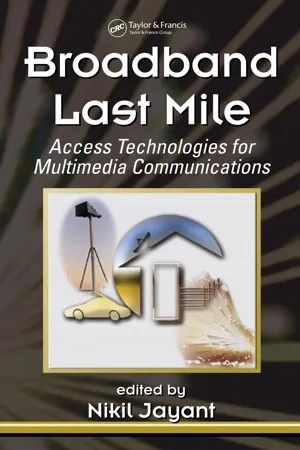
Broadband Last Mile: Access Technologies for Multimedia Communications provides in-depth treatments of access technologies and the applications that rely upon them or support them. It examines innovations and enhancements along multiple dimensions in access, with the overarching goal of ensuring that the last mile is not the weak link in the broadband chain. Written by experts from the academic and commercial segments of the field, the book's self-contained sections address topics related to the disciplines of communications, networking, computing, and signal processing.
The core of this treatment contains contemporary reviews of broadband pipes in the classes of copper, cable, fiber, wireless, and satellite. It emphasizes the coexistence of these classes within a network, the importance of optical communications for unprecedented bandwidth, and the flexibility and mobility provided by wireless.
The book also includes perspective on the increasingly important topic of network management, providing insights that are true regardless of the nature of the pipe. The text concludes with a discussion of newly emerging applications and broadband services.
This book offers an all-in-one treatment of the physical pipes and network architectures that make rich and increasingly personalized applications possible. It serves as a valuable resource for researchers and practitioners working in the increasingly pervasive field of broadband.
Information
1
Broadband in the Last Mile: Current and Future Applications
1.1 INTRODUCTION
In technical as well as nontechnical contexts, the term broadband (an adjective, used here as a noun) seems to imply an agile communication medium carrying rich information. The term last mile, used mostly in technical circles, connotes the access link that connects the information-rich Internet (and the World Wide Web) to the end user. The location of the user is fixed, quasi-stationary, or mobile. Although relevant to many earlier communication services, the notion of the last mile has become particularly common in the relatively newer context of its being a potential weak link in an otherwise highspeed communication network. It is the purpose of this book to describe communications technologies that support newer generations of information and entertainment services that depend on the notion of pervasive broadband. It is the aim of this chapter to point out the conceptual and quantitative connection between the access pipe and the application, and to describe application classes and core capabilities that the broadband capabilities in succeeding chapters will support.
A 2002 report from the National Research Council of the United States was one of the first authoritative treatments on the subject of broadband last mile, the topic of this book. The report, entitled Broadband: Bringing Home the Bits, looked at the subject from a comprehensive viewpoint that included technology timelines, economic considerations, and regulatory policy.1 The report regarded “broadband” as a convergent platform capable of supporting a multitude of applications and services, and observed that “at best, broadband can be as big a revolution as Internet itself.” It noted examples of significant broadband deployment worldwide and maintained that pervasive broadband access should be a national imperative in the U.S., keeping in mind the limited success of the 1996 Telecommunications Act in the country. The report went on to list significant findings and made several recommendations for stimulating broadband deployment, including pointed research in the area for industrial as well as academic laboratories. Among the salient technical observations of the report were
•An elastic definition of broadband
•The critical relationship among broadband, content, and applications
•The need to look at regulatory practices at the service layer, rather than at a technology level
Broadband Options. In the specific dimension of the physical broadband pipe, the NRC report eschewed a horse race view of alternate modalities (such as copper, fiber, wireless, and satellite) and instead predicted that, although wireless and optical accesses have obvious fundamental attractions (in terms of mobility and bandwidth affluence, respectively), the most realistic future scenario is one in which the alternate modalities will coexist in different locality-specific mixes. In fact, none of the modalities mentioned have reached the saturation point in terms of metrics, such as the bandwidth-range product, or tracked the well-known Moore’s law in their evolution with time — not to mention the complementary opportunities at the network layer.
Also noteworthy is the fact that the advantageous optical and wireless modalities are currently less often deployed, for reasons such as cost, than the copper (DSL) and cable modalities. DSL is preparing to be a significant carrier of entertainment over copper lines known originally for (nearly universal) telephony. Likewise, the cable medium, originally deployed for entertainment services, is vying to be a serious carrier of (Internet protocol [IP]) telephony. The satellite modality has advantages in terms of geographical coverage and footprint, but is constrained by limitations on on-board power and inherent latency, particularly affecting the capability of interactive two-way services. The power-line channel has the advantage of ubiquity to and within the home, but services on this channel are currently limited by and large to low-rate data-monitoring applications.
The report serves as a natural point of departure for this collection of chapters on broadband access. Several of this book’s chapters focus on the access modalities, dedicating a chapter for each of them. The purpose of this chapter is to provide some of the broad context pointed up in the NRC report, particularly, the application dimension. In this introductory chapter, we make liberal use of the NRC report, authored by a committee chaired by the editor of this collection. This chapter continues in Section 1.1.1 by providing two definitions of last mile broadband, as defined in the NRC report, and then briefly highlighting some of the applications of broadband.
We then introduce the notion of the broadband margin (BBM) for a network. A key element of the broadband margin is source coding or compression; media compression is arguably one of the most important enablers of broadband applications. Because no other chapter covers media compression, we devote an entire section to it. Therefore, Section 1.2 of this chapter continues by providing an overview of the science and art of media compression. A number of important broadband applications are examined in Section 1.3, including interactive applications such as voice over IP (VoIP), peer-to-peer (P2P) networks and file sharing, and media streaming. Applications that involve video have the potential to become some of the most important uses of broadband; therefore, the problem of video delivery over broadband networks is examined in more depth as an illustrative example of a challenging broadband application.

1.1.1 Last Mile Broadband and Broadband Applications
1.1.1.1 Definition of Last Mile Broadband
The Last Mile. Figure 1.1 defines the access link that connects the end user to the Internet (the backbone or core network). This access link has been called the last mile. It has sometimes been referred to in a user-centric style as the first mile. Regardless of nomenclature, the simple way of characterizing the challenge is to say that this mile should not be the weakest link in the chain. The more difficult problem is to understand the many dimensions along which the strength of the link needs to be understood. It is also important to note that the landscape includes several technological functionalities besides the pipe and the application. Some of these are depicted in the smaller-font labels in Figure 1.1. Others, not shown in the figure, include the notion of the penultimate mile or the second mile. This is the mile that captures distribution granularity in the downlink and data rate aggregation in the uplink. As the problem of the last (or first) mile is solved, attention may well shift to the penultimate (or second) mile, as we seek to attain the ideal of end-to-end — and, ideally, user-steered — quality of service (QoS).
The Last Meter. For the purposes of this book and the technology challenges that it reflects, more important than the penultimate (or second) mile is the problem of the last meter. This notion is particularly meaningful in the context of the home or small office. Here, the access link includes the topologically and logically distinct segments to the home and within the home. Part of the challenge of pervasive wireless is to create a seamless unification of these two segments (supported and constrained by two classes of standards, NG-wireless standards for cellular wireless and IEEE 802.11 standards for wireless local area networks). Neither of these modalities has currently succeeded in making multimedia as ubiquitous as telephony or low bit rate data.
The Backbone Network. The box labeled “the Internet” in Figure 1.1 includes the notion of a backbone network. In a somewhat simplified view, this network has much higher capacity (arising mainly from the pervasive deployment of optical channels) compared to the last mile or the last meter. Assurance of QoS in the backbone in any rigorous sense is less clear, however. Yet, it is realistic to use the model in which the most serious broadband bottlenecks are attributed to the access part of the network, rather than its backbone. This is indeed the premise of this book. As the end-to-end network evolves and the last mile and meter get better and more heavily used, points of congestion can shift away from the access piece, back into the network. Furthermore, at any given time, the notion of end-to-end QoS, in any rigorous sense, is likely to remain an elusive ideal rather than a universal reality. Chapter 2 provides a description of the backb...
Table of contents
- Cover
- Half Title
- Title Page
- Copyright Page
- Series Introduction
- Prologue
- Acknowledgments
- About the Editor
- Contributors
- Chapter 1: Broadband in the Last Mile: Current and Future Applications
- Chapter 2: The Last Mile, the Edge, and the Backbone
- Chapter 3: Last Mile Copper Access
- Chapter 4: Last Mile HFC Access
- Chapter 5: Optical Access: Networks and Technology
- Chapter 6: Last Mile Wireless Access in Broadband and Home Networks
- Chapter 7: Satellite Technologies Serving as Last Mile Solutions
- Chapter 8: Management of Last Mile Broadband Networks
- Chapter 9: Emerging Broadband Services Solutions
- Index
Trusted by 375,005 students
Access to over 1.5 million titles for a fair monthly price.
Study more efficiently using our study tools.
Frequently asked questions
Yes, you can cancel anytime from the Subscription tab in your account settings on the Perlego website. Your subscription will stay active until the end of your current billing period. Learn how to cancel your subscription
No, books cannot be downloaded as external files, such as PDFs, for use outside of Perlego. However, you can download books within the Perlego app for offline reading on mobile or tablet. Learn how to download books offline
Perlego offers two plans: Essential and Complete
- Essential is ideal for learners and professionals who enjoy exploring a wide range of subjects. Access the Essential Library with 800,000+ trusted titles and best-sellers across business, personal growth, and the humanities. Includes unlimited reading time and Standard Read Aloud voice.
- Complete: Perfect for advanced learners and researchers needing full, unrestricted access. Unlock 1.5M+ books across hundreds of subjects, including academic and specialized titles. The Complete Plan also includes advanced features like Premium Read Aloud and Research Assistant.
We are an online textbook subscription service, where you can get access to an entire online library for less than the price of a single book per month. With over 1.5 million books across 990+ topics, we’ve got you covered! Learn about our mission
Look out for the read-aloud symbol on your next book to see if you can listen to it. The read-aloud tool reads text aloud for you, highlighting the text as it is being read. You can pause it, speed it up and slow it down. Learn more about Read Aloud
Yes! You can use the Perlego app on both iOS and Android devices to read anytime, anywhere — even offline. Perfect for commutes or when you’re on the go.
Please note we cannot support devices running on iOS 13 and Android 7 or earlier. Learn more about using the app
Please note we cannot support devices running on iOS 13 and Android 7 or earlier. Learn more about using the app
Yes, you can access Broadband Last Mile by Nikil Jayant in PDF and/or ePUB format, as well as other popular books in Tecnologia e ingegneria & Ingegneria elettronica e telecomunicazioni. We have over 1.5 million books available in our catalogue for you to explore.