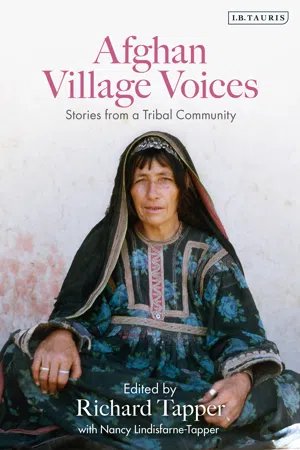
Afghanistan in the 20th century was virtually unknown in Europe and America. At peace until the 1970s, the country was seen as a remote and exotic land, visited only by adventurous tourists or researchers. Afghan Village Voices is a testament to this little-known period of peace and captures a society and culture now lost. Prepared by two of the most accomplished and well-known anthropologists of the Middle East and Central Asia, Richard Tapper and Nancy Tapper-Lindisfarne, this is a book of stories told by the Piruzai, a rural Afghan community of some 200 families who farmed in northern Afghanistan and in summer took their flocks to the central Hazârajât mountains.
The book comprises a collection of remarkable stories, folktales and conversations and provides unprecedented insight into the depth and colour of these people's lives. Recorded in the early 1970s, the stories range from memories of the Piruzai migration to the north a half century before, to the feuds, ethnic strife and the doings of powerful khans. There are also stories of falling in love, elopements, marriages, childbirth and the world of spirits. The book includes vignettes of the narrators, photographs, maps and a full glossary. It is a remarkable document of Afghanistan at peace, told by a people whose voices have rarely been heard.
eBook - ePub
Afghan Village Voices
Stories from a Tribal Community
- 528 pages
- English
- ePUB (mobile friendly)
- Available on iOS & Android
eBook - ePub
About this book
Information
1
Prologue: Introducing the Piruzai
Great Games in Afghanistan
Afghanistan has had a rich and eventful history, and at times very much preoccupied European governments, particularly during the nineteenth-century ‘Great Game’ between the British and Russian empires, which treated the country as a ‘buffer state’ between them. In the north, as the Russians absorbed the khanates of central Asia (later to crystallize into the states of Turkmenistan, Uzbekistan and Tâjikistan), the present frontier was established on the Oxus river (Amu-daryâ). In the 1880s an Anglo-Russian Boundary Commission marked out the north-western land frontier. In the south and east, following the first two Afghan wars (1839–42 and 1878–80), the British drew the Durand Line (1893) to separate Afghanistan from India (eventually Pakistan). Britain continued to control Afghan foreign relations until the third Afghan war (1919). (See Map A.)
Afghanistan’s most marked geographical feature is the Hindu-Kush mountain massif and its extensions, the western end of the Himalayas. In the nineteenth century the central mountains were inhabited by Persian-speaking Tâjiks, Aymâqs and Hazâras. In the north, Tâjiks and Turkic-speaking Uzbeks and Turkmens occupied the foothills and plains of Afghan Turkistan. Pashtu-speakers predominated in the south, east and west.
None of these political, geographic or ethno-linguistic boundaries were impermeable. Pashtun-dominated Afghan governments never accepted the Durand Line, which bisects Pashtun lands, though it divides only a few tribes. The northern frontier similarly was and is a political not an ethnic reality – Turkmens, Uzbeks, Tâjiks and others live on both sides. Mountain peoples, notably Hazâras, have long migrated to Iran, India, Pakistan and elsewhere for trade and work, while Pashtun and other nomads of the plains traditionally trekked seasonally into the mountains or across the Durand Line.
After the Second World War, a new ‘Great Game’ began, this time as a peaceful competition between the USA and the USSR to provide aid and infrastructure to neutral Afghanistan. ‘Development’ – the spread of education, industrialization and other manifestations of modernity – proceeded slowly; too slowly for many in the urban educated classes. A series of events began in the 1960s that were to restore the country to the centre of world attention in ensuing decades. Though a new constitution and a reformed parliament with democratic elections were instituted in 1964, the Kabul government was weak and ineffective, particularly in dealing with the severe drought of 1970–71, the subsequent harsh winter, and the spring 1972 famine that killed many thousands in the west and north-west. This failure was a major factor leading to Dâ’ud’s coup in July 1973.1
Afghan Turkistan: the setting
North-central Afghanistan – the western part of Afghan Turkistan, between Mazâr-e-Sharif and Maymana – is both fertile and ethnically diverse. From the steppes and sandy deserts of low elevation near the northern frontier, the land rises in rolling loess hills southward towards the Band-e-Turkistan mountains, the north-western spur of the Hindu-Kush, with peaks up to 3,500 metres. Higher mountain chains lie further south in Ghor and Bâmyân provinces. Springs and snow runoff from these ranges feed streams and rivers flowing north, cutting deep, spectacular canyons across the mountains before being consumed by irrigation. Summers and winters in Turkistan are extreme. In the mountains, summers are pleasant but short, winter snow often lying in the valleys for over six months of the year. (See Map B.)
During the nineteenth century this region experienced decades of internecine warfare and raiding, cholera epidemics and famine, and by the 1880s it was under-populated. The steppes and foothills, traditionally the lands of the Uzbeks, provided fine winter and spring grazing, used by Arab and Turkmen nomads, while Uzbek and Tâjik farmers struggled to maintain the irrigation systems in the Sar-e-pol, Shur-daryâ and Shirin-tagaw river valleys. The main towns (Maymana, Andkhoy, Âqcha, Sheberghân, Sar-e-pol) were seats of small Uzbek khanates.2
Uzbeks were tribally organized, and once included semi-nomadic pastoralists. By the 1960s, however, all Uzbeks in this region were settled, though many, particularly the better-off, continued to spend summer months in felt-covered mobile huts set up in orchards near their houses. Most craftsmen and tradesmen in the towns are Uzbek.3 Uzbek farmers tend fruit orchards and vineyards in the valleys near the market centres of Sar-e-pol, Sangchârak/Toghzâr, Gorziwân, Belcherâgh and Maymana; they also grow rainfed wheat on the hillsides up to 2,000 metres.
Turkmens are few in Sar-e-pol but numerous in the northern districts of Sheberghân and Andkhoy. Linguistically and culturally related to the Uzbeks, but distinct and seen as such by all, the Turkmens are still tribally organized and largely pastoralists, though they do not normally practise long-range migrations. A dominant feature of Turkmen economic organization is livestock corporations, headed by chiefs and producing karakul lambskins for the world market. They are also prominent in the carpet-weaving industry, for which western Turkistan is noted.
Numerous communities of Arabs live in the Sar-e-pol and Suzma-qala districts. They too are mainly pastoralists, specializing in the Arabi breed of sheep, producing lambs and yearlings for local and national meat-markets. They claim descent from Arab tribes of the original Muslim conquests, but they are Persian-speaking and have adopted both Uzbek and Turkmen cultural features.
The Sar-e-pol river rises in the highlands of Sar-e-pol and Sangchârak sub-provinces, running north through Sar-e-pol town to Sheberghân, centre of Jawzjân province. To the south, Hazâras, Tâjiks and Aymâqs inhabit the mountain valleys at 1,500 to 3,000 metres, where fast-flowing streams irrigate a limited amount of wheat and barley. On the slopes above, they grow precarious crops of rainfed wheat. After the snows melt, there is good if rocky pasturage over 3,000 metres, and flocks of hardy mountain sheep can be raised locally if enough fodder is grown in the valleys for use in the long winters. In the scattered settlements, houses are closely packed for protection against extreme cold.
The Hazâras4 are mainly Shi‘a Muslims, whereas the large majority of the population of Afghanistan are Sunni. Their mountain homeland, the Hazârajât, covers Bâmyân, Oruzgân, eastern Ghor, southern Jawzjân and parts of several other provinces. Here they long defended their independence as a nation of about a million people, until they were overcome and integrated into the state in 1893 by Amir Abdor-Rahmân (1880–1901). Many Hazâras are settled in the lowlands, for example in several large villages near Sar-e-pol town, where they are known as industrious farmers and have an influential chief. In close economic and social contact with people of other ethnic groups, they retain their distinctive identity and maintain ties with relatives in the mountains, who practise mixed farming of wheat and barley, together with Hazâragi sheep – which have a high milk yield and contribute much of the ghee that all groups in the region value. In the Hazârajât, society is still dominated by powerful local Mirs.
Tâjiks in Sar-e-pol are Persian-speaking Sunnis. They are often confused – and confuse themselves – with Aymâqs. In Sar-e-pol there are outposts of Firuzkuhi and Taymani, two of the main Chahâr-Aymâq (‘Four-Tribes’) of western Afghanistan, but most of them have forgotten their original identity and lost contact with their fellow-tribesmen; they often call themselves Tâjik. Some who called themselves ‘Aymâq’ – especially in the Kachan valley and in Sangchârak – are plausibly thought to have been Hazâras recently converted to Sunni Islam; Kachani ‘Aymâqs’ have marriage links in the Hazârajât. Tâjiks, Aymâqs and Kachanis are mixed farmers, cultivating grain, fodder and fruit; they also raise sheep and cattle, and many have summer camps on the slopes above their villages.
These mountain-dwellers are territorially quite well defined and often isolated – two to three days’ journey even in good weather from the nearest market or administrative centre. They rarely leave their valleys, let alone the region. For knowledge of the outside world they rely on military conscripts, the few locals who travel to market, and the nomads who pass through their lands in spring and late summer.
Pashtuns come to Sar-e-pol
In the 1880s, as Turkistan came under the control of Kabul, Amir Abdor-Rahmân, keen to have his northern domains repopulated and his frontiers defended, promoted a major immigration of his fellow-Pashtun tribespeople, especially from the two rival confederations, the Durrani and the Ghiljai. The colonization came from two directions. First, he sent large numbers of Ghiljai and other tribes from south-eastern Afghanistan – often his political opponents – to settle and farm in the north-east. Some of these immigrants moved west to Sheberghân and Maymana. Then (see Chapter 2) in 1886 he ordered Tâju Khân Khânikheyl of the Es’hâqzai tribe to take several thousand families of mâldâr – nomadic or semi-nomadic pastoralists – from the south-west to guard Bâdghis and the north-western frontier. These were Durrani, like the amir and all but one of Afghanistan’s rulers between 1747 and 1978. Abdor-Rahmân trusted his fellow-tribesmen’s loyalty. Spurred on by drought conditions in their homeland, the migrants were granted land rights in favoured spots and advances to help them settle...
Table of contents
- Cover
- Half-Title Page
- Dedication
- Title Page
- Contents
- List of Maps, Tables and Figures
- List of Illustrations
- Preface
- 1 Prologue: Introducing the Piruzai
- 2 The Es’hâqzai Come North
- 3 Ethnic Politics in Sar-e-pol
- 4 Tribal Politics
- 5 A Shepherd’s Life
- 6 For the Animals
- 7 Land: A Golden Tent-Peg
- 8 On the Farm
- 9 Other Business
- 10 The Marriage Market
- 11 Family Matters
- 12 Religion, Life, Death, Disease
- 13 The World of Jinns
- 14 Shrines, Sufis, Exorcism
- 15 Epilogue: The Piruzai Since 1972
- Appendices
- Glossary
- Bibliography
- Acknowledgements
- Index of People and Places
- Index of Subjects
- Copyright
Trusted by 375,005 students
Access to over 1.5 million titles for a fair monthly price.
Study more efficiently using our study tools.
Frequently asked questions
Yes, you can cancel anytime from the Subscription tab in your account settings on the Perlego website. Your subscription will stay active until the end of your current billing period. Learn how to cancel your subscription
No, books cannot be downloaded as external files, such as PDFs, for use outside of Perlego. However, you can download books within the Perlego app for offline reading on mobile or tablet. Learn how to download books offline
Perlego offers two plans: Essential and Complete
- Essential is ideal for learners and professionals who enjoy exploring a wide range of subjects. Access the Essential Library with 800,000+ trusted titles and best-sellers across business, personal growth, and the humanities. Includes unlimited reading time and Standard Read Aloud voice.
- Complete: Perfect for advanced learners and researchers needing full, unrestricted access. Unlock 1.5M+ books across hundreds of subjects, including academic and specialized titles. The Complete Plan also includes advanced features like Premium Read Aloud and Research Assistant.
We are an online textbook subscription service, where you can get access to an entire online library for less than the price of a single book per month. With over 1.5 million books across 990+ topics, we’ve got you covered! Learn about our mission
Look out for the read-aloud symbol on your next book to see if you can listen to it. The read-aloud tool reads text aloud for you, highlighting the text as it is being read. You can pause it, speed it up and slow it down. Learn more about Read Aloud
Yes! You can use the Perlego app on both iOS and Android devices to read anytime, anywhere — even offline. Perfect for commutes or when you’re on the go.
Please note we cannot support devices running on iOS 13 and Android 7 or earlier. Learn more about using the app
Please note we cannot support devices running on iOS 13 and Android 7 or earlier. Learn more about using the app
Yes, you can access Afghan Village Voices by Richard Tapper,Nancy Lindisfarne-Tapper in PDF and/or ePUB format, as well as other popular books in History & Central Asian History. We have over 1.5 million books available in our catalogue for you to explore.