This book details New Zealand's worst public health crisis, and its worst natural disaster: over 8, 500 New Zealanders died from influenza and pneumonia in just six weeks. Nearly a quarter of the victims were Maori, who died at seven times the death rate of European New Zealanders. First published in 1988, Black November now has three new chapters to bring it up to date, over fifty first-hand eyewitness accounts, and over 200 photographs and cartoons, many published here for the first time.
- 328 pages
- English
- ePUB (mobile friendly)
- Available on iOS & Android
eBook - ePub
About this book
Information
CHAPTER ONE
‘Leg rope’: Influenza before 1918
Influenza is unusual among major diseases known to humanity in that nearly all of us will experience it more than once in a lifetime, yet we do not expect to die from it. The initial symptoms of sneezing and a runny nose are similar to those of the common cold, which is caused by a different virus, but influenza is a potentially dangerous disease. Unlike a cold, a bad dose of flu can kill you. The very young and the very old have always been especially at risk of dying from influenza, while otherwise healthy adults can expect to recover even from a severe dose of flu within two or three weeks. We may feel totally washed out and depressed, but it isn’t usually life-threatening. And you certainly know when you have the flu. You may try to treat it like a cold and ‘soldier on’, going to work and infecting your colleagues and people on the bus, but with influenza you just can’t stay on your feet. The high fever is the classic symptom of flu, and its greatest danger, because of the secondary infections it can unleash, most often pneumonia. Recovering flu sufferers are likely to say ‘it knocked me off my feet’ or ‘it knocked the stuffing out of me’.
The French term for influenza is la grippe, a disease that grips you tightly and immobilises you. In New Zealand during the 1890 influenza pandemic this term was Anglicised into ‘grip’ or ‘leg rope’, the latter being quite an appropriate description from a country where farmers are accustomed to tying an animal’s back legs together to make it lie down.
Epidemics of influenza are distinctive for their sudden onset and rapid spread throughout the population. When this pattern is recorded by annalists and chroniclers in past centuries, and they also notice symptoms such as high fever, severe headache, coughing, vomiting and extreme prostration, we may be fairly sure that those poor people in the past had influenza. One of the earliest probable descriptions of the disease survives from 412 BC, by Hippocrates himself, the almost legendary Greek physician who has often been called the father of Western medicine. Roman historians such as Livy and medieval chroniclers such as Matthew Paris occasionally describe epidemics of ‘fevers’ which may or may not have been influenza, but it is a safe bet that influenza has been afflicting the human race for many thousands of years.1
The word ‘influenza’ is Italian, and reflects the old medieval belief that some diseases were caused by the ‘influence’ of the stars or the heavens, just as mental illness was once thought to be caused by the moon (hence the old term ‘lunatic’). Medieval Christians firmly believed that epidemics were sent by God to punish wicked humans for their sinfulness. Indeed, any unusual or unexplained event in the medieval centuries was routinely attributed to ‘the will of God’, but that did not stop thoughtful observers from wondering about diseases and how they were spread. Hippocrates believed that some diseases were caused by poisonous vapours, or ‘miasmas’ arising from swamps or rotting organic material.
This miasmatic theory of infectious disease was widely accepted for centuries, and persisted in some parts of Europe until the end of the nineteenth century. Other observers, however, believed that disease could be spread by contact with infected persons, clothing or bedding. During the Black Death of the fourteenth century, in which an estimated one third of Europe’s population perished, several chroniclers were convinced that infection spread ‘through the breath and the sight’.2
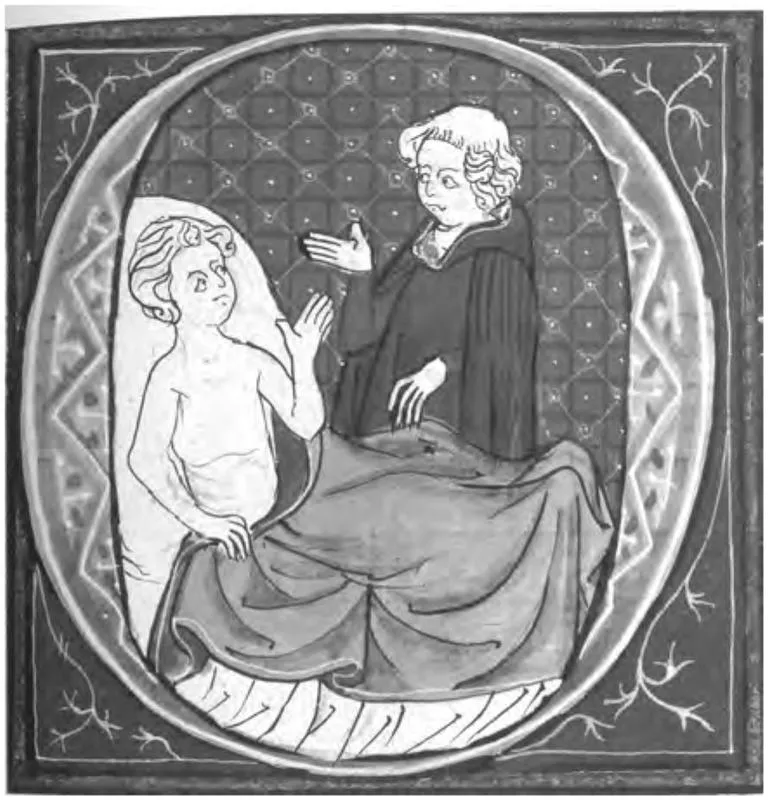
Medieval doctor and patient. From a fourteenth-century Latin edition of Galen.
Librairie Nationale, Paris
This rival ‘contagion’ theory also had its supporters across the centuries, and is now recognised as a more correct description of how influenza is spread. When a flu sufferer coughs or sneezes, millions of invisible virions are sprayed into the air around them, and if that vapour is breathed in by someone else nearby, that person may come down with the flu. This is called droplet infection, and it explains why flu epidemics can spread so quickly from person to person.3 So the miasmatists and the contagionists were both right to some extent, but the vapour is produced by people rather than swamps or rotting vegetation. It took a long time for humans to realise that insects and animals also transmit disease. But why did some people catch the flu and not others? We now know that this has a lot to do with an individual’s immune system and previous exposure to infection, but this riddle helps to explain the lasting popularity of the miasmatic model of infectious disease, because it was a convenient ‘catch-all’ explanation that blamed disease on the environment rather than other humans.4
As far as we know, the term ‘influenza’ was first used in Italy in 1504, when an epidemic was blamed on an unusual alignment of the stars. A European pandemic of influenza in 1510 spread as far as England, but identifying the disease in the sixteenth century is complicated by the prevalence of ‘the English Sweat’ (sudor Anglicus), a peculiar disease that appeared in the mid-fifteenth century and disappeared in the early seventeenth. Though it closely resembled influenza, medical historians now think it was a separate viral infection, for it killed more quickly than flu and caused much greater mortality. As the name suggests, its chief symptoms were uncontrollable shivering and copious sweating. People at the time distinguished between the various fevers they experienced. Malaria (the name is Italian for ‘bad air’, a clear reflection of miasmatic theory) was known as ‘ague’ throughout the early modern period and was either tertian (shivering on the first and third days) or quartan (on the first and fourth days). But influenza was clearly different from other fevers because of the other symptoms involved, and its different epidemiology.5
It is often difficult to identify influenza epidemics in the past because of the incompleteness of symptoms recorded and the variety of names the disease was given before the Italian name was widely adopted. In England in the 1550s recurrent ‘hot burning fevers’ killed thousands of people, old and young alike, but whether or not this was influenza remains uncertain. When Mary Queen of Scots arrived at Edinburgh in 1562, both her court and the town were swept by an epidemic known simply as ‘the Newe Acquayntance’. Though incomplete, the symptoms here suggest influenza:
It ys a plague in their heads that have yt, and a soreness in their stomaches, with a great coughe, that remayneth with some longer, with others shorter tyme … the Queen kept her bed six days. There was no appearance of danger, nor manie that die of the disease, except some olde folks …6
Medical historians are inclined to think that the pandemic of 1580 was influenza, and that it may have been the first recorded global pandemic of flu, as it is mentioned in contemporary accounts from Asia, Africa, Europe and the Americas. Over 9,000 people died in Rome from this outbreak.
Europe’s climate turned cold in the seventeenth century. Glaciers in the Swiss Alps advanced further down the valleys than anyone could remember, and some historians have dubbed this period ‘Europe’s Little Ice Age’. Not surprisingly, therefore, respiratory illnesses abounded. Though most people have heard of the Great Plague of London in 1665, few would know that in between plague outbreaks most deaths in this period were from ‘fevers’, most likely influenza and pneumonia. The diarist John Evelyn suffered ‘an extreme cold’ that was ‘rife all over Europe, like a plague’, in October 1675. This was almost certainly a flu pandemic, and another outbreak in 1693 was unusual because it killed strong healthy adults as well as the very young and the very old. Further flu outbreaks were noticed in 1729, 1733 and 1737, but with only moderate mortality. The Italian term ‘influenza’ was first used in England to describe an outbreak in 1743, when another famous diarist, Horace Walpole, complained of the worst ‘cold and fever’ he had ever experienced. The death rate in London trebled at the height of this epidemic.7
By the eighteenth century influenza had become a fairly regular visitor to Europe, usually in the winter months. Mortality varied, and in some years was quite alarming, but influenza never killed on the same scale as the Great Plague of London in 1665, when nearly 70,000 plague burials represented almost a sixth of the city’s pre-plague population.8 The worst flu pandemic of the eighteenth century occurred in 1781–82 and was reported in almost every country in the known world. In Rome two-thirds of the population were affected, and in Munich the estimate was three-quarters. As in 1693, the strong and robust were affected as much as the weak and elderly, suggesting a new type of virus to which most of the population had no immunity. This pandemic raged across Britain in the summer months, from June to August, and a second wave in 1782 carried off the Prime Minister, the Marquis of Rockingham, who had only held office for four months.9
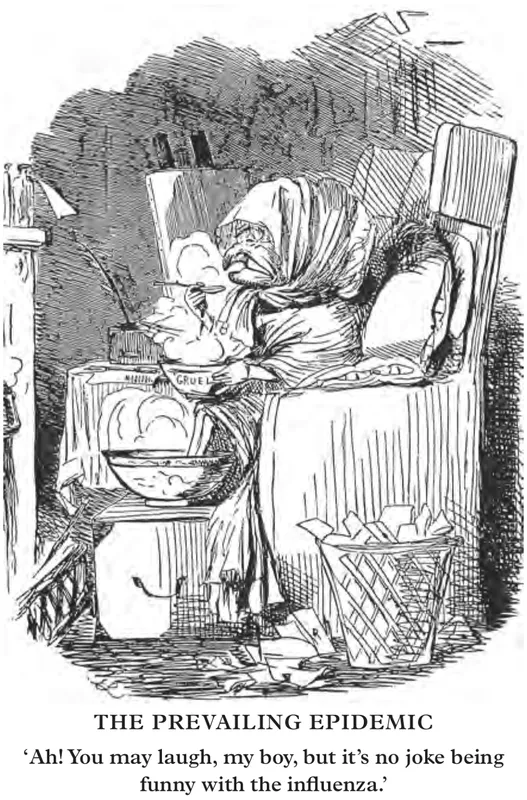
Cartoon by John Leech (1817–64) in Punch, London, 1847.
Influenza then disappeared from Britain for nearly twenty years, returning during the Napoleonic Wars in 1800–02, but this outbreak was mild, causing only minor mortality. Another pandemic in 1830–33 coincided with the major cholera epidemic in Britain, and the death rate in London quadrupled in just two weeks at the height of the flu, but the greatest influenza pandemic of the nineteenth century came in 1847, when 250,000 cases were reported in London and half the population of Paris came down with the flu. Though cholera has dominated the medical histories of this period, the 1847 influenza killed more people than the 1832 cholera outbreak. Influenza pandemics seemed to come round at regular twenty- to thirty-year intervals, but isolated places might escape altogether.10
New Zealand was probably too isolated to have shared in any of these early modern pandemics, but as European visitors to the South Pacific increased in numbers at the end of the eighteenth century and in the early nineteenth, the likelihood of influenza epidemics also increased. Classical Maori society had been spared most of the world’s nastiest diseases, including smallpox, measle...
Table of contents
- Cover
- Title Page
- Dedication
- Contents
- Preface
- Acknowledgements
- Introduction to the first edition
- A few facts about influenza
- 1: ‘Leg rope’: Influenza before 1918
- 2: The Great War and the Great Flu
- 3: Auckland’s Armistice Epidemic
- 4: Crisis in the Capital
- 5: The Southern Cities
- 6: Beyond the Cities: A typical country town
- 7: ‘Severest setback’ for Maori?
- 8: Origins and Diffusion: Was the Niagara to blame?
- 9: Patterns of Death
- 10: The Victims
- 11: The Reckoning
- 12: Influenza after 1918
- Appendices: Influenza timeline since 1918 282
- Epidemic mortality in counties and towns: Epidemic mortality in counties and towns in 1918
- Durations and peaks of the 1918 flu: Influenza durations and peaks
- Bibliography
- Index
- Copyright
Trusted by 375,005 students
Access to over 1.5 million titles for a fair monthly price.
Study more efficiently using our study tools.
Frequently asked questions
Yes, you can cancel anytime from the Subscription tab in your account settings on the Perlego website. Your subscription will stay active until the end of your current billing period. Learn how to cancel your subscription
No, books cannot be downloaded as external files, such as PDFs, for use outside of Perlego. However, you can download books within the Perlego app for offline reading on mobile or tablet. Learn how to download books offline
Perlego offers two plans: Essential and Complete
- Essential is ideal for learners and professionals who enjoy exploring a wide range of subjects. Access the Essential Library with 800,000+ trusted titles and best-sellers across business, personal growth, and the humanities. Includes unlimited reading time and Standard Read Aloud voice.
- Complete: Perfect for advanced learners and researchers needing full, unrestricted access. Unlock 1.5M+ books across hundreds of subjects, including academic and specialized titles. The Complete Plan also includes advanced features like Premium Read Aloud and Research Assistant.
We are an online textbook subscription service, where you can get access to an entire online library for less than the price of a single book per month. With over 1.5 million books across 990+ topics, we’ve got you covered! Learn about our mission
Look out for the read-aloud symbol on your next book to see if you can listen to it. The read-aloud tool reads text aloud for you, highlighting the text as it is being read. You can pause it, speed it up and slow it down. Learn more about Read Aloud
Yes! You can use the Perlego app on both iOS and Android devices to read anytime, anywhere — even offline. Perfect for commutes or when you’re on the go.
Please note we cannot support devices running on iOS 13 and Android 7 or earlier. Learn more about using the app
Please note we cannot support devices running on iOS 13 and Android 7 or earlier. Learn more about using the app
Yes, you can access Black November by Geoffrey Rice in PDF and/or ePUB format, as well as other popular books in History & Australian & Oceanian History. We have over 1.5 million books available in our catalogue for you to explore.