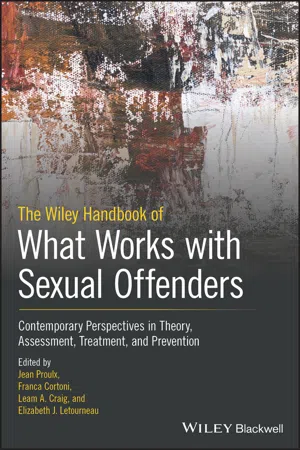
The Wiley Handbook of What Works with Sexual Offenders
eBook - ePub

The Wiley Handbook of What Works with Sexual Offenders

Contemporary Perspectives in Theory, Assessment, Treatment, and Prevention

  1. English
  2. ePUB (mobile friendly)
  3. Available on iOS & Android
eBook - ePub

The Wiley Handbook of What Works with Sexual Offenders

Contemporary Perspectives in Theory, Assessment, Treatment, and Prevention

About this book

From a rehabilitation series–what works for those who've sexually offended

The Wiley Handbook of What Works with Sexual Offenders is an important addition to the What Works in Offender Rehabilitation handbook series. This handbook specifically looks at the topics of sexual offender theory, assessment, rehabilitation, prevention, policy, and risk management. Current assessment frameworks and intervention programmes are evaluated, with consideration of treatment efficacy.

The handbook provides professionals with an evidence-based approach to the management and rehabilitation of individuals who have sexually offended, while presenting ideas on the prevention of sexual abuse. Concepts and theory behind sexual offender rehabilitation are presented with a focus on how this information can be applied in the development of real-world policies that seek to reduce re-offending.

The Wiley Handbook of What Works with Sexual Offenders also includes discussions from renowned international researchers and clinicians on the empirical findings of treatment effectiveness.

  • Presents theory, research, policy, and practice related to sexual offenses
  • Addresses a full range of topics, such as sexual aggression, structured risk assessment, sexual offenders with intellectual disabilities, and pharmacological treatment of sexual offenders
  • Discusses how conceptual and theoretical material can be used in establishing policy and practice

As an important reference work, this rehabilitation handbook offers material for practitioners, including probation officers, social workers and psychologists. Each handbook within the What Works in Offender Rehabilitation series studies current theory, policy, and practice related to a type of offending.

Trusted by 375,005 students

Access to over 1.5 million titles for a fair monthly price.

Study more efficiently using our study tools.

Information

Year
2020
Print ISBN
9781119439332
9781119439455
Edition
1
eBook ISBN
9781119439424

Part I
Theories of Sexual Offenders

Jean Proulx, Section Coordinator

1
Theories That Explain Sexual Aggression Against Women

Jonathan James and Jean Proulx
School of Criminology, University of Montreal, Montreal, Canada

Introduction

What leads some men to sexually assault a woman? Unfortunately, there is no consensus on the developmental processes that underlie this behavior (Lussier, 2018a). This may be due in part to the dominant approach to the analysis of sexual offending, that is, correctional psychology, which focuses on the management of convicted sexual offenders' risk of sexual recidivism. Consequently, while effective tools do exist for the assessment of this risk, identification of the features of a sexual offender's life course that increased his likelihood of committing a sexual crime remains elusive.
Many studies of sexual offending have focused on the identification of characteristics that are specific to sexual offenders, and have attempted to answer questions such as: Are these individuals different from those who have never committed a crime? Are all perpetrators of sexual crimes—particularly sexual aggressors against women—identical? And (the perennial) are sexual offenders the same as other criminals?
This chapter presents the most noteworthy explanatory theories and models, and empirical results, related to sexual aggression against women. For these purposes, “sexual aggression against women” is defined as an extrafamilial sexual assault by an adult male against an adult female (at least 16 years old) (for a discussion of theories related to marital rapists, see Proulx & Beauregard, 2014a). In addition, while sexual offending against women is polymorphic, and comprises sexual violence, sexual misconduct, and sexual exploitation, this chapter discusses only rape and contact sexual aggression (see Figure 1.1). For a discussion of child sexual abuse, sexual homicide, and noncontact sexual offenses, see Chapters 2, 17, and 21 of this book.

The Neuropsychology of Sexual Aggressors Against Women

In recent years, there has been a surge of interest in the identification of neuroanatomical and neurophysiological deficits in antisocial individuals, and in the relationship of these deficits to the psychological functioning of these individuals. Antisocial offenders, especially sexual offenders, have received particular attention (e.g., Beech, Carter, Mann, & Rotshtein, 2018; Raine, 2013).
Diagram displaying an ellipse at the left labeled Sex offending with lines connected to rounded boxes at the right for sexual misconduct, sexual exploitation, sexual violence, sexual homicide, and so on.
Figure 1.1 Sex offending: a multidimensional viewpoint. Lussier and Mathesius (2018).
Joyal, Beaulieu‐Plante, and de Chantérac (2014) conducted a meta‐analysis of studies of the neuropsychological characteristics of sexual offenders, in order to determine the specificity of the relationship between neuropsychological deficits and sexual offending. Their meta‐analysis compared sexual offenders against women (N = 533) to sexual offenders against children (N = 530), and compared all sexual offenders (N = 1,063) to nonsexual offenders (N = 378) and to noncriminals (N = 378). In tests of cognitive functioning, such as visual attention, speed processing, task switching, cognitive flexibility, and verbal fluency, both sexual offenders as a whole, and sexual offenders against women, exhibited a wider variety of cognitive problems than noncriminals. In addition, while sexual offenders against women scored higher than sexual offenders against children on tests of cognitive flexibility, perseveration, and reasoning, they scored lower on tests of verbal fluency and cognitive inhibition. Finally, sexual offenders against women and nonsexual offenders had similar neuropsychological profiles (e.g., low scores on tests of verbal fluency and inhibition).
This meta‐analysis revealed some important points. First, it is possible that poor cognitive performance is associated with sexual offending. Second, because the neuropsychological profile of sexual offenders against women differs from that of sexual offenders against children, these two groups should be investigated separately in both quantitative analyses and theoretical models. Finally, the many similarities between the neuropsychological profiles of sexual offenders against women and nonsexual offenders suggest that there is no causal relationship between neuropsychological deficits and sexual offending against women (Joyal et al., 2014). However, it is important to note that these results do not mean that all sexual offenders against women have neuropsychological characteristics similar to those nonsexual offenders. In fact, drawing that conclusion requires analysis of the heterogeneity of sexual offenders against women, and, especially, of the differences between sexual offenders with deviant and nondeviant sexual preferences (see Knight, 2010; Proulx & Beauregard, 2014b).

The Psychology of Sexual Aggressors Against Women

Deviant sexual preferences

Hanson and Morton‐Bourgon (2005) conducted a meta‐analysis of studies involving postsentencing follow‐up of 29,450 sexual aggressors (considered a homogeneous group), and concluded that deviant sexual preferences were the strongest predictor of sexual recidivism. Results such as this may reinforce the popular belief that sexual deviance is a causal factor of sexual aggression and the hypothesis that all sexual aggressors against women prefer nonconsensual sexual contact with women over consensual sexual contact (Barbaree, 1990). However, these results must be balanced against the results of Lalumière and Quinsey's (1994) meta‐analysis of phallometry results from sexual aggressors against women (N = 415) and a control group (N = 192; nonsexual offenders against women and noncriminals). Those authors found that sexual aggressors responded more than nonrapists to rape cues and more to rape cues than to consensual sex cues. This being said, it is important to note that not all sexual aggressors against women are characterized by a sexual preference for rape (see also Michaud & Proulx, 2009), which means that a deviant sexual preference is at best a partial explanatory factor for sexual aggression.

Lack of empathy, antisociality, and psychopathy

Hanson and Morton‐Bourgon (2005) found antisocial orientation (antisocial personality, antisocial traits, history of rule violation) to be the second‐strongest predictor of sexual recidivism. This finding is consistent with theories of sexual offending that posit that sexual aggressors' infliction of pain, fear, or suffering on their victims denotes a characteristic lack of empathy (e.g., Marshall & Barbaree, 1990). Paradoxically, however, committing a sexual assault is not synonymous with a lack of empathy for the victim—some aggressors are convinced that their victim obtained pleasure from their sexual contact. In addition, even with sexual aggressors who admit to a lack of empathy for their victim (e.g., were indifferent to, or attracted by, their victim's suffering), there is no basis for concluding that this lack of empathy is structural and generalized, rather than specific and situational (e.g., due to negative emotions or intoxication at the time of the offense) (Hanson & Scott, 1995). Keeping these nuances in mind, it is noteworthy that the results of studies that found no difference between the empathy of sexual aggressors, nonsexual offenders, and noncriminals cons...

Table of contents

  1. Cover
  2. Table of Contents
  3. About the Editors
  4. About the Contributors
  5. Introduction
  6. Part I: Theories of Sexual Offenders
  7. Part II: Assessment of Sexual Offenders
  8. Part III: Management of Sexual Offenders
  9. Part IV: Special Populations
  10. Part V: Policy and Prevention
  11. Index
  12. End User License Agreement

Frequently asked questions

Yes, you can cancel anytime from the Subscription tab in your account settings on the Perlego website. Your subscription will stay active until the end of your current billing period. Learn how to cancel your subscription
No, books cannot be downloaded as external files, such as PDFs, for use outside of Perlego. However, you can download books within the Perlego app for offline reading on mobile or tablet. Learn how to download books offline
Perlego offers two plans: Essential and Complete
  • Essential is ideal for learners and professionals who enjoy exploring a wide range of subjects. Access the Essential Library with 800,000+ trusted titles and best-sellers across business, personal growth, and the humanities. Includes unlimited reading time and Standard Read Aloud voice.
  • Complete: Perfect for advanced learners and researchers needing full, unrestricted access. Unlock 1.5M+ books across hundreds of subjects, including academic and specialized titles. The Complete Plan also includes advanced features like Premium Read Aloud and Research Assistant.
Both plans are available with monthly, semester, or annual billing cycles.
We are an online textbook subscription service, where you can get access to an entire online library for less than the price of a single book per month. With over 1.5 million books across 990+ topics, we’ve got you covered! Learn about our mission
Look out for the read-aloud symbol on your next book to see if you can listen to it. The read-aloud tool reads text aloud for you, highlighting the text as it is being read. You can pause it, speed it up and slow it down. Learn more about Read Aloud
Yes! You can use the Perlego app on both iOS and Android devices to read anytime, anywhere — even offline. Perfect for commutes or when you’re on the go.
Please note we cannot support devices running on iOS 13 and Android 7 or earlier. Learn more about using the app
Yes, you can access The Wiley Handbook of What Works with Sexual Offenders by Jean Proulx, Franca Cortoni, Leam A. Craig, Elizabeth J. Letourneau, Jean Proulx,Franca Cortoni,Leam A. Craig,Elizabeth J. Letourneau in PDF and/or ePUB format, as well as other popular books in Psychology & Forensic Psychology. We have over 1.5 million books available in our catalogue for you to explore.