The writer and philosopher George Santayana is reported to have said, “Those who cannot remember the past are condemned to repeat it." In other words, ignoring, or being blind to, the lessons of the past puts you at a disadvantage. It makes sense to me: I believe that if you’re going to create better and smarter cities, you need to understand a little about their origin. Figuring out why we humans started living in ever-growing urban centers and have now decisively made them our future home helps you understand the present and — even more importantly — what it means for the future of cities.
I don’t bore you with an extensive history lesson on the origin of cities, but I do provide you with enough information to give you a sense of the key milestones that have resulted in the urban planet humans now inhabit.
I also help you explore the consequences of urbanization and look at trends that are contributing to today’s rapid city growth, and I begin to tease out the impact and challenges to be solved in a future of megacities (cities with a population of more than 10 million inhabitants).
What is a city?
But wait — first, what is a city? It’s a physical location that is permanently settled by a large number of people and has defined boundaries. It has formal systems for supporting areas such as land use, housing, sanitation, energy, and transportation. Most occupants in a city work on nonagricultural activities. A city has some recognized form of governance that facilitates the operations of the area and interactions between the community, businesses, and government.
Charles–Édouard Jeanneret, the internationally influential Swiss architect and city planner, said that cities are “a machine for living in.”
Today, most people live in a city. You know, cities are quite popular now. Opportunities that range from employment to entertainment and from education to healthcare all tend to be better in an urban context. For most of human history, as you can read later in this chapter, it wasn’t this way at all.
Do you know the origin of the city where you're living now? I’d bet that some people do, but I’m also confident that many don’t. After all, for most people, there’s little utility in this knowledge.
If you find yourself in a role today that’s directly related to the function and success of your city, historical context is golden. It can inform all manner of future decision-making, by highlighting strengths and challenges, ensuring alignment to culture, and exploring untapped opportunities.
For everyone else, wouldn’t it be fascinating to know how your community came to be? I’m a naturally curious person, so this type of detail fascinates me. Learning about your city might surprise you. It may make you happy or perhaps even make you sad. Whatever the emotional response, my guess is that you’ll become enlightened and likely curious to go deeper into the areas that spark your curiosity.
Go online and search for your city’s website. (Let’s assume it has one.) Then find out the answers to these questions about your city:
- When was it established?
- Why was it started?
- What are the current challenges of the community?
- What are the current priorities of the city?
- Oh, and does your city have a smart city strategy or something similarly named?
There’s no grade for doing this assignment, but isn’t it interesting? Talk about it with your family. I’d bet that the discussion is fascinating and enlightening for everyone.
For extra credit, you might repeat this exercise for another city somewhere else in the world that you’re curious about.
Okay, let’s move on.
Why each of the world’s cities came to be is a big part of the broader narrative of the human story. Humans can’t change the past, so we’re stuck with the current outcome of a myriad of decisions and their consequences — some good and, frankly, many not-so-good. Some of the past humans have been able to control, but there’s a fairly good chunk that we haven’t been able to. For example, being invaded probably wasn’t something the residents of any city welcomed. Natural disasters are acts that humans have no role in creating but must deal with the aftermath of (although the role of human behavior in climate change apparently is making many of these disasters much worse).
On the positive side, getting lucky and establishing a human presence in places that had abundant, in-demand resources like oil or coal created what some could consider unfair advantages, and being strategically located in the supply chain for products that humans fell in love with also helped. The human thirst for coffee and tea, their love of silk, and an addiction to tobacco are all examples of the development of certain urban areas over others. This is because all sorts of intermediaries and services were required along the complex global supply-and-trade routes. An exchange of ideas resulted from diverse traders from different geographic areas meeting at the urban centers of these trade routes. This was a catalyst for innovation. Cities became engines for a whole new generation of creative solutions.
(Hang on. Writing that last paragraph made me thirsty. I’m going to make a cup of tea.)
The origin of cities, like so much of the human story, is the result of a series of unpredictable and surprising events. Human history certainly didn’t progress in a straight line — and any change along the way would have resulted in a world far different from the one we live in today. But this is simply a thought experiment. It doesn’t help much to wonder what the world would look like, for example, if there hadn’t been colonialism by European nations. What matters is understanding what did happen and what that means for you today and for the future.
Building the first cities
Humans living in cities is a relatively new phenomenon. For most of human history — around 200,000 years of that history, by our best guesses — members of homo sapiens lived and wandered together in relatively small groups, tending to their crops and hunting for animals and fish. It was a basic and crude existence. Life span barely ever reached 40 years. Nothing much changed for most of that 200,000 years. The world in which people were born was identical to the world they exited.
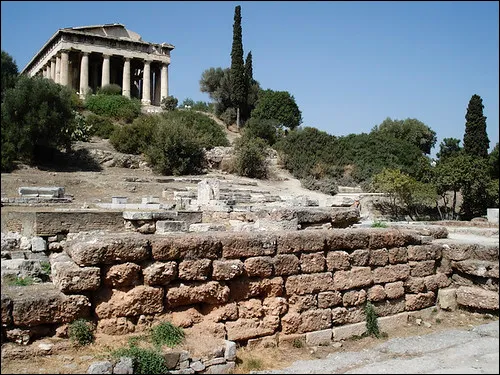
A little over 10,000 years ago, the first significant urban areas emerged. Damascus, in Syria, is often cited as the oldest continually inhabited city. Athens in Greece wasn’t far behind and, like several other urban centers of that period, was a source of rapidly maturing human development. (Figure 1-1 illustrates Athens' Agora, an important center of developing commerce, political, and artistic life.) A handful of these cities, spanning from the Middle East through Europe and into China and India, were founded in this general period. Though many of these cities were instrumental in defining civilization, they were all modestly sized compared to the massive, industrial megacities of today. Athens, at its peak of enlightenment, was populated by mere thousands of people.
For most of human history, there really weren’t that many people, and most of us lived a rural lifestyle. Until as recently as the early 1800s, the entire world had fewer than a billion people. Compared to today, where over 55 percent of humans live in cities, back in 1800 only 3 percent occupied urban settings.
Cities emerged and grew because they offered a compelling alternative to life in rural areas. For example, rather than hunt, gather, or farm all the materials needed to survive, in a city a person could trade in a specialization to earn money to live. Not to get too technical, but this behavior originates as a consequence of the Neolithic revolution, a time defined as the transition from a rather ad hoc approach to wandering and hunting to settling into permanent areas and formalizing farming. The subsequent agricultural revolution created food abundance, which was highly liberating to humans. No longer tethered to the obligation of acquiring food, humans were free to focus on other tasks (like invent and watch television).