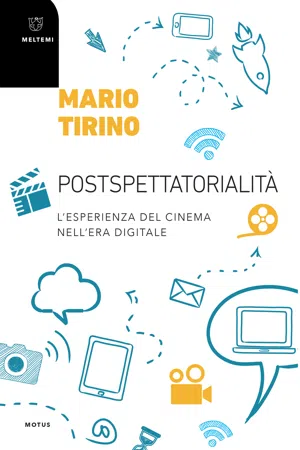
A partire dai concetti di mediashock, forma culturale ed esperienza mediale, questo volume intende analizzare le imponenti trasformazioni socioculturali che hanno investito la relazione tra gli spettatori e le immagini in movimento, con il progressivo e pervasivo radicamento dei media e delle tecnologie digitali. Da un lato, in una prospettiva il più possibile aperta ai transiti disciplinari, questo studio intende presentare le teorie sociologiche, fenomenologiche, mediologiche e culturologiche della spettatorialità. Dall'altro, il testo prova a delineare un nuovo framework teorico – quello della postspettatorialità – che, alla luce di un'estesa analisi delle pratiche della spettatorialità cinematografica nell'era digitale, superi i limiti del concetto di spettatore, al fine di identificare una nuova tipologia di utente mediale, attivo e partecipe nei processi socioculturali della contemporaneità, che sia insieme consumatore, distributore, programmatore, archivista, produttore.
- English
- ePUB (mobile friendly)
- Available on iOS & Android
eBook - ePub
About this book
Information
Subtopic
SociologyIndex
Social SciencesBibliografia*43
N. Abercrombie, B. Longhurst, Audiences, London, Sage, 1998.
A. Abruzzese, Forme estetiche e società di massa, Venezia, Marsilio, 1973.
A. Abruzzese, L’immagine filmica, Roma, Bulzoni, 1974.
A. Abruzzese, La fabbrica panoptica. Il cinema nel vuoto tra scrittura e lettura, in L. Albano (a cura di), Modelli non letterari nel cinema, Roma, Bulzoni, 1999, pp. 39-62.
A. Abruzzese, L’intelligenza del mondo. Fondamenti di storia e teoria dell’immaginario, Roma, Meltemi, 2001.
A. Abruzzese, Introduzione, in R. Barjavel, Cinema totale. Saggio sulle forme future del cinema, Roma, Editori Riuniti, 2001b.
A. Abruzzese, L’occhio di Joker. Cinema e modernità, Roma, Carocci, 2006.
A. Abruzzese, La grande scimmia. Mostri vampiri automi mutanti, Roma, Sossella, 2007.
A. Abruzzese, Il crepuscolo dei barbari, Milano, Bevivino, 2011.
A. Abruzzese, M. Ferraresi (a cura di), Next. Identità tra consumo e comunicazione, Milano, Fausto Lupetti, 2009.
A. Abruzzese, A. Miconi, Zapping. Sociologia dell’esperienza televisiva, Napoli, Liguori, 1999.
C. Acland, IMAX Technology and the Tourist Gaze, ‘Cultural Studies’, Vol. 12(3), 1998, pp. 429-445.
C. Acland, Screen Traffic: Movies, Multiplexes, and Global Culture, Durham, Duke University Press, 2003.
F. Addeo, M. Esposito, Processi identitari e percorsi professionalizzanti nelle comunità di pratica: il caso Itasa, in D. Salzano (a cura di), Turning around the Self. Narrazioni identitarie nel social Web, Milano, FrancoAngeli, 2015, pp. 173-179.
F. Addeo, P. Montesperelli, Esperienze di analisi di interviste non direttive, Roma, Aracne, 2007.
P. Alasuutari, Rethinking the Media Audience, London, Sage, 1999.
F. Alberoni, L’élite senza potere. Inchiesta sociologica sul divismo, Milano, Bompiani, 1973.
N. Alexander, Catered to Your Future Self: Netflix’s ‘Predictive Personalization’ and the Mathematization of Taste, K. McDonald, D. Smith-Rowsey (eds.), The Netflix Effect: Technology and Entertainment in the Twenty-First Century, New York, Bloomsbury Academic, 2016, pp. 81-97.
R.C. Allen, Vaudeville and Film 1895-1915: A Study in Media Interaction, New York, Arno Press, 1980.
M. Allen, Web 2.0: an argument against convergence, ‘First Monday’, 13(3), 2008, https://journals.uic.edu/ojs/index.php/fm/article/view/2139/1946.
J. Allen-Robertson, Digital Culture Industry: A History of Digital Distribution, Basingstoke-New York, Palgrave Macmillan, 2013.
S. Alpini, Sociologia del cinema. I mutamenti della società italiana attraverso ope...
Table of contents
- Prefazione. La ‘nuit americaine’ du cinéma di Gino Frezza
- Introduzione La spettatorialità nell’era postcinematica
- Capitolo primo ‘Mediashock’. Lo spettatore e la forma culturale del cinema dall’analogico al digitale*
- Capitolo secondo Teorie della società e dei media digitali
- Capitolo terzo La spettatorialità digitale negli Audience Studies e nella sociologia del cinema
- Capitolo quarto Teorie dell’esperienza sociale, filmica e mediale
- Capitolo quinto L’audience contesa. Politiche e pratiche dell’engagement
- Capitolo sesto L’esperienza del moviegoing nell’era digitale
- Capitolo settimo L’esperienza del DVD: educazione cinematografica, collezionismo e relazionalità
- Capitolo ottavo La favola del mulo, del torrente e dei pirati:lo spettatore tra distribuzione formale e informale*
- Capitolo nono Lo spettatore archivista
- Conclusioni (?) Sfere d’esperienza. Dalla spettatorialità post-cinematografica alla postspettatorialità espansa
- Bibliografia*
Trusted by 375,005 students
Access to over 1.5 million titles for a fair monthly price.
Study more efficiently using our study tools.
Frequently asked questions
Yes, you can cancel anytime from the Subscription tab in your account settings on the Perlego website. Your subscription will stay active until the end of your current billing period. Learn how to cancel your subscription
No, books cannot be downloaded as external files, such as PDFs, for use outside of Perlego. However, you can download books within the Perlego app for offline reading on mobile or tablet. Learn how to download books offline
Perlego offers two plans: Essential and Complete
- Essential is ideal for learners and professionals who enjoy exploring a wide range of subjects. Access the Essential Library with 800,000+ trusted titles and best-sellers across business, personal growth, and the humanities. Includes unlimited reading time and Standard Read Aloud voice.
- Complete: Perfect for advanced learners and researchers needing full, unrestricted access. Unlock 1.5M+ books across hundreds of subjects, including academic and specialized titles. The Complete Plan also includes advanced features like Premium Read Aloud and Research Assistant.
We are an online textbook subscription service, where you can get access to an entire online library for less than the price of a single book per month. With over 1.5 million books across 990+ topics, we’ve got you covered! Learn about our mission
Look out for the read-aloud symbol on your next book to see if you can listen to it. The read-aloud tool reads text aloud for you, highlighting the text as it is being read. You can pause it, speed it up and slow it down. Learn more about Read Aloud
Yes! You can use the Perlego app on both iOS and Android devices to read anytime, anywhere — even offline. Perfect for commutes or when you’re on the go.
Please note we cannot support devices running on iOS 13 and Android 7 or earlier. Learn more about using the app
Please note we cannot support devices running on iOS 13 and Android 7 or earlier. Learn more about using the app
Yes, you can access Postspettatorialità by Mario Tirino in PDF and/or ePUB format, as well as other popular books in Social Sciences & Sociology. We have over 1.5 million books available in our catalogue for you to explore.