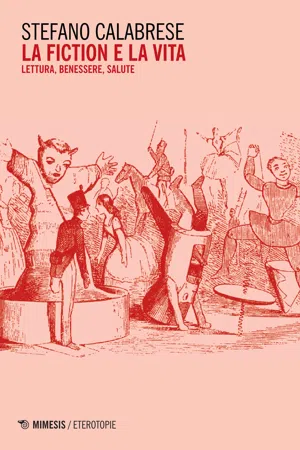
Il volume studia gli effetti della fiction (romanzi, film, serial TV) sul corpo in termini di incremento dell'empatia, diversificazione dei trasmettitori neurochimici, consolidamento del Sé, miglioramento delle capacità di mind reading, terapia dell'autismo, ecc. Si tratta di argomenti che la comunità scientifica internazionale sta scoprendo proprio in questi anni e ancora poco noti in Italia, di cui ha parlato un articolo apparso su "Nature" di recente. Il volume documenta il fatto che oggi le fiction "fanno bene" e ne spiega a lungo le ragioni, mentre in passato gli effetti erano considerati negativi, come appare evidente dal case-study dedicato ai lettori normanni di Madame Bovary e al gioco di identificazioni incrociate cui essi hanno dato luogo.
- English
- ePUB (mobile friendly)
- Available on iOS & Android
eBook - ePub
About this book
Information
Topic
Personal DevelopmentSubtopic
Performing ArtsBIBLIOGRAFIA
Arnal L.H., Giraud A.-L. (2012), Cortical oscillations and sensory predictions, in “Trends in Cognitive Sciences”, 16, pp. 390-398.
Aubry T. (2011), Reading as Therapy. What Contemporary Fiction Does for Middle-Class Americans, University of Iowa Press, Iowa City.
Bal P. M., Veltkamp M. (2013), How Does Fiction Reading Influence Empathy? An Experimental Investigation on the Role of Emotional Transportation, in “PloS One”, 8, n. 1.
Barnes J.L. (2012), Fiction, imagination, and social cognition: Insights from autism, in “Poetics”, 40, pp. 299-316.
Barnes J.L. (2015), Fanfiction as imaginary play: What fan-written stories can tell us about the cognitive science of fiction, in “Poetics”, 48, pp. 69-82.
Baron-Cohen S. (2004), Questione di cervello. La differenza essenziale tra uomini e donne, trad. it., Mondadori, Milano.
Baron-Cohen S., Lombardo M.V., Auyeung B., Ashwin E., Chakrabarti B., Knickmeyer R. (2011), Why Are Autism Spectrum Conditions More Prevalent in Males?, in “PLoS Biology”, 9, e1001081. doi:10.1371/journal.pbio.1001081.
Baron-Cohen S. (2012), La scienza del male. L’empatia e le origini della crudeltà, trad. it., Raffaello Cortina, Milano.
Barraza J. A., Zak P. J. (2009), Empathy toward Strangers Triggers Oxytocin Release and Subsequent Generosity, in “Annals of the New York Academy of Sciences”, 1167, pp. 182-189.
Barraza J.A., Alexander V., Beavin L.E., Terris E.T., Zak P.J. (2015), The heart of the story: peripheral Physiology during narrative exposure predicts charitable giving, in “Biological Psychology”, 105, pp. 138-143.
Barrett L. (2015), Beyond the Brain: How Body and Environment Shape Animal and Human Minds, Princeton University Press, Princeton.
Beck S.R., Robinson E.J., Carroll D.J., Apperly I.A. (2006), Children’s Thinking About Counterfactuals and Future Hypotheticals as Possibilities, in “Child Development”, n. 77, pp. 413-426.
Berlyne D.E. (1971), Aesthetics and Psychobiology, Appleton-Century-Crofts, New York.
Berthoz A. (2015), La vicarianza. Il nostro cervello creatore di mondi, trad. it., Codice, Torino.
Bonina G. (2007), Il carico da undici. Le carte di Andrea Camilleri, Barbera, Siena.
Boyd B. (2009), On the Origin of Stories. Evolution, Cognition and Fiction, The Belknap/Harvard University Press, Cambridge Ma. – London.
Boyer P. (2010), E l’uomo creò gli dei. Come spiegare la religione, trad. it., Odoya, Bologna.
Brechman J.M., Purvis L. (2015), Narrative, Transportation and Advertising, in “International Journal of Advertising”, 34, pp. 366-381.
Breuning L.G. (2016), Meet Your Happy Chemicals, System Integrity Press, Oakland.
Brown D. (2004), Angeli e demoni, trad. it., Mondadori, Milano.
Brown S. (2010), Where the wild brands are: some thoughts on anthropomorphic marketing, in “The Marketing Review”, 10, pp. 209-224.
Bruner J. (1986), Actual Minds, Possible Words, Harvard University Press, Cambridge, MA.
Busselle R., Bilandzic H. (2009), Measuring Narrative Engagement, in “Media Psychology”, 12, pp. 321-347.
Calabrese S. (2015), Anatomia del best seller. Come sono fatti i romanzi di successo, Laterza, Roma-Bari.
Camilleri A. (2014), Il cane di terracotta, Sellerio, Palermo.
Carroll J. (2009), The Adaptive Function of Literature and the Other Arts, in “On The Humans. A Project of the National Humanities Center”, giugno.
Carroll L. (1939), The Complete Works, a cura di A. Woollcott, Nonesuch Press, London.
Carroll L. (1978), Alice nel Paese delle Meraviglie e Attraverso lo Specchio, trad. it., Einaudi, Torino.
Caye M. (1954), À la recherche de ‘Monsieur Homais’, in “Revue d’Histoire de la Pharmacie”, 42, pp. 382-385.
Chartier A.M., Hébrard J. (2000), Discours sur la lecture: 1880-2000, BPI-Centre Pompidou, Paris.
Cohen L., Dehaene S., Naccache L., Lehéricy S., Dehaene-Lambertz G., Hénaff M.-A., Michel F. (2000), The Visual Word Form Area: Spatial and Temporal Characterization of an Initial Stage of Reading in Normal Subjects and Posterior Split-Brain Patients, in “Brain”, 123, pp. 291-307.
Cohn N. (2014), The architecture of visual narrative comprehension: the interaction of narrative structure and page layout in understanding comics, in “Frontiers in Psychology”, 5, pp. 1-9.
Connell P.M. (2013), The Role of Baseline Physical Similarity to Humans in Consumer Responses to Anthropomorphic Animal Images, in “Psychology & Marketing”, 30, pp. 461-468.
Cornelissen P.L., Morten L., Kringelbach M.L., Ellis A.W., Whitney C., Holliday I.E, Hansen P.C. (2009), Activation of the Left Inferior Frontal Gyrus in the First 200 ms of Reading: Evidence from Magnetoencephalography (MEG), in “PLoS ONE”, 4.
Davis P.E., Meins E., Fernyhough Ch. (2013), Individual differences in children’s private speech: The role of imaginary companions, in “Journal of Experimental Child Psychology”, 116, pp. 561-571.
Derrick J.L., Gabriel S., Hugenberg K. (2009), Social surrogacy: How favored television programs provide the experience of belonging, in “Journal of Experimental Social Psychology”, 45, pp. 352-362.
Dehaene S., Le Clec’H G., Poline J.B., Le Bihan D., Cohen L. (2002), The Visual word form Area: A Prelexical Representation of Visual Words in the Fusiform Gyrus, in “Neuroreport”, 13, pp. 321-325.
DeWalt D.A., Berkman N.D., Sheridan S., Lohr K. N., Pignone M. P. (2004), Literacy and Health Outcomes: Systematic Review Literacy and Health Outcomes A Systematic Review of the Literature, in “Journal of General Internal Medicine”, 19, pp. 1228-1239.
Diderot D. (2005), Elogio di Richardson, trad. it. a cura di A. Perego, in “Itinera”, pp. 1-13.
Ditman S., Kuperberg G.R. (2010), Building coherence: A framework for exploring the breakdown of links across clause boundaries in schizophrenia, in “Journal of Neurolinguistics”, 23, pp. 254-269.
Djikic M., Oatley K., Zoeterman S., Peterson J. (2009), On being moved by art: How reading fiction transforms the self, in “Creativity Research Journal”, 2...
Table of contents
- Copertina
- Frontespizio
- Copyright
- INDICE
- I. IL BENESSERE DELLA FICTION
- II. QUANDO I ROMANZI FACEVANO MALE ALLA SALUTE
- III. COME LA LETTURA AGISCE SUL CORPO
- IV. LA FICTION MIGLIORA LE PRESTAZIONI COGNITIVE?
- V. HAPPY BRAIN!
- VI. LA FICTION COME TERAPIA
- VII. LETTORE MASCHIO, LETTORE FEMMINA
- IL BIO-LIBRO: UN CONGEDO
- BIBLIOGRAFIA
Trusted by 375,005 students
Access to over 1.5 million titles for a fair monthly price.
Study more efficiently using our study tools.
Frequently asked questions
Yes, you can cancel anytime from the Subscription tab in your account settings on the Perlego website. Your subscription will stay active until the end of your current billing period. Learn how to cancel your subscription
No, books cannot be downloaded as external files, such as PDFs, for use outside of Perlego. However, you can download books within the Perlego app for offline reading on mobile or tablet. Learn how to download books offline
Perlego offers two plans: Essential and Complete
- Essential is ideal for learners and professionals who enjoy exploring a wide range of subjects. Access the Essential Library with 800,000+ trusted titles and best-sellers across business, personal growth, and the humanities. Includes unlimited reading time and Standard Read Aloud voice.
- Complete: Perfect for advanced learners and researchers needing full, unrestricted access. Unlock 1.5M+ books across hundreds of subjects, including academic and specialized titles. The Complete Plan also includes advanced features like Premium Read Aloud and Research Assistant.
We are an online textbook subscription service, where you can get access to an entire online library for less than the price of a single book per month. With over 1.5 million books across 990+ topics, we’ve got you covered! Learn about our mission
Look out for the read-aloud symbol on your next book to see if you can listen to it. The read-aloud tool reads text aloud for you, highlighting the text as it is being read. You can pause it, speed it up and slow it down. Learn more about Read Aloud
Yes! You can use the Perlego app on both iOS and Android devices to read anytime, anywhere — even offline. Perfect for commutes or when you’re on the go.
Please note we cannot support devices running on iOS 13 and Android 7 or earlier. Learn more about using the app
Please note we cannot support devices running on iOS 13 and Android 7 or earlier. Learn more about using the app
Yes, you can access La fiction e la vita by Stefano Calabrese in PDF and/or ePUB format, as well as other popular books in Personal Development & Performing Arts. We have over 1.5 million books available in our catalogue for you to explore.