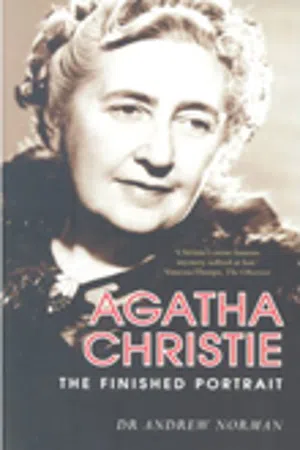
Agatha Mary Clarissa Miller (who became Agatha Christie) begins her autobiography by declaring that one of the most fortunate things that can happen to a person in their lifetime, is to have a happy childhood. Her childhood, she describes as ‘very happy’. She loved her home and her garden; her nanny was ‘wise and patient’, and because her parents loved one another, this meant that they were successful, both in their marriage and in being parents.1
Agatha was born on 15 September 1890 at the Devonshire seaside resort of Torquay, an event which came about in the following way. Agatha’s mother Clarissa (‘Clara’), whose family came from Sussex, was born in Belfast in 1854. When Clara grew up she married Frederick Alvah Miller, an American who had moved to Manchester. (In fact, Frederick and Clara were related by marriage, Clara’s Aunt Margaret being the second wife of Nathaniel Frary Miller, and Frederick being Nathaniel’s son by his first wife Martha).2 At the time of their marriage in April 1878, Frederick was aged thirty-two and Clara twenty-four.
The couple set up home in Torquay, and it was here, in 1879, that Agatha’s sister Margaret – ‘Madge’ – was born. Finally, having returned to America, where in 1880 Agatha’s brother Louis Montant – ‘Monty’ – was born, Frederick suggested to Clara that she set up home permanently in Torquay, where he would join her after concluding his business arrangements in New York. Using the money from a legacy, Clara promptly bought ‘Ashfield’, described as a sizeable mansion standing in extensive grounds which included ‘an orchard, conservatories, a tennis court, and croquet lawn…’.3 This is the house where Agatha was born, and around which her early life was centred, for as will be seen, her mother did not for some years consent to her attending school.
Of Agatha’s love for her parents, there is no doubt. However, she describes her mother Clara as someone who had a habit of seeing the world as a drama, or even as a melodrama. Because of the creative nature of her imagination, she was never able to visualize places or events as being ‘drab or ordinary’. She was also highly intuitive, which meant that she was often able to deduce the thoughts of others.4
Those who subscribe to there being a genetic basis for behaviour would argue that Agatha’s own imaginativeness and creativity was inherited from her mother.
As for her father Frederick, she describes him as a lazy man of independent means; a collector of fine furniture and china, glass and paintings, who spent mornings and afternoons at his club, and, during the season, days at the cricket club – of which he was president – in Torquay. Nevertheless, Agatha acknowledged that Frederick had a loving nature, and was deeply concerned for his fellow men.5 Frederick also possessed an extensive library which included comprehensive editions of the novels of the nineteenth century.6 This facility would be of great benefit to Agatha in the years to come, in her own literary career.
Despite her father’s undoubted inadequacies, Agatha had this to say about fathers in general Everyone found the phrase ‘father knows best’ amusing, but nevertheless, it did epitomize the view that was prevalent in Victorian times. In other words, the father was ‘the rock upon which the home was built.’7
Two other members of the family who would feature prominently in Agatha’s life were Mary Ann Boehmer (née West), Agatha’s maternal grandmother; she lived in Bayswater, London and was known as ‘Grannie B’. Also, Mary Ann’s sister Margaret Miller (née West), Agatha’s maternal great aunt, who, after the death of her husband Nathaniel, moved from Cheshire to Ealing, Greater London. She was known as ‘Auntie Grannie’.
Notes
1. Christie, Agatha. An Autobiography, p.13.
2. Morgan, Janet. Agatha Christie – A Biography, p.2.
3. Matthew, HCG and Brian Harrison (eds.). Oxford Dictionary of National Biography, Vol.2, p.528.
4. Christie, op.cit., p.19.
5. Ibid, p.14.
6. Matthew, op.cit., p.528.
7. Christie, op.cit., p.116.
In Agatha’s early years, home and family were paramount, and it is, therefore, not surprising that she became deeply attached to those who were assigned to look after her.
At Ashfield, Agatha’s parents employed a nanny for Agatha. She was known as ‘Nursie’ and described as elderly and rheumatic. Agatha was devoted to Nursie, with whom she shared so much, for example, being allowed in the kitchen in order to help with the making of her own little bread loaves and plaited buns. When Nursie retired, Agatha described this as the ‘first real sorrow of her life…’.1 There was also a cook, Jane Rowe, who remained with the family for forty years, and several house-maids and a parlour-maid. In this seemingly idyllic world, however, all was not entirely sweetness and light. It was when she was about 5 years old, recalled Agatha, that her father first began to have money worries.
Her grandfather had invested his money in a series of trust funds, intended to provide income for his relatives after his death. However, the money that was due to come to Agatha’s father did not materialize, either because of ‘sheer inefficiency’, or because one of the four trustees had managed to manipulate matters to their own advantage, which, Agatha did not know.2 Agatha was at pains to stress, therefore, that although her father was an American, and all Americans were supposed to be rich, her family was not particularly well off. They had no carriage and horses; no butler or footman, and only three servants – which was a minimum in those days. However, poverty for the Miller family was only a matter of degree, because Agatha goes on to describe a typical meal served at Ashfield as including soup, boiled turbot or fillets of sole; followed by sorbet, saddle of mutton, lobster mayonnaise, pouding diplomatique and charlotte russe!3
In order to economize, the Millers decided to let Ashfield, and spend the winter of 1895 in France where the cost of living was lower. Having crossed the Channel, Agatha described the excitement of going to bed in the train which would take them to Pau in the South of France, where they spent about six months. It was here that she went horse riding, and with the help of Marie Sijé, an assistant fitter whom they met in the dressmaker’s shop, improved her French. Soon Agatha was able not only to converse fluently, but also to read books in the French language. When Clara asked Marie if she would care to accompany the family back to England, the latter was delighted. Then they left for Paris, to find the streets ‘full of those new vehicles called Automobiles’.4 They returned via Brittany and Guernsey.
These early experiences on the Continent would leave an indelible impression on Agatha; to the extent that she later chose to make her famous male detective a Belgian, whose charm was that he could view the British, and particularly the English with their traditions and eccentricities, from a Continental standpoint.
Although Agatha’s elder siblings, sister Madge and brother Monty, had attended boarding school, their mother Clara became convinced that the best way to bring up girls was to give them as much freedom as possible, with good food and an abundance of fresh air. Their minds were not to be ‘forced’ in any way. Boys, of course, were an entirely different proposition. For them, education had to be along rigidly conventional lines...