Medieval folk had long suspected that the Devil was carrying out his work on earth with the help of his minions. In 1484, Pope Innocent VIII declared this to be true, which resulted in witch-hunts across Europe that lasted for nearly 200 years. In 1645, England – and Essex in particular – was in the grip of witch fever. Between 1560 and 1680, 317 women and 23 men were tried for witchcraft in Essex alone, and over 100 were hanged. Essex Witches includes biographies of many of the local common folk who were tried in the courts for their beliefs and practice in herbal remedies and potions, and for causing the deaths of neighbours and even family members. These unfortunate citizens suffered the harshest penalties for their alleged sorcery and demonic ways, and those punishments are recorded here.
- 160 pages
- English
- ePUB (mobile friendly)
- Available on iOS & Android
eBook - ePub
Essex Witches
About this book
Information
TEN
THE ACCUSED
‘You shall have no other gods before me’: the first of the Ten Commandments was used by Protestantism and its proxy secular institutions to justify the killing of people who possessed supernatural abilities, who were deemed as heretics who had made a pact with the Devil. Their witchcraft was said to be associated with wild satanic rituals, which included naked dancing, and cannibalistic infanticide. The German-speaking lands of Europe, France and Scotland were the hotbeds of witch-hunts until 1645, when England, and most notably the county of Essex, was in the grip of witch fever. In the time of religious strife between Catholics and Protestants, political arguments that led to the Civil War and the subsequent widening of the gap between the rich and the poor, the persecutions of suspected witches went almost without restraint.
In rural communities isolated from the outside world, witches were seldom regarded as benign. In every place and parish, every old woman ‘with a wrinkled face, a furrowed brow, a hairy lip, a gobber tooth, a hooked-nose, a squint eye, a squeaking voice, a scolding tongue, having a ragged coat on her back, a skull cap on her head, a spindle in her hand, a dog or cat by her side’, was not only suspected, but pronounced for a witch.
It will be noticed, however, that the accusations of witchcraft occurred almost exclusively between neighbours in both towns and villages after the refusal of one neighbour to help another, which was quite an offence in a cooperative society. The one who refused to help was almost always the one who was alleged to have been bewitched. People were also advised not to help anyone suspected of witchcraft, and it seemed that people could easily be fooled into believing the worst about their neighbours. This also served as an opportunity for some to get rid of the ones that they disliked.
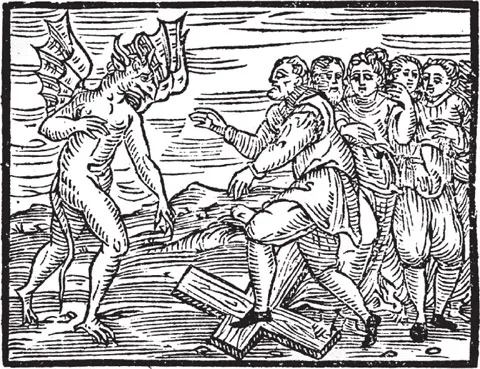
The Devil and witches trampling a cross. (From the Compendium Maleficarum, the witch-hunter’s manual, 1608)
The belief in the power of a curse was so strong among communities in Tudor and Stuart England that even the justices of the peace and grand jurymen were instructed that one of the signs of bewitchment was the sudden onset of a disease in a previously healthy person; this was not considered an occurrence of misfortune. Plague had raged through Europe since around 1599, and recurred once every generation until the beginning of the eighteenth century. With nothing known about the root causes of disease, like bacteria and viruses, the outbreak of the ‘Great Plague’ of 1665–66 was thought by many to have been the work of witches, who were also the primary ‘plague-spreaders’.
Over 90 per cent of the accusations made in Essex were made against women, but in many cases, the accusers had to seek the official backing of long-standing local recorded accusations against a particular individual before taking a case of bewitching to court for any real chance of success in a prosecution.
Whatever the truth of the matter, folk tradition condemned witches as servants of the powers of darkness, who had sold their souls to the Devil in exchange for magical powers. They were brought to trial often on the flimsiest of evidence and most confessions would have been gained through torture. Today, none of these trials would ever make it to court and would certainly not be taken seriously if they did. The fear of witchcraft did, however, last for many years and one of the latest incidents recorded in Essex involving witchcraft was as late as 1863 in Sible Hedingham.
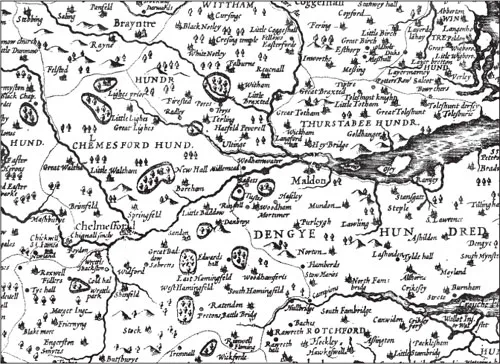
A map of Essex in 1661. (Author’s collection)
ABBERTON
Stephen Hugrave, a labourer known for brawling and being a ‘sower of discorde’ between neighbours, along with Alice Hugrave, a spinster, was indicted at the assizes held at Chelmsford on 18 March 1594 for bewitching a widow, Margaret Stanton.
They were also indicted for bewitching four hogs worth 26s 8d, and eight ‘pigges’ worth 20s, that belonged to Thomas Clarke (senior), whereby they died. They pleaded not guilty to both charges, and were found not guilty. Stephen Hugrave was also indicted for the charge that on 16 March 1594, he bewitched two cows worth £4, belonging to John Smithe, so that they died. He pleaded not guilty and was found to be so.
ALPHAMSTONE
Alice Buske, widow, pleaded not guilty when she was brought before the assizes at Chelmsford on 24 July 1609, indicted with bewitching John, the son of William Polley, on 5 July, following which he died two days later. The testimony of witnesses William, Mary, John and James Polley, William Rayner and John Miller, was sufficient for the jurors to find her guilty, and they sentenced her to be hanged as a witch.
ALRESFORD
Susan Sparrow, who had lived with her daughter under the same roof as ‘Goodwife’ Mary Greenleif, and her own daughter of a similar age at her home in Arlesford, gave evidence before the justices at Little Bentley on 25 April 1645, that on one night, she heard the 13- or 14-year-old daughter of Mary Greenleif cry out in a fearful manner, ‘Oh Mother, now it comes, oh help me, Mother, it hurts me.’ Sparrow said that she called out to Greenleif, ‘If your child be asleep, waken it, for if anyone comes by, and hears it making such a moan, they will say that you are suckling your imps upon it.’ Greenleif, who already had an ill name in the village, replied, ‘I do so indeed, and I will fee with them (her said imps), that they shall suck my daughter one night, and thine on another.’
Sparrow said that on the following night her own daughter cried out in the same manner, and clasped her arms around her mother’s neck. She was sweating and very frightened, and shrieking in a terrible manner that she had been nipped and pinched on her thigh. The following morning, Sparrow looked to find the cause of her daughter’s pain, and found a black and blue spot as broad and as long as her hand above her daughter’s right knee, the discomfort from which lasted for at least a month.
Sparrow also stated that the house she dwelled in with the said Mary was ‘haunted’ with a leveret (a young hare), which usually sat before the door. She knew that one Anthony Sharlock had an excellent greyhound that had killed many hares, and had heard that a child of the said Anthony was much haunted and troubled, and that its mother suspected Greenleif to be the cause of it. Sparrow went to Sharlock and told him that a leveret did usually come and sit before the door, where she and Greenleife lived, and asked him to bring down his greyhound to see if he could kill the said leveret.
The next day, Sharlock did accordingly bring his greyhound, and coursed it, but whether the dog killed the leveret is not known. However, a short time before it was coursed by a man known as ‘Goodman’ Merrill’s dog. The dog ran at it, but the leveret never stirred, and just when the dog came at it, he skipped over it, turned about, stood still and looked on it. Shortly after that, the dog languished and died.
Sparrow was careful not to claim that the leveret was a familiar, but simply suggested that, ‘shee wondered very much to see a Leveret, wilde by nature, to come so frequently and sit openly before the dore in such a familiar way.’
The information from two further informants, Elizabeth Hunt and Priscilla Brigs, taken upon oath before the said justices, said they had been employed to search Greenleif on the suspicion of being a witch. They stated they had:
found bigges or teates in her secret parts, but were not like emerods [haemorrhoids], nor in those places where women use to be troubled with them; and that they verily beleeve, these teates are sucked by her Impes; for that these Informants have been formerly imployed to search other women suspected for Witchcraft, who have had the like bigges, and have afterwards confessed themselves to be Witches.
Greenleif was asked by the examiner how she came by those teats which were discovered in her secret parts, and she replied:
She knows not unless she were born with them; but she never knew she had any such until this time, they were found in those parts upon the said search. She also denied that any impe had ever sucked on these teates, but did confess that, ‘she hath seen a leveret once fitting before her door within a yard of the threshold; and that she wondered much at it, being about noon time as she remembreth.’ She said that she was, ‘not guilty of any accusation charged upon her by this Examinant.’
BARKING
Elizabeth Hardinge, spinster, of Barking appeared before the justices at the assizes held at Chelmsford on 6 August 1579, indicted for bewitching twelve chickens on 1 November. She was found guilty and judged according to the form of the Statute of 1563. A second indictment of bewitching Ellen, the wife of John Goode, to her great injury, on 1 August, also brought her a guilty verdict and was judged according to the form of the statute.
Despite the hardships she must have endured from her sentencing, Hardinge was brought before the assizes at Brentwood on 17 March 1580, indicted for bewitching Cecily, the 3-year-old daughter of William Miles, on 3 February, who died on 20 March. Hardinge was found guilty and was remanded in prison at Colchester.
BELCHAMP WALTER
Agnes Dix, a common witch and entrantress, wife of John Dix, labourer, appeared before the assizes at Brentwood on 9 July 1574, indicted for bewitching Ellen, wife of John Potter, on 20 January, who then died. Dix was also indicted for bewitching Richard Hayward on 1 May, following which he languished for fourteen days. Dix was found guilty on the first indictment, but no record has been found of any sentence.
Rose Chapman, of Belchamp Walter, was brought before the justices at Chelmsford on 30 June 1600, indicted with causing the death of John Payne by witchcraft. Evidence was given by the wife of William Payne, who was a labourer of the same place.
BLACK NOTLEY
Margery Wilson, widow, of Black Notley, was brought before the assizes held at the summer session at Brentwood on August 1603, where she pleaded not guilty on three indictments. The first was that on 10 December she bewitched Mary Rust, who languished until 10 March following, when she died. The second was that she bewitched a brown milk cow belonging to Thomas Goodaye, whereof it died on 14 May, and the third was of bewitching Bridget Bruer, ‘whereby she was afflicted in divers parts of her body’ until 26 July. Wilson was found guilty on all three charges and was hanged as a witch.
BOCKING
Margaret Rooman was indicted at the assizes held at Chelmsford, that on 5 May, she bewitched a black cow worth 40s belonging to Thomas Olmesteede. Rooman was found guilty and sentenced to one year in prison with quarterly sessions of six hours in the pillory.
BOREHAM
Agnes Haven was tried for witchcraft at Boreham on 10 April 1593. She was accused of bewitching Edith Hawes in ‘divers parts of her body’ on 1 December 1592, whereby she died on 20 December. Haven pleaded not guilty, but was found guilty. She was also found guilty on a second charge, that she bewitched a John Brett, so that he was ‘grievously afflicted in divers parts of the body.’ Haven was hanged and buried outside the churchyard. A curious fact relating to Agnes Haven is that during the construction of a military airfield nearby in 1944, her grave was accidentally broken open by a bulldozer. Many farmers in the area subsequently suffered poor harvests and damaged crops, which were believed by local people to have been caused by the curse of the witch.
Mary Belstead alias Muldeton, spinster, pleaded not guilty at the assizes held at Chelmsford on 18 March 1594 that on 1 November she bewitched a brown mare worth £3 and four pigs worth 26s 8d that belonged to John Hare, so that they died. Belstead was found guilty and remanded for one year.
BORLEY
At the session rolls at Michaelmas in 1578, Margaret Ganne, alias Welles, and Joan Norfolk, spinsters, of Borley, were indicted with bewitching John Furmyn on 1 March 1578, so that he languished until 1 May, when he died. The jurors said that Welles and Norfolk killed and murdered Furmyn by witchcraft, contrary to the peace, and that evidence would be given by John Bragge, Alice Furmyn, and William Furmyn against Welles at the next assizes. These were held at Chelmsford, where Welles and Norfolk subsequently appeared before Robert Lord Riche, Thomas Myldmaye, and others, and where they pleaded not guilty. The jurors found them both guilty of murdering John Furmyn by witchcraft, while the justice of the peace found them not guilty. No verdict was recorded.
BOXTED
Betty Potter lived in a cottage along Straight Road, Boxted, about 5 miles north of Colchester. In around 1646, ‘witch fever’ had reached the area, and Betty, an elderly lady, was reputed to have cured the sick daughter of a wealthy Colchester merchant, for which she was richly rewarded. But she was also accused of bewitching the horses that were pulling a wagonload of wheat...
Table of contents
- Cover
- Title Page
- Contents
- Introduction
- One England after the Tudors
- Two What is Witchcraft?
- Three Witches or Cunning Folk
- Four Familiars and Witches’ Marks
- Five Potions and Remedies, Spells and Incantations
- Six The Acts upon Witchcraft
- Seven The Assizes
- Eight Mathew Hopkins – The Witch-finder General
- Nine Confession and Torture
- Ten The Accused
- Eleven Witches and Halloween
- Twelve Dispelling the Myth
- Glossary
- Credits
- Bibliography
- Copyright
Trusted by 375,005 students
Access to over 1.5 million titles for a fair monthly price.
Study more efficiently using our study tools.
Frequently asked questions
Yes, you can cancel anytime from the Subscription tab in your account settings on the Perlego website. Your subscription will stay active until the end of your current billing period. Learn how to cancel your subscription
No, books cannot be downloaded as external files, such as PDFs, for use outside of Perlego. However, you can download books within the Perlego app for offline reading on mobile or tablet. Learn how to download books offline
We are an online textbook subscription service, where you can get access to an entire online library for less than the price of a single book per month. With over 1.5 million books across 990+ topics, we’ve got you covered! Learn about our mission
Look out for the read-aloud symbol on your next book to see if you can listen to it. The read-aloud tool reads text aloud for you, highlighting the text as it is being read. You can pause it, speed it up and slow it down. Learn more about Read Aloud
Yes! You can use the Perlego app on both iOS and Android devices to read anytime, anywhere — even offline. Perfect for commutes or when you’re on the go.
Please note we cannot support devices running on iOS 13 and Android 7 or earlier. Learn more about using the app
Please note we cannot support devices running on iOS 13 and Android 7 or earlier. Learn more about using the app
Yes, you can access Essex Witches by Peter C. Brown in PDF and/or ePUB format, as well as other popular books in History & British History. We have over 1.5 million books available in our catalogue for you to explore.