- 296 pages
- English
- ePUB (mobile friendly)
- Available on iOS & Android
eBook - ePub
About this book
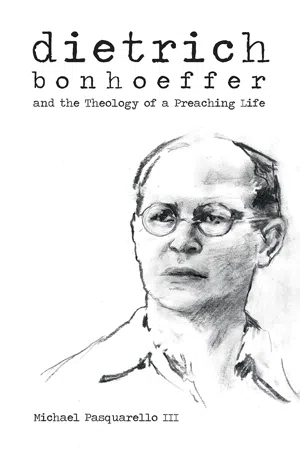
Dietrich Bonhoeffer (1906-1945) remains one of the most enigmatic figures of the twentieth century. His life evokes fascination, eliciting attention from a wide and diverse audience. Bonhoeffer is rightly remembered as theologian and philosopher, ethicist and political thinker, wartime activist and resister, church leader and pastor, martyr and saint. These many sides to Bonhoeffer do not give due prominence to the aspect of his life that wove all the disparate parts into a coherent whole: Bonhoeffer as preacher. In Dietrich: Bonhoeffer and the Theology of a Preaching Life Michael Pasquarello traces the arc of Bonhoeffer's public career, demonstrating how, at every stage, Bonhoeffer focused upon preaching, both in terms of its ecclesial practice and the theology that gave it life. Pasquarello chronicles a period of preparation--Bonhoeffer's study of Luther and Barth, his struggle to reconcile practical ministry with preaching, and his discovery of preaching's ethic of resistance. Next Pasquarello describes Bonhoeffer's maturation as a preacher--his crafting a homiletic theology, as well as preaching's relationship to politics and public confession. Pasquarello follows Bonhoeffer's forced itinerancy until he became, ultimately, a preacher without any congregation at all. In the end, Bonhoeffer's life was his best sermon. Dietrich presents Bonhoeffer as an exemplar in the preaching tradition of the church. His exercise of theological and homiletical wisdom in particular times, places, and circumstances--Berlin, Barcelona, Harlem, London, Finkenwalde--reveals the particular kind of intellectual, spiritual, and moral formation required for faithful, concrete witness to the gospel in the practice of proclamation, both then and now. Bonhoeffer's story as a pastor and teacher of preachers provides a historical example of how the integration of theology and ministry is the fruit of wisdom cultivated through a life of discipleship with others in prayer, study, scriptural meditation, and mutual service.
Information
Topic
Theology & ReligionSubtopic
Religious BiographiesNotes
Preface and Acknowledgments
1 I have attempted to address the topic of “homiletic theology” in Michael Pasquarello III, Sacred Rhetoric: Preaching as a Theological and Pastoral Practice of the Church (2005; repr., Eugene, Ore.: Wipf & Stock, 2012); Christian Preaching: A Trinitarian Theology of Proclamation (2006; repr., Eugene, Ore.: Wipf & Stock, 2011); We Speak Because We Have First Been Spoken: A “Grammar” of the Preaching Life (Grand Rapids: Eerdmans, 2009).
2 See Isabel Best’s editor’s Introduction in The Collected Sermons of Dietrich Bonhoeffer, ed. Isabel Best, trans. Douglas W. Stott et al. (Minneapolis: Fortress, 2012), xiii–xxvi. I was also encouraged by several earlier works that called attention to Bonhoeffer’s sermons and thinking about preaching, particularly Clyde E. Fant, ed.,Bonhoeffer: Worldly Preaching (Nashville: Thomas Nelson, 1975); Edwin Robertson, The Shame and the Sacrifice: The Life and Martyrdom of Dietrich Bonhoeffer (New York: Scribner, 1988); Frits de Lange, Waiting for the Word: Dietrich Bonhoeffer on Speaking about God, trans. Martin N. Walton (Grand Rapids: Eerdmans, 1995).
3 Randi Rashkover, “The Future of the Word and the Liturgical Turn,” in Liturgy, Time, and the Politics of Redemption, ed. Randi Rashkover and C. C. Pecknold (Grand Rapids: Eerdmans, 2006), 3–4.
4 Charles Marsh writes, “Bonhoeffer did not become a practical theologian as such, at least in the sense in which that term is sometimes used to describe a theological field separate from systematic or philosophical theology; although I would say that the kind of writing he forged in the crucible of the church struggle points us toward a style of theological writing beyond conventional types, or perhaps one that moves us closer to the truth of things: a theology that confesses, that preaches, that prays, that rejoices, that proclaims the Amen and the Yes, that encourages and sustains the redemptive practices of the church; a theology, which even should the church fall into ruins, cleaves to the mysteries of Christ’s presence in the world.” Marsh, “Bonhoeffer on the Road to King: ‘Turning from the Phraseological to the Real,’” in Bonhoeffer and King: Their Legacies and Import for Christian Social Thought, ed. Willis Jenkins and Jennifer M. McBride (Minneapolis: Fortress, 2010), 137.
Introduction
1 Eberhard Bethge, Dietrich Bonhoeffer: Theologian, Christian, Contemporary (London: Collins, 1970), 174.
2 Stephen R. Haynes’ study includes “the radical Bonhoeffer,” “the liberal Bonhoeffer,” “the conservative Bonhoeffer,” and “the universal Bonhoeffer.” Haynes, The Bonhoeffer Phenomenon: Portraits of a Protestant Saint (Minneapolis: Fortress, 2004).
3 This argument has been made by Haynes in The Bonhoeffer Phenomenon.
4 John W. de Gruchy, “The Reception of Bonhoeffer’s Theology,” in The Cambridge Companion to Dietrich Bonhoeffer, ed. John W. de Gruchy, Cambridge Companions to Religion (Cambridge: Cambridge University Press, 1999), 93–94 (emphasis in original).
5 On the chronology of Bonhoeffer’s writings in relation to his theological development, see Wayne Whitson Floyd Jr., “Bonhoeffer’s Literary Legacy,” in de Gruchy, Cambridge Companion, 71–92.
6 A recent example of this approach is Andrew Root, Bonhoeffer as Youth Worker: A Theological Vision for Discipleship and Life Together (Grand Rapids: Baker Academic, 2014).
7 See Keith L. Johnson, “Bonhoeffer and the End of the Christian Academy,” in Bonhoeffer, Christ, and Culture, ed. Keith L. Johnson and Timothy Larsen (Downers Grove, Ill.: IVP Academic, 2013), 153–74.
8 Rashkover, “Future of the Word,” 3–4.
9 This argument has been made by Haynes in The Bonhoeffer Phenomenon.
10 See Best’s editor’s introduction in Collected Sermons of Dietrich Bonhoeffer, xiii–xxvi. For an older, but still informative, introduction to Bonhoeffer’s thought on preaching, especially his homiletical lectures, see Fant,Bonhoeffer. It is interesting to note that the Cambridge Companion to Dietrich Bonhoeffer does not include a chapter on Bonhoeffer’s homiletical work.
11 A good example is the best-selling biography by Eric Metaxas that portrays Bonhoeffer as an “evangelical” but contains no references to preaching in its index. Metaxas, Bonhoeffer: Pastor, Martyr, Prophet, Spy (Nashville: Thomas Nelson, 2010). For a historical survey of evangelical appropriations of Bonhoeffer, see Timothy Larsen, “The Evangelical Reception of Dietrich Bonhoeffer,” in Bonhoeffer, Christ and Culture, ed. Keith L. Johnson and Timothy Larsen (Downers Grove, Ill.: IVP Academic, 2013), 39–57.
12 Dietrich Bonhoeffer Works: Act and Being; Transcendental Philosophy and Ontology in Systematic Theology, ed. Wayne Whitson Floyd Jr., trans. H. Martin Rumscheidt, Dietrich Bonhoeffer Works (English) 2 (Minneapolis: Fortress, 1996), 133. Hereafter the volume information will be abbreviated as DBWE. DBWE volumes are cited in the notes and bibliography by editor and volume title.
13 Charles Marsh writes, “Bonhoeffer did not become a practical theologian as such, at least in the sense in which that term is sometimes used to describe a theological field separate from systematic or philosophical theology; although I would say that the kind of writing he forged in the crucible of the church struggle points us toward a style of theological writing beyond the conventional types, or perhaps moves us closer to the truth of things: a theology that confesses, that preaches, that prays, that rejoices, that proclaims the Amen and the Yes, that encourages and sustains the redemptive practices of the church; a theology, which even should the church fall into ruins, cleaves to the mysteries of Christ’s presence in the world.” Marsh, “Bonhoeffer on the Road to King: ‘Turning from the Phraseological to the Real,’” in Jenkins and McBride,Bonhoeffer and King, 137.
14 I have attempted to address the topic of “homiletic theology” in Sacred Rhetoric; Christian Preaching; and We Speak Because We Have First Been Spoken.
15 Dietrich Bonhoeffer Works: Barcelona, Berlin, New York, 1928–1931, ed. Clifford J. Green, trans. Douglas W. Stott, DBWE 10 (Minneapolis: Fortress, 2008), 128.
16 I am indebted to David Schnasa Jacobsen for the term “theology on the way.” See Jacobsen’s introduction to Homiletical Theology: Preaching as Doing Theology, ed. Jacobsen, The Promise of Homiletical Theology 1 (Eugene, Ore.: Cascade, 2015), 5.
17 Robert W. Jenson writes of the Trinitarian nature of the conversation: “As the church speaks and hears the gospel and as the church responds in prayer and confession, the church’s life is a great conversation, and this conversation is our anticipatory par...
Table of contents
- Cover
- Title Page
- Copyright Page
- Contents
- Preface and Acknowledgments
- Introduction
- I Preparation
- II Preaching
- III Consequences
- Conclusion
- Notes
- Bibliography
- Index
Trusted by 375,005 students
Access to over 1.5 million titles for a fair monthly price.
Study more efficiently using our study tools.
Frequently asked questions
Yes, you can cancel anytime from the Subscription tab in your account settings on the Perlego website. Your subscription will stay active until the end of your current billing period. Learn how to cancel your subscription
No, books cannot be downloaded as external files, such as PDFs, for use outside of Perlego. However, you can download books within the Perlego app for offline reading on mobile or tablet. Learn how to download books offline
Perlego offers two plans: Essential and Complete
- Essential is ideal for learners and professionals who enjoy exploring a wide range of subjects. Access the Essential Library with 800,000+ trusted titles and best-sellers across business, personal growth, and the humanities. Includes unlimited reading time and Standard Read Aloud voice.
- Complete: Perfect for advanced learners and researchers needing full, unrestricted access. Unlock 1.5M+ books across hundreds of subjects, including academic and specialized titles. The Complete Plan also includes advanced features like Premium Read Aloud and Research Assistant.
We are an online textbook subscription service, where you can get access to an entire online library for less than the price of a single book per month. With over 1.5 million books across 990+ topics, we’ve got you covered! Learn about our mission
Look out for the read-aloud symbol on your next book to see if you can listen to it. The read-aloud tool reads text aloud for you, highlighting the text as it is being read. You can pause it, speed it up and slow it down. Learn more about Read Aloud
Yes! You can use the Perlego app on both iOS and Android devices to read anytime, anywhere — even offline. Perfect for commutes or when you’re on the go.
Please note we cannot support devices running on iOS 13 and Android 7 or earlier. Learn more about using the app
Please note we cannot support devices running on iOS 13 and Android 7 or earlier. Learn more about using the app
Yes, you can access Dietrich by Michael Pasquarello III in PDF and/or ePUB format, as well as other popular books in Theology & Religion & Religious Biographies. We have over 1.5 million books available in our catalogue for you to explore.