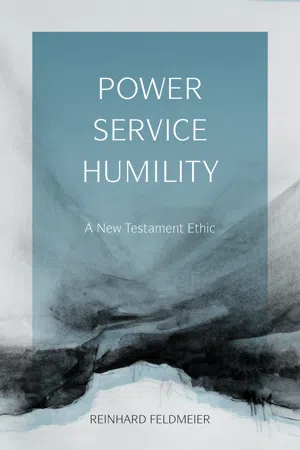
Since ancient times, depictions of the divine have been painted with the colors of divine power. Not surprisingly, power language became a central part of the New Testament's understanding of God and human relationships. In Power, Service, Humility, biblical scholar Reinhard Feldmeier reads across the New Testament canon--the Gospels, Pauline epistles, and Revelation of John--to distinguish two ways in which power works. Feldmeier's chief claim is that power based on oppression, the kind Satan offers Christ, is a far different kind of power than the empowerment that God grants Jesus in the resurrection. Further, Feldmeier demonstrates the antithetical link between worldly power and the power present in Christ-like service and humility. As Feldmeier discovers, the differences between sacred and secular power have dramatic implications for how humans handle power within the church and beyond. Power, Service, Humility provokes thoughtful considerations of both human and divine relationships with power and power's holy place within the Christian faith.
- 155 pages
- English
- ePUB (mobile friendly)
- Available on iOS & Android
eBook - ePub
Power, Service, Humility
About this book
Information
Topic
Theology & ReligionSubtopic
Biblical StudiesChapter 1
Power
Religion and Power:
The Context in the History of Religion
The Context in the History of Religion
It is not by chance that the devil begins with the title “Son of God,” when he seeks to turn Jesus away from his path by seducing him to grasp a power that will be his own. The divine is always connected with power; indeed, divinity and power can almost become synonymous. U. von Wilamowitz-Moellendorff sums up the case of the Greek gods as follows: “The divine is that which is kreitton in relation to us. The gods are often called kreittones.”1 The comparative kreitton (more powerful) emphasizes the power of the gods. At the same time, the superior power is regarded as the decisive difference between the divine and the human; indeed, one might say that the superior power is divine. This does not only apply to the divine as an abstract; one particular deity can function as a predicate concept for power. For example, the name “Zeus” can denote not only the mythological ruler of the Olympian pantheon but also one particular form of divine power.2 In one sense, therefore, we can say that the Greek deities are not so much persons as personifications of powers and that, consequently, Greek religion is concerned with the systematization of such powers.3
This immediate link between divinity and power is repeatedly made explicit in the ancient sources. The Attic poet Menander expresses it axiomatically: “everything that exercises power is called ‘god.’ ”4 In the Roman sphere, Cicero says something very similar in his treatise about the being of the gods: “whatever is outstanding is rightly adored.”5 A papyrus from the second century of the Common Era shows that this equation between divinity and power still held good in the imperial period. It begins with the question [t]i theos? (What does “god” mean?) and then gives the lapidary answer t[o] kratoun (the exercise of power).6
The link between power and religion is not restricted to the object of religious veneration. It also concerns the phenomenon of religion as such, inasmuch as this is always also a societal reality and is thus itself a factor of power. Religion justifies and legitimates rule and law in all the ancient cultures, and it regulates life in society. In the Roman Empire, for example, religion is so closely interwoven into every sphere of culture, of society, and especially of politics7 that one can almost understand it as the ideological basis of Roman society and of the concept of the state,8 and the regulations of religion can be described as sacral institutions.9
This bond between religion and political power found its most striking expression in the Roman imperial cult. As S. R. F. Price shows in his monograph Rituals and Power, one does not do justice to this phenomenon if one reduces it to a “religion of loyalty” that was instrumentalized by politics. The functionalization of the imperial cult in practical politics is undeniable; but it must be evaluated as an authentic religious phenomenon, which, precisely for this reason, plays a decisive role in the constitution of the power of the Roman imperial system.10 In classical antiquity, therefore, “reflection on the gods” is always to be understood “also as a reflection on power”11—with all the attendant ambivalences.12
The Power of the God of Israel:
Differentiations
Differentiations
At first sight, the biblical belief in God fits this pattern. The power to perform great miracles with his right hand and to annihilate his enemies is attributed to him as a complete matter of course (see Exod 15:6); and, as the Creator and sovereign Lord of the entire world, he possesses a unique power (see, in this regard, Pss 93–100). When the God of Israel is thus called “LORD Sabaoth,” the “Lord of hosts,” in the Old Testament, and this is rendered as Kyrios pantokratôr, “almighty Lord,” in the Septuagint, the Greek translation of the Old Testament, the link between the idea of God and a power that is superior to everything else appears to have taken on a programmatic character. This does not remain restricted to the Old Testament. Christianity carries forward the Jewish inheritance in this area too, as we see not least from the fact that the only predicate of God that was included in the Apostolic Creed was his omnipotence—and not only once, but twice.13
At the same time, however, the Old Testament and early Jewish writings emphasize that the God who has liberated Israel and “cast Pharaoh’s chariots and his army into the sea” (Exod 15:4) is not a God who is always “on the side of the big battalions.”14 As the one who breaks the bow of the strong and girds the weak with strength (cf. 1 Sam 2:4), God resists the arrogant power of human beings—and hence those who exalt themselves. This conviction finds its classic formulation in the Septuagint version of Proverbs 3:34:
God resists the haughty,
but he gives grace to the humble.15
but he gives grace to the humble.15
It was not only in ancient Judaism that this antithetical parallelismus membrorum acquired the significance of a fundamental proposition about the relationship between God and human power;16 this aphorism was profoundly influential in the New Testament and in early Christian literature as well,17 and it played an important role not least in the elaboration of the ideal of humility (see below).
Parallels to the idea that the divinity raises up the lowly and brings down that which is high also exist outside the biblical tradition. It is precisely the link between an idea of the divine that has an increasingly ethical accentuation and the responsibility of God or the gods for justice that leads in the pagan sphere as well to a reluctance to associate earthly power unreflectingly with the divine. Hesiod already begins his Works and Days with a corresponding praise of Zeus:
For easily he makes strong the weak,
and easily he brings the strong man low;
easily he humbles the proud and raises the obscure,
and easily he straightens the crooked and blasts the proud—
Zeus who thunders aloft and has his dwelling most high.18
and easily he brings the strong man low;
easily he humbles the proud and raises the obscure,
and easily he straightens the crooked and blasts the proud—
Zeus who thunders aloft and has his dwelling most high.18
The distinctiveness of the biblical testimony is that the God who cares for justice does not present himself as the one who “has his dwelling most high” above everything but as the one who decidedly takes the side of the weak. This other accent can be seen, for example, in the text that one could call the Old Testament counterpart to Hesiod’s song in praise of Zeus, the song of Hannah, which in turn has its parallel in the New Testament in Mary’s Magnificat (Luke 1:46-55):
The bows of the mighty are broken,
but the feeble gird on strength.
Those who were full have hired themselves out for bread,
but those who were hungry are fat with spoil. . . .
The Lord kills and brings to life,
he brings down to Sheol and raises up.
The Lord makes poor and makes rich;
he brings low, he also exalts.
He raises up the poor from the dust;
he lifts the needy from the ash heap,
to make him sit with princes
and inherit a seat of honor. (1 Sam 2:4-8)
but the feeble gird on strength.
Those who were full have hired themselves out for bread,
but those who were hungry are fat with spoil. . . .
The Lord kills and brings to life,
he brings down to Sheol and raises up.
The Lord makes poor and makes rich;
he brings low, he also exalts.
He raises up the poor from the dust;
he lifts the needy from the ash heap,
to make him sit with princes
and inherit a seat of honor. (1 Sam 2:4-8)
In keeping with this, Psalm 113 sees the very point of God’s being enthroned on high in his bending down into the depths and thus raising up the one who is lowly:
He is seated on high,
he looks far down
on the heavens and the earth.
He raises the poor from the dust,
and lifts the needy from the ash heap,
to make him sit with princes,
with the princes of his people. (113:5-8)
he looks far down
on the heavens and the earth.
He raises the poor from the dust,
and lifts the needy from the ash heap,
to make him sit with princes,
with the princes of his people. (113:5-8)
“The Lord is my strength”
This is not the expression of an arbitrary partisanship. Rather, this turning to the lowly expresses a specific understanding of divine power, which may perhaps not be unique in the history of religion, but which comes into its own in a particularly pregnant manner in the biblical writings. For, despite all the emphasis on God’s preeminence, his greatness does not consist in the kreitton, his superior power, and thus not in his difference from the weakness of the human person. Instead, God’s power benefits his human partner. Indeed, it becomes his own power, and the psalmist who experiences oppression can praise his God as his strength:
I love you, O Lord, my strength.
The Lord is my rock, my fortress, and my deliverer. (Ps 18:2-3)
The Lord is my rock, my fortress, and my deliverer. (Ps 18:2-3)
In another Psalm, the one who prays professes his belief:
The Lord is my light and my salvation;
whom shall I fear?
The Lord is the stronghold of my life;
of whom shall I be afraid? (27:1)
whom shall I fear?
The Lord is the stronghold of my life;
of whom shall I be afraid? (27:1)
This praise is often summed up in the pregnant formula: “the Lord is my strength” (Hab 3:19; cf. Pss 43:2; 46:2; 59:18; 81:2; et passim). “Decisive is the soteriological relational aspect of Yahweh’s power.”19 Psalm 62:12-13 expresses this with a synthetic parallelismus membrorum in which the second part tellingly switches from an impersonal statement to a direct address:
Power belongs to God,
and steadfast love belongs to you, O Lord.
and steadfast love belongs to you, O Lord.
The counterpart of this God, whose sovereignty consists in his exaltation of the one who is lowly, is the human being who does not want to amount to anything in his own right but awaits everything from God. It is not always easy here to distinguish clearly between a lowly situation in which the believer finds himself because of external circumstances and a lowliness that is the attitude whereby the believer foregoes arrogance. These two already overlap in the Old Testament and in Judaism, and this is well illustrated in the New Testament by a comparison of the Matthean Sermon on the Mount with the Lukan Sermon on the Plain, where the beatitude pronounced on the materially poor at Luke 6:20, which is probably more original, becomes the beatitude pronounced on the “poor in spirit” in Matthew 5:3. But irrespective of whether this is a situation or an attitude, fellowship with God is promised not to those on high but to those below:
The Lord is near to the brokenhearted,
and saves the crushed in spirit.20 (Ps 34:19)
and saves the crushed in spirit.20 (Ps 34:19)
This different understanding of God thus implies a different ideal human being: in the Bible, it is not the human being who himself strives for higher things who becomes the counterpart of God, but the one who knows that he is distinct from God and dependent upon him and who thus corresponds to the divine will to enter into a relationship. Accordingly, even a “humiliation” can become the occasion for praise and thanksgiving, since it has led the believer to throw himself unconditionally into the arms of this God (see Ps 119:67, 71). This will later become significant with regard to the consequences for human conduct; at this point, it is first of all important to note, with regard to God, that the power of the biblical God is linked ever more closely to his will to enter into a relationship. This becomes especially clear in the divine predicate, which, we are often told, expresses most directly the boundless superior power of God, namely, his omnipotence.
From Yahweh Zebaoth to the Almighty
In those parts of the Septuagint that are translated from Hebrew, with the exception of the book of Job, Pantokratôr is almost always employed together with Kyrios as a translation of Yhwh Ṣĕbā’ôt. In these passages, Pantokratôr is an addition that defines the divine name Yhwh/Kurios more precisely, but it is increasingly employed absolutely in Hellenistic Judaism. Pantokratôr (the Almighty) becomes a distinct name for God.21 This, however, does not mean that the idea of power becomes the interpreter of the idea of God. In fact, the opposite seems to be the case, since there is at the same time an ever-stronger emphasis in the early Jewish texts that the God who is called King, Lord, Ruler, or Almighty is and remains the God of Israel,22 whose power benefits his people.23 It is above all in the context of oppression by enemies and of the violence suffered by Israel that the Almighty is invoked, praised, and attested as the Savior of his people. One characteristic example is the speech in which Judas Maccabeus encourages his soldiers to fight:
They trust to arms and acts of daring,
but we trust in the Almighty God,
who is able with a single nod
to strike down those who are coming against us,
and even, if necessary, the whole world. (2 Macc 8:18)
but we trust in the Almighty God,
who is able with a single nod
to strike down those who are coming against us,
and even, if necessary, the whole world. (2 Macc 8:18)
A fine example in the area of the divine predicates is the book of Judith, which was probably written in the second or first century before the Common Era.24 It repeatedly speaks of “the Almighty” (Jdt 4:13; 8:13; 15:10; 16:6, 17), but it also professes faith in God as a “God of the lowly, helper of the oppressed, upholder of the weak, protector of the forsaken, savior of those without hope” (Jdt 9:11; cf. 4:9; 6:19).25 It thus remains decisive for the understanding of the Jewish God that his power is no potentia absoluta, but a potentia personalis sive relationis.26
This soteriological qualification of the idea of omnipotence is not without support in the Greek term that is employed for omnipotence in the biblical-Jewish tradition. Pantokratôr is a so-called nomen actionis. This noun may in fact have been coined within Judaism; at any rate, it was decisively influenced by Judaism.27 Unlike the adjective pankratês, which is occasionally found in pagan texts as a divine predicate28 and to which the Latin omn...
Table of contents
- Cover
- Title
- Copyright
- Contents
- Acknowledgments
- Prelude with the Devil
- 1 Power
- 2 Service
- 3 Humility
- 4 Once Again: Power
- Notes
- Bibliography
- Index
Trusted by 375,005 students
Access to over 1.5 million titles for a fair monthly price.
Study more efficiently using our study tools.
Frequently asked questions
Yes, you can cancel anytime from the Subscription tab in your account settings on the Perlego website. Your subscription will stay active until the end of your current billing period. Learn how to cancel your subscription
No, books cannot be downloaded as external files, such as PDFs, for use outside of Perlego. However, you can download books within the Perlego app for offline reading on mobile or tablet. Learn how to download books offline
We are an online textbook subscription service, where you can get access to an entire online library for less than the price of a single book per month. With over 1.5 million books across 990+ topics, we’ve got you covered! Learn about our mission
Look out for the read-aloud symbol on your next book to see if you can listen to it. The read-aloud tool reads text aloud for you, highlighting the text as it is being read. You can pause it, speed it up and slow it down. Learn more about Read Aloud
Yes! You can use the Perlego app on both iOS and Android devices to read anytime, anywhere — even offline. Perfect for commutes or when you’re on the go.
Please note we cannot support devices running on iOS 13 and Android 7 or earlier. Learn more about using the app
Please note we cannot support devices running on iOS 13 and Android 7 or earlier. Learn more about using the app
Yes, you can access Power, Service, Humility by Reinhard Feldmeier in PDF and/or ePUB format, as well as other popular books in Theology & Religion & Biblical Studies. We have over 1.5 million books available in our catalogue for you to explore.