- 332 pages
- English
- ePUB (mobile friendly)
- Available on iOS & Android
eBook - ePub
About this book
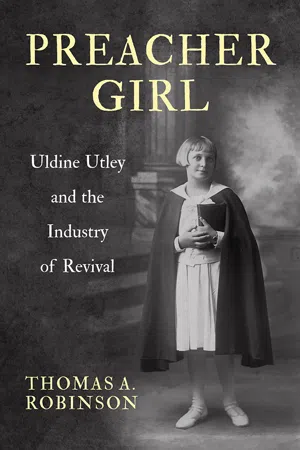
Uldine Utley defined the "girl evangelist" of the 1920s and 1930s. She began her preaching career at age eleven, published a monthly magazine by age twelve, and by age fourteen was regularly packing the largest venues in major American cities, including Carnegie Hall and Madison Square Garden. She stood toe to toe with Billy Sunday and Aimee Semple McPherson, the most famous revivalist preachers of the day. She became a darling of the secular press and was mimicked and modeled in fiction and plays. In Preacher Girl, the first full biography of Utley, author Thomas Robinson shows that Utley's rise to fame was no accident. Utley's parents and staff carefully marked out her path early on to headline success. Not unlike Hollywood, revivalism was a business in which celebrity equaled success. Revivalism mixed equal parts of glamour and gospel, making stars of its preachers. Utley was its brightest. But childhood fame came at a price. As a series of Utley's previously unpublished poems reveal, after a decade of preaching, she was facing a near-constant fight against physical and mental exhaustion as she experienced the clash between the expectations of revivalism and her desires for a normal life. Utley burned out at age twenty-four. The revival stage folded; fame faded; only a broken heart and a wounded mind remained. Both Utley's meteoric rise and its tragic outcome illuminate American religion as a business. In his compelling chronicle of Utley's life, Robinson highlights the surprising power of American revivalism to equal Hollywood's success as well as the potentially devastating private costs of public religious leadership. The marketing and promotion machine of revivalism brought both fame and hardship for Utley--clashing by-products in the business of winning souls for Christ.
Information
Topic
Theology & ReligionSubtopic
Religious Biographies1
Dreaming Dreams
From Childhood to Hollywood
Within three weeks of her birth, Utley moved from Durant, Oklahoma. She would make many more moves. It may have been in her blood, for before her birth, her parents had moved often, as her father, an entrepreneur with clear ambition and considerable skills, sought his pot of gold. This was an age where the frontier was retreating,1 though golden opportunities might still be found there if one got there soon enough—and was lucky enough. But the moves that came from seeking gold would pale when compared to the ones the family would make when their young daughter became a revivalist preacher seeking sinners. From age eleven until she collapsed at age twenty-four, Utley was rarely in one place for more than three weeks (the average length of a crusade), traveling from one end of the country to the other, with hotels as home and diners as kitchens. For much of the earlier part of Utley’s career, her family would have been itinerant too, for she was much too young to be on her own, and, besides, every star, even a preaching star, needs staff.
At the time Utley became a revivalist preacher, her family was living in California. That was sixteen hundred miles west of her birthplace in Oklahoma. Much of this book traces Utley’s life as a revivalist. This chapter follows her family’s moves before that, living on the edge of the disappearing American frontier. That story is one of adventure and adversity, of hope and hardship, of dreams and disappointments, of the highest heights and the deepest depths, of dancing with Geronimo and of digging into the dirt to make a home out of a hole in the ground. Hers was, as she described it shortly before the end of her career, “a story packed with drama and almost too strange to be true.”2
Stories like this have been told before. Laura Ingalls Wilder’s Little House children books come to mind, with the best-known title in the series, Little House on the Prairie, being adopted as the name of the television series.3 These stories draw on memories of the Ingalls family’s trek from Wisconsin to the Indian Territory near Independence, Kansas, in 1869–1870, where they had homesteaded only a few miles from the Oklahoma border. They lived there only briefly, however, being ordered to leave because their homestead was on Indian land. The family then moved to Minnesota, living for some time in a dugout. The Utley family could have written their own Little House on the Prairie story. They too had lived in a dugout, and for a longer period. They too had lived the American frontier experience. And they had an abundance of colorful, funny, affectionate, and adventurous stories to prove it, easily matching with fact the mixture of fact and fiction in Laura Ingalls Wilder’s tales.
In telling the story of Utley, the story of her parents cannot be set aside as unimportant. Simply because they were her parents, their story is part of their daughter’s story. But a closer connection existed between them than is normally the case between parent and child. When their eleven-year-old daughter began her career as a full-time revivalist promoting Jesus, Utley’s parents in their early forties began their new full-time career promoting their daughter, supporting and being supported by Utley’s revivalist successes. And after their daughter collapsed and after years of institutional care brought no recovery, they became their daughter’s sole caregivers from their mid-sixties until they reached their eighties and could no longer carry that load.
Their story is intertwined with that of their daughter’s. But they had their own story, too, and Oklahoma was an important part of it; though for their daughter, Oklahoma was merely a location inscribed on her birth certificate, and the place she left a few weeks after her birth.
Oklahoma
Everyone has heard of Oklahoma. Rodgers and Hammerstein, in their first joint work, made sure of that. Their 1943 musical Oklahoma! won rave reviews and garnered coveted awards. The musical was based on the 1931 play Green Grow the Lilacs, written by the part-Cherokee writer Lynn Riggs, and featuring such popular folk songs as “Git along Little Dogies,” “Home on the Range,” and “Skip to My Lou.”4
The story was set in 1906, one year before Oklahoma gained statehood. In this new state of Oklahoma, five years after statehood, little Uldine Utley’s story was to begin. Her parents’ story started a little before that, in the same year and the same location of the fictional story featured in the play Green Grow the Lilacs and the musical Oklahoma! A young man from Kentucky named Azle Utley, then age twenty-five, began a three-year courtship to woo and wed a blonde-haired gal from Kansas, Hattie Bray, who was two years his junior. But before the story of Azle and Hattie coming to Oklahoma can be told, the story of Oklahoma coming to statehood must be recounted, for without Oklahoma there would have been no wooing and wedding of a guy and a gal born and raised five hundred miles apart.
Oklahoma was late to statehood compared to most of the territory surrounding it—but there was good reason. Oklahoma had never been intended to be like other areas. It was land set aside for Native American settlement: “Indian Territory,” as it was called. Actually, Oklahoma was the last of Indian Territory.5 Years before, Indian Territory had embraced vast lands, but as pressure from white settlement increased, slice after slice of Indian land had been carved off, creating an ever-retreating frontier that still seductively promised golden opportunities for some—at the expense of lands lost for others.
Well over a century before the disappearance of this final parcel of Indian land, Britain’s chief representative in Virginia, Lord Dunmore, was almost prophetic in his analysis of the American attitude and its inevitable consequence. Writing to Lord Dartmouth, Britain’s secretary of state for the colonies, two years before the outbreak of the Revolutionary War, Dunmore provided his assessment of the American colonists’ aspirations. The Americans, he said, “for ever imagine the Lands further off are still better than those upon which they are already settled. . . . If they attained Paradise, they would move on if they heard of a better place farther west.”6
Whether Dunmore had captured the American spirit exactly, it seems an apt description of Utley’s family on both her mother and her father’s side, and of many others. Dunmore had identified what he saw as the crucial difference that had developed between the British government and the American colonists regarding the extent to which westward expansion by white settlers should be permitted. In 1763 the colonial government restricted any further white settlement to lands east of the Allegheny Mountain Ridge. Although the British had various reasons for such restrictions, one that seemed pressing was the protection and preservation of the hunting lands of the Indian tribes.7 In a previous letter to Dartmouth, Dunmore had stated that westward expansion was an act of “Inhumanity and Injustice to the Indians.”8 Dartmouth would have concurred, being an evangelical Anglican with ties to revivalist John Wesley and to Countess of Huntingdon’s religious circle.
Americans on the frontier might have had a different opinion of Dartmouth’s interest in the Indians. The British attitude seemed to show, as one historian has put it, “an insufferable tenderness for the Indians.”9 But tenderness was to change to toughness with independence from Britain. The western border of the new American nation now extended to the banks of the Mississippi River, opening up the vast lands between the Alleghenies and the Mississippi to white settlement. Shortly after that, the size of the American territories increased again, doubling in what came to be known as the Louisiana Purchase, bringing the land from the Mississippi westward to the Rocky Mountains under American control. In these vast new lands, a multitude of native tribes had their home.
Pushing the frontier ever westward seemed almost in the American blood, as section by section of land in Indian Territory was opened up to white settlement,10 confirming by action what Dartmouth had detected decades earlier. Particularly after the Civil War, the federal government could and did dismiss or rewrite older treaties they had signed with the native tribes that had (unwisely) chosen to fight for the South in the Civil War, a breach the American government felt voided earlier treaties.11 With continued loss of land to white settlement, by the end of the 1800s, the eastern part of Oklahoma was all that remained of Indian Territory. The last battles of the Indian Wars had been fought, and the last holdouts, Geronimo and his Apache followers, were now in custody in Fort Sill in Oklahoma Territory just to the west.
In 1901 parts of western Oklahoma were to be opened up for settlement by land lottery, a system whereby coveted 160-acre plots were awarded.12 Such lotteries had been put in place after the disorganized and sometimes disastrous land runs (or land rushes) that had been used earlier, by which prospective settlers could establish claim to land.13 Utley’s mother’s family had come to Oklahoma a few years earlier,14 and when the land lottery was announced, they registered for the draw, hoping to become part of a new city that would arise “overnight” from the land lottery of farming parcels surrounding the city and from the sale by auction of smaller lots within the city. The city was to be named Lawton, after an army commander, Henry W. Lawton, who had been responsible for the capture of Geronimo.15 Fort Sill, where the famous warrior Geronimo and other Apache prisoners had been held since 1894, was only about four miles away.
Little held people to the Lawton area if they had not been able to pick up a land parcel in the lottery, for these were the last lands of the Indian Territory to be opened to white settlement, and nothing more would be coming available. And the rumors of gold and oil that also had brought some people to the area neither panned nor gushed out, even though some other places in the territory had an oil boom, making Oklahoma the leading oil-producing state a little later.16 Lawton’s population soon plummeted, from about thirty thousand to under eight thousand by 1910, though that was still a sizable enough city, with opportunities of various sorts for the taking, for the new city had nothing to begin with—no schools, no streets, and no adequate water supply.17 Anyone with a talent or resources could set up shop. Hattie Bray and her younger sister Mabelle18 became schoolteachers, and Hattie was able to make a good profit in some land speculation, which had become one of the unintended consequences of the land lottery system.19
In Lawton, six years after the establishment of the city, Hattie Bray met her future husband, Azle Utley. Azle had arrived in Lawton sometime in 1906 on his own, unlike the Brays, who had come, it seems, in a large-scale family move. By the time he met Hattie in 1907, he had established various business interests in Lawton, one being a photography studio on the second floor of a store that happened to be next door to a five-and-ten-cent store where Hattie worked during school holidays. He was president of a dance association called the Terpsichorean Club.20 Azle also ran a roller skating rink on the edge of town, one of the hot new fads of the time. Since the roller rink was near where the Brays had their homestead, Azle frequently noticed Hattie out that way, as well as at the store next door to his studio. Thus began their courtship, which included fun times at the roller rink and the dance club, along with variou...
Table of contents
- Cover
- Title Page
- Copyright Page
- Dedication
- Contents
- Preface
- Acknowledgments
- Introduction
- Chapter 1. Dreaming Dreams
- Chapter 2. Seeing Visions
- Chapter 3. Utley, Inc.
- Chapter 4. Utley’s Religion
- Chapter 5. Utley’s Revivalism
- Chapter 6. “Kindly Remove My Halo”
- Conclusion
- Utley’s Writings
- Notes
- Select Bibliography
- Index
Trusted by 375,005 students
Access to over 1.5 million titles for a fair monthly price.
Study more efficiently using our study tools.
Frequently asked questions
Yes, you can cancel anytime from the Subscription tab in your account settings on the Perlego website. Your subscription will stay active until the end of your current billing period. Learn how to cancel your subscription
No, books cannot be downloaded as external files, such as PDFs, for use outside of Perlego. However, you can download books within the Perlego app for offline reading on mobile or tablet. Learn how to download books offline
Perlego offers two plans: Essential and Complete
- Essential is ideal for learners and professionals who enjoy exploring a wide range of subjects. Access the Essential Library with 800,000+ trusted titles and best-sellers across business, personal growth, and the humanities. Includes unlimited reading time and Standard Read Aloud voice.
- Complete: Perfect for advanced learners and researchers needing full, unrestricted access. Unlock 1.5M+ books across hundreds of subjects, including academic and specialized titles. The Complete Plan also includes advanced features like Premium Read Aloud and Research Assistant.
We are an online textbook subscription service, where you can get access to an entire online library for less than the price of a single book per month. With over 1.5 million books across 990+ topics, we’ve got you covered! Learn about our mission
Look out for the read-aloud symbol on your next book to see if you can listen to it. The read-aloud tool reads text aloud for you, highlighting the text as it is being read. You can pause it, speed it up and slow it down. Learn more about Read Aloud
Yes! You can use the Perlego app on both iOS and Android devices to read anytime, anywhere — even offline. Perfect for commutes or when you’re on the go.
Please note we cannot support devices running on iOS 13 and Android 7 or earlier. Learn more about using the app
Please note we cannot support devices running on iOS 13 and Android 7 or earlier. Learn more about using the app
Yes, you can access Preacher Girl by Thomas A. Robinson in PDF and/or ePUB format, as well as other popular books in Theology & Religion & Religious Biographies. We have over 1.5 million books available in our catalogue for you to explore.