- 256 pages
- English
- ePUB (mobile friendly)
- Available on iOS & Android
eBook - ePub
About this book
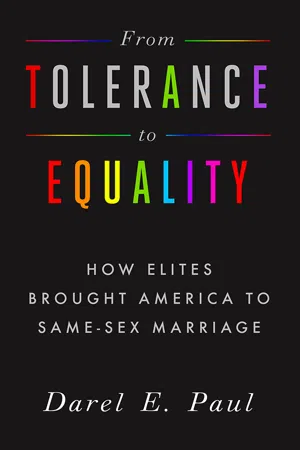
Over the last twenty-five years, a dramatic transformation in the American public's view of homosexuality has occurred, symbolized best by the movement of same-sex marriage from the position of a fringe few to the pinnacle of morality and a cornerstone of establishment thought. From Tolerance to Equality explores how this seismic shift of social perspective occurred and why it was led by the country's educational and business elite. Rejecting claims of a commitment to toleration or a heightened capacity for moral sympathy, author Darel E. Paul argues that American elites use opinion on homosexuality as a mark of social distinction and thus as a tool for accumulating cultural authority and political power. Paul traces this process through its cultural pathways as first professionals and, later, corporate managers took up the cause. He marshals original data analysis and chapters on social class and the family, the ideology of diversity, and the waning status of religious belief and authority to explore the factors behind the cultural changes he charts. Paul demonstrates the high stakes for same-sex marriage's mostly secular proponents and mostly religious opponents--and explains how so many came to fight so vigorously on an issue that directly affects so few. In the end, From Tolerance to Equality is far more than an explanation of gay equality and same-sex marriage. It is a road map to the emerging American political and cultural landscape.
Information
1
Introduction
From Outlaw to Married Citizen
The cultural and legal status of homosexuality has experienced one of the most rapid and thorough reversals in American social history. The revolutionary shift played out especially dramatically in 2003. In June of that year the U.S. Supreme Court ruled in the case Lawrence v. Texas that the U.S. Constitution guarantees a broad right to sexual privacy, including consensual same-sex sexual conduct. As a result, the country’s last fourteen state sodomy laws from Idaho to Florida were immediately overturned.1 Only five months later, in November, the Massachusetts Supreme Judicial Court mandated in Goodridge v. Department of Public Health that “civil marriage” be opened to same-sex couples, thus inaugurating the country’s era of same-sex marriage.2 Only twenty-one months earlier the same high court definitively nullified Massachusetts’ own long-standing sodomy law.3 In the blink of an eye the gay man and lesbian were transformed “from outlaw to married citizen.”4
The ground for this transformation had been prepared for decades, however. At the beginning of the 1970s forty-nine states had sodomy laws on their books. At the decade’s end just twenty-seven did. In 1973 the American Psychiatric Association declassified homosexuality as a mental illness, blazing a trail quickly followed by all the country’s major mental health professional organizations. The first same-sex marriage cases wended their way through state and federal judicial systems during the 1970s and reached supreme courts in Minnesota (1971), Kentucky (1973), and Washington (1974), as well as the U.S. Supreme Court (1972).
While cultural change was clearly in the air, just seven years before the Lawrence and Goodridge decisions it was safe to say that both popular and elite opinion still remained strongly—if not universally—opposed to treating homosexuality as normal. In December 1996 a Hawaii state circuit court judge ruled that a strictly opposite-sex definition of marriage was in violation of the state constitution’s commitment to equal protection.5 Public reaction was swift and decisive. Marshaling a peremptory strike in anticipation of just such a ruling, in September of that year the U.S. Congress passed and President Bill Clinton signed into law the Defense of Marriage Act (DOMA). The law both defined marriage for federal purposes as a strictly opposite-sex institution and allowed states to refuse recognition of same-sex marriages conducted in other jurisdictions. While it may be hard to fathom today, DOMA received overwhelming support from both political parties. Among Republicans, not a single senator and but one member of the House of Representatives voted against it. Democrats strongly supported the legislation, too, with House members voting in favor by a nearly two-to-one margin (118–65) and Senate Democrats surpassing even that mark (32–14).6 Strong Democratic support granted the bill a veto-proof majority and Democratic President Bill Clinton signed the measure. While doing so somewhat reluctantly—the professed degree of reluctance growing notably over the decades—Clinton nonetheless stated clearly at the time, “I have long opposed governmental recognition of same-gender marriages and this legislation is consistent with that position.”7 His signature completed a fast-track process for the legislation, which took a mere four months to travel from congressional subcommittee to law of the land.
As it turned out, DOMA was premature by nearly a decade. The Hawaii threat was repelled nearly as soon as it arose. In 1997 the Hawaii state legislature passed a proposed constitutional amendment that if passed by referendum would allow it to define marriage as a strictly opposite-sex institution. In 1998 residents voted in one of the country’s first two state marriage referenda. One of the bluest of blue states rebuked its own court and backed the measure by a lopsided 71%–29% margin.8 Even down to the late 1990s, a clear societal consensus existed on marriage.
By the time the country’s first legally recognized same-sex marriage ceremony took place in 2004, this broad national agreement had disintegrated. The national Democratic Party’s reversal on DOMA was the most dramatic. In 2004 House Democrats strongly opposed the Marriage Protection Act—a bill designed to insulate DOMA from federal court interpretation or challenge—by a 176–27 margin. This reflected a tremendous collapse of support within the party’s House caucus for a traditionalist definition of marriage, from 64% in 1996 to a mere 13% in 2004. It also represented an implicit repudiation of DOMA itself. In the 1990s even the most liberal Democrats avoided clear public endorsements of same-sex marriage, carefully couching their opposition to DOMA as opposition to discrimination. By 2004 all three minor Democratic candidates for president were calling openly for national same-sex marriage.
Corporate America also came to embrace the normalization of homosexuality in this period. When DOMA was passed in 1996, slightly over 500 U.S. firms offered domestic partner health benefits to their same-sex partnered employees. By 2004 the figure had skyrocketed to over 8,200. The country’s largest corporations in particular were becoming increasingly gay-friendly. At the time DOMA was passed only 28 of the Fortune 500 were offering domestic partner health benefits. By 2004 the number had risen to 216.9 Moreover, the largest firms in the country were the private sector’s pioneers in granting spousal equivalency to unmarried same-sex couples across a broad range of employee benefits, including life insurance, pensions, and family leave. According to former Human Rights Campaign President Joe Solmonese, “Corporate America is far ahead of America generally when it comes to the question of equality for GLBT people.”10
The courts also began trending decisively toward same-sex marriage. Judges from Hawaii to Massachusetts and Iowa to Texas began discovering constitutional rights their predecessors a generation earlier had either decisively rejected or never imagined existed. The weight of such a “significant change in the definition of marriage as it has been inherited from the common law, and understood by many societies for centuries” was embraced by more and more members of the judiciary who now found the older views fundamentally irrational.11 Beginning in 2003 state court judges inaugurated same-sex marriage in Massachusetts, California, Connecticut, Iowa, New Jersey, and New Mexico. Federal judges in more than half a dozen states and ultimately in Washington, D.C. found both federal and state DOMAs unconstitutional.
American elites have largely embraced same-sex marriage, but the wider public remains divided on the issue. When the polling organization Gallup first asked a same-sex marriage question in 1996, just 27% of Americans were in favor while 68% opposed it. Support rose markedly in the mid- and late 2000s to a 37%–46% range, and in 2011 Gallup reported that a majority of Americans favored same-sex marriage for the first time. Notable opposition was raised throughout the early 2010s, however. Until 2012, all thirty-one states that held a marriage referendum rejected same-sex marriage. Even in that year North Carolina became the country’s thirty-second state to constitutionally define marriage as strictly opposite-sex. In 2010 Iowans turned three state supreme court justices out of office who had mandated same-sex marriage. In 2012 three of the four Republican state senators instrumental in passing same-sex marriage in New York the previous year failed to survive the next election. In 2013 and 2014, after federal judges found that state DOMAs in Utah and Oklahoma violated the U.S. Constitution, the governors of those states fought the rulings rather than capitulating. In two polls over 2016 and 2017, Gallup found over one-third of the country still continued to oppose same-sex marriage.12
Marriage has become the social and legal touchstone for the normalization of homosexuality in the United States. At the same time, it has everything to do with the family, the country’s most volatile social, cultural, and political fault line. This clash reaches into every facet of public and private life. In the United States at least, the family is the foundation upon which both the state and the market are organized. Economically speaking the family is the primary site of consumption, of social reproduction, and even today of some aspects of production (for example, domestic services). Socially the family remains the primary provider of housing, an important secondary provider of welfare and education (and primary provider for young children and adults outside employment), and the primary site of social interaction. Politically the family continues to be the primary generator of tax revenues, and its ability to carry out economic and social tasks requires constant political support through legislation and government spending.
Regardless of class, race, ethnicity, or region, as recently as the 1970s Americans largely lived and promoted a single dominant family model of husband, wife, and their natural-born children. This is usually called the “nuclear family” or the “natural family” model. Today there are many new models—the blended family, the single-parent family, the cohabitating family, the same-sex couple family—both lived and promoted. These increasingly define the country’s politics. Proof lies in the fault lines that now characterize the American electorate. Marital status has become one of the most important determinants of voting behavior. Larger than the much more publicized gender gap, the marriage gap produces an increasingly married Republican partisan and an increasingly divorced, separated, or never-married Democratic partisan.13
At the same time, marriage has increasingly become an institution for elites. In 1950 a negative relationship existed among women between marriage rate and level of education. At the time, those with a bachelor’s degree or more were the least likely to be married while those without a high school degree were the most likely. By 2011 some 60% of women with a bachelor’s degree or more were married, while among women without a high school diploma the figure was under 30%.14 In 1960 the marriage gap between all adults with at least a bachelor’s degree and those with a high school diploma or less was just 4%. In 2010 the gap was 17%. No wonder 45% of persons with a high school education or less agreed that marriage is “becoming obsolete” while only 27% of adults with college degrees said the same.15 The gap isn’t due to the least educated eschewing marriage. By age 46, 89% of Americans over the years 2003–2010 with a bachelor’s degree or higher had been married while the same was true for 87% of those with a high school diploma and 81% of those with less than a high school education. The gap is more due to high divorce rates on the lower rungs of the class ladder, where 58% of first marriages of the lowest educated group end in divorce as do 48% of those among high school graduates. Among college graduates the figure is less than 30%. The marriage gap by education has become especially large among men. Between those with a bachelor’s degree and those without a high school diploma, the difference is 11% for ever being married, 24% for ever being divorced, and 34% for still being in a first marriage.16 While cohabitation has become much more common throughout the United States in recent decades, there is a large and growing difference by education level. In 1995 among women ages 22–44, those without a high school degree had a 12% higher rate of first union as cohabitation compared to those with a four-year degree or more. By 2006–2010 the gap had nearly doubled to 23%. While dissolution rates of first unions were roughly the same across all educational groups, the highly educated tended to turn cohabitation into marriage much more often than did others. At three years from the formation of first union, 53% of college educated women in the late 2000s had turned cohabitation into marriage while only 39% of high school graduates had done so and just 30% of women lacking a high school diploma. A pregnancy during cohabitation is especially likely to transition the most educated women in America to marriage but is not likely to transition the least educated. While the probability of marriage after cohabitation within one year of pregnancy is 53% for the college educated, it is only 30% for those with only high school diplomas and a mere 19% among those without.17
A once-small racial marriage gap in America has also swelled. From 1880 to 1950 the difference in marriage rates between white and black women was never more than 5%.18 As of 2010 the gap stood at a yawning 24%.19 While much of the marriage gap by education is due to high divorce rates among the least educated, the marriage gap by race is driven much more by very low marriage rates among blacks. In the years 2003–2010, by 46 years old 90% of whites had been married but only 68% of blacks had been.20 Combined with the fact that at the end of the period a mere 31% of all black adults were married, prominent observers were moved to ask, “is marriage for white people?”21
This dramatic and widening divide in family formation along both ideological and sociological lines prompted some to transfer the “red state-blue state” story of American presidential politics onto the American family. According to law professors Naomi Cahn and June Carbone, “red families” characteristic of conservative parts of the country—although not necessarily typical among conservative families—“insist on the unity of sex, marriage, and procreation; the complementary nature of the relationship between men and women; and the importance of commitment (and, indeed, acceptance of the ‘authority of marriage’) to marital stability.” On the other hand, the “blue family” typical of liberal regions of the country—although, again, not necessarily typical among liberal families—“emphasizes autonomy and [individual] responsibility”; rejects gender roles in favor of “egalitarian values”; and accepts and even celebrates nonmarital sex as long as it is also nonprocreative. These models of the family are based in differences in family law across the country and the cultural debates and practices that animate them. By focusing only on law to the exclusion of actual social behavior, however, these models oversimplify. Rival ideals of marriage cannot be reduced simply to “external authority” (red) versus “individual freedom” (blue). The blue model is, after all, a socially imposed cultural script as much as is the red model. Both are held out as norms of belief and behavior for all.22
The real differences turn on two key factors. The first is the social meaning of gender. The second is the desirability of unifying sex, marriage, and pr...
Table of contents
- Cover
- Title Page
- Copyright Page
- Dedication
- Contents
- Acknowledgments
- Chapter 1. Introduction
- Chapter 2. The Elite Embrace of Normalization and Same-Sex Marriage
- Chapter 3. Normalization as a Class Value
- Chapter 4. Beyond Tolerance
- Chapter 5. Normalization and the Family
- Chapter 6. Diversity without Tears
- Chapter 7. Class Culture Wars
- Chapter 8. Conclusion: The Revolution beyond Tolerance
- Appendices
- Notes
- Bibliography
- Index
Trusted by 375,005 students
Access to over 1.5 million titles for a fair monthly price.
Study more efficiently using our study tools.
Frequently asked questions
Yes, you can cancel anytime from the Subscription tab in your account settings on the Perlego website. Your subscription will stay active until the end of your current billing period. Learn how to cancel your subscription
No, books cannot be downloaded as external files, such as PDFs, for use outside of Perlego. However, you can download books within the Perlego app for offline reading on mobile or tablet. Learn how to download books offline
Perlego offers two plans: Essential and Complete
- Essential is ideal for learners and professionals who enjoy exploring a wide range of subjects. Access the Essential Library with 800,000+ trusted titles and best-sellers across business, personal growth, and the humanities. Includes unlimited reading time and Standard Read Aloud voice.
- Complete: Perfect for advanced learners and researchers needing full, unrestricted access. Unlock 1.5M+ books across hundreds of subjects, including academic and specialized titles. The Complete Plan also includes advanced features like Premium Read Aloud and Research Assistant.
We are an online textbook subscription service, where you can get access to an entire online library for less than the price of a single book per month. With over 1.5 million books across 990+ topics, we’ve got you covered! Learn about our mission
Look out for the read-aloud symbol on your next book to see if you can listen to it. The read-aloud tool reads text aloud for you, highlighting the text as it is being read. You can pause it, speed it up and slow it down. Learn more about Read Aloud
Yes! You can use the Perlego app on both iOS and Android devices to read anytime, anywhere — even offline. Perfect for commutes or when you’re on the go.
Please note we cannot support devices running on iOS 13 and Android 7 or earlier. Learn more about using the app
Please note we cannot support devices running on iOS 13 and Android 7 or earlier. Learn more about using the app
Yes, you can access From Tolerance to Equality by Darel E. Paul in PDF and/or ePUB format, as well as other popular books in Politics & International Relations & Political Ideologies. We have over 1.5 million books available in our catalogue for you to explore.