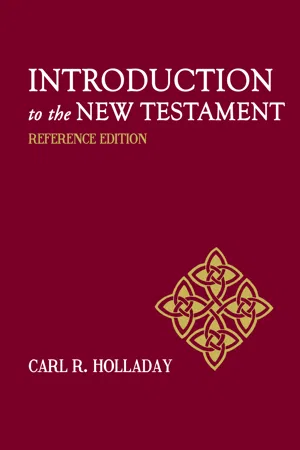
In Introduction to the New Testament Carl R. Holladay does just that. He roots each of the New Testament's twenty-seven writings in their historical, literary, and theological contexts. A true "Reference Edition," Holladay provides thorough, detailed, and exacting overviews, background material, and textual analysis. Holladay leads readers to consider questions of canon, authority, and genre that shape the formation of the text and the text's formation of the identity, theology, and mission of the church today. This Introduction does not leave its readers stranded in the first century; it also intentionally connects the message of the New Testament to the issues facing its faithful readers today. No stone goes unturned and no issue unexamined--Holladay's Introduction to the New Testament is an essential text for any serious student of biblical interpretation.
- 1,008 pages
- English
- ePUB (mobile friendly)
- Available on iOS & Android
eBook - ePub
About this book
Christian interpretation of the Bible is not a simple task. While finding both its beginning and end in the theological claim that Scripture reveals to us "what God has done in Christ," Christian interpretation demands much more. The interaction between believer and text is also conversation between reader and interpretive community, both ancient and modern. Theological interpretation entails close readings of texts but also a close analysis of contexts--the social and political shape of the Mediterranean world as well as our own. Interpretation requires the interweaving of theology, history, and literature.
Information
Topic
Theology & ReligionSubtopic
Biblical StudiesPart 1
Theology and Scripture
1
The New Testament as Theological Writings
Christian theology is the fully reflective understanding of the Christian witness of faith as decisive for human existence.
Schubert Ogden
[The New Testament writings] are theological as actualizations of the unique revelation that preceded them.
Willi Marxsen
Theology may be thought of in different ways. If we ask someone, “What is your theology?” we are probably asking about that person’s religious beliefs. In the strictest sense, we would be asking what the person believes about God, since “theology” technically means “discourse about God.”1 But the term can include beliefs about other divine or semidivine beings, such as angels or devils. It can also encompass beliefs about human beings: whether we are inherently good or evil; why we behave as we do; how we deal with our sins; how we relate to God and neighbor; and what happens to us when we die. These are only a few of the standard topics—theological loci—encompassed by the term “theology.”
But how do we arrive at what we believe? How do we come to have a theology? Quite simply, by doing theology. By shifting the verb from having to doing, we point to the process through which we arrive at our theological beliefs. When we subscribe to a particular creed, we may be struck by its simple formulation. How we have come to adopt it, however, may not be so simple. We may have undergone a period of religious instruction to learn about the elements that comprise the statement of faith. Prior to that, we may have undergone a radical conversion experience or perhaps have come to faith more gradually. In either case religious conversion has a ripple effect that touches all aspects of our lives, simplifying them in some respects, complicating them in others. The process of moving from “believing in” to “believing that” may turn out to be quite complex.
We might also reflect for a moment on how a statement of faith arises. We may be impressed by its cadence, its smoothly turned phrases, and even its poetic quality, but this surface simplicity masks the rich, often long, history that led to its formulation. Seemingly simple combinations of words may have resulted from lengthy church controversies that turned on a single word or phrase, or even on a single letter. Competing formulations may have created deep divisions within the church that caused sharp debates and required the convening of church councils. Statements of faith have usually arisen from a long, complex process in which the church as a whole struggled to express its “belief in” as “belief that.”
Whether we think of an individual believer who comes to faith or of an entire church that formulates its beliefs in a creedal statement, the process of clarifying belief may be thought of as doing theology. But why the verb “doing”? Why not simply “having”? Because to have a theology means that we have made some decisions about certain things to believe. To that extent, they are fixed decisions. Even if we find ourselves rolling them over in our heads in light of different life experiences, they are still reference points to which we return. How we think about them may change, but the fundamental item of belief remains constant. Taken together, these beliefs frame our house of faith.
Life is never static. Faith remains dynamic by responding to new questions. We find that the points of belief to which we have committed ourselves, perhaps many years ago, constantly need clarification. To say that we believe in God the Father may express our fundamental belief in God, but we find ourselves asking whether “the Father” is the only, or even the best, way of attributing reality to God. We may ask, “What does this metaphor actually mean?” or “Are there less traditional but equally profound ways of expressing our faith in God?” These questions may be prompted by life around us, by our conversations with other believers, and by struggles within the church over what language is most appropriate for talking about God. As we pursue these questions openly, we seek to clarify, refine, and enrich our basic convictions. In doing so we may draw on many resources as we do theology.
The questions that prompt us to do theology arise from many quarters. They may derive from our own personal quests, but they often arise within the church. Perhaps our congregation is trying to decide an issue relating to its own life together. Our denomination may be facing an issue with broad ramifications for church policy and for the ways people think about themselves and their fellow Christians and how they will speak about God, Christ, and the Spirit. However these questions originate, we find ourselves trying to think about them in light of our faith commitments. We find them challenging our faith as well as requiring a response from our faith.
Responding faithfully means much more than simply repeating our statements of faith. We talk with others to clarify what we believe and to formulate our faith in light of these newly raised issues. We also find ourselves reading—going to our church libraries as well as our public libraries—to educate ourselves further about these issues. What we read may vary widely, ranging from the works of Christians who lived centuries ago to the writings of contemporary theologians. We find ourselves praying alone and with others as we try to discern what is at stake for faith and life. In short, we use virtually every resource imaginable as we seek to clarify what and how we believe about a particular issue.
The process of theological discernment is not merely a theoretical process. It is not as though we simply sit down and think. That we do, but we also act. We talk with others; we do research; we pray; we worship; we continue to make a living; we go to movies, art galleries, and sports events. Through this tangle of events and experiences we try to gain greater clarity about our beliefs. As we give shape to our thoughts, we put them into words and behave in ways that express those beliefs. All of this is involved in doing theology. What makes it “doing”? The ongoing activity. What makes it theology? That it is ultimately about God and from God.
To say that we formulate patterns of behavior that reflect our beliefs introduces yet a third dimension: living our theology. In one sense this behavioral element is inseparable from having and doing theology. Even as we do theology we are expressing our faith in action. Still, we can distinguish this third element as a discrete aspect of theology. At the risk of gross oversimplification, we can say that having a theology is an essentially cognitive act. At a critical point, it is a matter of intellectual assent. Doing theology, while involving cognitive activity, may be thought of as an essentially practical act. It involves specific practices that have been developed over time as the church has related faith to life.
While doing theology may appear to be intuitive, random, and even somewhat unpredictable, it actually implies certain well-defined theological practices that have been shaped in a variety of contexts, including churches, schools, homes, and various public institutions. To take just one example, biblical interpretation has occurred for centuries, yielding its own set of rules and practices that are widely recognized, even if they are practiced differently. Or, when we engage in thought, we use principles of logic and common sense that constitute a set of assumptions that is widely shared, even among archrivals. We all recognize inconsistency as something we avoid rather than strive for. And so on. Without developing an entire taxonomy of theological practices, we can see how doing theology both presupposes and utilizes such practices. They include cognitive activity, but they include much more.
In contrast to having a theology and doing theology, living a theology is behavioral in a way that neither of the other two is. As indicated earlier, it includes patterns of behavior that are consonant with our beliefs but also are expressive of them. Typically this aspect of theology encompasses the field of ethics: how we behave as individuals and as communities of faith. Behavior should be understood to encompass both thoughts and actions. Forming attitudes can be thought of as a behavior, even though the most conspicuous forms of behavior are those that express our underlying attitudes. By patterns of behavior, however, we refer primarily to how we act: how we worship, both in public and private; what we say; how we relate to others, whether we embrace or exclude them, protect or harm them; how we form communities or institutions that serve to promote our faith; how we form families; how we play; and how we rejoice and mourn.
These behaviors along with many others are the means by which theology is lived. If there were some way to consider our behaviors comprehensively and look for consistent themes in how we behave, we would discover the theology that lies behind them. If we have any doubt about how closely correlated having a theology and living a theology are, we need to consider only some of its more conspicuous examples. In the ancient world, the members of the Qumran community, who separated themselves from what they regarded as the corrupt religious leadership associated with the temple in Jerusalem, expressed their theology in quite remarkable behavioral patterns. They lived together as a sectarian community, they engaged in certain communal practices, they followed their own calendar, they worshiped in a certain way, and they read the Hebrew Scriptures in a distinctive way. This example simply confirms what we already know at an experiential level: that the theology we have and the theology we live are inseparably connected. In fact, each affects the other quite dramatically.
To say that theology is discourse about God suggests that there is an underlying reality—God—who serves as more than the topic of theology. When we say that we believe in God, we are doing more than setting the conversation topic; we are identifying God as our conversation partner. Behind every confession of faith is belief in the Living God, even if this is expressed in a Trinitarian form that also encompasses Christ the Son and the Holy Spirit. When we engage in doing theology, we are doing more than thinking and talking about God. Through it all, we are trying to make sense of God, the Someone beyond us all. To say that God transcends us suggests that God exists independently of any one of us. Taken seriously, this means that God is not something or someone we construct in our heads, even if we think constantly about God. Trying to understand who God is and to discern how God is present and active in the world is the central task of theology. The Living God, then, is the primary Subject of theology, serving both as the One whom we adore and the One whom we discuss. It is possible to think and talk about God with great sophistication and yet not believe in God. Thought and conversation about God, however, take a different form when they stem from belief in God. At the heart of theology, in any of its forms—having, doing, and living—is the Living God who is finally the source and goal of our intellectual longing.
Christian Theology: Believing in Christ
To speak of Christian theology narrows the focus of our discussion, for it implies that God has been revealed through the figure Jesus Christ. Classic formulations of this belief, such as “God was in Christ reconciling the world to God’s Self” (2 Cor 5:19; my trans.), render more precisely the ways God is present in the world. Among the most pressing questions is how to think of Jesus Christ in relation to God. Naturally it is a question Christian believers have considered from many different angles over the centuries: Is Christ God? If so, in what sense? How do their essential natures compare? Has Christ always been God, or was this a status he had to attain?
“God at work in Christ” suggests the notion of delegated authority, in which one person carries out the work of someone in a higher position. Whether Christ is thought of in highly personal terms, such as God’s Son, or in less personal terms, such as God’s Logos, he is seen as the one through whom God’s work is accomplished. To the extent that Christ is privy to God’s desires, he provides clues to who God is.
Understanding how God has been revealed in Jesus Christ and how God has been experienced as present in the world through Jesus Christ is the special task of Christian theology. Among the many resources available to anyone engaged in this task, the twenty-seven writings of the New Testament occupy a unique position. With a few possible exceptions, they are the earliest writings that reflect this distinctive perspective. Eventually they acquired canonical status throughout the church, which means that they were regarded as normative in a way that other writings were not. As the title New Testament suggests, they were intended to be read alongside the Old Testament and thus were given a privileged status among the many early Christian writings.
It is fully appropriate to approach the NT as a set of writings that bear witness to “God at work in Christ.” If they are about anything, they are surely about this. Rather than trying to prove that God exists or that God has been active in the world, they assume both. They do not assume that God has been generally present in the world but rather that God’s tracks are most visibly present in Israel—its people and their history—as abundantly illustrated in the Jewish Scriptures. This earlier story of how God chose Israel and nurtured their growth as God’s people is regarded by the NT writers as a prelude to the story of Jesus Christ. The Jewish Scriptures are seen as earlier chapters of a larger story that continues into the time of Jesus Christ. The NT writings express it in different ways, but they confidently place Jesus Christ in Israel’s line of succession leading all the way back to Adam and including such notable figures as Abraham, Isaac, Jacob, Joseph, Moses, and David. They regard Jesus Christ, however, as more than another link in the chain of successors. They see him as the culmination of the line—the last link in the chain.
For the NT writers, the Jewish Scriptures are more than a collection of proof texts that point forward to a future Messiah. Rather, t...
Table of contents
- Cover
- Title Page
- Copyright Page
- Summary of Contents
- Contents
- List of Maps, Figures, Tables, and Plates
- Preface to the Reference Edition
- Preface to the First Edition
- Abbreviations
- Introduction
- Part 1: Theology and Scripture
- Part 2: The Gospels: Narrative Traditions About Jesus
- Part 3: The Story of Jesus Continued: The Church’s Origin and Expansion
- Part 4: The Pauline Letters and Hebrews
- Part 5: The Catholic Letters
- Part 6: Jesus in the Apocalyptic Imagination
- Part 7: The New Testament as the Church’s Book: The Formation of the New Testament Canon
- Appendix 1: Ancient Canonical Lists
- Appendix 2: Early Christian Views of the Gospels
- Index
Trusted by 375,005 students
Access to over 1.5 million titles for a fair monthly price.
Study more efficiently using our study tools.
Frequently asked questions
Yes, you can cancel anytime from the Subscription tab in your account settings on the Perlego website. Your subscription will stay active until the end of your current billing period. Learn how to cancel your subscription
No, books cannot be downloaded as external files, such as PDFs, for use outside of Perlego. However, you can download books within the Perlego app for offline reading on mobile or tablet. Learn how to download books offline
Perlego offers two plans: Essential and Complete
- Essential is ideal for learners and professionals who enjoy exploring a wide range of subjects. Access the Essential Library with 800,000+ trusted titles and best-sellers across business, personal growth, and the humanities. Includes unlimited reading time and Standard Read Aloud voice.
- Complete: Perfect for advanced learners and researchers needing full, unrestricted access. Unlock 1.5M+ books across hundreds of subjects, including academic and specialized titles. The Complete Plan also includes advanced features like Premium Read Aloud and Research Assistant.
We are an online textbook subscription service, where you can get access to an entire online library for less than the price of a single book per month. With over 1.5 million books across 990+ topics, we’ve got you covered! Learn about our mission
Look out for the read-aloud symbol on your next book to see if you can listen to it. The read-aloud tool reads text aloud for you, highlighting the text as it is being read. You can pause it, speed it up and slow it down. Learn more about Read Aloud
Yes! You can use the Perlego app on both iOS and Android devices to read anytime, anywhere — even offline. Perfect for commutes or when you’re on the go.
Please note we cannot support devices running on iOS 13 and Android 7 or earlier. Learn more about using the app
Please note we cannot support devices running on iOS 13 and Android 7 or earlier. Learn more about using the app
Yes, you can access Introduction to the New Testament by Carl R. Holladay in PDF and/or ePUB format, as well as other popular books in Theology & Religion & Biblical Studies. We have over 1.5 million books available in our catalogue for you to explore.