eBook - ePub
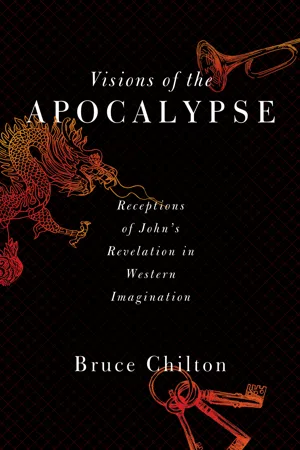
Visions of the Apocalypse
Receptions of John's Revelation in Western Imagination
- 175 pages
- English
- ePUB (mobile friendly)
- Available on iOS & Android
eBook - ePub
About this book
John's Revelation has led to countless diverse and divergent interpretations. Readers' cryptic notions of violent end-time scenarios, strict prophetic truths, and encouragement for the faithful have undeniably colored the book's reception through the centuries. In Visions of the Apocalypse, Bruce Chilton maps the ways in which the text has been read through the centuries and introduces these main interpretations of Revelation, such as Papias' millenarian kingdom, Augustine's vertical ascent to heaven, Origen's transcendent message, and Dionysius' belief in Revelation's hidden message. Visions of the Apocalypse provides the ways in which Revelation has been read and suggests to today's readers the strategies for understanding John's Revelation in a contemporary context.
Information
1
A Thousand Years of Joy
And I saw an angel coming down from heaven having the key of the abyss and a great chain in his hand. And he seized the dragon, the primordial serpent who is the devil and Satan, and bound him for a thousand years and threw him into the abyss and closed and sealed it over him, that he might not still deceive the nations until the thousand years have been completed. After this he must be loosed for a small period.
Revelation 20:1-3
The millennium, the thousand years referred to here in the Revelation of John, became a standard way in the West to speak of the ultimate future of humanity. In today’s popular culture millennial expectations are typically laced with horror, threat, and the dread of cataclysm. A long-running series called Left Behind includes bestselling books and widely distributed films, and has popularized a reading of the Revelation as the planet’s deathwatch. Feature-film releases such as Melancholia (2011) and Seeking a Friend for the End of the World (2012) appropriate the language of the Revelation and apply it to their own scenarios of catastrophe.1 It is fascinating to see how and why recent interpretations have come to see the Revelation of John in terms of unrelieved disaster. But that is a story for a later chapter. To understand the impact of the Apocalypse, we need to begin at the beginning. During the century after the book was written, the millennium emerged as a principle of hope, rather than as a prediction of disaster.
The Revelation promises a thousand years, not of catastrophe, but of utopian righteousness and enjoyment. John of Patmos says in chapter 20 that he saw Satan bound for the duration of that millennium, sealed in a deep pit and no longer able to deceive humanity. People are liberated from the deceit of the devil, the source of evil in this world as far as the Revelation is concerned, and freed to take innocent pleasure during a thousand years of joy.
Millennialism or “chiliasm,” from the word for “thousand” in either Latin (mille) or Greek (khilia), refers to belief in this epoch of delight. The Revelation’s millennium seized the imaginations of the first readers of the book, because those who had been executed unjustly under Roman persecution receive millennial vindication in this vision. “This,” says the seer, “is the first resurrection.” And he pursues his vision:
Blessed and holy is he that has a part in the first resurrection; over these the second death has no authority, but they will be priests of God and of Christ, and they will reign with him the thousand years. (Rev 20:5b-6)
This is a collective reign (see also 20:4), and it continues even beyond the thousand years, into the time when Satan will be briefly loosed from his prison, only to be killed along with his minions, who then die the “second”—and permanent—death.
The Revelation climaxes with a seven distinct visionary signs (chapters 17–22) that complete the book’s structure of repeated series of seven. The millennium is the central sign in this last and climactic series, the fourth of the seven visionary signs. In the first, the whore of Babylon (the Roman Empire) is destroyed (17:1–19:5), while the second vision celebrates the Wedding of the Lamb (19:6-10). The Lamb here represents Jesus as risen from the dead and alive in heaven, but Jesus also appears in the third sign as the conquering Word of God defeating all enemies (19:11-21). Then comes the millennium (20:1-6), the fourth sign, followed by the final, cosmic war of Gog and Magog (sign five, 20:7-10), divine judgment (sign six, 20:11-15), and the new Jerusalem (sign seven, 21:1–22:6).
The Revelation blends what seem to be predictions concerning time—most obviously, of a thousand years—with visions such as the Wedding of the Lamb that appear to be symbols of eternal and celestial truth rather than events on earth. The millennium is central to the Revelation and to its interpretation, so that we should consider the mixture of statements about it, temporal and celestial, within the text.
Celebration of the millennium, according to the Revelation, does not have to wait for Satan to be bound. Already, in the chapter previous to the reference to the millennium, all who fear God, small and great, praise the Almighty as already victorious. The second of the last visions, the Wedding of the Lamb—the celestial animal that is the primary symbol of Jesus throughout the Revelation—calls for festivity (Rev 19:5-10). His bride, the church, is prepared. She wears fine linen, which is identified with the righteous acts of the saints (19:8). “Saints,” here and elsewhere in the New Testament, does not refer to individuals of special piety, or to heroes of faith canonized by the church, but to all the people of God, called the “holy ones” (which is what hagioi means in the Greek language).
The announcement “Blessed are those invited to the Wedding Supper of the Lamb,” in chapter 19, verse 9, is the counterpart of the blessing pronounced in chapter 20, verse 6, on those who have a part in the first resurrection. Because the Revelation is a visionary text, it balances statements in regard to heaven with assertions of what is to occur on the earth.
The Wedding Supper of the Lamb, the second sign, relates to the darker vision of the Word of God pursuing enemies to the point that they are devoured by birds in the third sign (Rev 19:18). This punitive feast is inspired by the book of Ezekiel in a passage that also prophesies the death of Gog, God’s enemy on the field of battle (Ezek 39:11, 17-19; see also Rev 20:8, the fifth of the final signs). Once John’s visions are read in terms of the biblical precedents upon which they draw, their coherence becomes much clearer. He uses the prophets in the Scriptures of Israel in order to frame a way of seeing human experience in the light of unfolding pictures of events in heaven.
The blessing of those who take part in the feast of the Wedding of the Lamb also echoes the imagery of Jesus’ teaching, especially his parable of a wedding feast in Matthew (22:2-14); Luke’s version of that parable (14:16-24) finds its preface when a follower of Jesus says, “Blessed is he who will eat bread in the kingdom of God” (14:15). Worship during meals among Jesus’ followers was called “the Supper of the Lord,” as Paul shows in the earliest written record concerning what later was called the Eucharist (1 Cor 11:20-26). This corresponds with what John of Patmos calls “the Supper of the Lamb” (Rev 19:9), a celestial feast as well as a common meal.
In the ritual setting of the Eucharist, Paul explains that worshippers “announce the Lord’s death until he comes” (1 Cor 11:26). The Lord’s Supper anticipated the ultimate feast. For John of Patmos, the Wedding Supper of the Lamb combined an awareness that Jesus was the Lamb who was slain and the Lamb who received eternal worship in heaven (a theme of the Revelation since 5:11-14).
The relationship between the Wedding Supper of the Lamb and the actual worship of the church explains why this vision is so important for John of Patmos. The Eucharist anticipates the millennium and celebrates its victory. The Revelation’s closing vision is of the new Jerusalem that is to descend from heaven (chapter 21). In that city, the “Lord God Almighty is its temple, and the Lamb” (21:22). The Lamb that is Christ takes the place of the temple that the Romans had destroyed in 70 CE, so that the Wedding Supper of the Lamb anticipates the millennial resolution of human history.
The issue of the temple emerged with its destruction by the Romans, a catastrophe for the whole of Judaism that ended the sacrificial practice mandated by the covenant of Moses. Most of those who believed in Jesus prior to 70 CE, whether they were Jewish or not, also saw Jerusalem’s temple as the center from which God would act for the world as a whole. In Jesus’ words, quoting Isaiah 56:7, the temple was to be “a house of prayer for all nations” (Mark 11:17).
What had become, then, of God’s choice of Jerusalem as the place where he would be worshipped one day by all nations? How could sacrifice be offered according to God’s will? The Apocalypse addressed these challenges with the claim that the true place of worship, the real sacrifice that God desired, had been reserved in heaven even as it was being revealed to John of Patmos. For John and those who shared his vision, the temple that the Romans had burned stood for a much deeper reality: the Wedding Supper of the Lamb—when the followers of Jesus were united to him in Eucharist—was the heavenly truth that one day would be realized on earth, as in heaven.
Near the same time the Revelation was written, the Epistle to the Hebrews (ca. 95 CE) also portrayed Christ as the truth underlying sacrificial worship. Hebrews asserted in the wake of the temple’s destruction that the temple with its various offerings had existed for all the centuries it did for a single and purely preliminary purpose: to prophesy the perfect sacrifice of Christ. When Christ died, he entered into the heavenly sanctuary, completing every requirement of the law of Moses and showing that only his offering could be fully pleasing to God (Heb 9). The burning of Jerusalem and the ruin of the temple under the Roman general Titus in 70 CE showed that the old covenant really was old (Heb 8:13), merely a foretaste of the new and eternal covenant.
While Hebrews develops a changeless image in heaven, making Christ’s sacrifice an eternal reality,2 in the Revelation the images of Jesus are anything but static. The Lamb that was slain develops sequentially as a Lion (Rev 5:5), a bridegroom at his wedding feast (19:7), and the conquering Word of God (19:13). In the last role, he has power to bind Satan, and ultimately to appear with God in order to constitute the temple in the new Jerusalem (21:22) in a sequence of acts that changes conditions on the earth as the heavenly imagery changes. Both Hebrews and the Apocalypse deal with eternity, but in Hebrews the eternal is changeless, “yesterday and today the same, and forever” (13:8), while in the Revelation it varies, so that both heaven and earth experience change. Revelation’s eternity is dynamic, rather than static.
The thousand years of joy, anticipated by John of Patmos, involves a new Jerusalem (Rev 21), the changing imagery of the Lamb that was slain (from Rev 5 onward), and a sequence of final judgment that peaks in the millennium. These visions answer the question of what God will do in response to the temple’s destruction. But as we have seen, the Revelation’s visions refer both to earth and to heaven, often mixing the two. Is the millennium in chapter 20 a temporal period of a thousand years, or rather a symbol of vindication whose meaning is determined by the celestial Wedding Supper of the Lamb in chapter 19 of the book?
Interpretation of the Revelation has often fixed on the issue of the millennium. During the second century, many Christians saw the Apocalypse as a map to the moment of a total reversal in fortunes, so that they would no longer confront persecution at the hands of the Romans. For them, it was apparent that the millennium was an imminent reward for righteousness.
Papias—Bishop of Hierapolis in Asia Minor3 during the first half of the second century CE—emerged as a prominent teacher of this point of view. He lead congregations in a city in the same region where the seven letters of the Revelation were sent, and where martyrdom at the hands of the Romans had become a grisly reality. (The execution of one his colleagues in 156 CE, Bishop Polycarp of Smyrna, spurred an entire literature of martyrdom.) Papias taught that believers would not only emerge unscathed from Roman persecution, but also live in millennial delight in a condition akin to Adam and Eve’s in paradise. The thousand years were to be a definitive transformation on earth, determined by the visionary signs of John’s Apocalypse.
Papias’ literary work has been largely lost, except for quotations in the works of later writers. Some of those who quoted Papias ridiculed him, dismissing his teaching as crude materialism. We will consider their criticisms in the next chapter, but they clearly demeaned Papias unfairly. His approach involved a startling but calibrated application of John of Patmos’ visions.
Irenaeus, one of Papias’ sympathizers from later in the second century, quoted a saying that Papias had attributed to Jesus. It encapsulates how Papias thought this world would be transformed according to the signs of the Apocalypse:
The days will come in which vines shall grow, each having ten thousand branches, and in each branch ten thousand twigs, and in each true twig ten thousand shoots, and in every one of the shoots ten thousand clusters, and in every one of the clusters ten thousand grapes; and every grape when pressed will give two hundred and twenty-five gallons. And when any one of the saints shall lay hold of a cluster, another shall cry out, “I am a better cluster: take me. Bless the Lord through me.” In like manner he said that a grain of wheat would produce ten thousand ears, and that every ear would have ten thousand grains, and every grain would yield ten pounds of clear, pure, fine flour; and that apples and seeds and grass would produce in similar proportions; and that all animals, feeding then only on the productions of the earth, would become peaceable and harmonious, and he in perfect subjection to man. (Against Heresies 5.33.3)4
Papias’ image uses the thousand years of Revelation 20:2 as a multiplier to develop each description. Likewise, his introduction of the grapes and winemaking extrapolates the promise of living from the tree of life in Revelation 22:2. The millennium promised by John is Papias’ baseline, from which he extrapolated the description of the vineyard.
Papias spoke in the visionary idiom of the Apocalypse and deployed its symbolic arithmetic. In fact, another second-century apocalypse relates the prophecy of the millennial vineyard, with its increasing magnitude of thousands of vats of wine, but instead attributes it all to a heavenly voice, rather than to Jesus. The text involved, called 2 Baruch or Apocalypse of Baruch, influenced both Jewish and Christian belief. (It is classed with the Pseudepigrapha, works widely read by Jews and Christians, but not considered part of the canon.)5 Papias spoke with the authority of a similarly strong and realistic eschatology that saw no virtue in denying the palpable joys promised by God.
At the same time, the depiction of millennial bliss is by no means simply a matter of ordinary pleasures writ large. Rather, Papias’ dedication to a principle of transformation means that, although the joy involved is tangible, it exceeds anything that might be experienced now.
Irenaeus quotes Papias within a work from circa 180 CE devoted to what he calls a Refutation and Overthrow of Knowledge Falsely So-Called (and has since been referred to as Against Heresies). Irenaeus’ design is to argue against the Gnosticism of his time, which depicted the physical world we live in as hope-lessly debased as compared to the spiritual realm of God.6 One of Irenaeus’ principal arguments is that God created the world and will vindicate the righteous in the world. To make that case, he refutes the gnostic conception that another divine power, a lesser divinity, was responsible for the material universe, and also insists that the resurrection promised by God must be in the flesh, rather than purely spiritual.
Just before he cites Papias, Irenaeus goes out of his way to argue that when Jesus promised his followers that they would drink wine new in the kingdom of God, that meant they would also have new flesh (Against Heresies 5.33.1; cf. Mark 14:25). Papias’ expectation and Irenaeus’ use of his teaching set out a coherent reading of the Apocalypse together with a comprehensive theory of human fate.
The Revelation pictures the restored end-time as an epoch of surreal fertility, when the inhabitants of the new Jerusalem will be more than adequately sourced by the fruits of the earth. The risen Jesus in the section of the book that celebrates the Wedding Supper of the Lamb (19:6-10) is also identified as the judge of all, mounted on a white horse, whose name is “the Word of God” (19:11-16). He treads the winepress of God’s wrath, imagery taken from Isaiah 63:3 and extended in Julia Ward Howe’s “Battle Hymn of the Republic” and John Steinbeck’s The Grapes of Wrath. These are not bare, literal grapes for John of Patmos, Papias, Howe, or Steinbeck.
Yet grapes remain grapes, even when they signify more than themselves. Once they are trodden they become wine, and the magnificent provision that comes from God and the Lamb is not merely symbolic in Papias’ understanding of the Revelation. He was not in the least shy about a material reward for the just. The appeal of the vision of eschatological wine (that is, wine for the eskhaton, the final or ultimate state of humanity) resonated for centurie...
Table of contents
- Cover
- Title
- Copyright
- Contents
- Acknowledgments
- Introduction
- 1 A Thousand Years of Joy
- 2 Transcendent Power
- 3 Oracle of Redemption
- 4 War with the Antichrist
- 5 The Progress of the Saints
- 6 Hell on Earth
- 7 Visions in Patmos, and Beyond
- Notes
- Scripture Index
- General Index
Trusted by 375,005 students
Access to over 1.5 million titles for a fair monthly price.
Study more efficiently using our study tools.
Frequently asked questions
Yes, you can cancel anytime from the Subscription tab in your account settings on the Perlego website. Your subscription will stay active until the end of your current billing period. Learn how to cancel your subscription
No, books cannot be downloaded as external files, such as PDFs, for use outside of Perlego. However, you can download books within the Perlego app for offline reading on mobile or tablet. Learn how to download books offline
Perlego offers two plans: Essential and Complete
- Essential is ideal for learners and professionals who enjoy exploring a wide range of subjects. Access the Essential Library with 800,000+ trusted titles and best-sellers across business, personal growth, and the humanities. Includes unlimited reading time and Standard Read Aloud voice.
- Complete: Perfect for advanced learners and researchers needing full, unrestricted access. Unlock 1.5M+ books across hundreds of subjects, including academic and specialized titles. The Complete Plan also includes advanced features like Premium Read Aloud and Research Assistant.
We are an online textbook subscription service, where you can get access to an entire online library for less than the price of a single book per month. With over 1.5 million books across 990+ topics, we’ve got you covered! Learn about our mission
Look out for the read-aloud symbol on your next book to see if you can listen to it. The read-aloud tool reads text aloud for you, highlighting the text as it is being read. You can pause it, speed it up and slow it down. Learn more about Read Aloud
Yes! You can use the Perlego app on both iOS and Android devices to read anytime, anywhere — even offline. Perfect for commutes or when you’re on the go.
Please note we cannot support devices running on iOS 13 and Android 7 or earlier. Learn more about using the app
Please note we cannot support devices running on iOS 13 and Android 7 or earlier. Learn more about using the app
Yes, you can access Visions of the Apocalypse by Bruce D. Chilton in PDF and/or ePUB format, as well as other popular books in Theology & Religion & Biblical Criticism & Interpretation. We have over 1.5 million books available in our catalogue for you to explore.