- 216 pages
- English
- ePUB (mobile friendly)
- Available on iOS & Android
eBook - ePub
About this book
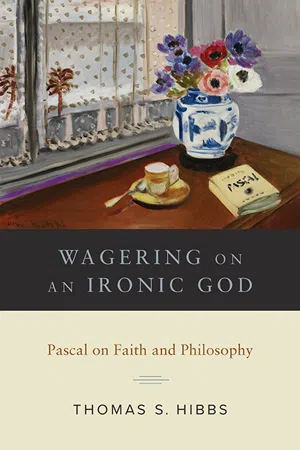
"Philosophers startle ordinary people. Christians astonish the philosophers." --Pascal, Pensées In Wagering on an Ironic God Thomas S. Hibbs both startles and astonishes. He does so by offering a new interpretation of Pascal's Pensées and by showing the importance of Pascal in and for a philosophy of religion. Hibbs resists the temptation to focus exclusively on Pascal's famous "wager" or to be beguiled by the fragmentary and presumably incomplete nature of Pensées. Instead he discovers in Pensées a coherent and comprehensive project, one in which Pascal contributed to the ancient debate over the best way of life--a life of true happiness and true virtue. Hibbs situates Pascal in relation to early modern French philosophers, particularly Montaigne and Descartes. These three French thinkers offer distinctly modern accounts of the good life. Montaigne advocates the private life of authentic self-expression, while Descartes favors the public goods of progressive enlightenment science and its promise of the mastery of nature. Pascal, by contrast, renders an account of the Christian religion that engages modern subjectivity and science on its own terms and seeks to vindicate the wisdom of the Christian vision by showing that it, better than any of its rivals, truly understands human nature. Though all three philosophers share a preoccupation with Socrates, each finds in that figure a distinct account of philosophy and its aims. Pascal finds in Socrates a philosophy rich in irony: philosophy is marked by a deep yearning for wisdom that is never wholly achieved. Philosophy is a quest without attainment, a love never obtained. Absent Cartesian certainty or the ambivalence of Montaigne, Pascal's practice of Socratic irony acknowledges the disorder of humanity without discouraging its quest. Instead, the quest for wisdom alerts the seeker to the presence of a hidden God. God, according to Pascal, both conceals and reveals, fulfilling the philosophical aspiration for happiness and the good life only by subverting philosophy's very self-understanding. Pascal thus wagers all on the irony of a God who both startles and astonishes wisdom's true lovers.
Information
Topic
Theology & ReligionSubtopic
Christian TheologyOne
Irony, Philosophy, and the Christian Faith
“Philosophers: they astonish the ordinary run of men. Christians: they astonish the philosophers” (613).1 With its allusion to both Socrates and St. Paul, Pascal’s pithy aphorism contains the key to understanding his conception of philosophy and its relationship to divine revelation. Revelation’s mode of pedagogy is ironic; disrupting the ordinary and expected flow of events, it occasions surprise. Irony seizes upon incongruity, on the gap between what we think we know and what we actually know, between what we anticipate and what actually comes to be, and between what we think we are and what we in fact are. To ordinary human beings, the philosopher, who eschews what the many esteem in favor of some other, less apparent good, seems at best comical and at worst threatening. Alternately mocked and reviled, Socrates is ultimately put to death for practicing a philosophical way of life. Similarly, many have been put to death for practicing the Christian life, which seems absurd or hazardous both to conventional life and the life of philosophy. Thus Paul speaks of the cross of Christ as folly.
In Pascal as in Paul, the praise of folly is ironic.2 It is not the result of a crude anti-intellectualism; rather, it reposes on a recognition of human beings’ “ignorance of an unseen or unexpected order.”3 Irony does not confine the intellect but awakens it, insofar as it is capable of grasping the irony, to “liberating depth.”4 The order or plane of knowledge on which an individual operates determines what he sees—or fails to see—in other orders or planes. Much more will be said below about irony, especially about the similarities and differences between philosophical and theological modes of ironic pedagogy. Interpreting Pascal from the perspective of ironic teaching has clear advantages; it suggests that his writings contain a much richer conception of the relationship between faith and reason than what interpreters typically recognize.
Pascalian irony, as we shall see in some detail below, is not to be confused with the ironic posture of the jaded, detached, postmodern nihilist; nor is it merely a self-protective tool of the philosopher or scientist attempting to shield himself from the threatening censure of church and state. Instead, it is a pedagogical tool inviting, castigating, bewildering—all with the intention of awakening dormant human souls to a quest for the good life.5
§1. Pascal and the Ancient Quarrel over the Best Way of Life
Reading Pascal in terms of the debate over the good life has a number of advantages; it offers a corrective to entrenched misreadings of his work and established misinterpretations of early modern philosophy. First, as a corrective to the tendency, especially prominent in Anglo-American philosophy, to focus almost exclusively on isolated segments of the apology, particularly on the “wager” argument, the approach via the good life enables us to see the parts in light of a coherent and comprehensive whole. Such a synthetic approach to Pascal’s apology has been on the rise, especially under the influence of leading Pascal scholar Jean Mesnard, whose work is credited with detecting an “underlying unity of heretofore disconnected fragments.”6 The various and seemingly unrelated elements have a place in the articulation of the debate between the philosophical and the religious ways of life. The wager, the only argument in Pascal that receives regular treatment from philosophers, is best read not as an isolated piece of reasoning but as one moment within a comprehensive defense of the Christian way of life. Thus, the wager, which is an invitation to a specific type of interlocutor to adopt the Christian way of life, can be properly understood only when recognized as part of a larger whole. As we shall see in detail in the last chapter, the wager is complex not only in its argument but also in its rhetoric. It is in fact a dialogue, replete with ironic reversals.7
Second, it shows how misleading and unhelpful is the reading of Pascal as an anti-intellectual fideist. As Thomas Carroll points out, the application of the term “fideist” to Pascal and other early modern figures is anachronistic. Moreover, there is no clear consensus about the meaning of the term.8 Now, in Pascal’s writings, there are indeed passages containing negative appraisals of reason and philosophy. To take these to entail a hasty dismissal of philosophy is to miss Pascal’s nuanced engagement of philosophy as a distinctive way of life. Moreover, highlighting the role of irony in Pascal’s theological teaching brings to the fore a significant and enduring analogy between reason and revelation.
Third, reading Pascal in terms of the great debate over the best way of life helps us to recover what is most compelling and most interesting about early modern philosophy, as such a reading sheds new light on Pascal’s relationship to his two most important interlocutors: Montaigne and Descartes. The standard narrative of these three early modern French thinkers is that Montaigne’s skepticism generates a response in the form of Descartes’ foundationalism, both of which give rise to Pascal’s fideism. As is typically the case with established narratives, there are reasons for the labels bestowed upon philosophers. Pascal himself will locate Montaigne among the skeptical school and Descartes among the dogmatists. But he also sees them, more broadly, as engaging in two distinct styles of writing and thinking: the spirit of finesse, which discerns patterns in disparate, concrete experiences, and the spirit of geometry, which operates in abstraction from the here and now and seeks a demonstrative certitude that eludes us elsewhere. Beyond these matters of epistemology and style, he reads them both as offering, in quite divergent ways, defenses of the sufficiency of the philosophical life as the best way of life.
From this perspective, we can see the debates between various early modern philosophers as conflicts over the best way of life and thereby recover a sense of the deep connections among philosophy, science, and ethics in the early modern period. Matthew Jones detects in seventeenth-century philosophy, and even in many of the scientific and mathematical texts of the time, a pervasive concern with “spiritual exercises,” which offer “practices and objects of knowledge held to be intellectually and affectively appropriate for living well.”9 On this account, Montaigne, often dismissed by philosophers as merely a literary figure, can be seen as a philosopher in the fullest sense of the term. Meanwhile, Descartes becomes a much more interesting writer than the standard textbook treatments of modern philosophy have allowed.10 The quest for certitude is subordinate in early modern philosophy, even according to Descartes himself, to the vital question of the best way of life. Descartes can thus be recovered as a philosopher in conversation with classical antiquity, particularly with the figure of Socrates, and with his contemporary, Montaigne. Focusing on that question helps us to see better what is at stake in early modern philosophy.
On the standard account of modern philosophy, Descartes looms large, while Montaigne and Pascal are but footnotes. Montaigne’s style, his penchant for the anecdote and the essay form, combined with his seemingly insouciant skepticism, render him an immature modern, eclipsed by the hard reasoning and demonstrative clarity of Descartes. If the sixteenth century, the century of Montaigne, breaks decisively with much of the past, particularly with the medieval past, it is only with the seventeenth century, the century of Descartes, that humanity sets “aside all doubts and ambiguities about its capacity to achieve its goals here on Earth, and in historical time, rather than deferring human fulfillment to an Afterlife in Eternity.”11 Only in the latter period, according to the standard view as described by Stephen Toulmin in his revisionist history Cosmopolis: The Hidden Agenda of Modernity, is the modern spirit of progress born with an “optimism” that leads to “major advances not just in natural science but in moral, political and social thought as well.” But Toulmin shows that this picture is misleading and dangerous, as it assumes that there is no dark side to the Enlightenment goal of transparent rationality. Through a reading of Montaigne, Toulmin argues that there are in fact “two distinct starting points” of modernity: “a humanistic one grounded in classical literature, and a scientific one rooted in natural philosophy.”12 The latter is abstract and theoretical and operates by an “analysis of the abstract core of theoretical concepts,” while the former is concrete and practical and operates through an “accumulation of concrete details of practical experience.”13 The contrast works so far as it goes, although Descartes, who repudiates mere theory as much as Montaigne, certainly claimed that his method would produce practical results, going so far as to claim that it will render us “masters and possessors of nature.”14 Without that part of Descartes, we cannot make sense of the seventeenth century as optimistic or progressive. But there is also much that Toulmin gets wrong, especially when it comes to Pascal, who is admittedly a minor character in his reconstruction of modernity. Toulmin locates Pascal with Descartes because Pascal rejects casuistry and thus, on Toulmin’s view, must also opt for the abstract over the concrete, the universal over the particular. But this is to ignore the predominance of rhetoric over science in Pascal’s apology and his penchant, even more pronounced than in Montaigne, for what Toulmin calls the “accumulation of concrete details of practical experience.” Moreover, Toulmin seems innocent of the knowledge that Pascal had already articulated Toulmin’s own template for the twofold source of modernity as a contrast between the spirit of finesse and that of geometry.15
As much as Toulmin rightly urges a rethinking of the origins of modernity through a rereading of Montaigne and Descartes, his own interpretation rests on a superficial acquaintance with the texts of these authors. Thus, he misses their and Pascal’s common preoccupation with the question of the good life, the recovery of which is crucial to a proper appreciation and appraisal of their writings.
Such a recovery is already underway in the exegesis of ancient philosophy, as is evident from the writings of thinkers as diverse as Pierre Hadot and Leo Strauss. In his discussion of Socrates in What Is Ancient Philosophy?, Hadot identifies “the existence of a philosophical life—more precisely, a way of life—which can be characterized as philosophical and which is radically opposed to the way of life of non-philosophers.”16 The philosophical life is not a matter of “knowing this or that, but of being in this or that way,” especially of being in a way that is a preparation for death, indeed an “exercise of death.”17 It “is a way of life, which corresponds to the highest activity which human beings can engage in and which is linked intimately to the excellence and virtue of the soul.”18 Wisdom itself is a “way of being.”19 Now, such a conception of the philosophical life proved quite congenial, as Hadot notes, to many early Christians, who described the following of Christ as “the way,” a distinctive path embodying the communal practice of certain virtues and oriented to a contemplation of Wisdom. Indeed, some go so far as to appropriate the term “philosophy” and to adopt some of philosophy’s “spiritual exercises.”20
Both philosophy and theology concern ways of life informed by authoritative texts, patterned after exemplary figures, and modeled on distinctive accounts of the human good.21 As Matthew Jones observes, when Pascal uses the term “philosophers” he includes “thinkers concerned with ways of life, with modes of caring for the self.”22 In one arena, various philosophical schools contend with one another over visions of the good life. In another, they share the assumption that reason or philosophy is the highest authority in the investigation of the good. In the latter, there is a chasm between philosophy and theology. In its authoritative texts (scripture, the church fathers, and the councils), exemplary figures (apostles, martyrs, and saints), and highest source of authority (Deus revelans, “God revealing”), Christianity precludes the possibility of its adherents being philosophers. This does not mean that Christians cannot offer philosophical arguments or that they cannot be lovers of wisdom and thus, in their own way, engage in philosophy. But as philosophy comes to be associated with a set of schools from antiquity, with their texts, authorities, and ways of living in accord with reason, Christians come to be associated with a different way of life and its distinctive set of authorities and texts. Pascal considers philosophy both in its complexity of schools and in its unity.
The question of the best way of life is inseparable from the question of who teaches authoritatively concerning that life, and that is a question, ultimately, of whether reason or faith is the supreme authority on the good life. Leo Strauss puts the point succinctly:
Man cannot live without light, guidance, knowledge; only through knowledge of the good can he find the good that he needs. The fundamental question, therefore, is whether men can acquire that knowledge of the good without which they cannot guide their lives individually or collectively by the unaided efforts of their natural powers, or whether they are dependent for that knowledge on Divine Revelation. No alternative is more fundamental than this: human guidance or divine guidance.23
This is precisely the question that informs Pascal’s apology for the Christian faith. One of the many paradoxes concerning Pascal’s disposition toward philosophy can be seen in the formulation of the central question, a question to which, for Pascal, the only adequate answer is theological. Yet, the manner of framing the question, even in the hands of a Christian apologist, is philosophical. Indeed, Pascal aims, as do classical philosophers, for an understanding of the whole and for a way of life at once wise and blessed.
As noted in the opening quotation, Pascal conceives of three ways of life: that of the ordinary man, that of the philosopher, and that of the Christian. In a related passage, he describes three orders of things: “There are three orders of things: the flesh, the mind, and the will” (933).24 A. W. S. Baird comments, “Pascal conceives of the three orders, not only as orders of being, . . . but also as moral categories, in which individuals range themselves according to the nature of the end which they pursue as the goal of existence.”25 That activities and ways of life are ordered to certain ends is integral to Pascal’s account of the human condition; it is also the basis upon which he engages both ordinary folks and philosophers. The wager, for example, presupposes that happiness and truth are naturally recognized goods or ends. Pascal embraces the premodern affirmation of the universal human desire for happiness:
All men seek happiness. There are no exceptions. However different the means they may employ, they all strive towards this goal. The reason why some go to war and some do not is the same desire in both, but interpreted in two different ways. The will never takes the least step except to tha...
Table of contents
- Cover
- Title Page
- Copyright Page
- Dedication
- Contents
- Acknowledgments
- Part 1. Irony, Philosophy, and the Christian Faith
- Part 2. Socratic Immanence: Montaigne’s Recovery of Philosophy as a Way of Life
- Part 3. The Virtue of Science and the Science of Virtue: Descartes’ Overcoming of Socrates
- Part 4. The Quest for Wisdom: Pascal and Philosophy
- Part 5. Wagering on an Ironic God
- Bibliography
- Index of Names and Authors
Trusted by 375,005 students
Access to over 1.5 million titles for a fair monthly price.
Study more efficiently using our study tools.
Frequently asked questions
Yes, you can cancel anytime from the Subscription tab in your account settings on the Perlego website. Your subscription will stay active until the end of your current billing period. Learn how to cancel your subscription
No, books cannot be downloaded as external files, such as PDFs, for use outside of Perlego. However, you can download books within the Perlego app for offline reading on mobile or tablet. Learn how to download books offline
Perlego offers two plans: Essential and Complete
- Essential is ideal for learners and professionals who enjoy exploring a wide range of subjects. Access the Essential Library with 800,000+ trusted titles and best-sellers across business, personal growth, and the humanities. Includes unlimited reading time and Standard Read Aloud voice.
- Complete: Perfect for advanced learners and researchers needing full, unrestricted access. Unlock 1.5M+ books across hundreds of subjects, including academic and specialized titles. The Complete Plan also includes advanced features like Premium Read Aloud and Research Assistant.
We are an online textbook subscription service, where you can get access to an entire online library for less than the price of a single book per month. With over 1.5 million books across 990+ topics, we’ve got you covered! Learn about our mission
Look out for the read-aloud symbol on your next book to see if you can listen to it. The read-aloud tool reads text aloud for you, highlighting the text as it is being read. You can pause it, speed it up and slow it down. Learn more about Read Aloud
Yes! You can use the Perlego app on both iOS and Android devices to read anytime, anywhere — even offline. Perfect for commutes or when you’re on the go.
Please note we cannot support devices running on iOS 13 and Android 7 or earlier. Learn more about using the app
Please note we cannot support devices running on iOS 13 and Android 7 or earlier. Learn more about using the app
Yes, you can access Wagering on an Ironic God by Thomas S. Hibbs in PDF and/or ePUB format, as well as other popular books in Theology & Religion & Christian Theology. We have over 1.5 million books available in our catalogue for you to explore.