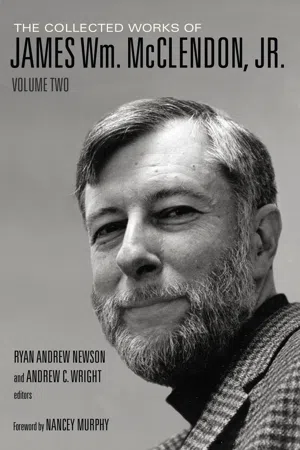
This two-volume set mixes previously unpublished and published lectures and essays with rare and little known works to form a representative collection of the essential themes of McClendon's work. The first volume focuses on the philosophical and theological shifts leading to McClendon's articulation of the baptist vision. The second volume specifically elucidates the more philosophical themes that informed McClendon's work, including ways in which these themes had immediate theological import. Taken together, the set provides the most comprehensive presentation of McClendon's work now available, revealing the sustained and systematic character of his vision over the course of his life. These two volumes will provide scholars, preachers, and students with McClendon's radical, narrative, and connective theology.
eBook - ePub
The Collected Works of James Wm. McClendon, Jr.
Volume 2
- 420 pages
- English
- ePUB (mobile friendly)
- Available on iOS & Android
eBook - ePub
The Collected Works of James Wm. McClendon, Jr.
Volume 2
About this book
James Wm. McClendon, Jr. was the most important "baptist" theologian of the twentieth century. McClendon crafted a systematic theology that refused to succumb to the pressures of individualism, grew out of the immediacy of preaching the text, and lamented the stunted public witness of a fractured Protestant ecclesiology.
Information
Topic
Teología y religiónSubtopic
Denominaciones cristianasContents
—VOLUME 1 —
Acknowledgments
Foreword
Introduction to Volume 1
PART I
Prospect
Prospect
§1The Radical Road One Baptist Took (2000)
PART II
Early Baptist Reflections
Early Baptist Reflections
§2Creation, Humanity, Sin (1964)
§3Atonement, Discipleship, and Freedom (1964)
§4Death, Resurrection, Survival, and Immortality (1964)
§5A Brief Narrative Account of My Professional Life and Work to the Present (1969)
§6Some Reflections on the Future of Trinitarianism (1966)
§7Baptism as a Performative Sign (1966)
PART III
Focusing the baptist Vision
Focusing the baptist Vision
§8A Decade of Deeds and Dreams: My History Continued, 1969–1978 (1978)
§9What Is a ‘baptist’ Theology? (1982)
§10The Concept of Authority: A Baptist View (1988)
§11Primitive, Present, Future: A Vision for the Church in the Modern World (1991)
§12The Mennonite and Baptist Vision (1993)
§13The Voluntary Church in the Twenty-First Century (1998)
PART IV
Social Ethics for Radical Christians
Social Ethics for Radical Christians
§14Social Ethics for Radical Christians: Analysis and Program (1989)
§15The End of the World (1989)
§16The Church Seeking a Peaceable Culture:
The Way of the Cross (1995)
The Way of the Cross (1995)
§17The Church Seeking a Peaceable Culture:
The Way of the Resurrection (1995)
The Way of the Resurrection (1995)
§18Knowing the One Thing Needful (1995)
§19The Politics of Forgiveness (1998)
PART V
Paths to Catholicity: The baptist Path
Paths to Catholicity: The baptist Path
§20What Is a Southern Baptist Ecumenism? (1968)
§21Christian Identity in Ecumenical Perspective
(with John Howard Yoder) (1990)
(with John Howard Yoder) (1990)
§22Balthasar Hubmaier, Catholic Anabaptist (1991)
§23Law and Faith (1994)
§24A baptist Millennium? (1998)
PART VI
Retrospect
Retrospect
§25Embodying the Great Story: An Interview with James Wm. McClendon, Jr. (2000)
Permissions for Volume 1
Scripture Index for Volume 1
General Index for Volume 1
—VOLUME 2 —
Acknowledgments
Foreword
Introduction to Volume 2
PART I
Retrospect
Retrospect
§26Three Strands of Christian Ethics (1978)
§27Distinguishing Modern and Postmodern Theologies (1989)
PART II
Language, Convictions, and Speech-Acts
Language, Convictions, and Speech-Acts
§28Christian Philosophers or Philosopher Christians? (1968)
§29How Is Religious Talk Justifiable? (1968)
§30Can There Be Talk about God-and-the-World? (1969)
§31Saturday’s Child: A New Approach to the Philosophy of Religion (with James Marvin Smith) (1970)
§32Homo Loquens: Theology as Grammar (1971)
§33‘Convictions’ after Twenty Years (1995)
PART III
Convictions Made Flesh
Speech-Acts as Embodied Narrative
Convictions Made Flesh
Speech-Acts as Embodied Narrative
§34Biography as Theology (1971)
§35Theology, Language, and Life: A Christian Perspective (1974)
§36The God of the Theologians and the God of Jesus Christ (1981)
§37Story, Sainthood, and Truth: Biography as Theology Revisited (1982)
§38Narrative Ethics and Christian Ethics (1986)
PART IV
On the Significance of Practices
On the Significance of Practices
§39Christian Practices and the Postmodern Philosophical Task (1991)
§40Toward a Conversionist Spirituality (1994)
§41A New Way to Read the Bible (1995)
§42A Practical Theory of Religion (1995)
PART V
Embodying the Great Story in the World
Embodying the Great Story in the World
§43Do We Need Saints Today? (1986)
§44Toward an Ethics of Delight (1988)
§45Ethics for a Career (1988)
§46How Can a Christian Be a Law Librarian? (1990)
§47How Is Christian Morality Universalizable? (1991)
§48Picture Eschatology (1995)
§49Taking the Side of the World (2000)
PART VI
Prospect
Prospect
§50Ten Theses on the Task of Today’s Theology (1989)
Permissions for Volume 2
Scripture Index for Volume 2
General Index for Volume 2
Acknowledgments
In working on this project, we are happy to have been introduced to Jim McClendon, a man neither of us met, through the diverse community of friends that surrounded him over the course of his lifetime. We are grateful for the opportunity to encounter many of McClendon’s friends, as well as others whom he never knew but, because of his work, have become friends of our own. At every point, such people expressed their support and extended significant hospitality our way: meeting with us, providing us with guidance and resources for the project, and helping us to come to know the relational context within which McClendon’s work took shape. Without their support, this project would not have gained the life that it now has for us, and we hope will have for the reader as well.
First and foremost, we are indebted to our teacher and mentor, Nancey Murphy. It was through her that we first came to understand and value the work of McClendon. Without her graciousness, guidance, and commitment to this project, we could not have navigated this labyrinth of material.
We are further indebted to Carey Newman, Jordan Rowan Fannin, Jenny Hunt, Diane Smith, and the rest of the staff at Baylor University Press, who for two years conversed, dialogued, and guided us in the formation of this project. We are grateful for their commitment to preserving McClendon’s work, and their guidance and wisdom throughout the process.
We could not have completed this project without the ongoing assistance of Nancy Gower and Adam Gossman in accessing the McClendon Archives at the David Allan Hubbard Library, Fuller Theological Seminary. Many thanks for their patience and organizational prowess.
Additionally, we are thankful to those scholars who took the time to provide crucial insight on McClendon the man and on our own undertaking, especially Tommy Airey, C. Rosalee Velloso Ewell, Curtis Freeman, Michael Goldberg, Brad Kallenberg, Ched Myers, Mark Thiessen Nation, Brendon Neilson, Parush Parushev, James M. Smith, Glen Stassen, and Terrence Tilley. We are also thankful to our friends and colleagues at Fuller Theological Seminary who provided support and perspective on the project as it developed, including (but not limited to!) Jacob Cook, Chris Moore, Eric Schnitger, and Amy Chilton Thompson.
We would both like to express our deepest gratitude for the love and (especially) patience our families have shown over many weekend and evening absences; they have been tangible signs of grace in a very stressful time. In particular, we wish to inadequately express love for our wives, partners, and friends, Rebecca and Rebecca—you have made this an undertaking both possible and enjoyable.
Finally, we would like to thank McClendon himself, whose meticulous work and clarity of vision continues to provide a witness to the power of the Great Story in our shared world. For laboring over his work and writing with the care that he did—in a manner that is nonetheless marked by an inexhaustible delight—we are all in his debt.
Andrew Wright and Ryan Newson
Twelfth Week of Ordinary Time
June 2013
Pasadena, California
Twelfth Week of Ordinary Time
June 2013
Pasadena, California
Foreword
Nancey Murphy
Ifirst saw him when he peered out suspiciously through a small crack of his office door. My first impression: a gray suit and a purple nose! I had enrolled at the Graduate Theological Union (GTU) for a doctorate in theology, and Jim had been assigned as my mentor. (“They thought I was the only one on the faculty who could handle you,” he said, referring to the fact that I’d just finished a Ph.D. in philosophy at Berkeley.)
Jim seems to have been a man who was either loved or hated. My theory is that his capacity for empathy was not very great, and so he got by in society largely by means of the lovely Southern manners his mother had taught him. But times and places had changed, and the patrician manner came across to some as arrogance.
Jim was sometimes thought to be humorless. I teased him about his book Convictions, saying it was quite good except for his overreliance on the philosophy of J. L. Austin—but he didn’t get the joke. However, I learned to enjoy his old Southern Baptist preacher jokes, all the more the more often he told them. Church member gives jar of brandied peaches to the pastor. The pastor replies that “they enjoyed the fruit, and especially the spirit in which it was given!” He began a list of denominational oxymorons before I met him: Unitarian heretic, thinking Baptist, Roman Catholic, Episcopalian preacher. As I become familiar with broader reaches of the Christian world, I try to add to the collection.
As noted in the introduction to volume 2, Jim wrote that “theology is struggle.” For him that meant not only seeking to put theological truth on paper, but also doing it in an aesthetically pleasing way—such that it sounded good being read aloud. Often I came home at the end of the day, and he would be on the sixth or eighth draft of a single page. He succeeded so well with the aesthetic task that I’m unable to read any of his theology in public without weeping.
I fell in love with his theology my first year at the GTU. I enrolled in his doctrine class my first quarter and took a seminar on Anabaptist history and theology in the spring. Jim once said that no one is ready to do systematic theology until the age of sixty, because theology is like a three-legged stool. One leg is the capacity to work with biblical texts in original languages; the second is knowledge of the development of doctrine from beginning to end; and the third is familiarity with all current approaches to the discipline. He was looking for the legs that supported theology. I already accepted the validity of theology (as a Catholic, still, at that point). I was looking for places where the theology from “up there” touched ground. I’d experienced Christian teaching in Catholic charismatic meetings, and I was beginning to see how the church teachings could be used to interpret our life together.
What I loved about Jim’s doctrine is that it always hit the ground. For example, take the abstract claim that Jesus died in our place. Now, in accordance with his “baptist vision,” imagine that you were one of the original disciples. Jim adds that there should have been thirteen crosses, including twelve for the disciples who ran away.
Jim’s doctoral seminar on the Anabaptists brought about a conversion of the sort that the editors quote from Biography as Theology (pp. 32–33): “Conversions are not so much the introduction of new elements into the self as they are the rearrangement of elements already present, the shifting of the center of gravity; ...
Table of contents
- Cover
- Title
- Copyright
- Contents
Trusted by 375,005 students
Access to over 1.5 million titles for a fair monthly price.
Study more efficiently using our study tools.
Frequently asked questions
Yes, you can cancel anytime from the Subscription tab in your account settings on the Perlego website. Your subscription will stay active until the end of your current billing period. Learn how to cancel your subscription
No, books cannot be downloaded as external files, such as PDFs, for use outside of Perlego. However, you can download books within the Perlego app for offline reading on mobile or tablet. Learn how to download books offline
Perlego offers two plans: Essential and Complete
- Essential is ideal for learners and professionals who enjoy exploring a wide range of subjects. Access the Essential Library with 800,000+ trusted titles and best-sellers across business, personal growth, and the humanities. Includes unlimited reading time and Standard Read Aloud voice.
- Complete: Perfect for advanced learners and researchers needing full, unrestricted access. Unlock 1.5M+ books across hundreds of subjects, including academic and specialized titles. The Complete Plan also includes advanced features like Premium Read Aloud and Research Assistant.
We are an online textbook subscription service, where you can get access to an entire online library for less than the price of a single book per month. With over 1.5 million books across 990+ topics, we’ve got you covered! Learn about our mission
Look out for the read-aloud symbol on your next book to see if you can listen to it. The read-aloud tool reads text aloud for you, highlighting the text as it is being read. You can pause it, speed it up and slow it down. Learn more about Read Aloud
Yes! You can use the Perlego app on both iOS and Android devices to read anytime, anywhere — even offline. Perfect for commutes or when you’re on the go.
Please note we cannot support devices running on iOS 13 and Android 7 or earlier. Learn more about using the app
Please note we cannot support devices running on iOS 13 and Android 7 or earlier. Learn more about using the app
Yes, you can access The Collected Works of James Wm. McClendon, Jr. by James W. McClendon, Jr., Ryan Andrew Newson,Andrew C. Wright in PDF and/or ePUB format, as well as other popular books in Teología y religión & Denominaciones cristianas. We have over 1.5 million books available in our catalogue for you to explore.