- 463 pages
- English
- ePUB (mobile friendly)
- Available on iOS & Android
eBook - ePub
About this book
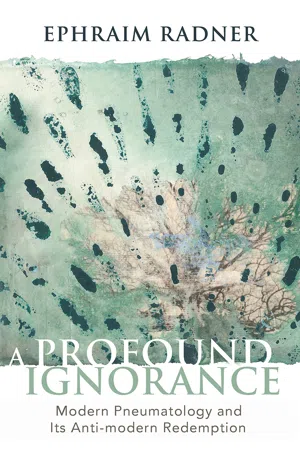
In the march of modernity and the opening of global boundaries, the face of the world changed. How we understood the world, and our place in it, changed. And with that great shift, our concept of the Holy Spirit also changed. Now the third person of the Trinity became a diffusive power in a universalizing attempt at resolving the expansively harsh realities of human existence. In A Profound Ignorance, Ephraim Radner traces the development of pneumatology as a modern discipline and its responses to experiences of social confusion and suffering, often associated with questions linked to the category of theodicy. Along the way, study of the Spirit joined with natural science to become study of spirit, which was at root study of the human person redefined without limitation. Radner proposes that the proper parameters of pneumatology are found in studying Israel and her historical burdens as the Body of Christ, showing how the Spirit is the reality of God that affirms the redemptive character of Christ, the Son. The traumas of the twentieth and twenty-first centuries have brought to the fore the problematic distance between earlier and more modern approaches to the Spirit. Drawing on writers from Paracelsus to John Berryman, and including theologians and philosophers like Anne Conway and John Wesley, as well as literary figures from d'Aubigné to Duhamel, Radner attempts to locate modern pneumatology's motives and interests within some of the novel social settings of a rapidly globalizing consciousness and conflicted pluralism. It is by following Israel into the Incarnation of Jesus, Radner contends, that humans find their unresolved sufferings and yearnings redeemed. The Holy Spirit operates in deep hope, the kind of hope that is inaccessible to simple articulation. Finally, Radner argues for a more limited and reserved pneumatology, subordinated to the christological realities of divine incarnation: here, creaturely limitations are not denied, but affirmed, and taken up into the life of God.
Information
Topic
Theology & ReligionSubtopic
Christian TheologyNotes
Introduction
1 For a relatively dispassionate, yet perhaps overly benign, overview of law and statistics up to 2016, see Ezekiel J. Emanuel, Bregje D. Onwuteaka-Philipsen, John W. Urwin, and Joachim Cohen, “Attitudes and Practices of Euthanasia and Physician-Assisted Suicide in the United States, Canada, and Europe,” Journal of the American Medical Association 316, no. 1 (2016): 79–90. Emanuel has not been a proponent of assisted suicide, it should be noted. On that score, his earlier attempt to debunk “cost-savings” is interesting, and it provides a window onto now popular economic criteria around death, if not consensus as to conclusions: Ezekiel J. Emanuel and Margaret Battin, “What Are the Potential Cost Savings from Legalizing Physician-Assisted Suicide?” New England Journal of Medicine 339 (1998): 167–72. For some more detailed, measured, but critical discussion of the Netherlands, in particular, see David Gibbes Miller and Kim Y. H. Scott, “Euthanasia and Physician-Assisted Suicide Not Meeting Due Care Criteria in the Netherlands: A Qualitative Review of Review Committee Judgements,” BMJ Open 7, no. 10 (2017); and, on the side of psychiatric patients, Kim Y. H. Scott, Raymond G. De Vries, and John R. Peteet, “Euthanasia and Assisted Suicide of Patients with Psychiatric Disorders in the Netherlands, 2011 to 2014,” Journal of the American Medical Association Psychiatry 73, no. 4 (2016): 362–68. For a critical perspective, offering a particular set of criteria from within the Dutch context, by a physician who supports assisted suicide for certain psychiatric patients, see Joris Vandenberghe, “Physician-Assisted Suicide and Psychiatric Illness,” New England Journal of Medicine 378, no. 10 (2018): 885–87. A straightforward defense of assisted suicide for severe depressives is given by Udo Schuklenk and Suzanne van de Vathorst in “Treatment-Resistant Major Depressive Disorder and Assisted Dying,” Journal of Medical Ethics 41, no. 8 (2015): 577–83. The idea of “equivalence” of suffering here is important.
2 For a wide review from within the American context, but with references to other jurisdictions and by an advocate, see Neelam Chhikara, “Extending the Practice of Physician-Assisted Suicide to Competent Minors,” Family Court Review 55, no. 3 (2017): 430–43. On the legal issues regarding the competency of minors, and criteria involved, with respect to assisted suicide in Canada, see Juliet Guichon, Farah Mohamed, Kim Clark, and Ian Mitchell, “Autonomy and Beneficence in Assisted Dying in Canada: The Eligibility of Mature Minors,” Alberta Law Review 54, no. 3 (2017): 775–802.
3 For a useful gathering of data and impressions, slickly packaged and with little theological value, as well as overly focused on the rise of the smartphone culture, see Jean Twenge, iGen: Why Today’s Super-connected Kids Are Growing Up Less Rebellious, More Tolerant, Less Happy—and Completely Unprepared for Adulthood (New York: Atria/Simon & Schuster, 2017).
4 Cf. the recent statistical survey for the United States by Gregory Plemmons et al., “Hospitalizations for Suicide Ideation or Attempt: 2008–2015,” Pediatrics 141, no. 6 (2018), doi:10.1542/peds.2017-2426; more broadly, see Aaron Kherlaty, “Dying of Despair,” First Things 275 (2017): 21–25.
5 Ephraim Radner, Spirit and Nature: The Saint-Médard Miracles in Eighteenth-Century Jansenism (New York: Crossroads, 2002). The best historical overview is still B. Robert Kreiser’s Miracles, Convulsions, and Ecclesiastical Politics in Early Eighteenth-Century Paris (Princeton: Princeton University Press, 1978).
6 Emil Cioran, De l’inconvénient d’être né [The trouble with being born] (Paris: Gallimard, 1973), 15.
7 My project could stand as a paltry parallel, in religious-existential terms, to the resistance Hannah Arendt articulated, in political-existential terms, against our era’s developed “earth alienation.” In pneumatological terms, that is, I am merely reiterating a firm “No!” to the fact that we have now economically, culturally, and imaginatively come to order our common life according to frameworks that render the earth and our biologically determined limitations within it, in all their phenomenal givenness, as something “other” than what we truly are or need. Once “other” to our true nature, we now view them as disposable. Arendt’s sweeping intellectual analyses of the rise and character of modernity may be dubious in some respects, but her conclusions seem compelling. See Hannah Arendt, The Human Condition (Chicago: University of Chicago Press, 1998 [1958]), 248–335.
8 Ephraim Radner, A Time to Keep: Theology, Mortality, and the Shape of a Human Life (Waco, Tex.: Baylor University Press, 2016).
9 John Berryman, from “Eleven Addresses to the Lord,” addresses 6 and 11, in Love & Fame (New York: Farrar, Straus, & Giroux, 1970), 91 and 96.
1. The New World, a New Spirit
1 The Hopkins fragment may relate to the sinking of the vessel Vicksburg, with many deaths, in 1875 as the ship left Quebec. Are the “children” icebergs? Or are they simply the wonderful creatures that a mysterious sea in fact creates, in “pity,” even through her destructive embrace? See Ross Stuart Kilpatrick, “‘The Sea Took Pity’: Hopkins 173,” Studies: An Irish Quarterly Review 84, no. 334 (1995): 168–72.
2 The intellectual historian Mark Lilla gets this right in his breezy but often unfairly sarcastic review of Brad Gregory’s The Unintended Reformation: How a Religious Revolution Secularized Society (Cambridge, Mass.: Harvard University Press, 2012). Gregory mounts, among other things, a massive argument for why specifically intellectual shifts in the sixteenth century reconfigured Western society. Lilla, in dismissing this approach, notes how common this view is, especially in certain “theoconservative” religious circles (though it is just as popular in progressivist circles as well). In singling out Étienne Gilson, John Milbank, or Alisdair Macintyre, Lilla might have added any number of other substantive thinkers, like Louis Dupré or Hans Blumenberg. There is clearly much to learn from such (mostly philosophically oriented) writers. But Lilla is still right when he notes, “It enlightens me not at all to think that ‘medieval Christendom failed, the Reformation failed, confessionalized Europe failed, and Western modernity is failing,’ as if each of these were self-conscious ‘projects’ the annual reports of which are available for consultation. Life does not work that way; history does not work that way.” Intellectual “projects,” even with all the strategically (or reactively) practical tactics that further them, rarely make sense of historical experience; and only now and again do they invent it. That, of course, is itself a religious assertion. See Lilla, “Blame It on the Reformation,” New Republic, September 13, 2012.
3 Charles Taylor’s more influential works here are the expansive and intricate Sources of the Self: The Making of the Modern Identity (Cambridge, Mass.: Harvard University Press, 1989); and A Secular Age (Cambridge, Mass.: Harvard University Press, 2007). One of Taylor’s key analytic categories is the “social imaginary,” which he explains as a “common understanding that makes possible common practices and a widely shared sense of legitimacy.” Taylor, Modern Social Imaginaries (Durham, N.C.: Duke University Press, 2004), 23. These “common understandings,” however, derive from extraordinarily complex interactive realities—people, events, ideas, larger and smaller human or natural forces. Part of Taylor’s attraction is his usually nonreductive analysis of these realities. At the same time, the focus on “understanding” itself tends to press him to consider data that are primarily intellectual.
4 The origin of the concept of a “social imaginary” is not clear. The Marxist philosopher and critic Cornelius Castoriadis seems to have used it before Taylor (cf. The Imaginary Institution of Society [1975], trans. Kathleen Blarney [Cambridge, Mass.: MIT Press, 1987]). In his work, the “social imaginary” is a kind of ex nihilo creative force for social change drawing on various collective resources. Hence, “social imaginaries” are susceptible to harnessing, transformation, and application; and they can—and should be—vehicles for projects that better the world. A similar hope—mostly unrelated to the ideas of Castoriadis, to be sure—seems to be shared by various contemporary followers of Taylor: if we can reshape ideas, we can also reshape the way social groups order themselves accordingly. Cf. on the side of conservative American Christianity, some of the contributions to Collin Hansen, ed., Our Secular Age: Ten Years of Reading and Applying Charles Taylor (Deerfield, Ill.: Gospel Coalition, 2017).
5 The kind of work done by Andrew Cunningham and Ole Peter Grell on issues of health and disease (cf. their The Four Horsemen of the Apocalypse: Religion, War, Famine and Death in Reformation Europe [Cambridge: Cambridge University Press, 2000]) is an example within the field of European experience. Anthony Pagden’s numerous works on the translatlantic encounter and imperial dynamics are among many works that have demanded a rethinking of European self-identity in the developing sixteenth century and beyond. Similarly, work by scholars like Sanjay Subrahmanyam on the very different, though in some sense related, cultural and material encounters of Portuguese and Asians has built on the meticulous work of other researchers; although Asia’s very different material encounter with Europe has meant that, in fact, the focus on ideas and their application has predominated (see Stefan Gaarsmand Jacobsen’s historiographical reflection, “Chinese Influences or Images? Fluctuating Histories of How Enlightenment Europe Read China,” Journal of World ...
Table of contents
- Cover
- Title Page
- Copyright Page
- Dedication
- Contents
- Acknowledgments
- Introduction
- I. Corruption
- II. Redemption
- Notes
- Index of Subjects and Persons
- Index of Scripture
Trusted by 375,005 students
Access to over 1.5 million titles for a fair monthly price.
Study more efficiently using our study tools.
Frequently asked questions
Yes, you can cancel anytime from the Subscription tab in your account settings on the Perlego website. Your subscription will stay active until the end of your current billing period. Learn how to cancel your subscription
No, books cannot be downloaded as external files, such as PDFs, for use outside of Perlego. However, you can download books within the Perlego app for offline reading on mobile or tablet. Learn how to download books offline
We are an online textbook subscription service, where you can get access to an entire online library for less than the price of a single book per month. With over 1.5 million books across 990+ topics, we’ve got you covered! Learn about our mission
Look out for the read-aloud symbol on your next book to see if you can listen to it. The read-aloud tool reads text aloud for you, highlighting the text as it is being read. You can pause it, speed it up and slow it down. Learn more about Read Aloud
Yes! You can use the Perlego app on both iOS and Android devices to read anytime, anywhere — even offline. Perfect for commutes or when you’re on the go.
Please note we cannot support devices running on iOS 13 and Android 7 or earlier. Learn more about using the app
Please note we cannot support devices running on iOS 13 and Android 7 or earlier. Learn more about using the app
Yes, you can access A Profound Ignorance by Ephraim Radner in PDF and/or ePUB format, as well as other popular books in Theology & Religion & Christian Theology. We have over 1.5 million books available in our catalogue for you to explore.