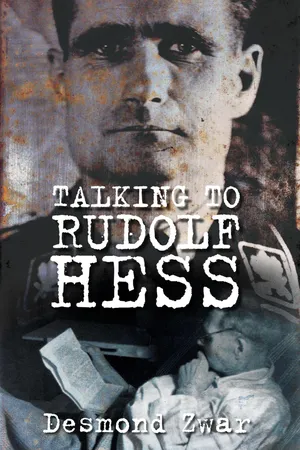
Rudolf Hess was Adolf Hitler's Deputy Führer until, in 1941, he flew to Scotland, ostensibly to negotiate peace between Germany and Britain. Captured by the British, he was held for the rest of the War, before being convicted of war crimes at the Nuremberg Trials in 1946. Desmond Zwar collaborated with Col. Burton C. Andrus, who was Commandant of Nuremberg Prison during the Trials, on his book The Infamous of Nuremberg, and with Col. Eugene K. Bird, US Governor of Spandau Prison (where Hess was held for over forty years), on The Loneliest Man in the World. For reasons of practicality, neither of these books told the full story, which is now revealed for the first time in Talking to Rudolf Hess. As well as his interviews with Hess and others, Zwar tells the story of how this book came to be written, including how Hess hid proofs in his underpants, how Bird was sacked by the US Army and how the CIA tried to recover the transcripts.
- 192 pages
- English
- ePUB (mobile friendly)
- Available on iOS & Android
eBook - ePub
Talking to Rudolf Hess
About this book
Information
CHAPTER 1
NUDES ON HORSEBACK
I awoke on a chilly winter’s morning, burrowing further under the blankets, summoning the courage to make a dash from the warm bed to the shower, when the phone rang.
‘Desmond? Neil Hawkes here.’ The chief of the London bureau of the Melbourne Herald, my old paper in Australia; a pedantic man, as always, taking his time to explain himself while I’m freezing in my pyjamas by my desk. I silently urge him to get to the point.
He had been working through the night, he said, and there had come on the teleprinter an odd message from one of the Herald group’s stable, the Australasian Post. A request he obviously felt was probably a time-waster, but grudgingly he would pay me to check it out anyway. ‘I’m not enthusiastic about the end result.’ (Yes, yes. Get on with it!)
I knew, as he did, that the Post was a notorious ‘tits and bums’ magazine devoted to sex, Australiana, oddball stories and sport. It tended to run pictures of outback toilets and dogs with two heads. By no stretch of the imagination had it ever touched on matters intellectual; and to my knowledge had rarely shown an interest in what was going on anywhere outside Australia.
That was why the London man was so puzzled, he ruminated. The Post’s editor desired an interview with the celebrated artist, Dame Laura Knight, the only living female Royal Academician. ‘He’s said something in the cable about Dame Laura painting nudes on horseback. He’ll want pictures.’ The penny dropped! Nudes and horses. Together! I said I’d go and see the old lady. It helped pay the rent. I dashed off to the shower. Working at the time for a lowly wage on the Daily Mail, I knew I had to grasp at freelance crumbs in a thin week.
Dame Laura lived alone in St John’s Wood, and when I phoned, she charmingly invited me to ‘take tea’ with her at three o’clock the next afternoon. I took a tube train to the nearest station and walked along a beautiful terrace of houses and rang the doorbell. She came to the door: a small, greying woman in her late seventies. Greeting me with a firm handshake, she led the way upstairs to her huge, airy studio. Cuttings in the Mail newspaper library had said she was a painter of world rank, and that made my task more embarrassing. How was I going to ask her about naked ladies riding horses? And then arrange to have the paintings photographed for the salacious readers of the Post?
A Royal Doulton tea service sat ready on a tray with a plate of tiny cucumber sandwiches. ‘But before we sit down, let me show you my studio,’ Dame Laura said. She led me on a tour of her paintings of ballet dancers, clowns and, I noticed, circus horses. The old lady must have been stunningly attractive when she was young. She wore her hair in a plait that was wound round her head; her eyes twinkling with merriment, raising her hands in girlish joy when she laughed. In the middle of the barn-like room, gazing at a sketch of one of her ballerinas I took the plunge.
‘Dame Laura, I hope you won’t be offended by this, but I have been asked if you would show me your paintings of … er … naked girls on horseback.’
She looked puzzled for a brief second, then she laughed. ‘Oh my boy! I am sorry to disappoint you. I paint nudes as you see and all my life I have been fascinated by circuses and have painted circus people and their horses. But never together. Have I disappointed you?’
I assured her, red-faced, that she had not. Only some prurient fellow back in Melbourne might be frustrated. We settled down to enjoy our China tea. From my place on the sofa I glanced across the studio and tried to remember where I’d seen the large painting that dominated the room. Then the penny descended in the foggy brain for the second time. It was the courtroom dock scene at the Nuremberg Trials; the line-up of the notorious accused: Hess, Goering, Von Ribbentrop, Speer. Dame Laura’s eyes were twinkling again. ‘You recognise it?’ I assured her, yes of course I did. She was the official war artist at Nuremberg. This was one of the world’s most famous paintings. ‘That was my working painting,’ she explained. ‘The original is in the Imperial War Museum.’ Nudes on horseback. I felt ill.
I explained, on the second cup of tea, that I was interested in German history. As a small boy, with a German name, I had been the butt of taunts and bashings at my country school. ‘Nazi! Nazi!’ I’d never forgotten the shame. We walked across to the painting. ‘Look at poor Goering,’ she said. ‘He had a terrible cold while I was painting him.’ Then, as we returned to the sofa, she said: ‘You must forget about interviewing me. There is a great friend of mine who was at Nuremberg, and was ever so much more important. When he comes to London he takes tea with me and sits where you are sitting now. Colonel Burton Andrus was the Commandant of Nuremberg prison, the building next to the court where the trials were going on. His job was to keep those terrible men in their cells; to prevent people getting them out; or even murdering them; and that was a real possibility. He has never told anybody his story. Why don’t you let me put you in touch with him?’
She always had her ‘nap’ at four o’clock. Why didn’t I wait in the studio for her, and in the meantime, read the air-letters she had written from the courtroom to her husband Harold, in London? They would probably give me an idea of what the Nuremberg Trials were like. She went downstairs and returned with a bundle of the blue letters in a box. ‘There,’ she said. ‘That will help you understand.’
I had in my hands a pile of letters that were a daily diary. They described in vivid, intimate detail what she had observed from her tiny observation box high up on one of the courtroom walls. And indeed, there at the top of one letter was her pen-picture of Goering: ‘He fidgets, sniffles, wipes his nose constantly. He looks miserable,’ she had told Harold. On the left-hand corner of the page there was a thumb-nail sketch of the fat, hated man, nose dripping.
By the time she came back I had made up my mind: I would contact Colonel Andrus in Tacoma, Washington, and ask him if I might discuss my writing about his Nuremberg life. The security of the Daily Mail had to be put to one side. Sure, the outlay of time and money would be considerable; but if he was prepared to talk for the first time about what went on in Nuremberg prison, it would be a literary scoop. The old boy sounded a character, but a formidable one. I wondered if he’d break his silence after all these years, and why he hadn’t by now?
I went back to my one-room bachelor flat at Cadogan Gardens, London, and wrote to Col. Andrus. It was 11 July 1965:
You will have had a note from Dame Laura Knight introducing me. She has spoken a lot about you … and after researching at my newspaper library at the London Daily Mail, I have become more intrigued than ever that you must hold the real story of Nuremberg that has never been written. I feel the real, personal story by you, of how those men lived and how you worked on their physical and mental well-being would be something people all over the world would want to read.
I know this may be forward and presumptuous and I hope you are not offended …
Weeks went by and then came a two-paragraph note from Andrus. ‘Maybe’, he said. ‘One day, maybe.’ For months after my visit to Dame Laura Knight, our sporadic, mostly one-sided correspondence seemed to be destined to go nowhere. It was only when I pointed out in a final letter that he was 75 and ‘history might die’ with him, that I had his phone call.
3 a.m. ‘Mr.Zwar? Andrus here. When ya comin’ over?’
‘Colonel! I can leave tomorrow.’
‘Fine. Let me know what time you’re gettin’ into Tacoma.’
He’s agreed! I’d made this accidental connection with this man surely with history in his grizzled head. He had held in custody twenty-four of the world’s most evil men – Streicher, Goering, Sauckel, Funk et al., while they were being tried in Nuremberg Court, next door to his prison. I was to meet him. And only because a sex-starved Australian magazine wanted pictures of naked ladies riding horses!
Airlines operating between Britain and the US were on strike. I met Burton C. Andrus, the ex-Commandant of Nuremberg prison, after a flight to Amsterdam, another across the Atlantic to Canada, and a bus ride to Tacoma, Washington State. A stern, crew-cut, greying man with a fierce expression on a leathery face, Andrus exuded no-nonsense army. He picked me up at Tacoma bus station at the end of my long hours’ travelling, and I felt exhausted. When we got into his car the colonel said he’d booked me into the visiting professorial quarters at the nearby University of Puget Sound, where he taught geography. (‘Thank God! I can sleep!’)
‘But in the meantime, I’ve arranged dinner at my club.’ I sighed inwardly. Bed would have been perfect.
I sat down at the Elks Club dining table, bleary-eyed from the long trip, and tentatively broached the subject of diaries. I hoped, I said, he’d still have the notes and diary records he had kept at Nuremberg. He stopped eating his steak: ‘Hell no. I never kept diaries.’ My stomach sank. How, then, would he remember what actually went on? There had been nothing in my London newspaper archives about the prison itself; there were cabinets full of cuttings about the trial and a whole row of books that had been written about the proceedings and the fate of the accused Nazis. But the news blackout on his prison, adjacent to where the trial was taking place, and what went on in the cells that incarcerated the Nazi leaders, had been coldly efficient. ‘Yeah. I operated a tight ship,’ agreed the nuggety Andrus. ‘I tried to make sure nothin’ got out.’ Obviously nothing had.
That was why I was there, I said. I wanted – through him – to tell the world what it was like incarcerating Hitler’s most notorious colleagues.
What sources were available for my research? Didn’t he have files? Instructions? Letters? I had a sinking feeling that the whole project was turning into a dead end.
He grinned at me as he finished his chocolate dessert. ‘Well, there’s a whole lot of stuff up in my loft in tin trunks at home. But you wouldn’t want to go up there in the dust. You told me in one of your letters you get hay fever.’
It was hard to know when Colonel Andrus was serious or joking. He had an immobile face and one eye that just stared at you, the other hardly moving, leaving you to make up your own mind. I said if it was okay with him, I would go up into the attic the next morning and look at the ‘stuff’. And risk the hay fever.
Next day I went to his home and climbed the ladder. Lying against one side of the loft were three dusty trunks he had brought back from Nuremberg in 1946. I carefully opened each one and pulled out orderly files of documents, letters and stapled reports. As I opened them I saw Classified, Top Secret, and Eyes Only across the majority of the folders. The colonel had kept letters from Goering asking why he wasn’t allowed a batman in his cell; even suicide notes. There were invitations from the judges to cocktail parties, Andrus’ pencilled record of the actual times of the hangings. It seemed that in eighteen months as Commandant he had thrown nothing away.
Amongst evidence gathered for the tribunal was an ancient letter Hess had written on 16 July 1924, from Landsberg prison, where he and Hitler had been jailed for the failed Munich ‘Beer Hall’ coup the year before. Hess, acting as Hitler’s secretary and already helping him to write Mein Kampf, was telling a colleague – Heim – that at the time Hitler was refusing to have anything more to do with ‘outside matters’ like the fighting within the Party.
I am against any books being sent to him. Hitler wants at this time to have nothing to do with daily questions from the outside. I tried this for the last time this morning, but in vain. Anyway he pulls himself back even more so from the leadership. He will not take the responsibility for what happens on the outside without his knowledge and also, partly, against his will. He is not able to do anything about the eternal fighting that goes on in the Party, at least not from here.
It is vain to deal at this moment with these little matters. On the other hand, he is sure to be soon able, when he receives his freedom again, to push everything into the right direction.
Then he will be very quickly able to finish everything that has led to confusion in his absence about the differences in religion … he will take all their strength and combine it together for the fight against Communism, the Communism that is more dangerous than ever; because it is under a blanket until the day of attack.
I believe there will soon come the moment that everybody, out of desperation of movement against the Bolshevistic threat will be behind Hitler … and that is why we hope that he will be let out of here soon enough to regain his freedom of movement.
Even if Communism will not be the cause of re-unification of all our difficulties, the damage because of the fighting in the Volk movement will not be so tragic. The personality of Hitler, with momentous meaning, (I have only here fully realised) will be able to overcome anything.
He will put his stamp on the German people and will put down the cancerous growth among his people. From today on, one does not look at all the in-fighting and stupid things his followers do. One will do it even less when in the Autumn, Hitler’s book will appear. That will not only show us a picture of the politician, but also the human being Hitler, shown in the widest understanding of Germany.
I enclose a special pamphlet from Hitler about Germany’s renewal.
I spent the next hours sneezing from the dust of twenty years and reading the documents’ contents onto a tape-recorder. As we both needed to lose weight, Col. Andrus and I had arranged to swim daily in the university pool and lunch frugally on liquid Chocolate Metrecal, which was supposed to replace food. (I’d spoil it all in the evening at the commissary where I’d pile my plate with flapjacks, ice-cream and marshmallows.)
I spent two more days in the loft feeling I was inside Nuremberg prison; I could almost hear the clanging of steel cell doors and smell the disinfectant. But there was a huge obstacle to using the material Andrus had filed. The printed pages and scrawled notes I was opening in the trunks were historical dynamite. But the most sensational were ominously stamped in stencil: CLASSIFIED. NOT TO BE RELEASED. EYES ONLY. The colonel and I were, if we used material from these files for our book, surely breaking a most sobering law which could land both of us in serious trouble. At any time he was obviously going to say to me, ‘I’m sorry. I should have told you. We can’t access any of this stuff.’ An...
Table of contents
- Cover
- Title Page
- Dedication
- Table of Contents
- CHAPTER 1 : NUDES ON HORSEBACK
- CHAPTER 2 : THE NAZIS ARRIVE
- CHAPTER 3 : GOERING FROM THE GRAVE
- CHAPTER 4 : UNDERSTANDING HESS
- CHAPTER 5 : COLONEL BIRD – REPORTER
- CHAPTER 6 : HESS’S DECISION
- CHAPTER 7 : I KISS YOUR HAND
- CHAPTER 8 : TWENTY YEARS OF PAIN
- CHAPTER 9 : INSIDE HESS’S CELL
- CHAPTER 10 : TRICKING THE SHRINKS
- CHAPTER 11 : PUNISHHIM!
- CHAPTER 12 : ON THE BRINK OF WAR
- CHAPTER 13 : THAT CUNNING CHURCHILL
- CHAPTER 14 : THEY’RE OUT!
- CHAPTER 15 : I AM HARMLESS NOW
- CHAPTER 16 : DEAR DOG …
- CHAPTER 17 : SMUGGLERS AND SPOOKS
- CHAPTER 18 : HE WAS MURDERED!
- AFTERWORD : THE LAST BIRD INTERVIEW
- Copyright
- Plates
Trusted by 375,005 students
Access to over 1.5 million titles for a fair monthly price.
Study more efficiently using our study tools.
Frequently asked questions
Yes, you can cancel anytime from the Subscription tab in your account settings on the Perlego website. Your subscription will stay active until the end of your current billing period. Learn how to cancel your subscription
No, books cannot be downloaded as external files, such as PDFs, for use outside of Perlego. However, you can download books within the Perlego app for offline reading on mobile or tablet. Learn how to download books offline
Perlego offers two plans: Essential and Complete
- Essential is ideal for learners and professionals who enjoy exploring a wide range of subjects. Access the Essential Library with 800,000+ trusted titles and best-sellers across business, personal growth, and the humanities. Includes unlimited reading time and Standard Read Aloud voice.
- Complete: Perfect for advanced learners and researchers needing full, unrestricted access. Unlock 1.5M+ books across hundreds of subjects, including academic and specialized titles. The Complete Plan also includes advanced features like Premium Read Aloud and Research Assistant.
We are an online textbook subscription service, where you can get access to an entire online library for less than the price of a single book per month. With over 1.5 million books across 990+ topics, we’ve got you covered! Learn about our mission
Look out for the read-aloud symbol on your next book to see if you can listen to it. The read-aloud tool reads text aloud for you, highlighting the text as it is being read. You can pause it, speed it up and slow it down. Learn more about Read Aloud
Yes! You can use the Perlego app on both iOS and Android devices to read anytime, anywhere — even offline. Perfect for commutes or when you’re on the go.
Please note we cannot support devices running on iOS 13 and Android 7 or earlier. Learn more about using the app
Please note we cannot support devices running on iOS 13 and Android 7 or earlier. Learn more about using the app
Yes, you can access Talking to Rudolf Hess by Desmond Zwar in PDF and/or ePUB format, as well as other popular books in History & Political Biographies. We have over 1.5 million books available in our catalogue for you to explore.