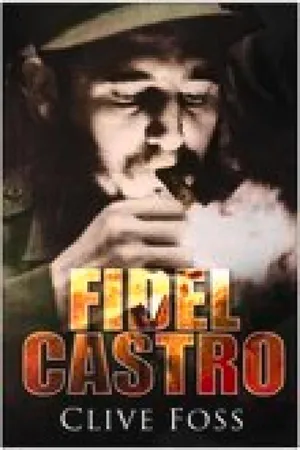
Fidel Castro was a dynamic and charismatic leader, who led Cuba through success and failures from 1959. Son of a rich landowner, he became a radical revolutionary who attempted to overthrow the government in 1956 with a tiny band of followers. Using propaganda and subversion as much as sudden attacks from his mountain hideout, he gained victory in 1959. He liberated his country from one dictator and the overwhelming influence of the United States, only to turn it into another dictatorship firmly under the control and patronage of the Soviet Union. The failure of the American attack at the Bay of Pigs in 1961 added to his reputation, while the missile crisis of 1962 put Cuba right at the centre of the Cold War. Later, by sending his army to Africa and supporting guerrilla movements in Latin America, he made Cuba a signficant player on the world stage. Despite many attempts to remove him and the economic collapse of the USSR, Castro survived and in 1999, celebrated 40 years of his regime.
eBook - ePub
Fidel Castro
About this book
Information
ONE
Growing up Cuban
1926-1945
Fidel Castro, who brought communism to Cuba, was the son of a very rich man. The house where he was born stands in lush rolling country about ten miles from the sea, in Birán, in the eastern part of the island. This massive wooden structure was untypically built on piles so the cattle, pigs and chickens could stay on the ground level, while the family occupied the upper floors. Broad verandas, big salons and several bedrooms made it airy and comfortable. A separate wing served for conducting business and paying the workers, for this was the centre of an active estate. Beside the mansion were a large store, butcher shop, post office, and hotel, along the road that led from the coast to Santiago, metropolis of Cuba’s Oriente province. The complex also included a small schoolhouse and shacks for the immigrant workers, while a pit for cockfights provided entertainment. There was neither church nor priest; the people were nominally Christian, but many followed Santería, a mixture of African religions and Catholicism.
All this was the work of Angel Castro, who left the impoverished northwest of Spain in 1898 to fight with the Spanish army against the Cuban revolution. After the war, he stayed on in Cuba, first peddling lemonade, then working on the railroad. He eventually bought a lumber mill and leased land from the powerful American United Fruit Company. He wound up controlling a vast tract of 25,000 acres, much of it planted in sugar processed by a nearby American mill. The estate ran its own narrow gauge-railway to the mill. At harvest time, it employed 600 laborers. Angel Castro became one of the biggest landowners in Oriente, the roughest part of Cuba, where the writ of the government hardly ran. Violence and gunfire were not unusual; Angel paid for a detachment of rural guards to protect his property. Locals like him or the toughs of United Fruit maintained such order as there was, for this was the region most subject to American influence.
The war that Angel had joined led to Cuban independence, but not in a form the rebels had envisioned. In 1898, after bitter fighting had gone on for three years, the United States intervened, defeated the Spaniards, and liberated the country. Its most dramatic moment was the charge of the Rough Riders which the aspiring politician Theodore Roosevelt led up San Juan Hill outside Santiago. For Americans, the Spanish-American War was a heroic action, freeing Spain’s last colony in the New World, but many Cubans thought the revolution had been snatched from their hands, with a new master replacing the old. After four years of US military occupation, Cuba finally gained independence in 1902, but with an important qualification. The Platt Amendment to the Cuban constitution allowed the Americans to intervene as necessary to ensure stability. They intervened militarily and politically well into the 1920s. As a result, Cuban nationalism became strongly anti-American. Its great hero and theoretician, José Martí, who was killed early in the war, had already voiced his suspicions of his powerful neighbor’s intentions.
A vast influx of American investment followed the war, whose ferocity and devastation had ruined the Cuban land-owning aristocracy. American companies took over the railways, public utilities and Cuba’s greatest industry, sugar. A tropical country with few natural resources, Cuba was ideally suited for producing sugar, which was grown on huge estates and demanded heavy investment in mills and distribution systems. Money and industrial products naturally came from the United States, only ninety miles away. By the time Fidel was born, US interests controlled ⅔ of Cuban agriculture. Oriente province, in particular, was dominated by the mills and model American-style towns of United Fruit from whom Angel Castro derived most of his wealth.
Angel married a schoolteacher who bore him two children, Pedro Emilio and Lidia, but his attention soon shifted to a young housemaid, Lina Ruz, who produced seven more: Angela, Ramón, Fidel, Raúl, Juana, Emma and Agustina. Some time after the birth of the first three, Angel married Lina. Illegitimacy carried no stigma in this society where formal marriages were rather a luxury. Lina, who was barely literate, turned out to be shrewd and canny, a good manager for the family and its establishment.
Fidel Castro was born at Birán on 13 August 1926 and named for an influential local politician, a lifetime friend and business associate of Angel. Despite the family’s wealth, he grew up in a rustic and unsophisticated atmosphere. Literature and art had no role here; the house did not have electricity; there were no motor vehicles on the estate. Angel Castro, a frugal and tough, even ferocious master, was no aristocrat. The family was notoriously chaotic and quarrelsome and chickens roosted everywhere in the house, except in Angel’s office. Yet his parents and sisters always gave Fidel important moral and financial support. He was the most spoiled and headstrong of the children. His father usually indulged him, though his mother’s favorite was the more tranquil Raúl.
From his earliest years, Fidel loved the outdoor life, and played happily and naturally with the children of his father’s Haitian laborers. The rough manners and language he learned sometimes shocked his mother, but he never lost her affection. He learned his first lessons in the one-room school on the family property, where he was an unruly child, who hated authority of any kind. As a result, the six year old Fidel was sent off to the Catholic La Salle school in Santiago. The brothers who ran the school, however, refused to accept an unbaptised, illegitimate child. So, Angel and Lina married and Fidel was duly sprinkled with holy water. Both ceremonies were performed by a Spanish priest, friend of Angel, called Pérez Serantes. He was to reappear in Fidel’s life at a crucial moment. In Santiago, Fidel lived with his godfather, the Haitian consul, whom he claimed didn’t feed him enough. He didn’t like living in a city, after the freedom of the open country. He made so much trouble that he was enrolled as a boarder, which improved his mood but not his disposition. He always pushed to be first in everything and got into fights with his classmates. He was notorious for taking on even the biggest boys, and never giving up or admitting that he was beaten. Fidel longed for the holidays when he could return to the country to ride, swim and climb. After he got into a fight with a teacher, he and his brothers, considered the worst bullies in the school, were brought home by Angel. Fidel’s mother interceded, while he threatened to burn down the house. Angel relented and let him return to school.
At the age of nine, Fidel entered the Dolores school in Santiago, where he began the Jesuit education that was to influence him deeply. He liked history (especially military history), geography, and stories of famous men like José Martí. He read extensively, even a ten-volume history of the French revolution – and became so fascinated by the ongoing Spanish Civil War that he devoured every newspaper he could find, beginning a habit that would never leave him. But his favorite activity was sport, where his outstanding skills gained the respect of his fellow students, who had looked down on him as a bumpkin. He became an enthusiastic hiker and mountaineer, and began to explore the nearby Sierra Maestra mountains, little suspecting the role they would play in his life. The Jesuits taught him well; he was near the top of his class. They imbued a Spartan life style, but not the rebelliousness that made him try to organize a strike among his father’s workers when he was thirteen. Impulsive but intense self-confidence and conviction that he should be Number One were already part of his character. By now he was growing aware of the outside world. When Franklin Roosevelt was reelected in 1940, the fourteen-year-old Fidel wrote him a letter of congratulation, asking for ‘a ten dollars bill green American’ and claiming to be twelve. Although the president didn’t answer directly, the response Fidel received from the State Department was proudly posted on the school’s bulletin board.
In Santiago, Fidel heard about the country’s most prestigious prep school, the Jesuit college of Belén in Havana. His parents agreed to send him there, but he was too young. According to one version, Angel paid a bribe for a revised birth certificate that added a year to his age. If that is true, Fidel was actually born in 1927 not 1926. In any case, in September 1941 he entered the new world of the vibrant, sensual and sophisticated capital. He had never left Oriente before. In the capital, he and his older sister Angela lived in a boarding house; she took care of his daily needs while his father sent a regular and generous allowance. Belén’s Jesuit masters taught seriously and enforced a strict discipline. The boys wore uniforms and attended mass; they were the children of Cuba’s elite, frequently going on to a career in the law or politics. Many of the teachers came from Franco’s Spain, advocated the superiority of Spanish culture, and had little admiration for the secular Anglo-Saxon nation to the north. Fidel delved into the works of the Spanish fascists as well as Mussolini and Hitler; ideas of liberal democracy had little influence here. His greatest admiration, though, was for the works and personality of José Martí, the author of Cuba’s independence, who became the model for his whole career.
The teenage Fidel concentrated only on the subjects he liked (Spanish, history, geography and agriculture). He also was fond of debate and public speaking; he studied the speeches of the great classical orators and practiced them in front of a mirror. Wining arguments suited his personality. So did sports, his favorite activity at school. He became head of the hiking club, and invariably took the lead in mountain climbing. When the coach of the basketball team rejected him, he threw himself into practice, even asking the padre to install a light so he could continue after hours. His work paid off: he not only joined the team, but became its captain in his senior year. This was a real achievement for someone who was considered pushy, over-talkative and too independent to be a team player. He had associates and admirers, but no really close friends.
Fidel won his first great distinction at the age of 18, when he was named Cuba’s outstanding collegiate athlete. His prowess in sports once again overcame the disdain that his aristocratic classmates felt for this rough rustic brawler. Nevertheless, Fidel never lost the resentment of the upper classes that his school experience generated. Love of sports meant that he often neglected his studies, but his incredible memory saved him. When his schoolmates asked him what was on a given page of the sociology text, he could respond by quoting all of it from memory. In his last year, he was excluded from the exams in French and logic because he hadn’t attended the classes. He persuaded the teacher to let him take the exams if he got 100% in French; he did. Determination, concentrated hard work, memory, and sport became the foundation of his career.
Fidel’s all round abilities earned him special recognition. When he graduated in 1945, the head of the school prophetically wrote in his yearbook: `He has known how to win the admiration and affection of all. He will make law his career and we do not doubt that he will fill with brilliant pages the book of his life’.1
While Fidel was growing up, Cuba was passing through turmoil, in a series of dramatic changes that left an unforgettable impression on the Cuban people. He was born during the presidency of Gerardo Machado who entered office in 1924 as a welcome reformer, replacing a series of hopelessly corrupt governments. Although he greatly improved the country through an ambitious program of public works (Havana’s seafront boulevard and the country’s main east-west highway among its products), he soon fell into the usual pattern, amassing power and wealth. In a country that had no tradition of democracy, politics was seen as the prime route to riches: high offices were bitterly contested and vast sums were stolen. After his fraudulent reelection in 1928, Machado was faced with economic chaos brought by the Great Depression. He responded with force. In November 1930, he suspended the constitution, censored the press, and dispatched secret police and death squads against those who dared to oppose him.
Cubans, who had never known dictatorship, resisted. Students were in the forefront; they constantly demonstrated against Machado who responded by closing the university. When resistance continued, he arrested student leaders and professors, then turned to torture and murder. The students gained an idealistic reputation as the ‘generation of 1930’; they were destined to influence the country for a long time. Many students joined hands with the communists whose party founded in 1925 had made great progress among the workers during the Depression. Neither communist-led strikes nor student protest, however, availed against the massed forces of the dictatorship until F. D. Roosevelt came to power in Washington. Unwilling to see continuing chaos so close to home and egged on by vociferous anti-Machado Cuban exiles in Florida and New York, Roosevelt sent a special emissary who negotiated with the opposition and forced Machado to leave the country in August 1933.
The first reaction was joy, followed by violence as mobs swarmed through Havana, burning, looting and slaughtering any of the dictator’s creatures they could find. An American-backed liberal regime took over. It only lasted three weeks: chaos, bloodshed, communism, and resentment of a government installed by foreigners, provoked a coup. The army commander, Fulgencio Batista, allied with the students to install a radical professor, Ramón Grau San Martín, in power. The coup introduced a Latin American tradition that Cuba so far had avoided: the involvement of the military in politics. Batista was another native of Oriente province, of very humble background. A mulatto in a society that practiced racial discrimination, he had drifted through a series of jobs (apparently at one point working for Angel Castro) until he joined the army where he served as a stenographer. A persuasive speaker and admirer of Mussolini, he became the leader of the sergeants and corporals who overthrew first their officers, then the government. The hundred days of the new regime were a heroic time for the students and radicals. Grau purged the government, dissolved the old political parties and pushed through a program of social reform. He regulated working hours, reorganised the unions, and seized two sugar mills as well as the Cuban Electric Company. He also repaid his student backers by granting total autonomy to the university, so that even the police could not enter. When Grau seemed poised to threaten American-owned banks and sugar interests, Roosevelt’s emissary, who had never given his approval, urged the President to send in the Marines. The threat was enough.
In January 1934, Batista, with the blessing of Washington, overthrew the government, crushed all opposition and reestablished stability. Batista’s reward for switching sides was cancellation of the hated Platt Amendment and negotiation of a favorable trade treaty that guaranteed a market for Cuban sugar in the United States, but at the same time opening the Cuban market to American industrial products. Batista did not rule directly, but chose a series of puppet presidents who restored prosperity, enacted social security legislation, reduced rents, extended land ownership and promoted health. All this culminated in the liberal Constitution of 1940, which granted universal suffrage, free elections and many of the social objectives of the 1930s. It limited the president to one term, but allowed him to suspend civil rights for 45 days at a time in an emergency. The same year, in the first reasonably honest election since 1912, Batista became president. He followed progressive policies, in close alliance with the United States. Backed by the army and business, he also gained the support of labor, and admitted communists to his cabinet. By now the Party had considerable popularity and its roots in the labor movement made it an attractive ally for Batista, who granted the workers many benefits. In 1944, though, his chosen candidate was surprisingly beaten by Grau San Martín, the radical of 1933. Batista left for Florida; the country had prospered under his administration, and so had he. He reputedly took $20 million, the product of the usual graft, with him. At home, though, real changes seemed imminent.
Fidel went home for the summer of 1945, persuaded his father to buy him a new Ford, and learned to drive it on the three day trip to Havana. He and his sister Angela moved into an apartment near the University. He enrolled in the faculty of law.
1 Quoted in Szulc 134.
TWO
The Rising Politician
1945–1952
Learning was not the only activity at the University whose elegant neoclassical buildings crown a hill in the centre of Havana. Since 1934, the University had been a special area where the police could not enter. In theory it was run by the democratically elected heads of the student unions that chose their own president. In practice, rival bands of professional gangsters, for whom it was the ideal refuge, controlled the campus. Some were students, others, often in their thirties, had only the loosest connection with studies. They flourished under the regime of Grau, who exchanged radicalism for corruption. Gangs harassed students and professors, monopolized the sale of textbooks and exam papers and fixed exam marks. The two most important were the Social Revolutionary Movement (MSR) and the Insurrectional Revolutionary Union (UIR) whose armed fighters decided student elections.
There was nothing ‘revolutionary’ or ‘insurrectional’ about these groups. Their aim was power; their tools were pistols. While Grau was in office, they committed 120 murders, some of factional rivals, others to help the politicians. Since they could be useful to the government, Grau did not suppress the gangs, but rewarded them. Huge sums looted from government contracts and offices supported organized thugs, ‘students’ who were a valuable counterweight to an army still favorable to Batista. One of the MSR’s leading hit men became chief of the criminal investigation department, while a UIR chief rose to head the national police academy. Grau gave jobs to followers of both factions, hoping to use them to intimidate the labor movement, where the communists remained strong, for, as the Cold War began, Cuba followed the anti-communist lead of the United States. Gangsters, sheltered on the campus, and politicians in the presidential palace and the Capitol were closely allied in a system that left little room for traditional learning.
The ‘students’ were not the only criminals who infested post-war Cuba. The country was booming, wide-open Havana catered to every taste, and the government was always willing to look the other way. The door was open to the American Mafia, whose leaders – three of them, with an entourage of 500 – gathered in Havana’s most elegant hotel, the Nacional, in February 1947 to pay their respects to their boss, Lucky Luciano, who had taken refuge there the year before. The Mafia liked Havana, where they could feel safe. They maintained close touch with the government, in arrangements that were mutually beneficial.
In October 1945, Fidel Castro entered a world where his excellent education and distinction in sport didn’t count for much. The university paid little attention to athletics and its formal education was per...
Table of contents
- Cover
- Title
- Copyright
- Contents
- Chronology
- Introduction
- Preface to the Second Edition
- 1 Growing Up Cuban, 1926–1945
- 2 The Rising Politician, 1945–1952
- 3 The Rebel, 1952–1956
- 4 The Hero, 1956–1958
- 5 Transforming Cuba, 1959–1960
- 6 Experiments in Revolution, 1961–1970
- 7 Moscow’s Man in Havana, 1970–1989
- 8 Staying Afloat, 1990–1999
- 9 Into the Future, 2000–2005
- Bibliography
Trusted by 375,005 students
Access to over 1.5 million titles for a fair monthly price.
Study more efficiently using our study tools.
Frequently asked questions
Yes, you can cancel anytime from the Subscription tab in your account settings on the Perlego website. Your subscription will stay active until the end of your current billing period. Learn how to cancel your subscription
No, books cannot be downloaded as external files, such as PDFs, for use outside of Perlego. However, you can download books within the Perlego app for offline reading on mobile or tablet. Learn how to download books offline
Perlego offers two plans: Essential and Complete
- Essential is ideal for learners and professionals who enjoy exploring a wide range of subjects. Access the Essential Library with 800,000+ trusted titles and best-sellers across business, personal growth, and the humanities. Includes unlimited reading time and Standard Read Aloud voice.
- Complete: Perfect for advanced learners and researchers needing full, unrestricted access. Unlock 1.5M+ books across hundreds of subjects, including academic and specialized titles. The Complete Plan also includes advanced features like Premium Read Aloud and Research Assistant.
We are an online textbook subscription service, where you can get access to an entire online library for less than the price of a single book per month. With over 1.5 million books across 990+ topics, we’ve got you covered! Learn about our mission
Look out for the read-aloud symbol on your next book to see if you can listen to it. The read-aloud tool reads text aloud for you, highlighting the text as it is being read. You can pause it, speed it up and slow it down. Learn more about Read Aloud
Yes! You can use the Perlego app on both iOS and Android devices to read anytime, anywhere — even offline. Perfect for commutes or when you’re on the go.
Please note we cannot support devices running on iOS 13 and Android 7 or earlier. Learn more about using the app
Please note we cannot support devices running on iOS 13 and Android 7 or earlier. Learn more about using the app
Yes, you can access Fidel Castro by Clive Foss in PDF and/or ePUB format, as well as other popular books in History & Historical Biographies. We have over 1.5 million books available in our catalogue for you to explore.