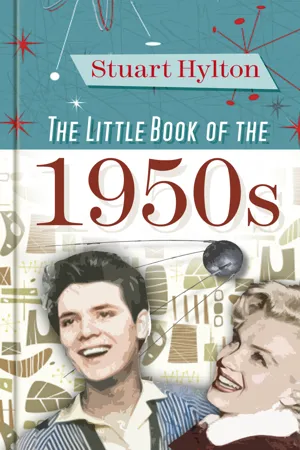
The Little Book of the 1950s is a fast-paced and entertaining account of life in Britain during an extraordinary decade, as we moved from post-war austerity to the swinging sixties. There are dramas, tragedies, scandals and characters galore, all packaged in an easily readable 'dip-in' format. We can see how major national and international events impacted on the population at home, the progress made by technology and the fads and fancies of fashion and novelty. We also see how different the world of the 1950s was to the one that we inhabit, though some things (like Cliff Richard) never change from one millennium to the next. Even those who lived through the decade (and are therefore experts on the subject) should find plenty to remind, surprise, amuse and inform them on these pages.
- 192 pages
- English
- ePUB (mobile friendly)
- Available on iOS & Android
eBook - ePub
The Little Book of the 1950s
About this book
Information
1
Let Me Entertain You … Broadcasting 1950s-Style
Television in its infancy
Whatever the choice of family entertainment you will find it in TELEVISION. It has brought a new meaning into home life and thousands who used to seek their entertainment outside, now find their television set a source of untold pleasure at home. Why not learn more about it?
(1950s advertisement for the new wonder of the age)
The 1950s was the decade in which television came of age. First, and foremost, there was the dramatic increase in television set ownership. When broadcasting resumed after the war, there were just 20,000 television sets, generally belonging to people living within 30 miles of the British Broadcasting Corporation’s (BBC’s) only transmitter at Alexandra Palace. As late as 1949, the majority of households had never seen a set in action, let alone owned one. Nonetheless, the potential market for television could already be seen – set ownership had already reached over 100,000 by the end of the forties. In 1950, the BBC opened what it boasted was the world’s most advanced transmitter at Sutton Coldfield, opening up the joys of viewing to an entirely new region. Set ownership took another leap, to 343,882, by March of that year. King George’s funeral, the coronation and the coming of commercial television helped swell the numbers to around 2 million by 1953 and 4 million two years later. The number of combined TV and radio licences exceeded those for radio alone for the first time in 1957, and by the end of the decade, 10.5 million television licences were being issued – 72 per cent of all households had a set.


Despite being monopoly holders of the national television franchise, many at the top of the BBC in the early 1950s took a very dim view of the upstart service. In their view: ‘ … it was not a medium to be taken seriously: pantomime horses and chorus girls were its natural ingredients; it was not suitable for news or current affairs.’

Worse still, it could have a toxic effect on broadcasting as a whole: ‘ … the high purposes of the Corporation would be trivialised by the influence of those concerned with what could be transmitted in visual terms.’
Accordingly, in 1950, the Corporation set up a 2,500-strong Television Panel, with the remit of helping the BBC to deliver: ‘… a keener, more sensitive and more intelligent appreciation on the part of all who see it of the world about us.’

(This from the organisation that would shortly give us Bill and Ben the Flowerpot Men). Television was thus starved of both cash and influence within the Corporation. In 1947, the total budget for television broadcasting was just £716,666, compared with the £6,556,293 allocated for radio, and had reached only £3 million by 1951. Prior to 1950, television was not even represented on the Corporation’s Board and thereafter its appointed champion was the Director of the Spoken Word (who does not sound like a pictures man). In 1956, a Director of Television was finally appointed, but Gerald Beadle did not own a set and saw the post as a means of winding down towards retirement.
At the same time as believing that television was a medium of no importance, officials at the BBC were also afraid that it would turn us into a nation of square-eyed couch potatoes. Modern viewers would find few grounds for such a fear with broadcasting as it was in 1950 – limited to just 30 hours a week. Programmes would start at 3 p.m. on a weekday (5 p.m. on Sundays) and would stop between 6 and 7 p.m., to enable parents to prise small children away from the set and get them to bed, and for older children to do their homework. Transmissions would normally close down entirely by 10.30 p.m. It was not until 1955 that the permitted hours of broadcasting increased to forty per week.
The battle over commercial television
At the start of the fifties, the BBC had a monopoly hold over all types of broadcasting. The values of Lord Reith, the pre-war Director General, still held sway in the corridors of Broadcasting House and the nation was given a diet of worthy, but often dull, programming. The arrival of a post-war Conservative Government under Churchill, in 1951, was the beginning of the end of the monopoly; Churchill had hated the BBC since the days of the 1926 General Strike, when he had tried to take it over as a propaganda tool. He regarded the Corporation as a nest of socialists, or worse. A White Paper was commissioned, which recommended licensing a new commercial television channel.
The nation was deeply divided on the subject; the case for keeping the BBC’s monopoly was advanced by the National Television Council, while the calls for a commercial alternative were led by the Popular Television Association. Each side recruited celebrities and other people of influence to their cause, and some rather overblown cases were made for them, particularly by the pro-monopolists. One of the leading voices for them was, of course, Lord Reith himself. Never one given to over-statement, he likened the influence of commercial television to smallpox, the bubonic plague and dog racing, and made a somewhat patronising comment to television’s growing audience. Easier hire purchase, he said, had enabled more poor people to acquire television sets, and Parliament had a grave responsibility to these people, to stop television becoming a by-word for crude and trivial entertainment. Meanwhile, Conservative politician, Lord Hailsham, likened the battle over commercial television to that of the nation’s survival in the Second World War. In those days, he said, the BBC had been the voice of freedom, and it was now in danger of handing over the greatest instrument for good that had been devised since the printing press, to purely commercial interests.
As we now know, the anti-monopolists won the day, and commercial television started broadcasting in the London area in September 1955. The parliamentary act authorising the new channels included a duty on them to ‘inform’ and ‘educate’ as well as ‘entertain’, but (no doubt prompted by the need to build audience share and advertising revenue) the new commercial interests were – or soon became – unashamedly populist. They would give the public what they wanted, not what some higher authority thought was good for them. (According to one ITV executive, the public wanted to see girls, wrestling, bright musicals, quiz shows and real-life dramas). They also had a much larger budget for programming than BBC TV, and were able to poach many of the BBC’s staff. Small wonder, then, that by the end of 1957, they had secured a 72 per cent audience share and were well on the way to becoming that infamous licence to print money.
Even after its establishment, a number of interests (including the Labour Party, some newspapers, senior clergy and academics) continued to lobby for commercial television to be closed down. The Spectator called commercial broadcasting ‘a monument to fraud and a daily reminder of the worthlessness of political promises’, and the Daily Express carried a leader in January 1956 calling for the authorities ‘to write off ITV as an experiment that went wrong and hand the wavelength over to the BBC before it got completely out of control’.
One of the interesting aspects of BBC programming during its monopoly years was its desperate desire not to abuse its prominence by seeming to be partisan, as seen in the fourteen-day rule, which forbade any matter due to be discussed in Parliament in the next fourteen days to be discussed on television. This was naturally something of a constraint on current affairs broadcasting and, by the mid-1950s, had become an obvious absurdity. Things came to a head in February 1955, when the programme In the News, one of the Corporation’s few attempts to be hard-hitting over current affairs, was stopped from discussing atomic bomb testing. The programme’s panel decided they would no longer be bound by the rule – which was simply a convention, rather than anything binding and statutory. The Postmaster General (the Minister responsible for television) tried to enforce it, but found he had no legal basis for doing so. This, and a media campaign, forced him to back down.
The BBC’s approach to television news was similarly blinkered. Until commercial competition forced them to review their approach, their newsreaders were not trusted to script their own reports, the names of the newsreaders were not announced to the viewers and their faces were not even seen (caption cards being shown on the screen instead). The only visual interest tended to come from cinema-style newsreels, which might be several days out of date. As Robin Day said: ‘Independent Television News set new standards for vigour, enterprise and pace for television news, making the BBC version look stiff and stuffy.’
What were we watching?
‘Television is a very unusual business. You don’t necessarily make more money in television if you provide a better product.’
(Sidney Bernstein, Head of Granada Television)
Here is a small sample of the treats in store for the 1950s television viewer.
When we were very young …
If you were very young, or had young children, from April 1952 you were likely to tune in to Watch with Mother, broadcast from 3.45– 4.00 p.m., between the midday nap and when the older children were getting back from school. Among its attractions were:
Andy Pandy (first shown in 1950) – a puppet whose taste in clothing would get him bullied at any modern school, and who lived in a picnic basket with a teddy bear, and a rag doll called Looby Loo. The programme always ended with the song ‘Time to go home … Andy is waving goodbye’.
Bill and Ben the Flower Pot Men (1952) – with its cliffhanger ending of ‘was it Bill or was it Ben’ who had committed this episode’s naughtiness? Readers may be interested to know that Bill and Ben had their real-life origins in William and Benjamin Brabban, the naughty younger brothers of the show’s creator.
Rag, Tag and Bobtail (1953) – featuring the glove puppets Rag, a hedgehog, Tag, a mouse, and Bobtail, a rabbit.
The Woodentops (1955) – a family of wooden dolls who lived on a farm with Buttercup the cow, Spotty Dog and domestic help in the form of Mr and Mrs Scrubbitt.
Watch with Mother would run until 1973.
Home on the range
For the older children there was a steady transatlantic supply of cowboys.
The Lone Ranger (who was not actually alone, but always accompanied by his faithful, Native American sidekick, Tonto). He was supposed to be an ex-Texas Ranger who went around righting wrongs on his white horse, Silver. He fired silver bullets and shouted ‘Hi-yo Silver, away!’ quite a lot. Deeply conscious of his duties as a role model to his younger viewers, the Lone Ranger taught the tiny tots to speak with perfect grammar and never shoot-to-kill.
The Cisco Kid and his companion, Pancho, were originally outlaws wanted for some unspecified crime, but went around performing Robin Hood-type services for the poor and oppressed. A similar role was assigned to the character Hopalong Cassidy.
Roy Rogers, with his golden palomino hor...
Table of contents
- Cover
- Title
- Acknowledgements
- Contents
- Introduction
- 1 Let Me Entertain You … Broadcasting 1950s-Style
- 2 Naughty Boys and Bad Girls
- 3 Sporting Disasters
- 4 On this Day …
- 5 Celebrations
- 6 Snappy Dressing – 1950s Fashion
- 7 Right and Proper – 1950s Morality
- 8 Transports of Delight: Getting about in the 1950s
- 9 The Things They Say about the 1950s
- 10 Tragedies
- 11 Crazy Cats – Teenage Music of the 1950s
- 12 1950s Food and 1950s Kitchens
- 13 Protest
- 14 The Space Race
- 15 And Another Thing …
- Copyright
Trusted by 375,005 students
Access to over 1.5 million titles for a fair monthly price.
Study more efficiently using our study tools.
Frequently asked questions
Yes, you can cancel anytime from the Subscription tab in your account settings on the Perlego website. Your subscription will stay active until the end of your current billing period. Learn how to cancel your subscription
No, books cannot be downloaded as external files, such as PDFs, for use outside of Perlego. However, you can download books within the Perlego app for offline reading on mobile or tablet. Learn how to download books offline
Perlego offers two plans: Essential and Complete
- Essential is ideal for learners and professionals who enjoy exploring a wide range of subjects. Access the Essential Library with 800,000+ trusted titles and best-sellers across business, personal growth, and the humanities. Includes unlimited reading time and Standard Read Aloud voice.
- Complete: Perfect for advanced learners and researchers needing full, unrestricted access. Unlock 1.5M+ books across hundreds of subjects, including academic and specialized titles. The Complete Plan also includes advanced features like Premium Read Aloud and Research Assistant.
We are an online textbook subscription service, where you can get access to an entire online library for less than the price of a single book per month. With over 1.5 million books across 990+ topics, we’ve got you covered! Learn about our mission
Look out for the read-aloud symbol on your next book to see if you can listen to it. The read-aloud tool reads text aloud for you, highlighting the text as it is being read. You can pause it, speed it up and slow it down. Learn more about Read Aloud
Yes! You can use the Perlego app on both iOS and Android devices to read anytime, anywhere — even offline. Perfect for commutes or when you’re on the go.
Please note we cannot support devices running on iOS 13 and Android 7 or earlier. Learn more about using the app
Please note we cannot support devices running on iOS 13 and Android 7 or earlier. Learn more about using the app
Yes, you can access The Little Book of the 1950s by Stuart Hylton in PDF and/or ePUB format, as well as other popular books in History & British History. We have over 1.5 million books available in our catalogue for you to explore.