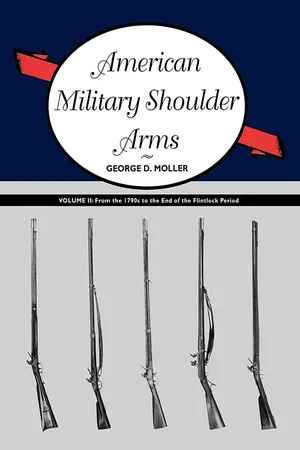
New data surrounding the procurement and modifications of arms produced by the national armories, and under federal contract procured by the individual states and by individual members of militias, is presented here for the first time. This information, interwoven with military, political, economic, and social factors, results in new and better definitions and a clearer understanding of the arms’ historical context. Though this work focuses on military flintlock shoulder arms, details on the federal government’s procurement of arms for Indians during rapidly changing military policies of the period is also included.
American Military Shoulder Arms, Volume II, contains more than three hundred photographs. As with the previous volume, Volume II is written primarily for students of arms, but also contains material of interest to historians, museum specialists, collectors, and dealers of antique arms.
Frequently asked questions
Yes, you can cancel anytime from the Subscription tab in your account settings on the Perlego website. Your subscription will stay active until the end of your current billing period. Learn how to cancel your subscription.
No, books cannot be downloaded as external files, such as PDFs, for use outside of Perlego. However, you can download books within the Perlego app for offline reading on mobile or tablet. Learn more here.
Perlego offers two plans: Essential and Complete
Essential is ideal for learners and professionals who enjoy exploring a wide range of subjects. Access the Essential Library with 800,000+ trusted titles and best-sellers across business, personal growth, and the humanities. Includes unlimited reading time and Standard Read Aloud voice.
Complete: Perfect for advanced learners and researchers needing full, unrestricted access. Unlock 1.4M+ books across hundreds of subjects, including academic and specialized titles. The Complete Plan also includes advanced features like Premium Read Aloud and Research Assistant.
Both plans are available with monthly, semester, or annual billing cycles.
We are an online textbook subscription service, where you can get access to an entire online library for less than the price of a single book per month. With over 1 million books across 1000+ topics, we’ve got you covered! Learn more here.
Look out for the read-aloud symbol on your next book to see if you can listen to it. The read-aloud tool reads text aloud for you, highlighting the text as it is being read. You can pause it, speed it up and slow it down. Learn more here.
Yes! You can use the Perlego app on both iOS or Android devices to read anytime, anywhere — even offline. Perfect for commutes or when you’re on the go. Please note we cannot support devices running on iOS 13 and Android 7 or earlier. Learn more about using the app.
Yes, you can access American Military Shoulder Arms, Volume II by George D. Moller in PDF and/or ePUB format, as well as other popular books in History & Military & Maritime History. We have over one million books available in our catalogue for you to explore.
Following the Revolutionary War the individual states maintained strong militias. The federal government's armed forces were relatively weak. In 1790 the small U.S. army under General Arthur St. Claire was almost wiped out by Indians in Ohio. This resulted in a reorganization of the army in 1791, and on May 8, 1792, Congress approved “An Act more effectively to provide for the National Defense, by establishing a Uniform Militia through the United States,” commonly known as the “1792 Militia Act.”
This act required all able-bodied white male citizens between the ages of eighteen and forty-five to enroll in their state's militia. Within six months, each militiaman was to “provide himself with a good musket or firelock.” He was also required to provide powder, flints, balls, personal equipment, and clothing.
The militias were under the direct control of their state governments. Each state established its own militia system, and there was considerable variation in the militia systems of the different states. The militias of most states were divided into a small active militia and a much larger inactive militia. In many states, only the active militia was armed and equipped, and met for drill and training several times a year. It was also this active militia that was called out to suppress local rioting or in case of other local emergencies. The inactive militia consisted of all the men liable for militia duty; it was merely a reserve pool upon which the state could call in a protracted emergency, such as a war. In some states, the inactive militia was equipped with arms; in others it was not.
Prior to the War of 1812, some states, such as New Jersey, Pennsylvania, and Virginia, issued state-owned muskets to the active militia. Other states had few state-owned arms and required all members of the active militia, and in some cases the inactive militia as well, to purchase their own arms. During the War of 1812, large numbers of federally owned muskets were issued to the states under the terms of the 1808 Militia Act. Some of these muskets had been procured under U.S. contract; others had been fabricated at the national armories. After this war, some states issued these muskets to their militias; others kept them in arsenals, as a reserve against another major war, when large numbers of additional militia might be called up for service.
As a result, for most of the first half of the 19th century, there were three basic groups of muskets in the hands of the several states and their militias. These are identified in this text as “privately owned militia muskets,” “state-procured muskets,” and “1808 U.S. Militia Act muskets.” Additional military muskets were fabricated by U.S. gunmakers for private sale outside the U.S. militia system and are described later.
PRIVATELY OWNED MUSKETS 144.A2
The muskets supplied by the individual militiamen for their own use are referred to in this text as privately owned militia muskets. Nationally, many thousands of militiamen were required to supply their own muskets for militia service, and they constituted a large market for both domestically produced or assembled muskets and imported arms. These muskets generally fall into one of two classifications based on their configuration: the “New England militia musket” and the “variant armory pattern musket.”
NEW ENGLAND MILITIA MUSKETS 144.A21
The New England militia muskets were generally similar to the British “India pattern” musket, in that they had barrels retained by lateral pins and were generally brass-mounted in the British style. They were usually of lighter construction, which enabled the owner to have a musket that was serviceable as a military arm and as a sporting arm, because these muskets were not too different from the full-stocked fowling pieces of the period.
Large quantities of New England militia muskets were assembled in the United States, most commonly using imported commercial rifle-size locks and imported or surplus military barrels. Vast numbers of complete muskets were also imported. During the last decade of the 18th century and the first two decades of the 19th century, the largest single firm involved in importing these muskets and their components was Ketland of England. In 1789, Thomas Ketland and his sons, Thomas, Jr., and John, moved to Philadelphia and established an office at 5 Walnut Street. Thomas, Sr., returned to England shortly thereafter, and his sons built up a profitable business under the name “Thomas & John Ketland.” John died in Philadelphia in 1799 at the age of twenty-nine. His brother Thomas continued the business. He and his family returned to England about the time of the War of 1812 and took up residence near Birmingham. His father, Thomas, Sr., died in December 1815. From about 1815 the English firm was known as “W. Ketland & Co.,” after Thomas's younger brother, William. There was an association with Thomas Allport, also of Birmingham, which produced locks for export. During this period, Thomas, Sr., and then Thomas, Jr., were also partners in the firm “Ketland, Walker & Adams.” After Adams's death in 1822, the firm continued as “T. Ketland & Co.” The company ceased operations shortly after 1830, and Thomas, Jr., died in December 1833.
William Ketland & Co., of Birmingham, operated in the United States during the early 19th century through the agency of Henry Upson, who was located in New York City. A William Ketland price list from circa 1815 offered a wide variety of “muskets with bayonets and steel rods” at 24 to 42 shillings each, as well as fusils, blunderbusses, several types of pistols, and a wide variety of gun locks. These arms and components were sold through Ketland's agents to U.S. importers and merchants, who resold the locks to gunmakers and the complete arms to individual militiamen or to militia companies.
After the War of 1812, a growing number of U.S. importers, merchants, and gunmakers began ordering locks directly from export houses and merchants2 in Birmingham, England. Almost all of the sporting locks used in many privately owned militia muskets came from Birmingham, and most were marked there with the names of the U.S. importers, merchants, or gunmakers, and were sold hardened and finished. This practice was widespread by the 1820s and was almost universal during the following three decades.
Because the vast majority of American-made and imported New England militia muskets are only generally similar one to another, and because each differs, sometimes dramatically, in detail, it is not feasible to describe representative or typical examples. Such descriptions would be largely redundant, and only relevant to the particular musket described. For this reason, a study of thirty-six New England militia muskets was undertaken so that some general information pertaining to these arms could be reported. This study yielded the following basic specifications:
This study also revealed several features common to most of these muskets, which are listed here with the exceptions noted:
1. General British styling, but of lighter construction.
2. Round barrels, fastened to the stock by lateral pins (one key-fastened barrel noted).
3. Brass, British-style furniture, which is usually decorated, rather than plain.
4. Three ramrod thimbles (one example noted with four).
5. Bayonet lug usually located on top of the barrel (three noted under the barrel).
6. No sling swivels (one noted with British-style swivels).
About 5 percent of all New England militia muskets observed have militarystyle locks. The great majority are equipped with small, commercial sporting locks. The lockplate and goose-neck cock have flat surfaces with beveled edges. The frizzen has a convex upper pan cover profile, and its tail curls upward. The frizzen spring usually is equipped with a roller bearing. The locks of most examples had decorative scroll or floral engraving.
Most of the muskets have new, commercially supplied barrels, but at least 25 percent are equipped with surplus American military musket barrels. The surplus barrels are usually stamped with U.S. armory or contract proof marks, and a few have been shortened to 39″ or 40″ long.
The stocks are usually of walnut, but maple and cherry were also noted. Many of the stocks were checkered at the wrist and had oval escutcheon plates on top of the wrist. All of the muskets have button-headed steel ramrods. However, New England militia muskets with wood ramrods have been reported.
Four of the thirty-six muskets had unmarked lockplates. Known lockplate markings include the following:
Adams
W. Ketland & Co.
Allport1
Lane & Read3
Ashmore, Warranted
Lane & Read, Boston3
R. Ashmore, Warranted
London Warranted
C. Baker
I. & H. Meachum, Warranted4
J. Bishop, Warranted
Payson & Nurse, Boston
J. Cooper
Rose Junr, Warranted
D. Dana
J. Tarratt, Warranted
Earl & Lee
John Walker, Warranted
Josh. Golcher2
A. Waters
1Thomas Allport was associated with “W. Ketland & Co.” and produced commercial locks for export. S. B. Allport was a Birmingham merchant and gunmaker.
2This marking is on the only known New England militia musket with a back-action lock.
3Known to be a merchant, not an arms or lock maker.
4Both Massachusetts-and New ...
Table of contents
Cover Page
Title Page
Copyright Page
Contents
Preface
Acknowledgments
Introduction
100. - Small arms Procurement Actions of the U.S. Congress in 1794
105. - Federal Period Import Arms
125. - 1792 U.S. Contract army Rifle
130. - Model 1795 Musket, Springfield Armory
131. - Model 1795 Springfield Musket, fixed bayonet Alteration
133. - Model 1795 Springfield Musket, 1813 Springfield Armory Alteration
134. - Model 1795 Musket, Harpers Ferry Armory
136. - Armory and Arsenal Repaired/Rebuilt Model 1795 Muskets
137. - Model 1812 Musket, Springfield Armory
138. - U.S. Navy Muskets
139. - 1794 U.S. Contract Muskets
140. - 1798 U.S. Contract Muskets
141. - 1808 U.S. Contract Muskets
142. - 1812 U.S. Contract Muskets
144. - State-Owned, Militia, and other Military Muskets
145. - State-Procured and Militia Military Rifles
146. - Militia Musketoons
147. - Naval Blunderbusses and Swivel Guns
149. - Model 1803 Harpers Ferry Rifle
151. - 1807 U.S. Contract army Rifles
152. - Model 1807 Springfield Indian Carbine
153. - U.S. Contract arms for the Indians
155. - Model 1814 U.S. Contract Rifle
157. - Model 1816 Musket
158. - Model 1817 Artillery/Cadet Musket
159. - Model 1817 U.S. Contract Rifle
163. - Jennings Multi-Charge Rifle
165. - Hall 1817 U.S. Contract Breechloading Rifle