eBook - ePub
Available until 31 Dec |Learn more
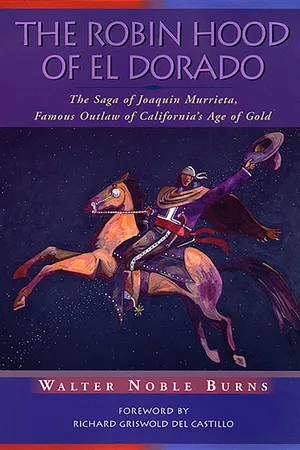
The Robin Hood of El Dorado
The Saga of Joaquin Murrieta, Famous Outlaw of California's Age of Gold
This book is available to read until 31st December, 2025
- 320 pages
- English
- ePUB (mobile friendly)
- Available on iOS & Android
eBook - ePub
Available until 31 Dec |Learn more
The Robin Hood of El Dorado
The Saga of Joaquin Murrieta, Famous Outlaw of California's Age of Gold
About this book
First published in 1932 and never reprinted since, this historical drama re-creates the life and adventures of Joaquin Murrieta, a Hispanic social rebel in California during the tumultuous Gold Rush. Published during the Great Depression, at a time of mass deportations of Hispanos to Mexico, this sympathetic portrait of Murrieta and Mexican Americans was a unique voice of social protest. The author romanticizes the pastoral society of Mexican California into which Murrieta was born and introduces the protagonist as a quiet, honest, unpretentious, and reserved resident of Saw Mill Flat, California. But the rape and murder of his wife, Rosita, by racist Anglo miners unleashes his vengeful rage. Picking up his pistols, Murrieta tracks and kills Rosita's murderers and defends Hispanos against violence and dispossession by rampaging gold rush miners. Richard Griswold del Castillo discusses the significance of Murrieta to twentieth-century Mexican Americans and Chicanos and of Burns's history to contemporary understanding of the mysterious social bandit.
Frequently asked questions
Yes, you can cancel anytime from the Subscription tab in your account settings on the Perlego website. Your subscription will stay active until the end of your current billing period. Learn how to cancel your subscription.
No, books cannot be downloaded as external files, such as PDFs, for use outside of Perlego. However, you can download books within the Perlego app for offline reading on mobile or tablet. Learn more here.
Perlego offers two plans: Essential and Complete
- Essential is ideal for learners and professionals who enjoy exploring a wide range of subjects. Access the Essential Library with 800,000+ trusted titles and best-sellers across business, personal growth, and the humanities. Includes unlimited reading time and Standard Read Aloud voice.
- Complete: Perfect for advanced learners and researchers needing full, unrestricted access. Unlock 1.4M+ books across hundreds of subjects, including academic and specialized titles. The Complete Plan also includes advanced features like Premium Read Aloud and Research Assistant.
We are an online textbook subscription service, where you can get access to an entire online library for less than the price of a single book per month. With over 1 million books across 1000+ topics, we’ve got you covered! Learn more here.
Look out for the read-aloud symbol on your next book to see if you can listen to it. The read-aloud tool reads text aloud for you, highlighting the text as it is being read. You can pause it, speed it up and slow it down. Learn more here.
Yes! You can use the Perlego app on both iOS or Android devices to read anytime, anywhere — even offline. Perfect for commutes or when you’re on the go.
Please note we cannot support devices running on iOS 13 and Android 7 or earlier. Learn more about using the app.
Please note we cannot support devices running on iOS 13 and Android 7 or earlier. Learn more about using the app.
Yes, you can access The Robin Hood of El Dorado by Walter Noble Burns in PDF and/or ePUB format, as well as other popular books in Literature & Historical Fiction. We have over one million books available in our catalogue for you to explore.
Information
CHAPTER 1: JUST ANOTHER MEXICAN
The old man in overalls and checked cotton shirt sitting in a rocking chair on the front porch fanned himself with his battered straw hat and looked out over the little valley. The high hills were dark with pine and live oak and here and there on their lower benches were four or five farm houses gray with weather and half hidden among orchard trees and roses and oleanders in full bloom. Wood’s Creek winding through a level flat sang a pleasant tune among willows and alders.
“This is all that’s left of Saw Mill Flat,” said the old timer waving his straw hat at the landscape. “Back in the early fifties when these California hills was swarmin’ with gold hunters, it was a roarin’ camp with more’n a thousand people and a main street a quarter of a mile long lined with saloons and gamblin’ houses. They say the fellers that come in the first rush picked up gold like hickory nuts along Wood’s Creek and later on a miner was out o’ luck who couldn’t wash out $300 and $400 a day in gold dust. I often wonder what become of all that gold. My dad was one o’ them miners, but he died pore and all he left was this here two-by-four farm. The rest o’ the people in Saw Mill Flat—there ain’t no more’n fifteen or twenty—ain’t got no more’n me. And I reckon you’ll find it that a-way all up and down the Mother Lode. The Forty-Niners dipped up a fortune casual-like from some nameless creek in a tin washpan but their children have had to scratch mighty hard for a livin’.
“There was a couple o’ saw-mills here in the early days and that’s how come the camp got its name. But Saw Mill Flat ain’t heard the whine of a buzz-saw for nigh on seventy years. The camp wasn’t as tough as Sonora a mile or so off over that ridge yonder or as wild and woolly as Columbia four miles up that other way but it was a hard town with the saloons and gamblin’ games wide open day and night and the fiddles goin’ in the fandango house from dark till sun-up. Judgin’ by the old tales, you might think them miners of early times worked all day up to their hips in muck and water and then drank whiskey and danced with Mexican gals and bucked the tiger all night. The camp didn’t have a man for breakfast every mornin’ but there was considerable cuttin’ and shootin’ and killin’ and a hangin’ now and then. You hear a lot about the honesty in the mines in them gold rush days and how the miners used to leave their gold dust layin’ around in their cabins in kettles and tin cans and buckskin sacks. Well, maybe that was true but the honesty of Saw Mill Flat wouldn’t ‘a’ stood no sech test and the feller who took them kind of chances was a fool. Thieves was thick as fleas, and with a bottle of whiskey worth its weight in gold, there was plenty o’ low-down cusses who’d slit your throat for the price of a dram. Hardly a night passed some sluice boxes wasn’t robbed.
“I was born in Saw Mill Flat and never was more’n sixty miles away from it in my life. But I can’t remember the old wild days. All I know about ‘em is what my father and mother and the old timers ‘ve told me. You see I’m only seventy-five years old. Like most of the old people of these parts I’m what you call a second generation Forty-Niner. But if I never seen the town when it was alive, I seen it die. I ain’t given to sentiment, bein’ raised rough, but I’m here to tell you, stranger, it ain’t pretty to see a town die. I felt like a mourner at a funeral standin’ by an open grave listenin’ to the clods thumpin’ down on the coffin. By the time I was old enough to remember anything, the gold here petered out, the miners struck out for new diggin’s and the saloonkeepers and gamblers and Mexican dance gals closed up shop and hit the out-trail. The town was left lifeless all of a sudden and seemed like it might ‘a’ died with its boots on with a bullet between the eyes. But its corpse was still here with no undertaker to bury it and, as the years went by, it crumbled into dust before my eyes. Some of the buildings was tore down for the lumber; others fell into wrack and ruin and almost before I knowed it, all was gone and where they’d stood was only chaparral and thickets of young pine.
“When I was a lad, the old place seemed like it was haunted. When I looked into the windows, splashed over with rain and dirt, I kinder thought I might see ghosts clinkin’ glasses at the old bars or whirlin’ round the dusty floor of the old fandango house. That palatial dancin’ establishment, made out o’ pine boards with a plank stretched across a couple o’ barrels for a bar, stood right out yonder where that jackrabbit is scratching hisself with his off-hind foot and where you see that robin wrastlin’ with a worm, Joaquín Murrieta1 dealt monte in Ed. Parson’s saloon. Nowadays as I set here on the front porch and look out over the empty valley, I sometimes rub my eyes and wonder if the old hell-roarin’ gold camp of Saw Mill Flat wasn’t just a dream after all.”
The old man mentioned Joaquín Murrieta’s name casually. A tablet by the red dirt road that winds through the valley corroborates his statement. “Joaquín Murrieta dealt monte here,” the tablet reads. So it is here in Saw Mill Flat we first pick up the trail of that famous young outlaw, knightliest of highwaymen, most romantic of cut-throats, who to avenge a tragic personal injury became the most remorseless of killers and wrote his name in letters of blood across California’s Age of Gold.
“See that big pine tree over there on the hill across the creek?” remarked the old timer. “Just about there Joaquín Murrieta lived in a little adobe house with his wife Rosita. A grape vine they say Joaquín and Rosita planted used to wind about the trunk o’ the tree. It’s done gone now but many’s the bunch o’ grapes I et off it when I was a boy. You can still see some low ridges grown over with weeds where the house used to stand. Them’s what’s left o’ the ‘dobe walls melted down to nothin’, you might say, by the rains of eighty years. And if you look close you can make out the line of a ditch runnin’ past what used to be the front door. That was the asequia that watered Joaquín’s little vegetable patch.”
It is difficult to imagine that this little valley, peaceful and beautiful, brimming with sunshine and filled with the clean smell of pines, was ever the scene of outrage and murder. But here in this cabin on the hillside occurred the tragedy that changed Joaquín Murrieta from a normal young man, living happily with a wife whom he loved and who loved him, into a murderous demon who tracked those who had wronged him to their death with a sustained passion of vengeance that knew no mercy. And the old pine tree that casts its shadow over the ruins of his home marks the starting point of a career as lurid as a madman’s dream.
A handsome young fellow with black eyes and black hair but with a face of ivory pallor such as you might have expected if his hair had been golden and his eyes blue. Of medium height, well set up, athletic. An hidalgo touch in his grave dignity, his punctilious politeness and his air of proud reserve. A calm thoughtful countenance that indicated a coolly poised character. Quiet, frank, unpretentious. Honest. Known as a square gambler and a square man. Not averse to a glass of wine. Considered a good dancer. A lively, agreeable companion. Some humor and laughter in him. Even tempered. Never known to have had a fight or a quarrel. A far remove from the traditional adventurer type. Finding his greatest pleasure in quiet domesticity. His interest centered in his wife and his home.
That was the Joaquín Murrieta that Saw Mill Flat knew. All the old timers, who knew him and who disagreed on many of the details of his career, were in unanimous agreement on this estimate of his original character. All declared that in these early years before he turned a corner of the road and by an accident of fate stumbled upon life-wrecking tragedy, there was nothing in his appearance or conduct to suggest even vaguely any dangerous or criminal possibilities. Yet beneath the calm exterior of this every-day young man were slumbering whirlwinds and in the still depths of his commonplace soul volcanoes of passion were smouldering. Doubtless if he had been left in the grooves of ordinary routine, he would have lived a humdrum, blameless life and been forgotten before the first daisies bloomed on his grave. But when a catastrophe of seismic proportions jarred him from his peaceful foundations, this unassuming youth became a devil who rode through blood to his horse’s bridle and sank all scruples of conscience and every kindly impulse in the depths of a frozen heart. One can imagine no stranger or more revolutionary metamorphosis. But with his wild, tempestuous future unguessed, this human hieroglyph, that no one could read, aroused no curiosity and went unregarded by the men who elbowed him on the street or crowded nightly about his monte table. Few knew or cared anything about him. He was a nobody lost in the hurly-burly of the mining camp. To Saw Mill Flat, Joaquín Murrieta was just another Mexican.
Listen now to the quaint tale of the love affairs of Joaquín and Rosita. At the Real de Bayareca between Arispe and Hermosillo in one of the great valleys into which the Sierra Madres divide the state of Sonora in the northwest corner of Mexico, Joaquín Murrieta and Rosita Carmel Feliz were born. Their families were of old pioneer stock and boasted pure Castilian descent though doubtless, as is commonly the case in Mexico, their ancestral lines had been tinctured at one time or another with a drop or two of Yaqui or ancient Aztec blood. The valley had been settled by the Spaniards soon after the Conquest; Cortez had visited it; from it Coronado had set out on his romantic quest for the Seven Cities of Cibola; and it is possible the forebears of Joaquín and Rosita had marched as mail-clad soldiers under the banners of the old Conquistadores. From babyhood, the boy and girl grew up together. They were educated at the convent school, went to mass every morning at the old church in the plaza, danced together at the fandangos. When Joaquín was eighteen and Rosita sixteen, they fell in love. Or perhaps they had been sweethearts all their lives.
Just here, Don Jose Gonzales steps unexpectedly from the wings into the little drama. Don Jose was old and very rich. His hacienda was measured in square miles rather than acres; he owned cattle and horses by the tens of thousands; he lived like a grandee among his servants and retainers and had once been a familiar figure at the court of the Emperor Augustin Iturbide. By chance one morning, Do...
Table of contents
- Foreword
- CHAPTER 1: JUST ANOTHER MEXICAN
- CHAPTER 2: THE MARK OF THE LARIAT
- CHAPTER 3: ROBIN HOOD AND HIS MERRY MEN
- CHAPTER 4: DESIRE UNDER THE DIGGER PINES
- CHAPTER 5: THE HILLS OF GOLD
- CHAPTER 6: A SENSE OF THEATER
- CHAPTER 7: THE PACK IN FULL CRY
- CHAPTER 8: THE BREAK OF THE LUCK
- CHAPTER 9: AS IN A STORY BOOK
- CHAPTER 10: HARVARD MAN
- CHAPTER 11: HANG TREE
- CHAPTER 12: THE BLACK KNIGHT
- CHAPTER 13: THE CITY OF THE ANGELS
- CHAPTER 14: THE LAST STAND
- CHAPTER 15: HEADING WEST
- CHAPTER 16: STRANGE TALES